Category: COVID-19

  • Genetic Engineering Key To Developing COVID-19 Vaccine

    Genetic Engineering Key To Developing COVID-19 Vaccine

    Scientists throughout the world are engaged in a herculean effort to develop a vaccine for the COVID-19 virus that has killed hundreds of thousands of people and decimated global economic activity. Without such a vaccine, normal life as we knew it before the pandemic began is unlikely to return any time soon.

    The key to such a vaccine is genetic engineering, which has already resulted in the development of several successful vaccines.

    The key to such a vaccine is genetic engineering, which has already resulted in the development of several successful vaccines. The active ingredients for the HPV (Human Papillomavirus Virus) vaccine, for example, are proteins produced from genetically modified bacteria. The hepatitis B vaccine, Erevebo, a vaccine for Ebola, manufactured by Merck, and the rotavirus vaccine are other examples of GE vaccines. A genetically modified rabies vaccine has been created for dogs and cattle.With these successes in mind, experts anticipate that recent advancements in genetic engineering could substantially shorten the development timeline for a COVID-19 vaccine. It takes on average ten to fifteen years to develop a vaccine, and the most rapidly developed vaccine was a mumps immunization, which still required four years to develop from collecting viral samples to licensing a drug in 1967.
    Time is clearly of the essence as there is the potential for a second wave of COVID-19 infections in the fall and winter, which would have further negative implications for public health and the global economy. The sooner we have a vaccine, the better off we’ll be, though serious logistical challenges remain.

    The Vaccine Race Begins

    On January 10, 2020, Chinese scientists greatly aided the vaccine development effort by publishing the genome of the novel coronavirus, SARS-COV-2. The virus is widely believed to have originated in bats near the city of Wuhan, China. It then jumped to another species, which was consumed by humans at the wet markets of Wuhan or came into direct contact with humans in some other way.

    After examining the genome, Dan Barouch, the Director of Virology and Vaccine research at Beth Israel Deaconess Medical Center in Boston, said, “I realized immediately that no one would be immune to it,” underscoring the importance of quickly developing an effective immunization.

    More than 120 possible vaccines are in various stages of development throughout the world, most of which are gene based with the hope that an effective and safe vaccine can be produced by the end of 2020 or early in 2021. This would be an astonishing accomplishment. By comparison, the Ebola vaccine, which is also genetically engineered, took five years to develop.Ken Frazier, the Chief Executive of Merck, which is working on a vaccine for COVID-19, has tried to dampen down expectations for a quick breakthrough, saying the goal to develop a vaccine within the next 12-18 months is “very aggressive. It is not something I would put out there that I would want to hold Merck to …vaccines should be tested in very large clinical trials that take several months if not years to compete. You want to make sure that when you put a vaccine into millions if not billions of people, it is safe.”
    Peter Bach, the Director of the Center for Health Policy and Outcomes at Memorial Sloan Kettering, added, “To get a vaccine by 2021 would be like drawing multiple inside straights in a row.”

    Genetic Engineering Is Our Best Bet

    To create a genetically engineered vaccine, scientists are utilizing information from the genome of the COVID-19 virus to create blueprint antigens (a toxin or other foreign substance which provokes an immune response that produces antibodies), which consists of DNA or RNA molecules that contain genetic instructions. The DNA or RNA would be injected into human cells where upon it is hoped the cell will use those instructions to create an immune response. If this type of vaccine is developed, it could offer protection for many years as the COVID-19 virus does not appear to mutate as quickly as influenza, though this critical variable could change in the future.
    RNA vaccines are considered to be better at stimulating the immune system to create antibodies. They also create a more potent immune response and therefore require a lower dosage. However, they are less stable than DNA vaccines, which can withstand higher temperatures; RNA vaccines, though, can be degraded by heat and thus need to be kept frozen or refrigerated.

    The DNA or RNA would be injected into human cells where upon it is hoped the cell will use those instructions to create an immune response. If this type of vaccine is developed, it could offer protection for many years as the COVID-19 virus does not appear to mutate as quickly as influenza, though this critical variable could change in the future.

    The Risks Of Moving Quickly

    Vaccine development is traditionally a lengthy process because researchers have to confirm that the drug is reasonably safe and effective. After the basic functionality of a vaccine is confirmed in a lab culture, it is tested on animals to assess its safety and determine if it provokes an immune response. If the vaccine passes that test, it is then tested on a small group of people in a phase one trial to see if it is safe, then in a phase two trial on a larger group of people. And if it passes those hurdles, a larger scale phase three trial is designed, which would involve at least 10,000 people.
    These trials are necessary because trying to develop a vaccine quickly can compromise its safety and efficacy. For example, the US government rushed a mass immunization program to prevent a swine These trials are necessary because trying to develop a vaccine quickly can compromise its safety and efficacy. For example, the US government rushed a mass immunization program to prevent a swine flu epidemic in 1976 that may have caused an increase in the number of reported cases of Guillain-Barre Syndrome, which can cause paralysis, respiratory arrest and death. The pandemic never materialized, though widespread public concern about flu immunization did.

    Many Challenges Remain

    Historically, the odds of producing a safe and effective vaccine are small, with just six percent of vaccines under development ever making it to the market. There are many diseases and viruses for which there are no vaccines (for example HIV/AIDS, Zika, Epstein-Barr and the common cold, among many others), even though great efforts have been made to develop them. Therefore, despite the gigantic efforts of drug companies and governments to produce a COVID-19 vaccine in the shortest possible period, there is no guarantee they will be successful.
    epidemic in 1976 that may have caused an increase in the number of reported cases of Guillain-Barre Syndrome, which can cause paralysis, respiratory arrest and death. The pandemic never materialized, though widespread public concern about flu immunization did.Soumya Swaminathan, the chief scientist for the World Health Organization said that an “optimistic scenario” is one in which tens of millions of doses could be produced and initially distributed to health care workers. Mass immunizations could begin in 2022, but to inoculate the world and “defeat” COVID-19 could take four to five years. She added, however, that this outcome “depended upon whether the virus mutates, whether it becomes more or less virulent, more or less transmittable.”
    epidemic in 1976 that may have caused an increase in the number of reported cases of Guillain-Barre Syndrome, which can cause paralysis, respiratory arrest and death. The pandemic never materialized, though widespread public concern about flu immunization did.

    The COVID-19 virus highlights just how vulnerable humankind is to the natural world, which periodically produces pandemics such as the Spanish flu, the Bubonic plague, Polio and Asian flu that have the ability to kill many millions of people.

    Assuming the virus doesn’t mutate, there are many logistical challenges that could slow mass immunization once a vaccine is developed. There is no precedent for scaling up a vaccine to potentially several billion doses. To do so would require a great deal of investment in vaccine production facilities throughout the world. Manufacturers would also have to scale up the production of vials, syringes, band aids and refrigeration units for temperature-sensitive vaccines.
    epidemic in 1976 that may have caused an increase in the number of reported cases of Guillain-Barre Syndrome, which can cause paralysis, respiratory arrest and death. The pandemic never materialized, though widespread public concern about flu immunization did.Additionally, it is not known if the vaccine would require one or two doses to confer immunity, or if it would have to be re-administered every few years. We would also have to determine how a vaccine would be shared internationally. There would clearly be tremendous pressure for any country that developed a vaccine to use it domestically before sharing it with other nations. It’s also possible that the race to develop a COVID-19 vaccine could siphon off dollars and manpower dedicated to developing treatments and vaccines for other deadly diseases.
    epidemic in 1976 that may have caused an increase in the number of reported cases of Guillain-Barre Syndrome, which can cause paralysis, respiratory arrest and death. The pandemic never materialized, though widespread public concern about flu immunization did.Among the most difficult public policy questions we’ll have to face, would the vaccine be made mandatory? The possibility has already triggered push back from vaccine skeptics who view such a policy as a threat to their “inalienable sovereignty” as free individuals.
    epidemic in 1976 that may have caused an increase in the number of reported cases of Guillain-Barre Syndrome, which can cause paralysis, respiratory arrest and death. The pandemic never materialized, though widespread public concern about flu immunization did.The COVID-19 virus highlights just how vulnerable humankind is to the natural world, which periodically produces pandemics such as the Spanish flu, the Bubonic plague, Polio and Asian flu that have the ability to kill many millions of people. Despite the inevitable challenges and trade-offs we face, the new tools of genetic engineering offer us the best chance of controlling, and possibly eliminating, the outbreak of future pandemics.
    This article is published earlier on 23 June 2020 in Genetic Literacy Project.
    This article, with images, is reproduced under ‘Fair Use of Articles & Images’ policy of GLP – https://geneticliteracyproject.org

  • Coronavirus: Fighting The Invisible Enemy

    Coronavirus: Fighting The Invisible Enemy

    The coronavirus pandemic is the biggest disruptive global health threat in more than a century. The economic, political, and social life of people in all countries has been adversely affected as never before. This new strain of the coronavirus has posed significant challenges to people, researchers, medical fraternity, and governments across the world. It poses serious health risk to the elderly and has stressed national health systems significantly. The development of a vaccine, despite global efforts, is not likely to be available any time before mid 2021. The Peninsula Foundation, through two doctors Ms Keerthika Gnanasegaran and Ms Vishnupriya Rajasegaran have put together complete information on the Coronavirus in simple and easy to understand details. Ms Avanti A Srinivasan, a high school student describes her experience and opinion of the crisis.

    Download Full Paper

  • Vocal about Local: Empowering local Governance Structures to deal with the Pandemic

    Vocal about Local: Empowering local Governance Structures to deal with the Pandemic

    Urban centres in times of the Pandemic 

    India is a rapidly urbanizing state. The 2011 census estimates that 31% of Indians live in urban areas. It counts 4041 statutory towns, 3892 census towns and 474 urban agglomerations as urban areas. These numbers however are quite outdated in 2020 and also there is considerable consensus among experts that there is an underestimation of urban spaces owing to the outdated definition of ‘urban’ in India. For example, the Joint Research Centre (JRC) of the European Commission, based on satellite data, reports that at least 54% of India’s population lived in cities or large urban areas in 2015 and the World bank using the Agglomeration Index finds out that 55.3% of India’s population lived in urban-like spaces in 2010. Regardless, the fact remains that these urban spaces should be governed democratically with the spirit of the 74th amendment. The COVID-19 situation further reasserts the importance of such governments and their role in Indian society.

    Cities and urban spaces have emerged as hotspots of the Coronavirus. It is from the cities that the coronavirus subsequently spread to other rural areas.

    Cities and urban spaces have emerged as hotspots of the Coronavirus. It is from the cities that the coronavirus subsequently spread to other rural areas. Throughout history, pandemics have originated and perpetuated from cities, therefore it is not irrational to predict another pandemic perpetuated from cities in today’s close-knit global village. This warrants a greater need to safeguard the cities which are the essential links that connect nation states to the globalized world. The first step in this direction would be to empower urban governments for efficient crisis management and prevention of communicable diseases by assuring basic public goods.

    Subsidiarity

    The principle of subsidiarity advises that the Central authority should have a subsidiary function, performing only those tasks which cannot be performed at a more local level. The principle therefore asserts the sovereignty of the citizen in a democracy and places her at the center of decision making.

    In line with the principle, everything that can be done better locally, including providing basic services like safe drinking water and ensuring public goods like clean air, should be done by the local governments. The rationale being that, one, it increases efficiency and promotes self-reliance; two, it provides legitimacy to democracy and three, it creates awareness among people and develops responsible citizens. And another obvious reason is that it is most effective in understanding the local problems and in ensuring a pragmatic feedback loop.

    All these reasons become much more clearer in times of crisis such as the Covid-19 pandemic when local assessment and rapid service delivery become difficult. Urban Local Bodies (ULBs) neither have properly delineated functions to perform nor do they have the finances to do so. The 12th schedule of the Indian Constitution lists a group of 18 subjects on which the local governments can act upon, but only if the States ‘may’ wish to assign those functions by virtue of another State legislation. Even when legislated, States usually encroach into the domain of the purview of the local governments.

    The Veerappa Moily commission’s sixth report dealing with local governance sums it up perfectly.
    “Confusion, unnecessary duplication, inefficiency, wastage of funds, poor outputs and outcomes are the result of this organisational jungle. The local organisations which should be the ones most directly and fully concerned are at best treated as a small part of the implementation, occasionally consulted but, in most cases, by-passed and ignored”.

    Furthermore, the establishment of parastatals has reduced the functions of the local governments. The Parastatals perform specific functions which are supposed to be performed by ULBs and are accountable only to the State government thereby circumventing the ULBs. In addition, the Union government also takes a share of the implementation space with centrally sponsored schemes thereby making proper delineation of powers impossible for ULBs.

    The Veerappa Moily commission’s sixth report dealing with local governance sums it up perfectly.
    “Confusion, unnecessary duplication, inefficiency, wastage of funds, poor outputs and outcomes are the result of this organisational jungle. The local organisations which should be the ones most directly and fully concerned are at best treated as a small part of the implementation, occasionally consulted but, in most cases, by-passed and ignored”.

    Now, when experts ask for decentralized governance to efficiently deal with the pandemic and to decentralize decision-making regarding lockdown measures, all they get is a dysfunctional organisation jungle where local governments do not have the wherewithal to function as self-governing institutions.

    Disaster Risk Reduction

    Strong local governments are of great importance, especially during disasters and pandemics. Experts suggest that a sound bottom-up governance approach has been more successful in the wake of disaster response. For instance, in a UNDP study on disaster risk reduction in Bangladesh, they point out the importance of local governance.

    The report suggests that local governments are crucial because they ‘play the greatest role in sustaining ongoing, participatory disaster risk reduction at local community level’. The report goes on to summarize that the key lesson learnt from the study is that decentralization of authority and decision making is essential to effectively deal with the disaster.
    “Decentralization of authority to local governments is vital to ensure local ownership of disaster risk reduction and the local implementation of the Hyogo Framework for Action. Local authorities should have the responsibility of implementing disaster risk reduction, and be accountable to the community they represent in doing so”.

    Much has been written about why governments closer to the people are more effective but what is equally important is that when decision making is decentralized, citizen satisfaction and responsibility is increased (for example, see this study done in Indonesia). This becomes important in times of the Covid-19 pandemic where individual responsibility is necessary to stop the spread of the virus. Also with lives and livelihoods pitted against each other, citizen satisfaction is important to make hard decisions which might deter personal freedom in the short term.

    Considering all this, the National Disaster Management Act, 2005, which was used by the Union government to impose lockdown measures, seems to lack the involvement of local governments in disaster risk reduction. V N Alok in his article for the Financial Express, deals with this complaint. He argues that there is only a passing reference to local government in the Act and even when referenced, functions are mostly subsidiary to the District authority headed by the Collector/Magistrate which is controlled by the State government. On the other hand, there is no ambiguity in assigning functions to the State and Union governments.

    India is often referred to as the ‘flailing state’, which is strong and sound in the centre, with no reliability at the grass-roots. Local governments can provide the missing link that could hinge the State to the people.

    This again echoes Veerappa Moily Commission’s concern that there is no proper delineation of powers for the local governments. Article 243 N and 243 ZF mandated that all laws inconsistent with parts IX and X of the Indian constitution shall be changed accordingly within a year of passing the 73rd and 74th Amendments. But most States have still not identified and changed all statutes conforming to the idea that local governments are self-governing institutions. This shows India’s hesitation to look at local governments as self-governing institutions capable of dealing with problems.

    India is often referred to as the ‘flailing state’, which is strong and sound in the centre, with no reliability at the grass-roots. Local governments can provide the missing link that could hinge the State to the people.

    Its importance is felt during the pandemic more so than ever, especially in cities where the institution is weak compared to rural India. An integrated approach, with involvement from the local government, would prove to be more effective than centralized decision making. But before relying on ULBs and locally elected leaders, they have to be empowered-politically, functionally and financially. The first step towards such empowerment could be by including local governments in conversations regarding governance and decision making; to be more vocal about local governments.

  • Covid 19: India uses Crisis to bring-in Economic Reforms as Package

    Covid 19: India uses Crisis to bring-in Economic Reforms as Package

    India’s four-phase lockdown of 68 days to deal with the Covid-19 threat has, while slowing the spread of the virus, come at huge economic costs. The lockdown for a vast majority of the people is, undoubtedly, the harshest in the world.

    The coronavirus triggered lockdown and its ensuing series of extensions have disrupted more than 60 percent of economic activities in the country, posing a huge threat to the  economy. The crisis was underway when the global economy was slowing down and India, in particular, had to deal with a poor health care system and an economy already under distress. Unemployment rate is estimated to be around 27 percent post lockdown and has resulted in nearly 12.2 crore people losing their jobs. In addition, a  severe slump in consumer demand is expected to persist for the next few quarters. Almost 85 percent of India’s workforce is engaged in the informal sector – quite naturally the government is under stress to implement effective policy reforms to counter the downturn. 

    In response to the contraction in the economy, the Prime Minister has announced a second round of economic package that stands at roughly around 10 percent of the Gross Domestic Product. The USA and Japan have announced relief packages of 13 and 21 percent of their GDP respectively. In comparison, India has seemingly provided a substantial Rs 20 lakh crore stimulus- highlighting the concept of ‘self-reliance’ as a way forward to deal with the economy post the pandemic. The stimulus package includes previous steps taken by RBI such as moratorium on loan repayments, interest rate cut, etc. In the five tranches of the stimulus package, the Finance Minister has announced a slew of measures to address the structural issues of Indian economy. However, it is estimated that the immediate fiscal boost will be only around 1 percent of GDP and most of the fiscal and monetary policies will attract long term capital with medium run  stabilization of the economy.


    Micro Medium and Small Scale Enterprises 

    Focusing on reviving the small businesses and micro enterprises, under this tranche Rs 3 lakh crore is allocated for collateral free loans for business enterprises. This package is estimated to be around Rs 5.94 lakh crore including RBI measures to improve liquidity in the economy. However, the direct fiscal cost for the government is around Rs 16,500 crore. For the stressed MSME units, the central government is planning to facilitate Rs 20,000 crore as subordinate debt and Rs 50,000 crore through equity infusion. Non Banking Finance Companies (NBFC) that serve the MSMEs will receive Rs 30,000 crore under investment guarantee scheme. While the six broad measures look attractive, the MSME sector in India is dominated by micro enterprises that are largely unregistered. However, these measures will not immediately benefit the micro business units with necessary working capital. Most of the enterprises and small business units are cash strapped and are on the verge of disappearing. Ninety-nine percent of the sector comprises micro enterprises – businesses with less than 10 working employees.

    Most of the enterprises and small business units are cash strapped and are on the verge of disappearing. Ninety-nine percent of the sector comprises micro enterprises – businesses with less than 10 working employees. 

    While the government has taken supply side measures to incentivize businesses, two important challenges remain intact. One, the large number of unregistered micro businesses might not benefit from the credit line offered by the government. Two, if the demand recovers slowly, it is likely the business sector especially small enterprises will suffer despite credit being infused. It is important to note that the supply and demand side has to be revived at the same rate to ensure sustainability of the MSME business. 


    Migrant labourers and Farmers: 

    Second stimulus of the Finance minister’s announcement was focused on migrant labourers and farmers. Close to 150 million internal migrants are present in India according to the latest census report.  Rs 3500 crores is to be spent on migrant labourers not covered under the Public Distribution System (PDS). Rs 5000 crore is set aside to facilitate easy access to street vendors. Funds worth Rs 6000 crore is planned for enhancing employment among adivasis and tribal groups. For the next two months, around 8 crore migrant labourers not covered under PDS will be provided 5kgs of grains per person and 1 kg chana per family in a month. ‘One Nation One Ration Card’ is a welcome move given the leakages present in the PDS, but the national coverage of this scheme is expected only by March 2021.  Additionally, in the National Food Security Act, 2013 , based on the 2011 census data, it is estimated that around 100 million people do not fall under this safety net accounting for growth in population over the past decade. The initiative to record and track the data on unregistered labourers is important for fiscal stimulus response to a COVID hit economy. National portability of ration cards is important but the execution is time consuming and does not address the problem of people being excluded from the ration card system. Universalizing PDS and decentralizing decisions to achieve food security with an efficient supply chain should be an immediate intervention. States with higher migrant labourers and people with less access to PDS should be targeted to universalise food distribution.  Acknowledging the shortcomings of the PDS and food supply channel, an emergency plan to ensure food supply to people below poverty line for the next six months needs to be prioritised.


    ‘One Nation One Ration Card’ is a welcome move given the leakages present in the PDS, but the national coverage of this scheme is expected only by March 2021. 


    Agriculture and Allied activities:

    Under the third tranche of the economic stimulus package, the government has taken bold measures to invest in agriculture and allied activities. Total package announced was worth Rs 1.63 lakh crores – relatively less compared to earlier stimulus packages. The main focus was on enhancing agriculture infrastructure, financing farm gate produce and improving post harvest supply.  A series of other funds were allocated for disease control for animal husbandry, promotion of herbal products and fisheries. Rs 10,000 crore was unveiled to support 2 lakh Micro Food Enterprises on a cluster based approach. 

    Lack of cold storage and supply chain was identified by the government to create an Agriculture Infrastructure Fund of Rs 1 lakh crore. A big push for agriculture reforms was spelled out by the decision to deregulate six commodities including cereals, pulses, oil and vegetables by amending  the Essential Commodity Act, 1955.

    Many experts believe the reforms undertaken were long due for India to enhance productivity of the agriculture  sector. But deregulation of essential products during the time of lockdown with poor food supply chains might not be beneficial especially for marginal farmers.  Almost 92 percent of the Food Supply Chain is controlled by the private sector and most of the farmers are not informed about Minimum Support Price and adopt unscientific farming practices. With liquidity constraint in the economy, demand for essential food is substantial. Factoring the drawbacks of PDS in supplying food items to the bottom section – a high probability of market failure is underway potentially hurting both farmers and consumers. Except for concessional credit for farmers and agriculture loans, the package has  limited scope to reduce the distress faced by the agrarian sector in near future. As far as the reforms are concerned, there was a clear bias towards post harvest investment. However, the productivity and scale of production has been the biggest problem in India that requires effective land reforms. India’s agriculture sector also suffers without adequate investment in Technology and Research & Development. During an unprecedented crisis, Indian government is pushing for big reforms but the structural issues of marginal-land farming are largely ignored. Even as a reform package─it is evident that it is likely to benefit primarily large farmers in the medium term.

    Except for concessional credit for farmers and agriculture loans, the package has  limited scope to reduce the distress faced by the agrarian sector in near future.

     Infrastructure, Defence  & Aerospace 

    Under this package, eight key sectors: coal, minerals, defence production, aerospace management, airports, power distribution, space and atomic energy were in the spotlight. In an effort to boost employment, a proclamation of structural reforms was stated in the fourth  tranche. The coal and mining industry is expected to receive an infrastructure development fund – making the sector self-reliant in production. The Foreign Direct Investment limit in defence has been increased from 49 percent to 74 percent to encourage foreign investment in production. In the aviation industry, India decided to open up 6 airports for auction. Additionally, three airports are to be operated under the Public Private Partnership model. Optimization of air space, building a hub for aircraft maintenance and overhaul are some of the important measures covered under this package. 

    Privatization and Globalization (New Economic Policy, 1991)- COVID-19 crisis has offered a space for the government to initiate certain radical measures to privatise a few industries.

    Private partnerships in the areas of space exploration and atomic energy offers an immense potential for private companies to get incubated for research and development. Sharing an economic pressure similar to the 1991 Balance of Payment crisis that resulted in Liberalization, Privatization and Globalization (New Economic Policy, 1991)- COVID-19 crisis has offered a space for the government to initiate certain radical measures to privatise a few industries. The measures will undoubtedly help the business ecosystem in India to develop in the medium term.  Though there seems to be a claim about substantial job creation this is not likely to happen immediately. 

    Rural Employment & Public Health

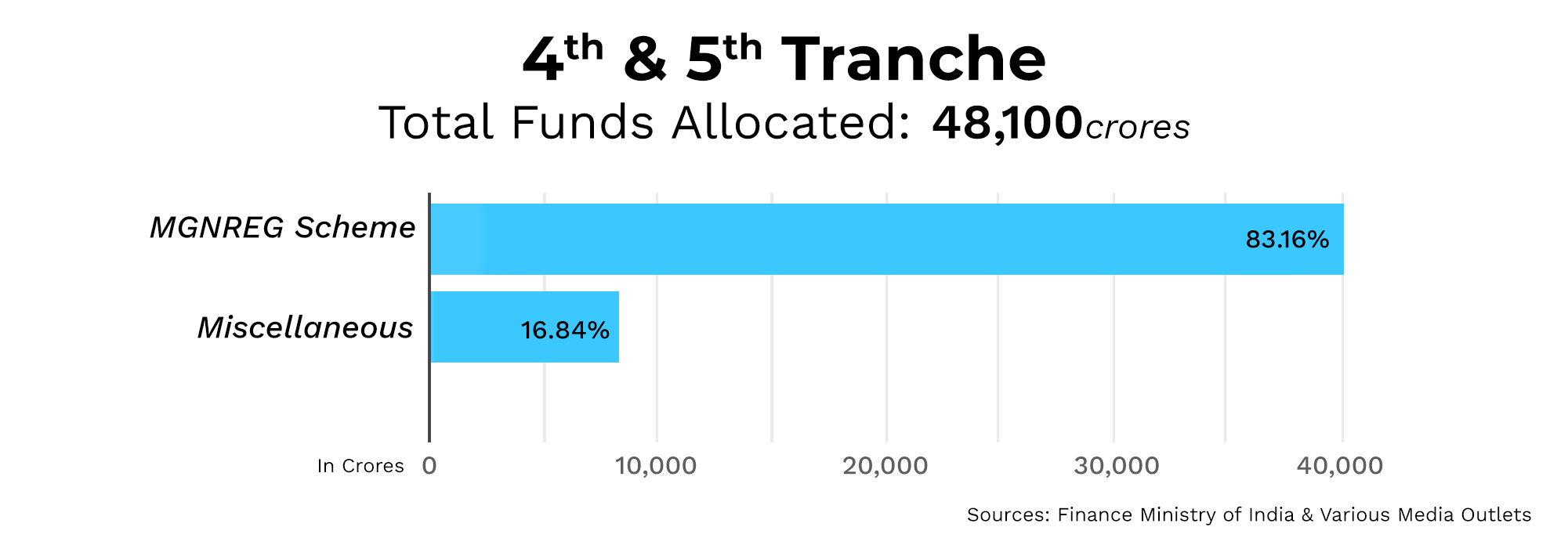
    In the final announcement, Rs 40,000 crore was allotted to Mahatma Gandhi National Rural Employment Guarantee Scheme (MGNREGS) to replace direct transfer from central government to migrant workers. Inadequate data about inter state informal labourers has placed limitations on policy formulation during the time of crisis. Under the Pradhan Mantri Garib Kalyan Yojna, Rs 50 lakh per person insurance cover will be applicable for health professionals. To ensure ease of doing business, non adherence to the Companies’ Act will be decriminalised. The government also committed to increasing health expenditure to face pandemics in the future. The finance minister also encouraged companies to entertain the idea of digital India to conduct meetings and businesses online. 

    The last two announcements together accounted for Rs 48,500 crore and experts criticize that most of them do not provide immediate relief for the people in distress. 

    Conclusion

    India has evidently seized the opportunity during the crisis to introduce reforms to boost the economy in the long run. The reform package undoubtedly is impressive on paper but in terms of immediate support to various sectors in distress it offers little. For example, a large part of the package – Rs 8.04 lakh crore- is additional liquidity injected by monetary policy in the last three months.  An investment bank has predicted that India will face a deeper recession in the short term but the economic stimulus would help the economy after a few quarters. As a consequence the real growth rate is to drop down by 5 percent year-on-year in 2020. Even after a massive package, the situation of poor and middle-class people remains bleak. The reforms might bear fruits in future but deferring the policy response to address current challenges will manifest into huge burden on vulnerable sections of the people. Current economic crisis has undoubtedly offered the central government to take advantage of the weak bargaining power of the stakeholders to push reforms but low attention is paid to immediate distress.

    The author was supported by Ms S P Bharani, on summer internship at TPF.

    Image Credit: Adobe Stock

  • COVID-19 Challenges for India: Tackling MSME Sector and Unemployment

    COVID-19 Challenges for India: Tackling MSME Sector and Unemployment

    The COVID-19 pandemic has shaken global markets as countries struggle to battle national and global health crisis. Indian government has announced an economic stimulus of  Rupees 20 lakh crore (Rs 20 trillion corresponding to $ 267 billion), roughly 10% of GDP for FY 21, in which six measures were framed for the Micro Small Medium Scale Enterprises (MSME). Government has allocated 3 lakh crore for collateral-free loans, additional debt and equity infusion with slew of other measures to protect the bruised MSME sector. The rise in the number of casualties and infected cases  all over the world present a grim picture. This is expected to result in a global recession that could lead to a loss of over $ 3 trillion to the global GDP. India, in an effort to contain the spread, has extended the lockdown at the cost of freezing almost 60 percent of its economy. Third extension of lockdown on May 3rd in order to flatten the curve will further contract the demand for next few quarters. IMF has revised India’s growth downwards to 1.9 percent for the year 2020 and 7.4 percent for the year 2021. Although the growth projection is not negative as in the cases of Eurozone and the US, India will need to overcome significant structural challenges to bring the economy back into a high growth trajectory. The cost of battling COVID-19 is not limited to the dip in growth but also includes the bleak prospects of a sizable percentage of the population being pushed below the poverty line.

    Apart from the virus, India faces two key challenges. Firstly, almost 80 percent of its labour force is part of the informal sector, which is expected to take major hit as a result of  the lock-down. Secondly, as India’s working age population will continue to expand  till 2055─ the cost of missing this demographic dividend will directly impact the future growth trajectory. Japan, China, South Korea and Singapore have capitalized on their demographic dividends and experienced double digit growths. The current disruption in the global economy will have a significant impact on India’s growth for the next few years. Therefore, diagnosing the systemic problems in the economy is crucial to developing a viable strategic economic policy. The Periodic Labour Force Survey (PLFS) notes that only nine percent of Indian workers are employed with organizations having more than 20 workers. Rest of the labour force are employed with small enterprises which have been forced to lay-off most of their employees due to the extended lockdown.

     Business Supply versus People Demand

    Contributing 30-35 percent of the GDP— Micro, Medium and Small scale industries face a higher risk of shutting down their production due to cash flow constraints. All India Manufacturers association reported that 43 percent of the MSMES will cease to operate with the lockdown extension. Around 99 percent of the MSMEs are dominated by Micro enterprises in which labour intensive production units are already under stress with restricted labour movements. Finance minister’s attempt at redefining MSME by including businesses with higher investment and turnover does not address the main problem of majority of unregistered micro enterprises shutting down due to less or nil operating capital.

    A total of 114 million people are employed in MSMEs and the shortage in working capital as a consequence of the lockdown would drive most businesses out of the market. Furthermore, an extended demand shock would curb the production and supply, as a result of which small industries with limited capital will most likely shut down. Additionally, 86 percent of the enterprises are unregistered and 71 percent of labourers have no written job contracts. Since most of the enterprises function in highly unorganised sectors, they would have been forced to lay off employees.  Thus relevant policies will need to be recalibrated in order to address the problem of unemployment– currently estimated to be 27.11 percent. The share of MSME exports is valued at $147.7 billion– showing an impressive jump from the previous value at $75 billion. The small number of exporting businesseswill be clamped down due to insufficient liquidity especially with weak global demand.  Hence, the policy must focus on balancing to keep the interest rates low in the long run and enhance discretionary spending to boost investors’ confidence. One of the six measures announced by the government is to protect the local MSMEs from unfair foreign competition. Pursuing a protectionist policy in the business sector before the recovery of domestic demand would imply higher risk of the economy being caught in a low demand cycle. Additionally, the recent exemption of labour laws threatens the workers’ income─ reducing the revival rate of consumer demand. According to a latest reading of the consumer demand risk map, casual labourers in both rural and urban areas are at highest risk of salvaging potential expenditure.

    Need to Reorganize MSME and Boost Employment

    Although strong relief packages are demanded, India has limited fiscal space. The slew of measures announced by the central bank to ease the liquidity will cushion the MSME sector during the lockdown period. However, incentivizing small scale businesses to operate amidst weak demand would need recapitalizing finance based on the firm’s productivity. A structural makeover of the business sector will call for measures beyond just monetary policy. While current economic stimulus aims at protecting the business sector, challenges remain in adopting a medium term policy given the unorganized structure. The OECD countries have broadly undertaken measures to reduce the impact on their Small and Medium Enterprises (SMEs) by providing wage subsidies, loan guarantees, direct lending and modified structural policies. The Reserve Bank of India (RBI) has similarly offered a much-needed loan moratorium, cuts in the Cash Reserve Ratio (banks minimum reserve requirement to be held with RBI) and working capital financing. Although the second round of relief package has focused on small industries, the expectation of a burgeoning fiscal deficit to 5.07 percent from revised estimate of 3.8 percent means that financial  stimulus is somewhat of a double edged sword.

    Even prior to the pandemic, unemployment was at a 45 year’s high at 8.5 percent and consumption was on downtrend. The economic response for India must factor in the welfare loss while assessing the economic consequence. In five out of the first ten years of entering its demographic dividend phase, Japan was experiencing double digit growth.  If India is not to lose out on growth momentum during the current stage of its youth bulge, it would require effective and radical policy measures to counter the problem. Economic relief packages during the crisis must be followed with strategies to provide economic security to the working age population across the country.

    To keep up with the growth of the working age population, estimates suggest that India must create 10 million jobs annually. Ease of doing business becomes a crucial factor in creating employment opportunities. Indian policymakers are tasked to identify the methods to sustain the operations of MSME sector post lockdown. The large workforce resulting from India’s youth bulge cannot be undermined by this crisis. Policy prescription to create rapid employment and facilitate business operations is the priority. For India, it is important to endeavour to balance the immediate financial response with continuous public and human capital investment. Biting the fiscal bullet is inevitable in a crisis situation but assessing the cost of growth foregone is crucial to strategize policies for future. The real challenge lies in the transition of role from being protective to promotional through structural operations by factoring in the consumption demand. Temporary infusion of money in businesses and renovation of MSME sector is much needed to realize the ‘Make in India’ dream.

    Image Credit: Adobe Stock

  • Responding to COVID-19: A Framework for Analysis

    Responding to COVID-19: A Framework for Analysis

    Beginning December 2019 in Wuhan in China’s Hubei province, Coronavirus (Covid -19) has overwhelmed the healthcare systems and affecting education, travels, events and the economies worldwide. Governments all over have taken or bracing themselves to take extraordinary measures to contain the threat. In some countries, the measures taken to contain the epidemic appear as putting the nation under a state of siege. Some governments are adapting rather extreme measures – complete lock-down of the cities, the provinces and even the country itself, school closures, travel ban, cancellation of flights. Questions are being asked about how much freedom we are prepared to give up, for how long and onto whose hands?

    The paper argues that with threats and vulnerabilities transcending national boundaries and challenging most advanced knowledge and information systems in this era of intense globalization, the need for harsh and often draconian measures can hardly be over emphasized. At the same time there could be problems and unwelcome consequences in putting too much power in the hands of the governments dealing with the threat for an indefinite period of time. In view of this, the securitization framework as put forth by the Copenhagen School could be a better tool to deal with situations of unexpected crises such as what SARS epidemic proved it to be or what Covid-19 would inevitably entail.

    This paper is originally published in Vol 7 No 5 (2020): Advances in Social Sciences Research Journal and is republished by TPF under the Creative Commons Attribution 4.0 International Licence.

    Download Full Research Paper

  • Some Crucial Lessons as we Prepare for ‘Lock Down 3.0’

    Some Crucial Lessons as we Prepare for ‘Lock Down 3.0’

    Category : Democracy & Governance/Public Health
    Title : Some Crucial Lessons as we Prepare for ‘Lockdown 3.0’
    Author : M A Kalam  02-05-2020Covid-19 is a jolt to the way we work and live. India has been under, what IMF has called, “The Great lockdown”. As India moves into ‘Lockdown 3.0’, M A Kalam explores, in his opinion piece, the challenges faced by different segments of the Indian population. The economic impact is seen to be huge, and as we return to work and business gradually, we will witness huge behavioural changes that will necessitate how we address the new economic challenges.

    Read More

  • Artificial Intelligence in the Battle against Coronavirus (COVID-19): A Survey and Future Research Directions

    Artificial Intelligence in the Battle against Coronavirus (COVID-19): A Survey and Future Research Directions

    Artificial intelligence (AI) has been applied widely in our daily lives in a variety of ways with numerous success stories. AI has also contributed to dealing with the coronavirus disease (COVID-19) pandemic, which is currently happening around the globe. This paper presents a survey of AI methods being used in various applications in the fight against the deadly COVID-19 outbreak and outlines the crucial roles of AI research in this unprecedented battle. We touch on a number of areas where AI plays as an essential component, from medical image processing, data analytics, text mining and natural language processing, the Internet of Things, to computational biology and medicine. A summary of COVID-19 related data sources that are available for research purposes is also presented. Research directions on exploring the potentials of AI and enhancing its capabilities and power in the battle are thoroughly discussed. It is envisaged that this study will provide AI researchers and the wider community an overview of the current status of AI applications and motivate researchers in harnessing AI potentials in the fight against COVID-19.

    Download Full Research Paper

  • A Novel Behavioural Economics Nudge to Fight the Novel Coronavirus

    A Novel Behavioural Economics Nudge to Fight the Novel Coronavirus

    The last time that the Olympics and the Wimbledon were cancelled, were during the world war. Nuclear bomb was the weapon that ended the war. But what is the weapon that can end the war against this Covid-19?

    Research in behavioural economics finds that often one panics, or fears more than necessary, due to a bias in thinking that goes by the name of ‘Probability Neglect’; not considering the true probability of the event occurring, but being influenced by the gravity of the adversity.

    Cass Sunstein (Feb 28, 2020), who co-authored the book ‘Nudge’ with the Nobel laureate Richard Thaler for his contribution to Behavioural Economics observes in a column in Bloomsberg:

    ‘But one thing is clear: A lot of people are more scared than they have any reason to be. They have an exaggerated sense of their own personal risk.’

    A similar view has been expressed by Mark Travers (March 6, 2020) in the Forbes.

    The reasoning for several such publications advocating that panic on the grounds of a person contracting the virus, is unjustified goes something like this: The probability of a person contracting the virus is extremely low (of the order of .0001, which could vary depending on the place one lives and such other factors). Further, 80% of those who contract the virus need no hospitalisation and would recover as they would recover from a common flu, and the fatality percentage is very low – Although the overall fatality rate is about 2%, if the one who has contracted the disease is in his forties, the fatality risk is only about 0.4%.

    Though inordinate fear and panic may be unjustified from an analysis of the personal risk involved, such fear is functional, particularly in the context of the present scenario. Why? The measures to contain the pandemic are primarily social distancing and washing hands. These are to be practised by individuals, and so fear in the minds of individuals, would promote the effective practise of the measures needed to control the virus.

    It is here that I wish to segregate fear, in the context of this pandemic, into two categories: fear that stems from Concern for the Self and fear that stems from Concern for Others.

    Fear stemming from a Concern for the Self is the fear that grips one from the likelihood of being infected and the consequences one would suffer thereby. It is fear caused by one’s love for the self. Risk of one contracting the disease, being hospitalised and dying, was shown to be so low and consequently fear that stems from Concern for the Self, despite Probability Neglect bias, has been low. If this fear had gripped the public, the spread of the virus would have been arrested by people effectively practising social distancing.

    Fear stemming from a Concern for Others is the fear that grips one due to the consequences others would suffer due to one being infected. It is fear caused by one’s love for others, one’s fellow human beings.

    A brief analysis of consequences others would suffer, with a minimum of technicalities, is presented here. The primary purpose of these computations is to project in quantitative terms a realistic picture (erring on the conservative side without exaggerating) for one to appreciate. The next four paragraphs demand the reader to engage System-2 thinking. System-2 thinking is lazy, and behavioural economics predicts a disposition in the reader to skim through – discarding the matter as an elaboration of what is already known – without following the computations that demand System-2 effort. The author gently nudges, that the reader pursues through this difficulty for the next four paragraphs to truly place the consequences in the forefront of one’s consciousness. (For a detailed understanding of System-1 thinking and System-2 thinking, I recommend that the prudent reader consults ‘Thinking, Fast and Slow’, a classic authored by Daniel Kahneman (2011), another Nobel laureate, for his contribution to Behavioural Economics.)

    A parameter R0, Basic Reproduction Number, refers to the mean number of individuals an infected person directly infects. It would be appropriate to consider R0 = 2, a conservative value for the current corona virus crisis. Another variable is the Generation Time, the mean time that an infected person takes to infect another person, since being infected. It would be appropriate to consider a value of 7 days (1 week) as the Generation Time for this virus, since this virus starts infecting others even before one is diagnosed with the disease.

    Considering the above mentioned values, an infected person, whom we will call Mr. Prime, would have infected two others after one week (Generation Time). After two weeks the two others infected, would have infected four others. Thus the total number infected by Mr. Prime at the end of two weeks is 6 (2 directly infected by Mr. Prime at the end of one week + another 4 indirectly infected by Mr. Prime at the end of two weeks). Continuing this way, at the end of four Generation Times (4 weeks), the numbers infected by Mr. Prime would be 30. The reader is encouraged to check this out by simple mind arithmetic. To aid one’s memory, if we approximate 4 weeks as a month, it is easy to see that in 30 days Mr. Prime would have effectively infected 30 others.

    Extending this further, one can see that in two months (8 weeks), Mr. Prime has been the sole cause for effectively infecting 510 people. (Research in behavioural economics foresees that a few prudent readers may observe that the number infected ought to be 900 and less prudent readers may suggest the number 60, and only few would agree with the number 510 as proposed by this author. This is the influence of the gullible System-1 thinking. Effortful System-2 thinking can however, lead a prudent reader to see that the number infected is indeed 510, under the given considerations.)

    We further examine the consequences of people getting infected. If Mr. Prime has infected about 500 people in two months, 20% of them would get (or shortly would be) hospitalised and 2% of the 500 would die. Thus Mr. Prime would have been responsible for hospitalisation of 100 people (contributing to the mayhem for the demand of ventilators) and for the death of 10 people (2% of 500). It can be said that Mr. Prime, by having not taken steps to prevent himself from being infected, has effectively killed ten people; a case of serial homicides by negligent behaviour.

    A corona infected person turns out to be a serial killer even before he or she has been diagnosed with the virus, and has no control over the serial killing sequence that has got triggered. Generally when a person is sick, people’s sympathies are with him or her and the sick person is seen as a victim. But the foregoing analysis shows, a corona infected person as a perpetrator. Not a very comforting perspective, as no one wishes to be a serial killer. Another way of describing the corona virus could be as a virus that when it infects, a normal human being turns into a serial killer, like a psychopath (-that you fall sick is a small matter).

    But this perspective has potential to induce a very functional fear, panic, of having blood on one’s hands. This fear can lead to people being paranoid about being infected by the corona virus. Well, this fear bordering on panic and paranoia could be an effective weapon to stop the pandemic from spreading.

    Are all those who have been diagnosed with Covid-19 guilty of being serial killers? The answer is no. Though they have indeed turned out to be killers, they are not guilty of being killers; they had not seen the virus from this perspective at the time of their being infected. But, despite being sensitised to this perspective, if one had not turned every stone to take the precautions, and had ended with an infection, yes, he indeed is guilty of being a serial killer.

    The war against Novel Corona virus can indeed be fought with the functional fear that stems from Concern for Others, love for your fellow human being; and not from fear that stems from Concern for the Self.

    A gentle nudge: Love your neighbour as yourself to end this war.


    References:

    Sunstein, Cass R; Feb 28, 2020; ‘The Cognitive Bias that Makes Us Panic About Coronavirus’, ‘Technology and Ideas’, Bloomberg

    Travers, Mark; Mar 06, 2020; ‘Psychology Research Explains Panic Over Coronavirus – and How You Can Calm Down’, Editor’s Pick, Forbes

    Kahneman, Daniel; 2011, ‘Thinking, Fast and Slow’, Allen Lane, Penguin Books


    Image Credit: Evgeni Tcherkasski on Unsplash

  • COVID-19: Coronavirus highlights the class divide in India

    COVID-19: Coronavirus highlights the class divide in India

    It would indeed be revealing, as well as quite embarrassing, particularly for the privileged middle and upper classes, if a survey is undertaken to locate and spot the residential blocks in the different cities of India where the instances of COVID-19 cases have occurred. That will also show how and from where the infection is spreading to other people and other localities. It is not at all difficult to do that; mapping through GIS is an easy exercise

    Needless to say, almost all of these cases surely are in the neighborhoods inhabited by the richer and privileged sections of the society, and most of them are those who have a travel history of having been abroad. After their return they have infected those who have come in contact with them.

    Fine, many of them have been isolated or quarantined, if not actually hospitalised, and as a consequence of the lockdown have the extravagance of ‘work from home’ (it is another matter that post-lockdown the TV viewership has increased sharply). Many of them also have the advantage of drawing their regular, guaranteed salary at the end of the month.

    At the other polar opposite of the class edifice, at the bottom of the pyramid, are the multitude of hapless groups of people, sections of our own society, the ‘others’, who for absolutely no fault of theirs, not to talk of any crime committed, have overnight been thrown out of everything — jobs, wages, shelters, source of income, and the like. This was because a nation-wide lockdown was imposed as a result of the overseas excursions of those at the other end (the upper end) of the class hierarchy.

    Besides the urban homeless and the needy, those who have been made to bear the brunt of this lockdown are the migrant labour who have become, during the last few years, a given in most of our cities and town. These migrant workers (aka ‘guest’ workers) are reluctantly accepted in many places; mainly because they come cheap and the ‘locals’ mostly refrain from doing certain kinds of jobs in the vicinity of their own habitations and locales (they may, however, do more demeaning jobs away from their own dwellings, say in West Asia/Gulf or other overseas contexts). These ‘guests’ are now being thrown to the wolves and the weather.

    As the State had no contingent plan for these migrant labour, an institution-created famine-like situation has arisen due to the starvation that they have been facing. After five days of lockdown the central government woke up to the misery of these souls and directed the state governments and the union territories to provide shelter and food to them. In the interim these people had a choice; either starve to death or risk breaking the physical distance barrier and get susceptible to the virus. Hopefully, now that their plight has been highlighted, things will get better for these ‘guests’.

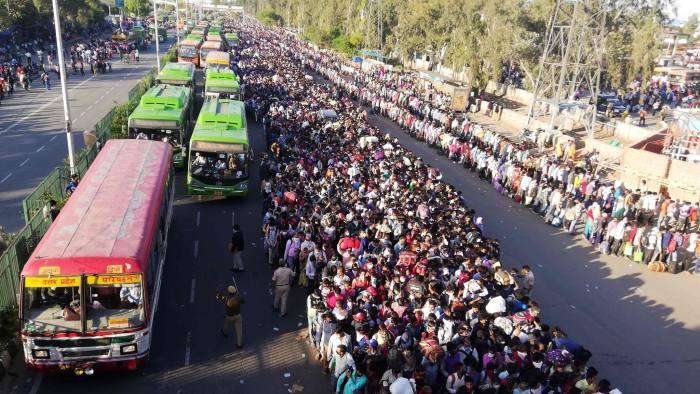
    The luxury of the so-called social distance does not operate in their ambit as lower class habitations as also other allied spaces that pertain to them are extremely dense by definition. Almost all seem to have chosen the option of reaching their respective homes going by the thronging witnessed at bus stops and highway halting points for buses and trucks. However, to no avail as the states in their wisdom have shut all borders for them by suspending all forms of transport.

    During Partition in 1947, people moved due to issues between the two countries. Now the mass movement of people is also because of a partition — a partition between the rich and the poor, within the national borders, across state borders wherein each state is guarding its territory with vehemence. The State has failed utterly on two counts; one, in not anticipating such an event, and second, in not being able to either prevent or combat the movement.

    It is really poignant that the choice is between death by hunger and death by the virus. Given such a choice, the poor feel it is better to die in their native place than in a strange locale. Also, if they do beat starvation death and live, the chances of recovery and survival from the virus appear to be higher even if they are infected. It is death by starvation that is most galling for them as evidenced by empirical responses that are obtained by sources that are interacting with them.

    It is such an unfortunate thing that all crises always seem to impact the poor in the worst negative way possible. Floods, droughts, hurricanes or what have you invariably target the less privileged. It is utterly ironical that the present crisis that has emerged among the upper echelons in India due to Covid-19 too does so.

    It is also pertinent to point out as to how the ilk of the original carriers of the virus, the upper classes, are planning their strategies in combating the absence of their domestics, cooks, drivers as can be ‘seen’ from the debates and dialogue of the resident welfare associations and similar bodies on social media. The dominant narrative is ‘no work, no pay’. Those who say they will pay, are making it sound as if they are achieving martyrdom by their act.

    This article was published earlier by “Moneycontrol

    Views expressed are the author’s own.

    Image Credit: www.ft.com