Category: Civil-Military Relations

  • Can a Muscular Response deter Chinese Aggression?

    Can a Muscular Response deter Chinese Aggression?

    The Sino-Indian War of 1962, which is seen as a humiliating defeat for India, continues to rankle all Indians. Clearly, it is seen as a result of poor leadership both at the political and military levels. In hindsight, many believe that the PLA could have been routed had India regrouped its Army and used the IAF in a massive counterattack. It was November, and with the onset of winter and the closing of the Himalayan passes, the PLA could have been demolished completely. That we didn’t even think of it shows the serious vacuum in strategic thinking. More than half a century later, and with the Indian military much stronger and battle-hardened, it is inexplicable why India’s leadership is shy of following an aggressive strategy, including the use of force proactively against China. Brigadier Deepak Sinha, a vetran and TPF’s Senior Fellow, raises this question while correlating the current situation with that of 1962.

    There is an urgent need for us all to shed our divisive politics, long-held dogmas and skewed perceptions, forget fanciful visions and face reality, especially when it comes to the question of national security. The last thing we need is for petty politics and fragile egos to control our nation’s destiny. Nothing can be more consequential, traumatic or shameful than being bested by a rival on the battlefield. The consequences of our “defeat” in the Sino-Indian Conflict of 1962 continue to rankle and haunt us to this day.

    Quite clearly, the fear psychosis that permeates our higher military and political leadership is palpable.

    Indeed, our reluctance, for fear of escalation, to launch a quid-pro-quo riposte and grab disputed territory elsewhere as a bargaining chip following the PLA’s blatant land grab of disputed territory in Eastern Ladakh is a clear indication of this. This was reinforced by an earlier interview with ANI by our Foreign Minister, who stated, “Look, they (China) are the bigger economy. What am I going to do? As a smaller economy, I am going to pick up a fight with the bigger economy? It is not a question of being reactionary, it’s a question of common sense….” Quite clearly, the fear psychosis that permeates our higher military and political leadership is palpable.

    On the other hand, the Chinese leadership has a very different perception of our capabilities as was reflected back in 1959 following the Longju incident. A declassified United States document of that time points out that “the late August clashes point to a mode of thought which has remained an ingredient in the Chinese leaders’ calculations on the border dispute: ‘When the Indians show a temperament to advance on the ground, we must alter their frame of mind by letting military action take over political caution. Besides, military risk itself is negligible because we are the stronger side.” Obviously, over the years, they have been given no reason to believe otherwise. In order to understand what ails us, it is worth briefly examining the course of the 1962 conflict to get a clearer idea of the extent of our loss at the hands of the Chinese. That should help us understand why, over fifty years later, we continue to remain so traumatised and fearful.

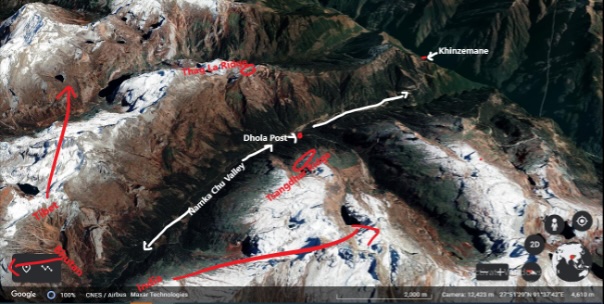
    The opening skirmish of that conflict occurred in the North East with the capture, on 8th Sept, of the isolated Assam Rifles post at Dhola, on the southern slopes of the Thag La ridgeline. This post was surrounded and completely dominated by PLA positions on higher ground, and its loss was a foregone conclusion. The actual conflict commenced at approximately 0500 hours on 20th October, when the PLA launched a massive infantry attack, supported by artillery, on the 7 Infantry Brigade positions. The Brigade was deployed in a tactically unsound manner on direct orders of GOC 4 Corps, Lt Gen B M Kaul, along the Southern banks of the Namka Chu River over a 20 Km frontage instead of on the heights overlooking the river.

    The battalions were deployed in platoon penny pockets, lacking mutual support, in temporary positions with no overhead cover. Artillery support was restricted to just one battery of Heavy Mortars and a troop of two field guns with limited ammunition. No intelligence was available to the Brigade Headquarters or any of the other higher headquarters as to PLA force levels or their intentions. The assault came as a surprise and just four hours later, by 0900 Hours, the Brigade ceased to exist as a fighting force. Within just another 96 Hours, the strategic border town of Tawang, approximately 100 Km in-depth, held by an understrength battalion, was attacked and captured without a fight.

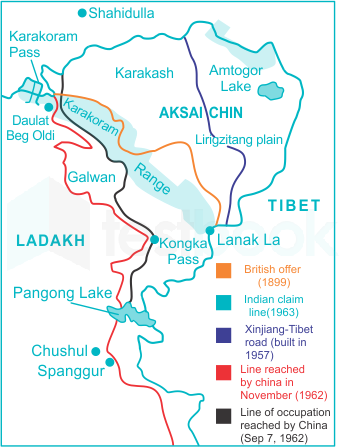
    Almost simultaneously in the Northern Theatre, isolated forward positions at Aksai Chin and the Pangong Tso area were also cleared after a brief skirmish. After an administrative pause of approximately a month, the PLA launched the next phase of its offensive with its assault on the Walong positions on 16th Nov and on the main defences of the 4 Infantry Division at Bomdi La, Se La and on the Division Headquarters at Dirang Dzong. Simultaneously, on 20th Nov, Chushul came under attack by an Infantry Divison. On 21st Nov the Chinese announced a unilateral ceasefire and subsequently withdrew to positions occupied by them prior to the commencement of the conflict.

    There are three main deductions that can be drawn from an examination of the facts. Firstly, that the conflict was, in essence, extremely limited in terms of time, space and force levels involved. From an army of 550,000 personnel, approximately 20,000 personnel were committed into this conflict, primarily due to our limited logistical capabilities. The conflict was primarily restricted to the tactical level only, at battalion level and below. While the conflict itself was spread over one month, the tactical engagements themselves lasted a few hours at best, and on one or two occasions where stiffer resistance was put up, extending to 48-72 Hours. Unfortunately, given the terrain, lack of field fortifications, etc, casualties suffered were relatively high, with approximately fifteen hundred killed, similar numbers wounded, two thousand missing and another 4000 taken prisoner. The Air Force, which could have played a critical role in blunting the PLA attacks and destroying their lines of communications, was deliberately confined to the logistics role for reasons that are still not clear, while the Navy remained a bystander.

    Sadly, our military and political leadership exhibited an utter lack of moral courage, determination and willpower by quietly acquiescing to the unilateral ceasefire, thereby kicking the main irritant of the demarcation of borders further up the road, where it has once again come to bite us on our posteriors.

    Secondly, far from being a major defeat, as has been commonly made out, it was at best a temporary reverse that could, and should, have been countered with the use of fresh troops under a more determined and professional leadership. More importantly, the PLA understood this fact and, therefore, undertook a unilateral withdrawal to its earlier pre-war line of defences. It must have been fully cognisant that if hostilities were to continue, it would find itself in an increasingly untenable position with its supply lines already badly stretched and being further impacted with the onset of winter. It would only have been a matter of time before the Indian Army got over its shock, regrouped and reorganised itself and launched a counter-offensive to recapture lost territory. Sadly, our military and political leadership exhibited an utter lack of moral courage, determination and willpower by quietly acquiescing to the unilateral ceasefire, thereby kicking the main irritant of the demarcation of borders further up the road, where it has once again come to bite us on our posteriors.

    Thirdly, what continues to remain totally inexplicable is the reasons why our military and political leadership continue to remain so traumatised and scared to this day. The truth is that the narrative that emanated following the reverses was set by officers and men belonging to units that, for the most part, had withdrawn before coming in contact with the PLA. They were low on morale and had come to believe the Chinese were supermen who could not be stopped by mere mortals. It was from amongst the experience and perception of these personnel that pamphlets on the tactics and capabilities of the PLA were subsequently formulated that continue to be relied on to this day, thereby giving further credence to that distorted narrative.

    The fact of the matter is that in any future conflict, the PLA will be fighting over 2000 Kms away from its home bases, supported along communication lines that run over some of the most difficult and inhospitable terrain in the world. They are also easily susceptible to interdiction, given the nature of the terrain. In addition, they would have to contend with a hostile and badly oppressed population not just within Tibet but in Xingjian as well, which could revolt if a suitable opportunity arose. This would require the PLA to deploy additional forces for rear area security to prevent disruption of the lines of communication.

    Moreover, while there are sizeable disparities in aspects such as force levels and capabilities, infrastructure development and economic strength, one needs to be cognizant of the fact that we have also made tremendous strides with regard to infrastructure development, logistics and offensive capabilities. Our forces still hold the edge vis-à-vis combat experience and operating in mountains, while the Air Force continues to hold the upper hand in the TAR purely on account of terrain profile and radius of action. Most importantly, the availability of two Mountain Strike Corps gives us immense flexibility, if properly utilized, to grab the initiative and force a decision dilemma on the PLA. In the circumstances, the reason for our extreme reluctance to stand up against the Chinese bully must lie elsewhere. One distinct possibility is that our political leadership lacks faith in the military leadership and its ability to fight and win.

    This will seem at odds with the fact that the military has a splendid history of having always successfully completing any task given to it. If anything, it has been grossly misused by the Central and State Governments to carry out tasks that are not in their ambit, whether these be organizing the Commonwealth Games or construction of railway over-bridges, because the concerned departments and agencies have been unable to produce the requisite results. Clearly, this mistrust, primarily in the sphere of civil-military relations, has more pernicious roots and is very deeply embedded in the politico-bureaucratic psyche.

     Interestingly, in the Official History of the 1962 Conflict with China, available in the public domain but yet to be published, the Chief Editor, Dr S N Prasad, concludes that the chief reason for our defeat was that the political establishment was unable to avoid war while it was in the process of transforming the military establishment. Given Prime Minister Nehru’s apprehensions about the military taking control, he wanted to change it from being, as Mr Prasad puts it, a “close-knit professional body, deliberately isolated from the citizen. Its predominant motive force remained esprit de corps and not identification with the people… Perhaps he wanted to model it after the People’s Liberation Army of China, more egalitarian, flexible, closer to the people………Such basic changes required a committed, or at least a pliant, band of army officers in key positions. So mediocre Thapar was selected instead of the doughty Thorat as Army Chief, and Bijji Kaul was made CGS……. “

      He further goes on to add that “To carry out this transformation of the national defence set up, a decade of peace was absolutely essential. For establishing indigenous weapons manufacture, money had to be found by cutting arms imports. The armed forces would be short of equipment and stores for several years till the new arms factories started producing. The officer cadre was a house divided within itself till the new breed fully took over. A period of transition was inevitable, during which the fighting machine would not be fully efficient and would be vulnerable………Therein seems to lie the basic cause of the debacle of 1962. India failed to avoid a war during the transition period. Lulled by faulty political assessment and wrong intelligence forecasts, the country got caught in a war when it was least prepared.

    With Mr Modi’s ascension to power, we came a full circle as he took it upon himself to steer it away from its apolitical and secular character towards a more ideologically compatible institution that would be in sync with his Party’s long-held vision of making India into a Hindu Rashtra.

    Fortuitously for the country, Nehru’s vision for a transformed military was stymied by the 1962 Conflict and the most important lesson that his successors assimilated quickly was to stay away from interfering in the internal affairs of the military as that could gravely damage internal cohesion and morale. With Mr Modi’s ascension to power, we came a full circle as he took it upon himself to steer it away from its apolitical and secular character towards a more ideologically compatible institution that would be in sync with his Party’s long-held vision of making India into a Hindu Rashtra.

    Towards this end Mr Modi has smartly used the concept of “deep selection” to ensure key senior appointments were filled by officers displaying an affinity for his government’s ideology, regardless of existing rules, seniority or merit. This, in turn, made them personally beholden to him, and he was thus able to use them to take ownership and deflect criticism from initiatives that were pushed through by his government regardless of their adverse impact on long-standing and cherished customs and traditions or on the operational capabilities of the Services. This has led to schisms within the institution, damaged the integrity and cohesion of the chain of command and cast a big question mark on the apolitical and secular character of the Services.

    In this context, a politically compromised Chief of Defence Staff and other senior officers shamefully endorsed the PMO, thrusting down the ill-conceived Agnipath Scheme on the military with not a single objection being raised. This scheme has all but destroyed the basic ethos of our fighting arms, ensuring that the deeply entrenched and effective Regimental System has been severed at the roots. Given their ignorance of matters military, they would have been ignorant of Winston Churchill’s wise advice that “Regiments are not like houses. They cannot be pulled down and altered structurally to suit the convenience of the occupier or the caprice of the owner. They are more like plants; they grow slowly if they are to grow strong…and if they are blighted or transplanted, they are apt to wither.”

    And wither they have, the resulting adverse impact on morale is not difficult to gauge. This is undoubtedly being further exacerbated by the considerable voids in manpower, with combat units reportedly functioning at less than 75% of their authorised strength, and truncated peace tenures to fill up operational voids in Eastern Ladakh, Manipur and Jammu & Kashmir. In addition, the government’s emphasis on the ‘Atman Nirbhar Abhiyan’ and ‘Make in India Scheme’ has resulted in deficiencies, even if temporary, in the holdings of weapons systems, ammunition and other warlike stores. Given all these factors, the military obviously finds itself in an extremely precarious situation, committed to its fullest capacity with limited options available. Ironically, a government that lays such a great emphasis on our Hindu origins, culture and history has managed to display a profound ignorance of statecraft and warfare, as brought out in Kautilya’s Arthashastra. In this classic, Chanakya points to the necessity for a strong army because, for all nation-states, there are only two states of being: either conquer or be conquered.

    …at the present time, we are once again confronted with an extremely turbulent geopolitical situation, with the world’s attention on the ongoing crises in Europe and the Middle East. The situation today, in many ways, is clearly reminiscent of the period on the eve of the 1962 Conflict. For reasons not very different from then, the Indian Military finds itself in a very similar situation as well.In these circumstances, the real question that we should be asking ourselves is not whether we can overcome our past traumas and face down the PLA, but more importantly, whether China will seize this opportunity to recalibrate the Sino-Indian relationship through the use of force.

    Interestingly, in 1962, China launched major operations against us at the end of the campaigning season, which could have been jeopardised by unseasonal snow. Obviously, this was because, at that time, the world’s attention was riveted to the Cuban Missile Crisis. Similarly, at the present time, we are once again confronted with an extremely turbulent geopolitical situation, with the world’s attention on the ongoing crises in Europe and the Middle East. In addition, the United States is deeply immersed in its own internal problems with presidential elections just around the corner and with little time for other matters.

    The situation today, in many ways, is clearly reminiscent of the period on the eve of the 1962 Conflict. Moreover, at that time, Chairman Mao was under intense pressure as his Great Leap Forward experiment had failed, and he had been removed from his appointment as State President. Today, President Xi also finds himself under similar pressure following his disastrous Zero Covid and hard-line economic policies that have tanked the economy. For reasons not very different from then, the Indian Military finds itself in a very similar situation as well.

    Undoubtedly, the political leadership and the military top brass must be fully cognizant of this state of affairs. Clearly, they are in no position to stare down the PLA. What makes matters worse is that following the General Elections, Mr. Modi’s authority and standing have been greatly diminished. Where does this leave those senior officers who have progressed by hanging on to his ideological coat-tails? Has the authority and credibility of the CDS, an out-and-out political appointee and loyalist, been affected within the Chiefs of Staff Committee of which he is the Chairman? What will be its impact on the move towards the establishment of theatre commands? In these circumstances, the real question that we should be asking ourselves is not whether we can overcome our past traumas and face down the PLA, but more importantly, whether China will seize this opportunity to recalibrate the Sino-Indian relationship through the use of force.


    Feature Image Credit: Border Clashes between India and China ‘regularly covered up’  The Telegraph

    Namka Chu and Dhola Post Picture credit: www.indiasentinels.com

  • The Scylla and Charybdis of Duty Discharge: Military Dilemma with undemocratic Leaders

    The Scylla and Charybdis of Duty Discharge: Military Dilemma with undemocratic Leaders

    A week after the attack on the U.S. Capitol, the joint chiefs of staff issued a memorandum to the joint force condemning the assault on Congress and the constitutional process. They re-affirmed Joe Biden’s electoral victory and re-iterated their commitment to protecting and defending the constitution against all enemies, foreign and domestic. This re-iteration came on the heels of another. In the summer of 2020, senior military leaders in the United States were alarmed at the Trump administration’s use of military force to deter civilian protestors gathering in American cities to voice their discontent about racial discrimination and police brutality towards minority communities. Retired officers and seniors in the Defense Department warned against the politicization of the military and cautioned civilian leaders against using the military to achieve partisan goals. The Concerned Members of the Gray Line — a coalition of over 1,000 West Point alumni from six decades of graduating classes who had collectively served across ten presidential administrations — wrote a letter to West Point’s class of 2020 cautioning the graduates that while “the principle of civilian control is central to the military profession … it does not imply blind obedience.”

    These are just two examples of unprecedented steps taken by active and former senior military professionals in the tumultuous civil-military relations that characterized the Trump administration. Another example of an unprecedented action came to light recently in the form of revelations from Bob Woodward and Robert Costa’s forthcoming book, Peril, which suggest that the chairman of the Joint Chiefs of Staff, Gen. Mark Milley, took “good faith precaution” to secure America’s nuclear weapons from what he believed to be a worryingly likely scenario of the president “going rogue” and initiating a military strike against China. In the weeks leading up to the inauguration, Milley feared that the outgoing president would either try to use the military to “prevent the peaceful transfer of power” or that he would unleash nuclear war to maintain power. To avert nuclear Armageddon, he inserted himself into the nuclear chain of command — an authority that he does not have by law and doctrine — and reaffirmed with other senior military officials the elaborate procedures that need to be followed in the event of an executive order to launch nuclear weapons. In so doing, Milley positioned himself as a bulwark to thwart a potentially calamitous chain of events set in motion by an increasingly erratic and bellicose leader. His actions have invited an array of responses, ranging from those who support himand defend his conduct to those who demand his resignation and implore that he be court-martialled for treason. In his testimony to the Senate Armed Forces Committee, Milley defended his loyalty to the nation and asserted that he acted well within his statutory role of being in the “chain of communication” as the president’s primary military adviser

    Milley’s conduct, while deserving of public awareness and scrutiny, needs to be understood in the context of the unprecedented dilemma that he faced. What can military leaders do when the norm of military subordination to civilian control clashes with their adherence to the constitution and the rule of law? Milley was a military professional confronting a civilian executive with a penchant for undermining democracy — obeying this leader would risk jeopardizing his oath to defend the constitution and the rule of law, while disobeying would threaten the norm of civilian supremacy and the military’s democratic accountability.

    In recent years, democratic backsliding has affected nascent and mature democracies alike. To preserve and extend their authority, leaders in the United States, Poland, Hungary, the Philippines, Brazil, Nicaragua, Turkey, and India have used and/or threatened to use the military to advance partisan goalslike enforcing controversial immigration policies, detaining journalists, repressing protests, arresting civil society activists, overturning election results or preventing elections from being held at all, and detaining opposition leaders. Understanding military behavior in other countries threatened by democratic erosion can help to contextualize the situation that Milley confronted and the actions that he undertook.

    Democracy and Civil-Military Relations

    The principal dilemma of all civil-military relations, as explained by civil-military relations scholar Peter Feaver, entails the cultivation of a military strong enough to do what civilian leaders ask yet subordinate enough to do so only when asked. Civilian control over a professional subordinate military is a quintessential element of democratic regimes. Non-democracies, on the other hand, are characterized by politically influential militaries that have either overthrown civilian leaders and usurped power through coups or have acted as powerful allies for civilian autocrats like in Syria and North Korea. Comparative politics scholar Dan Slater demonstrates how in many postcolonial regimes, militaries are powerful and effective brokers in ensuring authoritarian durability. As such, curbing the military’s politically aggressive tendencies involves bolstering civilian oversight mechanisms. For example, by punishing disobedient officers, monitoring the appropriate implementation of civilian orders, controlling their purse strings, and ensuring their accountability through public hearings, civilians could keep a check on the military.

    Whereas politically aggressive militaries used to be the dominant cause of democratic decline in the Cold War period, the decades after the Cold War became characterized by executive aggrandizement. This involves a gradual rollback by elected leaders of citizens’ power and rights. Societies with high levels of inequality, when saddled with political institutions that are unable to deliver opportunities for economic advancement, are particularly prone to being captured by demagogues. These “assassins of democracy” like Donald Trump, Recep Tayyip Erdoğan, Jair Bolsonaro, Narendra Modi, Viktor Orban, Daniel Ortega, and Rodrigo Duterte, among others, use the very institutions of democracy to kill it.

    In this context, the military’s actions are critical to further enhancing or eroding democracy. In dealing with undemocratic leaders, democratic militaries face an unenviable dilemma brought on by their tradition of subordination to civilian control. If they follow orders from an undemocratic leader, they become complicit in democratic erosion. If they disobey, they risk disrupting military cohesion. Populist leaders who are prone to using the military to further their partisan agendas end up affecting the military’s internal cohesion by creating supporters and detractors of their actions within the military. These fissures between supporters and opponents will inevitably paralyze decision-making, threaten the military’s operational effectiveness, and ultimately jeopardize national security.

    This was the dilemma confronted by the Indian military in the 1970s. Like the American military, the Indian armed forces are a professional subordinate institution, beholden to the precept of civilian control and obedience to the constitution and rule of law. And like their American counterparts, the Indian military have played a critical role in protecting India’s fragile postcolonial democracy through the vicissitudes of India’s chaotic politics.

    “India is Indira. Indira is India” 

    On June 25, 1975, the Indian president, Fakhruddin Ali Ahmed, declared a state of internal emergency upon the advice of Prime Minister Indira Gandhi, citing a right-wing conspiracy that aimed at preventing the democratically elected government from functioning. Prior to the announcement of the emergency, India was in the throes of nationwide protests, with agitators clamoring for Gandhi’s resignation after her conviction for electoral malpractice by the Allahabad High Court, which unseated her and nullified her candidature and 1972 electoral victory. The emergency declaration had an immediate effect — 900 arrests were made within 24 hours, 300 of whom were political prisoners including Gandhi’s leading opponent, J. P. Narayan. During the 18-month emergency, Gandhi disempowered state governments, censored the press, banned public meetings, and postponed the national election, tarnishing India’s democratic credentials.

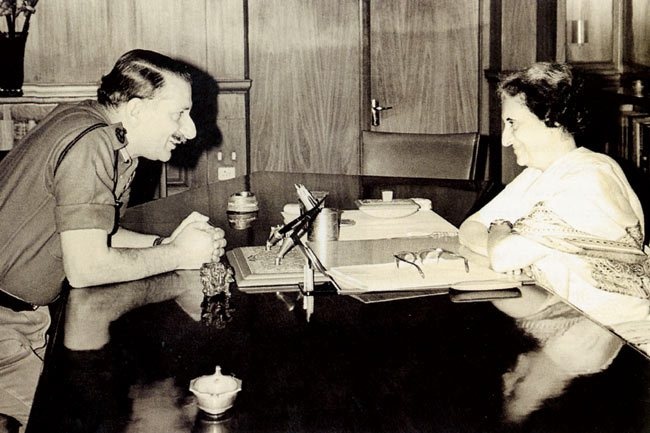
    The opposition implored the Indian army to dethrone Gandhi. Gandhi asked the army to support the implementation of the emergency. They did neither. In a massive rally organized on June 25 in the nation’s capital — New Delhi — Narayan appealed to “the police and armed forces not to obey the illegal and immoral orders of her [Gandhi’s] government” [emphasis added]. This was Gandhi’s last straw, leading to her swift and stealthy imposition of an emergency, as she acutely feared military intransigence and being overthrown in a coup. In a telling incident from 1969, Gandhi candidly asked former field marshal Sam Manekshaw if he planned to oust her. The military, however, refused to heed Narayan’s appeals and did not overthrow her. As explained by Aqil Shah, “the Indian military’s actions were shaped by institutional standards of appropriate behavior which made the notion of a constitutionally prescribed civilian supremacy inviolable and legitimate.” Not only did the military’s organizational beliefs and culture reinforce the norm of civilian supremacy, they also imbibed a learned behavior from their neighbor about the futility of political meddling. In Shah’s interviews with Indian Army officers: “many were typically surprised, and in some cases offended, by any comparison with other ‘political’ armies, including Pakistan. They found it profoundly difficult to countenance actions that constituted subversion of civil supremacy.”

    The army also remained uninvolved in the emergency’s implementation. Gandhi asked the then Indian army chief, Gen. T. N. Raina, for troops to aid civilian authorities in the implementation of her directives. According to retired Maj. Gen. Afsir Karim, who was serving in the army headquarters at the time and was involved in daily official dealings with the army chief’s office, Raina resisted Gandhi’s request and communicated to the military rank and file that “[they] are not a part of the emergency and [should] keep away from politics.” This refusal, however, contravenes their constitutionally prescribed function of obeying civilian authority. How did the army not become complicit in Gandhi’s authoritarian takeover when refusal to obey her meant the subversion of civilian control?

    In this dilemma, the Indian army feared a disruption to their organizational integrity and internal cohesion. Gen. G.G. Bewoor, another former chief of army staff, opined that the army “must protect itself against political influences that could shatter its professional cohesion and erode its capacity to defend the state against external aggression or internal conflict.” [emphasis added] To maintain cohesion and ensure that his troops remained unsullied by politicization, Raina circumvented the issue of obedience versus disobedience by relying on his operational training and professional experience as a trained soldier. When approached by the civilian Ministry of Defence, he instructed the army headquarters to follow the Union War Book, a voluminous classified document that contains detailed instructions for every government department on how to function in the event of war. Invoking the Union War Book implied a deployment for war. This was along the lines of the military’s well-established repertoire of action — the large-scale use of force as dictated by the army’s conventional offensive doctrine that has shaped their crisis behavior and strategy in all security crises since India’s independence. A mobilization on this scale meant the relocation of troops away from India’s restive western and eastern border regions to the national capital and other parts of the country as desired by civilian policymakers. However, the Defence Ministry rejected the army’s proposal, viewing it as “unnecessary for the purposes of an internal Emergency.”

    Raina confronted an elected leader who centralized authority, suspended judicial hearings on constitutional provisions, and undermined democracy. This example is illustrative of how democratic militaries can navigate the dilemma posed by subordination in the context of democratic erosion. The Indian army rejected the opposition’s attempts to co-opt them by reinforcing the norm of civilian supremacy. Simultaneously, they circumvented being used as a pawn in Gandhi’s authoritarian machinations by re-affirming their cardinal function — maintaining national security.

    On Jan. 7, 2021, Milley faced a similarly exceptional conundrum. In his attempt to not let the military be used in a partisan manner by the president and to avert a potential military confrontation with China, he exercised his professional judgment in a manner similar to Raina. Like its Indian counterpart, the U.S. military is organizationally and normatively well-versed in maintaining civilian supremacy, ensuring that coups are never countenanced as a way of expressing disapproval with civilian leaders.

    However, fearing further instability and threats to national security, Milley’s outreach to his Chinese counterpart and his insertion into the nuclear chain of command both leveraged his traditional training and professional experience in averting conventional wars. As argued by Tom Nichols, “Milley, invoking his personal relationship with his Chinese counterpart, told Li that he would hear about any military action from Milley himself. This is what reassurance and transparency looks like in a crisis.” Milley’s knowledge of and personal relationship with Gen. Li Zuocheng can be thought of as a critical wartime resource — both would also have come in handy in the event of an actual military operation. His backchannel reassurances to his Chinese counterpart helped to thwart a nuclear confrontation. In so doing, he stayed true to his higher calling of defending the nation, even when that seemed to undermine civilian supremacy.

    Exceptional circumstances beget exceptional responses. While military officers have a general duty to obey civilian control, they also take an oath to protect the constitution. When compared to other states that have experienced violent civil-military interactions, the United States has benefitted from a relatively stable relationship between its civilian leaders and its military. Obedience to civilian control implies obedience to constitutional and lawful orders. However, the former president delighted in upending norms in politics and civil-military relations, creating situations where obedience to civilian control clashed with protecting the rule of law. In this unprecedented situation, Milley relied on his best understanding of protecting the state — one that was honed through decades of professional experience and service. Shortly before his inauguration, Biden told the general, “we know what you went through. We know what you did.” The president’s confidence in his chief military adviser is a testament to Milley’s professional conduct in upholding American democracy.


    This article was published earlier in War on the Rocks.

    Feature Image Credit: theemergingindia.com 


  • Politics and the Military don’t gel

    Politics and the Military don’t gel

    It would be in the interest of the political establishment to desist from politicising the military. Creating an uncontrollable monster, that will go on to bite the hand that feeds it, is nothing but sheer stupidity.

    The former President of the United States, Donald Trump, has always had the reputation of being a man of questionable moral and ethical integrity with close connections to the radical right. Yet, there were those who voted for him in 2016 because they genuinely believed that he was the lesser of the two evils, and strongly felt that only an “outsider” like him was capable of draining the “Washington Swamp”, a phrase alluding to the seemingly all-pervasive corruption surrounding the Washington power elite. They would certainly have been disappointed by his insipid performance as President, especially the extent of his chicanery and selfishness. These have been laid bare in a recent book by two Pulitzer Prize-winning Washington Post journalists, investigative staff writer Carol Leonnig and former White House Bureau Chief Philip Rucker, on Trump’s final year in power, titled “I Alone Can Fix It”. A fitting sequel, and as perceptive and illuminating, is “A Very Stable Genius”.

    One of the most fascinating aspects of their latest book pertains to the manner in which the Chairman of the Joint Chiefs of Staff, General Mark Milley, responded to President Trump’s brazen attempts to overturn the election results by peddling his “Big Lie” that the elections had been “stolen” by the Democrats resorting to widespread fraud. Despite his legal challenges being summarily dismissed, he continues to peddle these allegations to this day. There can be little doubt that his incitement of his supporters culminated in a violent but abortive attempt on January 6 to disrupt proceedings at Capitol Hill to formalise the election results.

    Prior to this, one may recall, General Milley had been excoriated by military veterans, politicians and the media for having unwittingly dragged the military into politics by being present, in uniform, at Trump’s infamous “Bible photo op” at the St John’s Church, immediately after peaceful protestors had been forcefully evicted while demonstrating for racial equality. Indeed, that he then went on to tender a public apology for his error of judgement speaks volumes of his forthrightness, integrity and strength of character.

    On Trump’s attempts to cling to power through force, General Milley reportedly told his colleagues in the Joint Chiefs: “They may try, but they’re not going to f@@###g succeed…You can’t do this without the military. You can’t do this without the CIA and the FBI. We’re the ones with the guns.” His actions have lessons that our military leadership would do well to imbibe. 

    He then initiated action to ensure that the military was not dragged into the political sphere, despite Trump having appointed his own lackeys to key positions within the Pentagon. If the authors are to be believed, he went so far as to compare Trump to Hitler and refer to the January 6 insurrection as the “Reichstag Moment” for the US. On Trump’s attempts to cling to power through force, he reportedly told his colleagues in the Joint Chiefs: “They may try, but they’re not going to f@@###g succeed…You can’t do this without the military. You can’t do this without the CIA and the FBI. We’re the ones with the guns.”

    His actions have lessons that our military leadership would do well to imbibe. It is inconceivable that our senior military hierarchy can, or ever will, adopt such a confrontational attitude towards the leadership of a democratically elected Government, whatever be the provocation, or however unconstitutional be their actions. The aloofness displayed by the military during the 1977 Emergency is a case in point. True, there have been the likes of General Thimmayya, Field Marshal Manekshaw and a few more of that vintage who have displayed spine and opposed Government directions, but these have been few and far between, and restricted only to professional matters within their purview. Moreover, till recently, the military’s senior leadership has been quite circumspect in ensuring that its actions were completely unbiased, apolitical, secular and within constitutional parameters. In fact, it was their adherence to such behaviour that made the military the most popular and respected institution within the country.

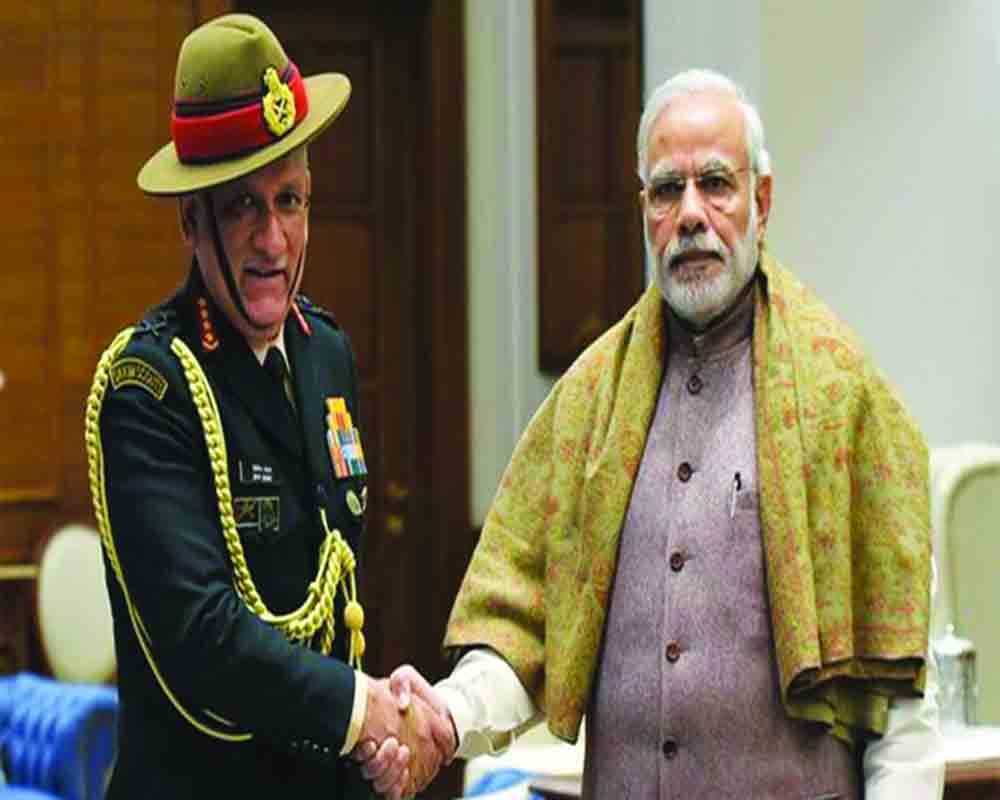
    Unfortunately, while the bulk of our military remains apolitical and secular, the actions and public statements of the Chief of Defence Staff, General Bipin Rawat, have created perceptions that the military’s senior leadership has become excessively politicised. Then there is the fact that some very senior officers have taken the plunge into active politics immediately on shedding their uniform.

    While some within the ruling elite may see this turn of events as advantageous to their ideological cause, and in fact encourage this shift within the military hierarchy through the process of “deep selection”, as some allege, they may well be biting off more than they can chew. If there is anything to learn from history, it is that once the military gets sucked into politics, it will not be satisfied acting as a mere handmaiden of those in power. As General Milley so eloquently put it, they are the ones with the guns! We just need to look closely at our own neighbourhood for examples.

    The Government and the legislative would do well to put rules in place that prevent members of the military and even the Civil Services from joining politics without an appropriate cooling- off period.

    It would be in the interest of the political establishment to desist from politicising the military. Creating an uncontrollable monster, that will go on to bite the hand that feeds it, is nothing but sheer stupidity. The Government and the legislative would do well to put rules in place that prevent members of the military and even the Civil Services from joining politics without an appropriate cooling- off period. That would go a long way in insulating them, especially the military, from politics.

    This article was published earlier in the pioneer.

    The views expressed are those of the author.

    Feature Image: www.dailypioneer.com

  • Civil-Military Relations: Differing Perspectives

    Civil-Military Relations: Differing Perspectives

    There are a number of theoretical constructs that have been propounded to explain Civil-Military Relations. However, these concepts, be it Huntington’s “Objective Civilian Control”, or Morris Janowitz views on “Subjective Control”, and there are others as well, basically interpret and differentiate the interplay between the degree of civilian dominance and military autonomy.

    Introduction

    At the present time, there is an ongoing controversy in the public domain with regard to our Higher Defence Management as the Services are unable to agree on how to proceed forward with the Government’s stated aim of establishing Theatre Commands. We are told that Raksha Mantri has asked the CDS to convene a meeting of the three services to thrash out the matter so that a consensus can be reached on how to proceed forward. This direction by the RM is a clear pointer to the distressing state of civil-military relations prevailing within our country.

    In any democracy civilian control over the military, which implies the control exercised by our elected representatives through the government, is the very foundation on which civil-military relations are based. Therefore, one would expect when the Services have divergent views, the politicians would step in and give concise directions on how the Services are to proceed. In roughly similar circumstances in the United States, for example, the US Congress broke the logjam through the Goldwater-Nichols Act in 1986. This brought about sweeping changes to the  Department of Defense by reworking the command structure of the United States Military. More recently, in China, on President Xi Jinping’s directions, transformational changes to the PLA’s organizational structure were undertaken. So, to clearly understand why our Ministry of Defence (MOD) is unable to push through such reforms, we perforce must examine its functioning and set up.

    In essence, however, Civil-Military Relations are a messy affair, not just here, but worldwide. The Goldwater Nichols Act, for example, took a year to be passed and nearly another four to five years to be implemented. There are a number of theoretical constructs that have been propounded to explain Civil-Military Relations. However, these concepts, be it Huntington’s “Objective Civilian Control”, or Morris Janowitz views on “Subjective Control”, and there are others as well, basically interpret and differentiate the interplay between the degree of civilian dominance and military autonomy.

    Leaving aside the theoretical aspects, the one thing on which there can be no disagreement is the fact that success or otherwise at tackling vital national security issues depends on, what Raj Shukla in his paper “Civil-Military Relations in India” (CLAWS, 2012), calls “the pattern of institutional interaction between the civil and military components of a nation’s polity.” Most importantly, in our context, this is essential not just because the military is responsible for protecting our national sovereignty and territorial integrity, and must, therefore, deliver the maximum bang for the buck, but more so, because defence spending, while at its’ lowest in the past seven years,  is still  13.73% of all government expenditure at Rs 4.78 Lakh Crores. Not an insubstantial amount in any way.

    In the opinion of Steven Wilkinson, author of  Army and Nation: The Military and Indian Democracy Since Independence, our military has been defanged and “coup proofed” by a series of measures put in place by the bureaucracy and its political masters.

    Historical Precedent

    It is important to remember the Spanish philosopher, George Santayana’s, words of wisdom that “those who cannot remember the past are condemned to repeat it”, we would also do well to recall the maxim that “there’s a reason why your windshield is bigger than your rear-view mirror. Where you’re headed is much more important than what you left behind”. Therefore, seventy plus years on, historical precedent means little, because we have had enough time to have absorbed lessons from the wars we have fought since and adapted our HDO accordingly. Suffice it to say that Prime Minister Nehru had an inherent dislike for the military and was apprehensive of what it could do, especially after seeing what was happening in our neighbourhood.

    In the opinion of Steven Wilkinson, author of  Army and Nation: The Military and Indian Democracy Since Independence, our military has been defanged and “coup proofed” by a series of measures put in place by the bureaucracy and its political masters. These include a steep decline in its precedence and perks, diversifying its ethnic composition and giving overriding powers to the civilian bureaucracy within the Ministry of Defence in every aspect of military functioning, including the selection of senior ranks.

    In addition, large paramilitary forces under the Union Home Ministry have also been formed to “ring-fence” the military and for use as countervailing forces against it, if required. Finally, the lure of post-retirement crumbs, such as an ambassadorship, governorship or membership of the Armed Forces Tribunal has ensured that the senior hierarchy remains quiet and continues to toe the Government line. All of this has weakened the military to a large extent making it a less attractive career, which is why it has been attempting to cope with large deficiencies over an extended period of time.

    The Kargil Conflict of 1999 caught us by surprise, and in its aftermath, there were calls for drastic changes to the existing system. It was obvious that the existing defence paradigm of the Indian state was obsolete while we were in the 21st century, our command and control structures were still in the 20th century. The Government established the Kargil Review Committee headed by K Subrahmanyam to go into the issue of reforms and its subsequent recommendations were handed over to a group of ministers for examination and implementation.

    Amongst the recommendations made, the three that were of most importance pertained to the necessity for integration of the services both with each other and with the MOD; the creation of a chief of defence staff (CDS); and joint operational commands. Like nothing else, the Kargil Conflict showed up the serious lack of synergy amongst the three Services of Armed Forces as well as a lack of coordination between the Armed Forces and Civil authorities. It must be pointed out that while some of the lesser recommendations were implemented, including facetiously attempting to fool the political establishment by renaming the Service Headquarters, it has only been after nearly two decades that any serious movement towards reforms has been undertaken with the appointment of the CDS and the Department of Military Affairs (DMA). It is still too early to comment on their efficacy.

    Characteristics of Civil-Military Relations in India

    It may come as a surprise to some that the Raksha Mantri and the civilian bureaucrats in the MOD, apart from handling the three Services and the Coast Guard, also deal with a number of civilian manned and run agencies such as DRDO, OFB and Veterans Welfare etc. The total number of civilians paid from defence estimates exceeds 500,000. To put it in perspective it is larger than the active strength of the Pakistan Armed Forces.

    Anit Mukherjee in a paper titled The Absent Dialogue (Seminar 599-2009)  suggests that there are three main characteristics that our Civil-Military Relations present, which explains to a large extent the ongoing interaction between the two. These are:

    • Strong administrative, procedural and bureaucratic controls over the armed forces. Where this differs from other democracies in this respect is the complete lack of expertise on defence matters among the civilian bureaucrats. As a result dialogue between both sides is constrained and, as is to be expected, they are more focused on the process than the outcome. This lack of knowledge also ensures that they are unable to “arbitrate between competing parochial interests”, and are also unwilling to take responsibility or be held accountable for controversial decisions.
    • While consulted, the military is excluded from the crucial decision-making forums, thereby denying them a role in the policy-making process. The CDS has only been granted the position of a member of the Defence Planning Committee (DPC) as well as in the Strategic Policy Group (SPG), both headed by the NSA, which is the “principal mechanism for inter-ministerial coordination and integration of relevant inputs in the formulation of national security policies.” Thus, the NSA de facto performs the duties of the CDS—a peculiar situation since the former completely lacks the requisite experience.
    • The military has been granted a great deal of autonomy concerning its own affairs. is allowed to do much of what it wants in what it considers its own sphere of activity: training and education, threat assessments, force structure, doctrine, innovations, appointments (up to a certain rank) and miscellaneous welfare activities. This makes for personality-driven interactions.
    • In addition to the above three characteristics as propounded by Anit Mukherjee, there is also the issue of disjointed and uncoordinated interaction between the MOD with the Ministry of Finance (MoF). For example, Amit Cowshish in his paper, Distortions in the Discourse on Modernization of Armed Forces, in the Journal of Defence Studies (Vol 8, No3, Jul-Sept 2014) writes that “in the run-up to the formulation of the 12th Defence Five-Year Plan (FYP) (2012–17), all the Services Headquarters confirmed to the MoD that the Op Directives were a good enough basis for formulating the plan. However, “the difference of opinion between the MoD and the Ministry of Finance (MoF) over the size of the 11th Defence FYP (2007–12) was one of the reasons why it could not be brought before the Cabinet Committee on Security (CCS)”.

    Impact on Functioning

    The impact on the functioning of our Higher Defence Management of all of this is that we live in a divided house in which the atmosphere reeks of distrust and hostility, the currency for interaction is power, and the aim of all stakeholders is to protect one’s own turf at all costs, at the very least. It is indeed unfortunate that the most important lesson we seemed to have picked up from the British and perfected, is the fine art of divide and rule.

    The second issue of import is the fact that over all these years we have not been able to formulate a comprehensive National Security Strategy document. This goes far beyond just the functioning of the MOD or Civil-Military interactions and can be blamed on our inability to adopt a ‘whole of government approach. Nonetheless, its absence has not only caused ambiguity in our strategic aims but also has had a debilitating effect on our military. As I have written elsewhere in my paper Rebooting the India Army: A Doctrinal Approach to Force Restructuring (ORF Issue Brief No439, Feb 2021) that “The NSS is also the foundation for a comprehensive military doctrine by the Armed Forces. This military doctrine acts as a formalised guideline that broadly visualises the nature of potential conflicts, the preparations required for them, and the methods to be adopted. In its formulation, it flows from the military-strategic goals enumerated, which dictate how the military must be organised, trained and equipped to carry out its assigned missions”.

    It implies, that instead of transforming our organizational architecture or processes to deal with future conflict scenarios we adopt the lowest common denominator that allows for compromise. 

    If perceptions, within the Services and at the MOD, vary about what our strategic aims are and how we plan to accomplish them, then substantive dialogue on the issue of integration and joint manship are extremely difficult. It implies, that instead of transforming our organizational architecture or processes to deal with future conflict scenarios we adopt the lowest common denominator that allows for compromise.  Basically, that allows us to adopt a bureaucratic bean-counting mode, to ensure harmony among all stakeholders, which translates to proportional representation in all aspects of functioning, entailing only superficial changes in the status quo. The Armed Forces Special Operations Division (AFSOD) is the perfect example of such an approach. Instead of consolidating all of our Special Operations Forces (SOF) resources, we have adopted a flawed approach, not unlike what the United States adopted.  after the disaster of Operation Eagle Claw in 1980, the abortive bid to free US diplomats held hostage by the Iranians. They formed the Joint Special Operations Agency which was flawed as it had neither operational nor command authority over any SOF. By providing minimal resources that have little operational impact, we have managed to pay lip service to jointness while each Service continues to control and employ its SOF assets as it chooses.

    Conclusion

    The only way forward for us is a change in mindsets and attitudes. We can no longer afford a system wherein, according to K. Subrahmanyam, “politicians enjoy power without any responsibility, bureaucrats wield power without any accountability, and the military assumes responsibility without any direction”. We need a more informed and enlightened polity that is aware of our security environment and is willing to demand answers from our political and security establishment as to how our tax Rupees are being spent on defence. There is no doubt that accountability is the key to a more secure future.

    It is time our political establishment got real, set aside bureaucratic infighting and apathy and took control as the Constitution requires them to do. This requires a better understanding of security issues along with political will, determination and a more assertive leadership that is focused on strengthening our institutions. Otherwise, as Anit Mukherjee so aptly asserts, “It might not make a pretty picture to say that we are weak because we choose to be weak, but sometimes it is necessary to look in the mirror”.

    Feature Image Credit: www.ipdutexas.org

    Article Image Credit: patimes.org


  • Theatre Commands in India: Have We got it  Backwards?

    Theatre Commands in India: Have We got it Backwards?

    As per a recent report by Nitin Gokhale, published on the Bharatshakti website, higher defence reforms are on track in India with the likely formation of two integrated commands by August 2021. Nitin also reiterates the reforms mandate to the CDS, General Bipin Rawat, to bring about jointness in communications, training, logistics & maintenance and support services, apart from operations, within three years while rationalizing the existing infrastructure to augment combat capabilities of the armed forces and reducing wasteful expenditure.

    The very fact of air defence being thought of as bringing just the SAMs and AD guns under one commander indicates a lack of such study and of military history as in Bekaa Valley in 1982.

    From the questions raised in this report itself on the conceptual framework of the Air Defence Command still requiring resolution, it becomes apparent that we are putting the cart before the horse in our haste to meet the given deadline. Surely, the senior leadership must have considered this issue of integration in all previous appointments and studied the experience of other nations, particularly the US being the largest in this field as a democracy, and formulated a plan to adapt their structure and best practices to our institutional and cultural environment instead of reinventing the wheel. The very fact of air defence being thought of as bringing just the SAMs and AD guns under one commander indicates a lack of such study and of military history as in Bekaa Valley in 1982.

    Even a cursory study would indicate that the essential initial steps for joint operations are training backed by the requisite secure communications integrating literally every fighting unit in the command loop to execute joint plans with the requisite flexibility in the fog of war, or in other words integrating sensors with shooters to minimize the OODA cycle in this era of informatized warfare. With all three services reportedly still using their individual communication networks which do not easily talk to each other, much less to the systems of other friendly nations that we regularly exercise with, the desired integration would remain a mirage. Just one example from the US would illustrate the importance of this issue. It may be recalled that the Goldwater-Nichols Act of 1986 created seven regional (theatre) combatant commands bringing all five US military services under unified, geographically organized command structures. Today, there are 11 including the recent Space Command. Even after five years, in Desert Storm, the Joint Air Component Commander, General Horner, could not electronically pass the Air Tasking Orders (ATOs) to the Carrier Groups of the US Navy and these had to be flown in manually every day. It took the air wings of the US Navy and the USAF almost another decade of cross-training till Operations Enduring and Iraqi Freedom to come together on a common platform and largely operate as one team, with some issues still to be resolved. In the case of the USAF and US Army, such a model was still being considered till 2007.

    35 years after the Goldwater-Nichols Act mandating unified commands, the USAF still operates eight separate commands, namely Air Combat Command, Air Education and Training Command, Material Command, Global Strike Command, Air Mobility Command, Space Command, AF Reserve Command and even an AF Special Operations Command. In addition, it has separate command organizations for Pacific Air Forces and USAF in Europe. When required to support operational missions, the Secretary of Defense directs the Secretary of the Air Force (SECAF) to execute a Change in Operational Control (CHOP) of these units to a Regional Combatant Commander. With over 5300 aircraft currently, surely the USAF could have been parcelled out to various theatre commands if that was the most operationally effective integrated approach. However, it was not, based on the principles of unity of command and concentration of firepower. In the case of a much smaller IAF, with just about 30 combat squadrons, against a sanction of 45, and a handful of combat support elements, how is the reported division in the name of reforms even being thought of?

    Similarly, the US Navy operates nine major commands like Navy Expeditionary Combat, Military Sealift, Sea Systems, Air Systems, Naval Facilities Engineering Systems, Supply Systems, IW Systems, Strategic Systems Program and Naval Education & Training apart from Fleet Forces commands for each region. Despite operating more than 3700 operational aircraft, the US Navy also does not divide its aircraft or carrier groups but allocates these based on the situation while continuing to train for all contingencies. Even the US Army runs many major commands and five major surface component commands like Pacific, Europe and Africa, North, South and Central all headed by 3 or 4-Star Generals. As recently as 2018, necessity resulted in the formation of an additional Army Futures Command (AFC).

    Co-location has been cited by many in India as a pre-requisite for integration, jointness and economizing by shutting down some existing commands. Against this, even in the case of the US Army where it is possible to pre-position most forces in the area of envisaged operations due to their relative immobility and reaction time, three unified commands and their army components have headquarters outside their area of operations. CENTCOM’s is located at MacDill  AFB in Tampa, Florida with a forward headquarters at Al Udeid Air Base in Qatar while the army component, ARCENT, is headquartered at Shaw AFB in South Carolina. Functioning is through efficient communications with the span of control of the commanders still a major consideration. Have we carried out a study on the actual savings versus operational effectiveness after the proposed closure and relocation of some commands?

    The Army also seems to work on its limited field of view by seeing the air force more as flying artillery for close air support, apart from air mobility, without the broader strategic vision of the Air Force.

    Unfortunately, in our case, the approach appears to be driven more by the numbers and vacancies for each service with the fixation of having the forces under command. The Army also seems to work on its limited field of view by seeing the air force more as flying artillery for close air support, apart from air mobility, without the broader strategic vision of the Air Force. Undeniably, the Air Force is the most technology-intensive service and a single platform today is capable of role switching and reacting in near real-time to emergent situations. Due to the roles and rapid strategic reach, it is also likely to be the first responder in most contingencies in our current geopolitical environment under a nuclear overhang. Based on this, it could be argued that the Air Force should lead most theatre commands duly assisted by component commanders from each service. In Desert Storm, General Norman Shwarzkopf wisely handed over the operations to the air component commander, General Charles Horner, to run a 1000-hour air campaign before a 100-hour ground campaign. Such maturity is unlikely in India without jointly educated and trained commanders and staff.

    It is also easier for an airman to understand surface operations than it is for a soldier to understand air operations. An example of a Corps Commander in 1989-91 later criticizing the non-use of Mi-25/35 attack helicopters in Kargil despite having had these helicopters under him in his Corps shows how limited their understanding of airpower is. The same General also talked of a certain number of fighter squadrons being authorized for close air support, once again displaying his ignorance on the use of multi-role fighters in particular and air power in general. The example of the Pakistani Army sending out a brigade, which was decimated by air at Longewala in 1971, without first achieving air superiority in that area further illustrates the thinking of soldiers in the sub-continent and strengthens the case for the air force.

    Training and communications issues, therefore, should have been first addressed and resolved before haste makes waste of our efforts at integration.


    This article was published earlier in The Sunday Guardian.

    Image Credit: Hindustan Times


  • The Democratic Warrior – Countering Unrestricted Violence with Clausewitz

    The Democratic Warrior – Countering Unrestricted Violence with Clausewitz

    This research paper was originally published in the “African Journal of Terrorism and Insurgency Research (AJoTIR)”, Volume 2, Number 1, April 2021. Pp. 89-106.


    Abstract

    We often find the application of indistinctive, brutal and extraordinary violence by all fighters and soldiers in terrorist, insurgency, and counter-insurgency acts in Africa. This article argues that we need a code of honour for those bearing arms to limit these unrestricted acts of violence, a code of honour that combines military duties with the demands of civil society in the model democratic warrior. The changes to the global system that followed the end of the Cold War are widely regarded as requiring a different kind of soldier for democratic societies. A number of writers have proposed that the new model should be that of the “warrior,” a concept that highlights the psychological and social distinctiveness of those who bear arms. Such men and (rarely) women are often conceived as operating according to a distinctive code of honour that sets them apart from civil society, usually in a positive way. But we know that the concept of honour may also lead to a terrible escalation. So, the task is to reconnect the concepts—warrior and honour—to civil society to de-escalate the ongoing brutal violence in civil wars. There is no honour in killing innocent people. On the contrary, it is perhaps the most egregious act against one’s honour and dignity to torture, violate, or kill the innocent. The concept of the democratic warrior seeks to reinstate honour and dignity to those bearing arms.Keywords: democracy, warrior, civil society, civil war, honour, dignity, terrorism, Clausewitz, wondrous trinity, containing violence.

    Introduction

    At first glance, the concept of the democratic warrior appears contradictory. Indeed, it combines seemingly conflicting value systems in a single concept. Like a magnet or Clausewitz’s favoured model of the unity of polar opposition between attack and defence, a methodology can be formulated to explain how this type of conflicted unity is not necessarily a logical opposition and can be a dynamic interrelationship on a continuum. At one end of the continuum is democratic equality and non-violent conflict resolution, while at the other end is the threat of (and sometimes) violently enforced limitation of war and violence; at one end is a civilized society, while at the other is a subsystem of society whose identity is defined by martial honour.

    The decisive bond that can link the two poles of this dynamic relationship, without eliminating their opposition, is the classical republican virtues, which can lay claim to relative validity in both spheres. Since Plato, the classical virtues have been prudence (wisdom), justice, fortitude, and temperance. Without a specific ethos aimed at the political functioning of the polity, a state can sustain itself only under the conditions of a dictatorship. If republican virtue, which is oriented toward the polity, cannot be directly reconciled with liberal democracy and its focus on the individual, it can take on a completely new significance as a bond linking a democratic society to democratic warriors. For Machiavelli, republican virtue already guarantees both external and internal freedom. In this respect, the necessary though not yet adequate condition of the democratic warrior is to also be a republican soldier. Add to this the limitation of war and violence in a global society to make democratic societies possible. A renewal of the republican virtue is the link between a liberal-democratic society and a warrior ethos.

    The “warrior” is by definition someone who chooses to bear arms and is proficient in their use. In this sense, whatever the distinctive characteristics of the warrior ethos, its institutionalization reflects the same preferences for professionalism, expertise, and individualism that are characteristic of modern society as a whole. Contemporary conditions, it is argued, no longer call for armed masses, but for experts whose willingness to serve in uniform will allow others the freedom not to serve.

    It must be admitted, however, that the concept of the warrior does not call forth associations with modernity, but rather of the “archaic combatant” (Röhl 2005), whose ethos, skills, and experiences set him apart from normal society and in opposition to its basic values, of which the most cherished is, of course, peace. The fact the warrior freely chooses his profession may be consistent with democratic values, but the existence of a “warrior class” uniquely skilled in the use of force, whose values are not those of society as a whole, is scarcely consistent with democratic interests. It is also true that those who serve in today’s democratic armies are called upon to do a great deal more than fight. Although phrases like “armed social worker” undervalue and denigrate the martial qualities that remain foundational to military life, it is true that only a small percentage of men and women in uniform actually fight, and that their duties entail a wide range of activities in which violence plays no part. To those who wish to uphold the warrior spirit, the diverse requirements of modern military missions are liable to hold scant appeal, which may undermine the sense of purpose and identity that drew them to the profession in the first place.

    The discussion that follows seeks to build a bridge between the distinctive ethos of the warrior and the moral and political requirements of democratic societies, using the concept of the “democratic warrior.” It seeks to do justice to the self-image of those who bear arms (a morally distinctive task) while connecting it to the various goals and practices of democratic societies, and the diverse uses to which they put their armed forces. We may begin by noting that a warrior, even in the most traditional terms, is not merely a combatant—a fighter—but has always performed and embodied a range of social, military, and political roles. Our starting point for considering what those roles must be is Clausewitz’s concept of the trinity, a metaphor intended to encompass all types of war, which, by extension, can provide a lens through which the ideal range of characteristics required of the democratic warrior can be envisioned. War itself, as Clausewitz avers, is compounded of primordial passions, an irreducible element of chance, and what he called an element of “subordination” to reason, by which its instrumental character is revealed. When Clausewitz set forth his trinity, he posited that the chief concern of the warrior must be the mastery of chance through intelligence and creativity; and so it remains. Yet there is no reason to suppose that such mastery means that war’s social and political requirements should be ignored. On the contrary, unless they too are mastered, the warriors sent forth by democratic societies cannot represent the values and interests of the communities that depend on them, and of which they remain apart (Herberg-Rothe 2007).

    Soldiers and Warriors

    In both German and English, the word “soldier” (soldat) originally referred to a paid man-at-arms. The term became common in early modern Europe and distinguished those who were paid to fight— primarily in the service of the increasingly powerful territorial states that were then coming to dominate the continent—from members of militias, criminal gangs, volunteer constabulary and local self-defence forces, and other forms of vernacular military organizations. The rise of the soldier was linked to the rise of the state. This connection distinguished him from the “mercenary,” who also fought for pay, but as a private entrepreneur, what we would today call a “contractor.” Standing armies comprised of soldiers were different from and militarily superior to, the feudal hosts of the past, whose fighters served out of customary social obligation and generally possessed neither the discipline nor the martial proficiency that the soldier embodied. Clausewitz highlights these developments briefly in the last book of On War, and portrays them as an advance in political organization and military efficiency (Clausewitz 1984, 587-91).

    The absolute monarchies that made the paid soldier the standard of military excellence in early modern Europe were generally indifferent to the social and political identities of those they paid to fight, though not always. Frederick the Great, for instance, lamented his reliance on foreign troops and believed that his own subjects made better soldiers. “With such troops,” he wrote, “one might defeat the entire world, were not victories as fatal to them as to their enemies” (quoted in Moran 2003, 49). It was, however, only with the French Revolution that a firm expectation was established that a soldier bore arms not merely for pay, but out of personal loyalty to the state, an identity that was in turn supposed to improve his performance on the battlefield. This connection, needless to say, was largely mythical. Most of the men who fought in the armies of the Revolution, and all major European wars since then, are conscripts who would not have chosen to bear arms on behalf of the state if the law had not compelled them to do so. Nevertheless, submission to conscription was itself regarded as an expression of the ideal of citizenship, a concept that, like honour, depends upon the internalization and subjective acceptance by individuals of norms arising within the larger society.

    The French Republic never referred to its soldiers as conscripts, always as volunteers. The success of its armies and those of Napoleon, although transient, insured that “defence of the Fatherland [became] the foundation myth of modern armies”(Sikora 2002). The myth of voluntary sacrifice by the “citizen-soldier” to defend the community proved central to the legitimization of conscript armies, even in societies where democratic values were slow to emerge. In the middle of the nineteenth century, as Frederick Engels observed, conscription was Prussia’s only democratic institution (Frevert 1997, 21).

    It had been introduced in reaction to Prussia’s defeat by Napoleon, whose triumph was owed to the fact that the resources of the entire French nation were at his disposal. The aim of the Prussian military reforms was to accomplish a similar mobilization of social energy for war, but without inciting the revolutionary transformation of society that had made such mobilization possible in France. Prussia was no sovereign nation of citizens, and while the reform of its armed forces helped it to regain its position among the leading states of Europe, their political effect was limited.

    Many of those who promoted reform, including Clausewitz, hoped conscription would contribute to the democratization of Prussia’s armed forces, and, indirectly, of society as a whole. But the moral influence could as easily run the other way, and, as Friedrich Meinecke observed, measures designed to bind army and society together had the effect, in Prussia, of militarizing society instead. Even the Great War did not fully succeed in stripping war of its moral glamour. The supposedly heroic massacre of German troops attacking the British at Langemarck (1914), for instance, remained a staple of right-wing mythology until the end of the Third Reich, by which “our grief for the bold dead is so splendidly surpassed by the pride in how well they knew how to fight and die (Hüppauf, 1993, 56). Alongside this kind of blood-drenched nostalgia, the industrialized warfare exemplified by battles like Verdun (1916) also asserted themselves. Under these circumstances, fighting and dying well acquired some of the aspects of industrialized labour, in which a soldier’s duty expresses itself, not through the mastery of chance as Clausewitz proposed, but through submission to what Ernst Jüngercalled “the storm of steel.”

    It was only after World War II that German soldiers became authentically democratic citizens in uniform. According to Wilfried von Bredow, the creation of the Bundeswehr in 1956 was “one of the Federal Republic of Germany’s most innovative and creative political reforms, fully comparable in its significance to the conception of the social market economy” (Bredow 2000). Its evolution as an integral part of German society has embodied a calculated break with the German past, one that has become even more apparent since the demise of the Soviet Union has shifted the mission of the German army away from national defence and toward expeditionary operations calculated to help maintain regional and global order. As the conscript armies of the past have given way to the professional and volunteer armies of the present, in Germany and elsewhere, the model of the democratic “citizen in uniform” has once again been required to adapt to new conditions.

    It is perhaps slightly paradoxical that as wars have become smaller and more marginal in relation to society as a whole, the ideal of the warrior as an apolitical professional fighter has regained some of its old prominences. Such individuals are thought to embody values different than those of society as a whole, to the point where their loyalties, like their special capabilities in battle, are thought to spring solely from their organization and mutual affiliation. John Keegan, a proponent of the new warrior, explains the rejection of the values of civil society in terms of the psychological impact of violence on those who experience and employ it. War, Keegan argues, reaches into the most secret depths of the human heart, where the ego eliminates rational goals, where pride reigns, where emotions have the upper hand, and instinct rules. One of Keegan’s models of the warrior is the Roman centurion. These officers were soldiers through and through. They entertained no expectation of rising to the governing class, their ambitions were entirely limited to those of success within what could be perceived, for the first time in history, as an esteemed and self-sufficient profession. The values of the Romans professional soldier have not diminished with the passage of time: pride in a distinctly masculine way of life, the good opinion of comrades, satisfaction in the tokens of professional success, and the expectation of an honourable discharge and retirement remain the benchmarks of the warrior’s life (Keegan 1995, 389-391).

    The enthusiasm of Keegan and others for the revival of the warrior ethos is the belief that “honour” can play an important role in limiting violence, far more effective than the proliferation of legal norms that lack the binding psychological validity required to stay the hand of those who actually take life and risk their own. Warriors use force within a customary framework of mutual respect for one another. This is part of what has always been meant by “conventional warfare”, a form of fighting that necessarily includes a dissociation from combatants considered to be illegitimate. How and whether these kinds of customary restraints can be successfully reasserted under contemporary conditions is one of the central problems with which the concept of the democratic warrior must contend. In opposition to Keegan, I think, that the warriors’ code of honour must be related back to civil society, although this is a task which requires bridging a gap and remains a kind of hybrid.

    Old and New Wars

    To judge what kind of “weapon carrier” will be needed in the twenty-first century, we must begin by looking at developments since the end of the East-West conflict. It has proven, broadly speaking, to be a period of rapid social, political, and economic development whose outstanding characteristics are marked by the decline or disappearance of familiar frameworks and inherited values. Thus, one speaks of denationalization, de-politicization, de-militarization, de-civilization, de-territorialization, and delimitation.

    Unsurprisingly, these changes are also supposed to be marked by “new” wars, characterized by the decline of statehood, the rise of privatized violence, the development of civil war economies, and the reappearance of types of combatants thought to be long gone— mercenaries, child soldiers, warlords, and so on. The new types of combatants are in turn associated with rising incidences of suicide bombing, massacre, and other forms of atavistic and irrational violence(Kaldor 1999, Münkler 2004).

    Political and academic discourses have produced a range of new concepts designed to capture these conditions, including privatized war, asymmetrical warfare, small wars, wild wars, low-intensity conflict, post-national wars; wars of globalization on the one hand, and of “global fragmentation” on the other. It is apparent, however, that each of these terms describes only one segment of a complex reality. To some extent, a new type of war is being discovered with each new war. At the same time, these different terms share a common assumption that war now consists mainly of conflicts involving non-state actors on at least one side, and, by extension, that the motivation and goals of such belligerents are likely to prove unfathomable in political terms. The result for some is an approaching anarchy (Kaplan 1994), whose remedy is a revived liberal interventionism, the only principle that seems able to guarantee a modicum of global order (Münkler 2007).

    It is possible, however, that the contemporary diffusion of conflict beyond the confines of the state system is no more than a transitional phase, with particular strong links to those parts of the world—Africa and Central Asia above all—where the challenges of post-imperial social and political adaptation are still especially pronounced. Neither does the fact that the parties to war are non-state actors necessarily mean that such wars lack a political or ideological basis. Such wars may not represent a clash between order and anarchy but between competing conceptions of order (Münkler 2004). While a revived interventionism may indeed be a suitable antidote to anarchy, it is unlikely to do more than aggravate indigenous conflicts over the politics of order – and as it seems at present, it is contributing to the escalation of violence throughout the world. Now, as in the past, violence is not simply a source of disorder. It is also a means of shaping order and providing the basis for community formation.

    It is possible to wonder, in other words, how new the “new wars” actually are. Widespread atavistic and vernacular violence were already prominent features of the Chinese civil war, the Russian civil war, the Armenian genocide, and many other episodes of “old wars”. Those who favour the concept note a number of formal changes that resulted from the disappearance of Soviet-American rivalry, above all a decline in external assistance. The proxy wars of the past have become the civil wars of the present, conducted by parties that must rely on their own efforts to obtain the necessary resources, including illegal trafficking in diamonds, drugs, and women; brutal exploitation of the population; extreme violence as a way of attracting humanitarian assistance that can then be plundered; and the violent acquisition of particularly valuable resources (robber capitalism). These changes may well amplify the social consequences of violence, but do not necessarily deprive it of its instrumental and political character (Schlichte 2006).

    The point of departure for the study by Isabelle Duyvesteyn, for example, is a very broad definition of politics based on Robert Dahl: “any persistent pattern of human relationship that involves, to a significant extent, power, rule or authority” (Duyvesteyn 2005, 9). Duyvesteyn refers especially to the fact that in the fast-developing states she has studied, the differences between economics and politics are not as clear cut as Westerners expect. Struggles that seem to be about the acquisition of resources can be motivated by power politics to obtain a separate constituency. Because the position of power in these conflicts is often determined by the reputation of the leader, what may appear to be personal issues can also be incorporated into a power-political context. Her hypothesis is not that economically, religiously, ethnically, or tribally defined conflicts are masks for politics, but rather that these conflicts remain embedded in a political framework that is understandable to the participants.

    It is also apparent today’s civil wars do not always trend irrevocably toward social and political fragmentation, becoming increasingly privatized until they reach the smallest possible communities, which are held together by only violence itself. The defeat of the Soviets in Afghanistan, for instance, gave rise to a civil war between warlords and individual tribes that appeared to be tending in this direction for a time, only to acquire a new and recognizably ideological shape once the Taliban seized power. This new tendency was confirmed by the Talibans’ willingness to give shelter to al-Qaeda, a global and trans-national organization of almost unlimited ambition, whose attacks upon the United States have in turn embroiled Afghanistan in a conflict about the world order pitting the West against militant Islam. At present, we witness in “Sahelistan” a similar development, but this is not confined to a single state, but to the whole region.

    At a minimum, it seems clear that the new wars, to the extent that they are new, are not all new in the same way. In some, violence does indeed appear to gravitate downwards towards privatized war; in others, however, the movement is upwards, towards supra-state wars of world order. Although these trends are linked in practice, analytically they are distinct. States do still wage wars, but for the most part, they are now doing so not in pursuit of their own particular interests but for reasons related to world order. This is what accounts for the new interest in an American empire and hegemony (Walzer 2003). Nor is America the only state capable of seeking and exercising global influence.

    Russia, China, India and Europe (whose superficial fragmentation masks its concerted economic, regulatory and power-political influence) are all capable of challenging American influence in particular spheres of activity; and one day they may do so in all spheres (Zakaria 2009). In any event, the use of force by strong states in pursuit of world order, whether cooperatively or competitively, is likely to remain the dominant strategic reality for some time to come; a fact that should not be obscured by the simultaneous proliferation of privatized violence on the periphery of the world system.

    Clausewitz’s Trinity as a Coordinate System

    The argument about the newness of new wars is also an argument about the continuing salience of Clausewitz’s understanding of war as, in his words, a “wondrous trinity,” by which primordial violence and the exigencies of combat may finally be subjugated to reason and politics. It is apparent, however, that while the proportions of these three elements may vary, a good deal nowadays, perhaps more so than in some periods in the past, they do not escape the theoretical framework that Clausewitz established. At the same time, his trinity points us towards the essential characteristics of the “democratic warrior,” whose success requires that he masters the multiple sources of tensions that Clausewitz detected in the nature of war itself.

    Clausewitz’s trinity present war as embodying three elements in constant tension with each other: primordial violence, the fuel on which war feeds; the fight between two or more opponents, by which violence is given military effective form; and the community, whose interests, as represented by policy, give war its purpose, and whose existence provides the soldier with his essential identity: as one who fights for something larger than himself. The shifting proportions among these elements that modern war continues to display would not have surprised Clausewitz. On the contrary, he knew that all three would always be present in every war and that a “theory that ignores any one of them . . . would conflict with reality to such an extent that for this reason alone it would be totally useless” (Clausewitz, On War, 1984, 89; see Herberg-Rothe 2007). Each requires exploration if the characteristics of the democratic warrior are to be understood.

    Violence and force

    The most crucial polarity in Clausewitz’s trinity is between the instrumentality of war and the autonomy of violence. Clausewitz noted the tendency of violence to become absolute, and therefore an end in itself, a tendency that was restrained both by the instrumental rationality of policy and, less obviously perhaps, by the skill of the combatants. Clausewitz also notes the paradoxical influences that can attend the use of force at a distance. If combatants are separated from each other in space and time, it may promote relative rationality in the use of force; or it may not, since it introduces the disinhibiting influence of impersonal killing, in which the humanity of the opponent is no longer perceived. Fighting “face-to-face” demands personal aggressiveness and even hatred, which can lead to increasing ferocity in the use of force. At the same time, however, it may make it easier to perceive the opponent as human. A similarly paradoxical logic may arise from the use of expensive weapons versus simple ones. Expensive weapons systems and the highly trained combatants required to use them can lead to a certain limitation of war because these cannot be so easily risked (as was the case, he argued, in the wars of the 18th century). In contrast, wars waged by relatively unskilled combatants employing cheap and simple weapons may be more likely to escalate – as is evident from many of the civil wars in Africa, particularly with child soldiers.

    The Fight

    The most basic reason that the violence of war is prone to escalate is that combatants share a common interest in not being destroyed. In most other respects, however, their interaction is asymmetrical, most profoundly so, as Clausewitz says, in the contrasting aims and methods of attack and defence, which he avers are two very different things. The shape of combat is also influenced by whether war is directed against the opposing will (in effect, a war to change the adversary’s mind)or if it aims at his “destruction.” Clausewitz specifies that by the destruction of the opposing armed forces, he simply means reducing them to such a condition that they can no longer continue the fight. Nevertheless, Clausewitz long favoredNapoleon’s approach to warfare, which emphasized direct attack against the main forces of the enemy. Other forms of fighting are also possible, however, whose aim is to exhaust the enemy’s patience or resources indirectly, rather than confront and defeat his armed forces in the field. The real war, in Clausewitz’s days and in ours, is generally a combination of direct and indirect methods, whose proportions will vary with the interests at stake and the resources available.

    Warring Communities

    When referring to warring communities, we must first differentiate between relatively new communities and those of long-standing. This is because in newly constructed communities, recourse to fighting is liable to play a greater relative role in its relations with adversaries; whereas, in the case of long-standing communities, additional factors come into play. Clausewitz argues that the length of time a group of communities has existed significantly reduces the tendency for escalation because their long-standing interactions will include elements other than war, and each party envision the other’s continued existence once peace is made, a consideration that may moderate the use of force.

    War’s character will also vary depending on whether it aims to preserve the existence of a community or, as in revolutionary crises, to form a new one; whether war is waged in the pursuit of interests, or to maintain and spread the values, norms, and ideals of the particular community (see Herberg-Rothe 2007). Closely related to this contrast, although not exactly congruent with it, is the question of whether the purpose of war lies outside itself or, especially in warring cultures, whether the violence of the fight has independent cultural significance. The social composition of each society and the formal composition of its armed forces (regular armies, conscripts, mercenaries, militias, etc), play an important role here. Summarizing these fundamental differences yields the coordinate system of war and violence shown in the diagram.
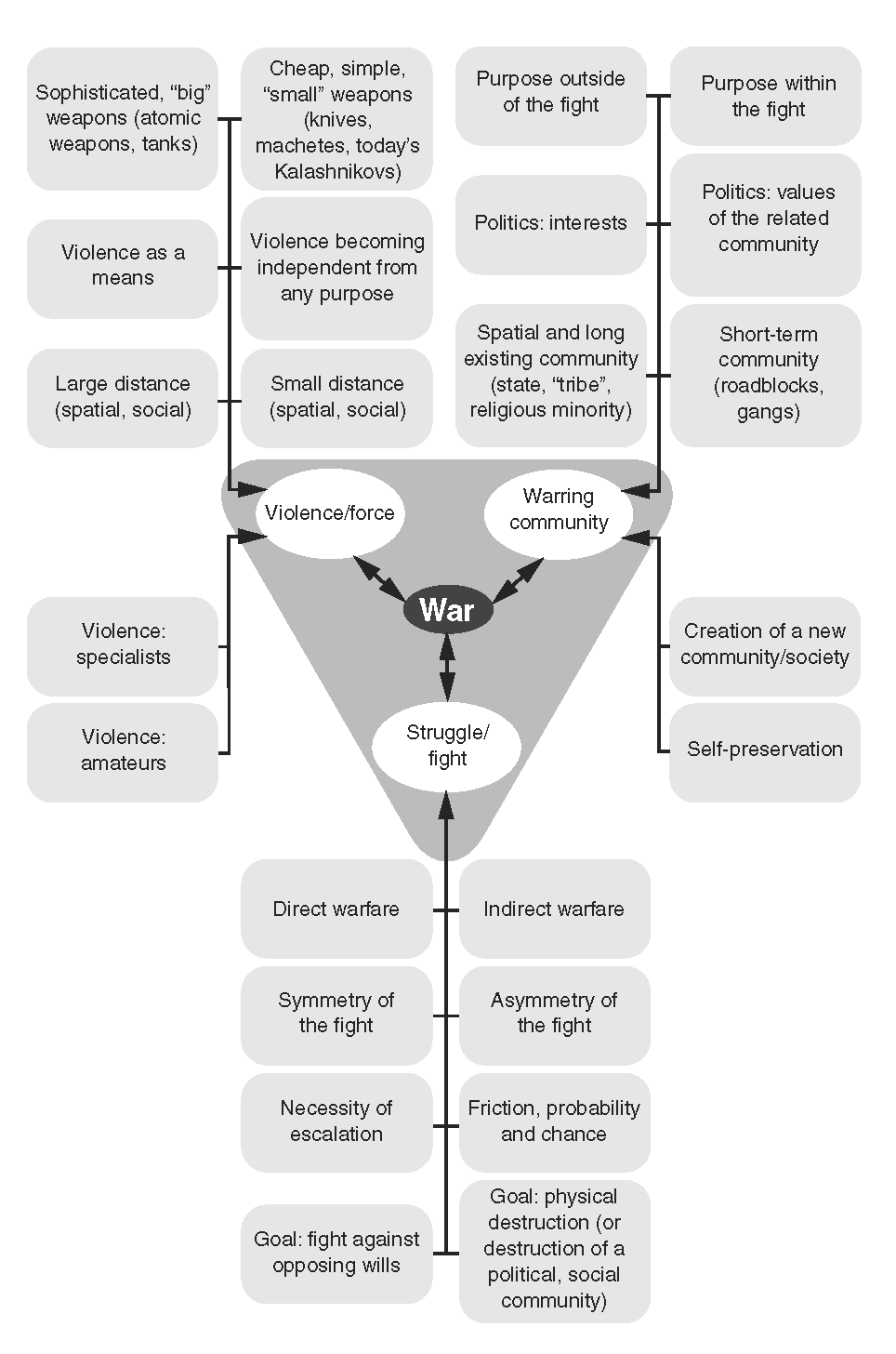
     

    Every war is accordingly defined in terms of its three essential dimensions: violence, combat, and the affiliation of the combatants with a community on whose behalf the combatants act. Historically, these three tendencies within the “wondrous trinity” display almost infinite combinations and multiple, cross-cutting tensions since every war is waged differently. Thus, every war has symmetrical and asymmetrical tendencies, for instance, even when it may appear that only one of these tendencies comes to the fore (Herberg-Rothe 2007).

    The tension between the coordinates of Clausewitz’s trinity may also be heightened by different forms of military organization. Those that feature strict hierarchies of command are perhaps most conducive to the transmission of political guidance to operating forces; whereas what is today called network-centric warfare is characterized by loose and diffuse organizational structures, in which the community’s political will and mandate can no longer be so readily imposed on combatants directly engaged with the enemy. As in the warfare of partisans, networked military organizations place a high value on the political understanding of the individual soldier. It is because of the relative independence of soldiers in network-centric warfare that this type of warfare does not require an “archaic combatant,” but a democratic warrior who has fully internalized the norms of the community for which he fights.

    The Democratic Warrior in the Twenty-first Century

    Even in Clausewitz’s day, war was not the only instrument of policy that state’s possessed, though it was undoubtedly the most central. Today, its centrality is less obvious, even as the complexity of its connections to other forms of state power has increased (Thiele 2009). Combining the different perspectives afforded by foreign, economic, developmental, judicial, domestic, and defence policy permits a global approach to conflict resolution while making the considerations surrounding the use of force more complicated than ever. States now pursue their security through many avenues at once, and all the agencies involved must consciously coordinate, connect, and systematically integrate their goals, processes, structures, and capabilities.

    Given the continuing expansion of the concept of security in recent years, a democratic army needs a specific task and function since its essential purpose—the use of force—can not be dispensed with. There have been those who thought it might be. When the East-West conflict ended, Francis Fukuyama announced the “end of history,” meaning an end to the practice of war and violence (Fukuyama 1992). The triumphant advance of democracy and free markets seemed unstoppable, to the point where it appeared as if the twenty-first century would be an age defined by economics and thus, to a large extent, by peace. These expectations have now been decisively overturned by ongoing massacres and genocide in Africa; by the return of war in Europe (as happened in the former Yugoslavia); by the September 11, 2001 attacks on the United States and, the subsequent wars in Afghanistan and Iraq; the war between Georgia and Russia over South Ossetia in 2008, the civil war in Syria and Iraq and finally the prospect of war to suppress Iran’s nuclear program (itself a profoundly dangerous and destabilizing step, should it become reality).

    In a complete reversal of Fukuyama’s thesis, a struggle against a new brand of Islamic totalitarianism appears to have begun, in which violence has become “unbounded”—because terrorist attacks are potentially ever-present because no end to them is in sight and there is no reason to assume there is any limit to the scale of violence terrorists might employ, including the use of nuclear weapons should they come to possess them. These processes of growing disinhibition must be countered by a new containment policy that limits the expansion of war and violence in the world.

    Two basic assumptions underlie this conception. The first is that the escalation of violence in world society is so multifaceted and differentiated that a single counter-strategy will not suffice. Rather, an overarching perspective is required to decide which measures are suitable in individual cases—without being able to exclude the possibility of terrible errors and miscalculations. The second assumption is that in today’s global society—as has been the case throughout history—many contrary processes are at work. Thus, regard for only one counter-strategy can have paradoxical, unanticipated consequences.

    This can be clarified using the example of democratization. If a general effort at worldwide democratization was the only counter-strategy against the disinhibition of violence and war, the results would almost certainly be counterproductive, not least because the spreading of democracy might itself be a violent process. A one-sided demand for democratic reform without regard for local conditions might, in individual cases, contribute to the creation of anti-democratic movements. The historical experience bears this out. After the First World War, nearly all of the defeated states underwent an initial process of democratization under the tutelage and supervision of the victors. Yet, almost all ended in authoritarian or even totalitarian regimes.

    Thus, the concept of the democratic warrior is not based on imposing democracy by force, but on limiting war and violence to enable the organic development of democratic self-determination. A differentiated counter-strategy of curbing war and violence in the world, with a view to fostering good governance (as a first step toward democratic governance), is the common element shared by humanitarian intervention and the development of a culture of civil conflict management. To this must be added measures to limit the causes of war and violence, such as poverty, oppression, and ignorance. Last but not least, this new form of containment requires effective restraint not just in the proliferation of weapons of mass destruction, but also of small arms, which continue to kill far more people than any other kind of arms.

    The containment of violence does not mean there will be entirely non-violent societies, much less a non-violent world society, in the foreseeable future. All else aside, the goal of completely eliminating violent conflict would ignore the fact that historically speaking, conflicts and their resolution have often furthered human development toward free and democratic ideals—as per the American struggle for independence and the French Revolution. The primary task of politics in the twenty-first century is therefore to radically limit violence and war so that non-violent structures and the mechanisms of the “social world” can have an impact. In this context, democratic warriors have a unique role to play; not as those who impose democracy by force, but as those who make diverse forms of culturally authentic self-determination possible, by curbing and containing war and violence.

    Conclusion

    It must be repeated, the concept of the democratic warrior appears to be contradictory. Indeed, it combines contradictory value systems in a single concept. Nevertheless, to adopt the metaphor favoured by Clausewitz (Herberg-Rothe 2007), the elements of tension in the democratic warrior’s identity can be conceived as the poles of a magnet, whose mutual opposition is not an illusion but is nevertheless a means to a larger, unitary end. It is what creates the magnet: the north pole of a magnet cannot exist alone. At one end of the continuum of the democratic warrior’s identity lies the values of democratic equality and non-violent conflict resolution; at the other, the realization that force itself may sometimes be necessary to limit war. At one end, is a civilized society, and at the other a subsystem of that same society, whose identity is defined by traditional concepts of honour and martial valour.

    As observed at the beginning of this essay, the bonds that link the two poles of this relationship, without eliminating their opposition, are the classical republican virtues, which lay claim to validity in both spheres. It was Plato who defined the classical virtues as intelligence, justice, fortitude, and temperance, which is also are characteristics in the Confucian tradition (Piper 1998 concerning Plato). Without them, a state can sustain itself only under dictatorship. With them, both external and internal freedoms are possible (Llanque 2008). They are the keys to the democratic warrior’s identity, providing the crucial link between the values of liberal-democratic society and those other values—courage, loyalty, self-sacrifice—that have always set the warrior apart.


    References

    Bredow, Wilfried von (2000), Demokratie und Streitkräfte (Wiesbaden: VS publishers, 2000).

    Clausewitz, Carl von (1984), On War. Ed. by Peter Paret and Michael Howard (Oxford: OUP).

    Duyvesteyn, Isabelle (2005), Clausewitz and African War (London: Routledge).

    Frevert, Ute (1997), Die kasernierte Nation (Munich: C. H. Beck, 2001).

    Frevert, Ute(ed.), (1997), Militär und Gesellschaft im 19. und 20. Jahrhundert

    (Stuttgart: Klett–Cotta).

    Fukuyama Francis (1992), The End of History and the Last Man (New York: Free Press).

    Herberg-Rothe, Andreas (2007), Clausewitz’s puzzle (Oxford: OUP). Herberg-Rothe, Andreas (2017), Der Krieg. 2.Edition. (Frankfurt:

    Campus).

    Herberg-Rothe, Andreas and Son, Key-young (2019), Order wars and floating balance. How the rising powers are reshaping our world view in the twenty-first century (New York: Routledge).

    Hüppauf, Bernd (1993), “Schlachtenmythen und die Konstruktion des ‘Neuen Menschen’,” in Keiner fühlt sich hier mehr als Mensch . . . : Erlebnis und Wirkung des ersten Weltkrieges, ed. Gerhard Hirschfeld, et al. (Essen: Klartext, 1993).

    Llanque, Marcus (2008) Politische Ideengeschichte. Ein Gewebe politischer Diskurse (Munich: Oldenbourg.

    Kaldor, Mary (1999), New and Old Wars: Organized Violence in a Global Era

    (Stanford: Stanford University Press).

    Kaplan, Robert (1994), “The Coming Anarchy.”In: Atlantic Monthly no.

    273, 44–76.

    Keegan, John (1995), Kultur des Krieges (Berlin: Rowohlt).

    Kuemmel, Gerhard (2005), Streitkräfte im Einsatz: Zur Soziologie militärischer Interventionen (Baden-Baden: Nomos).

    Moran, Daniel (2003), “Arms and the Concert: The Nation in Arms and the Dilemmas of German Liberalism,” in The People in Arms: Military Myth and National Mobilization since the French Revolution, ed. Daniel Moran and Arthur Waldron(Cambridge: Cambridge University Press).

    Münkler, Herfried (2004), The New Wars (New York: Policy). Münkler, Herfried (2007), Empires (Cambridge:Polity Press).

    Pieper, Josef (1998), Das Viergespann—Klugheit, Gerechtigkeit, Tapferkeit, Maß (Munich: Kösel).

    Röhl, Wolfgang (2005), “Soldat sein mit Leib und Seele. Der Kämpfer als existenzielles Leitbild einer Berufsarmee in EinJob wie jeder andere. Zum Selbst- und Berufsverständnis von Soldaten, ed. Sabine Collmer and Gerhard Kümmel (Baden-Baden:Nomos, 2005) 9–21.

    Schlichte, Klaus (2006), “Staatsbildung oder Staatszerfall. Zum Formwandel kriegerischer Gewalt in der Weltgesellschaft,In: ”Politische Vierteljahresschrift 47, no. 4.

    Sikora, Michael (2003), “Der Söldner,” in Grenzverletzer. Figuren politischer Subversion, ed. Eva Horn, Stefan Kaufmann, and Ulrich Bröckling (Berlin: Kulturverlag Kadmos, 2002).

    Thiele, Ralph (2009), “Trendforschung in der Bundeswehr”. In: Zeitschrift für Sicherheits- und Außenpolitik 2, 1–11.

    Walzer, Michael (2003), “Is there an American Empire?” In: Dissent Magazine 1 (2003), URL; http://www.dissentmagazine.org/menutest/archives/2003/fa03/walzer.htm  last accessed 16. 4. 2020.

    Zakaria, Faared (2009), The Post-American World (New York: W. W. Norton).
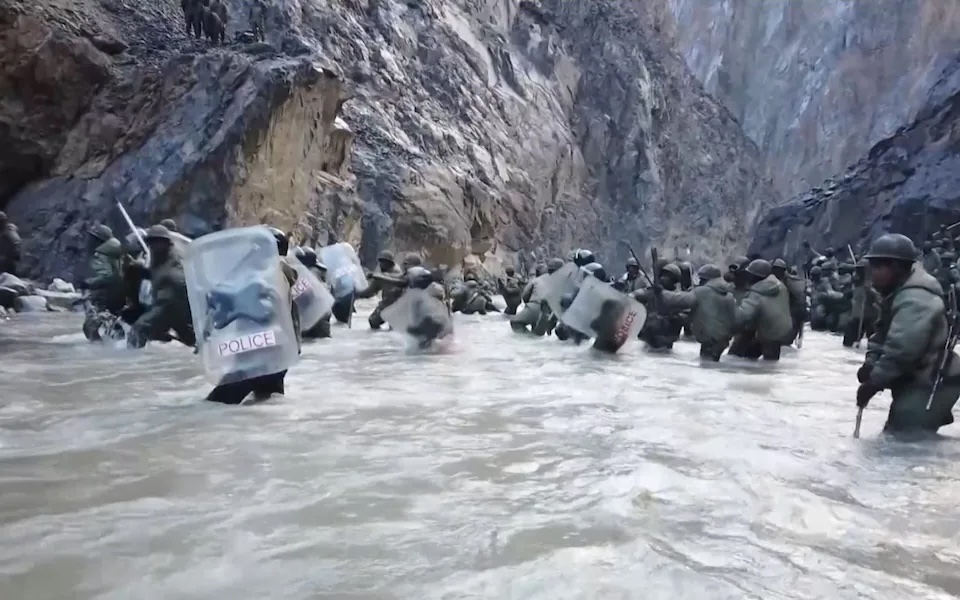
     

  • Chief of Defence Staff, a year later: Lack of Clarity and an ambiguous Mandate

    Chief of Defence Staff, a year later: Lack of Clarity and an ambiguous Mandate

    On 31st of Dec 2020 India’s first Chief of Defence Staff (CDS), Gen Bipin Rawat, completed one-year in office.  With China recently unveiling its 14th Five Year Plan aiming to bring its military on par with the USA by 2027, it would be interesting to observe if the appointment of CDS has helped the Indian Military spruce up its structure and operational philosophy in any manner.

    Appointment of CDS was put on hold for almost two decades after the Kargil Review Committee made its recommendations.  Opinion among the strategic community has always been divided on the appointment of CDS. Those who argued in favour espoused that CDS would be the panacea for all ills while those who opposed, opined that the time-tested Higher Defence Organisation proposed by Lord Ismay has worked well over the years and hence, the western concept of CDS is unnecessary. Now that the CDS is in place, it is futile to revisit the debate but the functioning of CDS would be a subject of scrutiny for the next few years.

    In the last few months, the Department of Military Affairs (DMA) headed by the CDS came for intense criticism for making proposals about the increase in retirement age and reduction in pensions. Previous proposals such as the closure of CSD canteens at peace stations, opening up of cantonment, doing away with Army Day parade etc, which are believed to have emanated from the DMA have been subjected to ridicule and disdain in the social media. It wasn’t exactly clear as to why the office of CDS was being used for such purely administrative issues, which are counterproductive in enhancing the morale and pride of the forces.

    Men in uniform yearned that CDS would play a vital role in bringing about the true integration of Services HQ with the MoD and expedite the process of defence modernisation. However, after one year, it is indeed of great concern that the office of CDS (read DMA) appears to be focussed on administrative and ceremonial issues with absolutely no strategic significance.

    When CDS assumed charge on 1st Jan 20, it was reported that the CDS would be the Principal Military Advisor to the Government (read Def Minister) and he would head the newly created DMA.  Additionally, he would assume charge of the Integrated Defence Staff (IDS), serve as the permanent Chairman of the Chiefs of Staff Committee (COSC), Head the Tri-Service Commands, and be a member of the Defence Acquisition Council besides the Nuclear Command Authority. Quite a tall order indeed but doesn’t seem to be adequately equipped with a statutory mandate to perform effectively. Men in uniform yearned that CDS would play a vital role in bringing about the true integration of Services HQ with the MoD and expedite the process of defence modernisation. However, after one year, it is indeed of great concern that the office of CDS (read DMA) appears to be focussed on administrative and ceremonial issues with absolutely no strategic significance. One of the first initiatives announced by Gen Rawat was to create an Air Defence Command which is yet to materialise and creation of Theatre Commands seems to be a long haul.

    it is beyond comprehension to fathom what prompted the Government to create a Department of Military Affairs within the MoD when the Integrated Defence Staff (IDS) was already functioning since 2001 awaiting the appointment of a CDS.  As Service Chiefs continue to exercise Command over their respective Service, the CDS as the head of IDS would be rightly placed to promote joint training initiatives, validate joint operational plans and act as a catalyst in defence modernisation.  However, for all this to be achieved, the role and functioning of the CDS should be spelt out; particularly the role of CDS as the “Principal Military Advisor” to the Raksha Mantri, vis-à-vis the Defence Secretary who continues to be the “Principal Advisor” to the Defence Minister. Such vital aspects are never left to chance based on an individual’s equations with political leadership but need to be appropriately institutionalised, mandated and published.

    Currently, Defence Secretary functions as head of the Department of Defence and is additionally responsible for coordinating the activities of the five Departments in the Ministry, including the newly created DMA. The Defence Secretary draws his functional powers from the Cabinet Secretariat –Manual of Office Procedures (CS-MoP) which clearly states that the Secretary of the Department “is the principal adviser of the Minister on all matters of policy and administration within his Ministry/Department, and his responsibility is complete and undivided”. If Defence Secretary is coordinating the affairs of all the five departments including DMA as the Principal Advisor, what is the status of the four-star-CDS?

    The Government of India (Allocation of Business) Rules, 1961 are made by the President of India under Article 77 of the Constitution for the allocation of business of the Government of India. The business of the Government is transacted in the Ministries/Departments, Secretariats and offices (referred to as ‘Department’) as per the distribution of subjects specified in these Rules. Allocation of Business Rules has not been revised since 2017 though DMA has been created one year ago.  As a result, the DMA is not listed in the First Schedule of the Allocation of Business.

    Transaction of Business (Rules) 1961 are made by the President of India for the convenient transaction of the Business of the Government of India. The disposal of business by various ministries, inter-departmental transactions and mandates of various committees are published in these rules. The significance of these rules can be gauged from the fact that the rules have been recently amended to deal with unprecedented challenges posed by Covid 19 pandemic. Cabinet Secretariat has amended Government of India Transaction of Business Rules, 1961 to widen powers of two committees to meet the economic crisis caused by Covid 19, using the powers under the Act. However, Transaction of Business Rules has not been revised clearly defining the role of CDS as the Principal Military Advisor to the Government.

    The organisation chart in the MoD has been removed possibly because it would only be too embarrassing to place the CDS under the Defence Secretary. There is an urgent need for the GoI to create a meaningful role for the CDS and empower him with a statutory mandate.

    A cursory glance at the website of the Ministry of Defence would reveal a lack of any sincerity in assigning specific responsibilities for DMA. It has been casually mentioned that DMA “deals with the armed forces of the Union….. and promotes jointness among the three services”. Were these objectives not met by the MoD in the past? So what value addition has the DMA provided? The organisation chart in the MoD has been removed possibly because it would only be too embarrassing to place the CDS under the Defence Secretary. There is an urgent need for the GoI to create a meaningful role for the CDS and empower him with a statutory mandate.

    Indian Military is not expeditionary. However, if there is a convincing need to create Theatre Commands in pursuit of joint operations and interoperability, replacing the existing 17 Service-specific Commands by fewer Theatre Commands would be the most challenging task for the CDS. If the experience of USA, UK and other major militaries is anything go by, such major military reforms could be pushed through only with steadfast backing from the government, taking all three services into confidence and aligning the entire military leadership with the desired outcomes of this humungous exercise which may eventually need constitutional validity through an Act of the parliament.

    For the appointment of CDS to make a meaningful purpose the following measures are imperative:

    • Abolish the DMA and facilitate the CDS to take complete control of the IDS, keeping its functioning outside the purview of Def Secretary
    • Revise the CS-MOP, Allocation of Business Rules, Transaction of Business rules and the Warrant of Precedence, clearly bringing out the role and responsibilities of CDS as the Principal Military Advisor to the Defence Minister, in contrast to the roles and responsibilities of the Defence Secretary which may also now need to be re-drafted.
    • Make CDS a permanent member of the Cabinet Committee on Security facilitating the single-point military advice to the National Security Council.
    • The cabinet should spell out a Defence Policy Guidance (DPG) with a 12 year to the 15-year horizon in the light of prevailing and forecasted geo-political scenario and assist the CDS in preparing a clear roadmap for Indian Military Modernisation

    To abrogate the stigma of “Attached Offices”, and to integrate the Services HQ with MoD, a beginning needs to be made by augmenting the IDS with officials from the MoD.

    • Currently, the budgeting and procurement plans are made in isolation and subject to scrutiny by the Ministry of Fin (Def) thereby losing time and effort. IDS needs to be adequately empowered by augmenting it with an integral wing of the Ministry of Fin (Def) headed by a Joint Secretary ranked officer.
    • A Defence Production Wing under the charge of an Additional Secretary ranked officer reporting directly to the CDS should be created with the long term objective of achieving complete integration of the department of defence production with IDS. This suggestion would certainly be the most unpopular with the bureaucracy but could turn out to be a game-changer if achieved.

    Kargil Review Committee had recommended the appointment of CDS to integrate the armed forces in their planning, procurement and functioning to transform the Indian Military as a unitary force to reckon with.  In the absence of a clear mandate and constitutional validity for the functioning of the CDS, the entire effort of instituting one, seems to be of little consequence, much less, competent of driving any significant reforms. The current arrangement needs a complete overhaul if that is to be achieved.

  • CDS: A Welcome Reform and the Challenges Ahead

    CDS: A Welcome Reform and the Challenges Ahead

    The Year 2020 ushered in a momentous reform for higher defence management (HDM) in India with the government implementing PM Narendra Modi’s announcement made earlier from the ramparts of the Red Fort on 15th Aug 2019, on establishing the institution of the Chief of Defence Staff (CDS). Retiring Army Chief General Bipin Rawat, not surprisingly, was appointed as the first CDS of the Indian Armed Forces. The unique honour brings with it myriad challenges lying ahead for the new appointee.

                To those at home and abroad who are accustomed to the working of governments of all political hues in India it should not be a surprise that this  critically vital appointment  took over 18 years to materialise. To recall, as part of the many HDM reforms this appointment was also approved by the NDA led Vajpayee government way back in 2001, after the 1999 Kargil War, based on the recommendations of the Subramanyam led Kargil Review Committee (KRC). Bureaucratic sluggishness, lack of will among different political dispensations as also the fact that there could be indifference on matters of even national security broadly explain the long delay. Thus, the Modi government deserves full credit for institutionalizing the long overdue appointment of the CDS. However, the designated role of CDS, the status and the government charter laying down all the details are still being worked out.

    Chief of the Defence Staff (CDS)

    As promulgated by the government, the CDS will be a ‘four star’ officer and will be considered as the ‘first among equals’ in relation to the chiefs of the Army, Navy and the Air Force. He will be the permanent Chairman of the Chiefs of Staff Committee (COSC) and can serve till 65 years of age. KRC recommended that CDS appropriately should  be a ‘five star officer’ considering his onerous responsibilities and role.

    Now that the government has given the green signal for the CDS to commence functioning to provide the desired levels of integration in all tri-service matters including policy, operational, training, communications, logistical aspects and so on, the CDS will be confronted with myriad challenges in achieving his onerous missions. Apart from an unwavering encouragement support from the Prime Minister’s Office (PMO) and the Ministry of Defence (MOD), the CDS will require more than a willing assistance from the three services to truly get-off the ground. As is natural and customary, no service likes to shed its resources and time honoured responsibilities to newer organizations. Having raised the Defence Intelligence Agency (DIA) way back in 2002, as a result of the same KRC recommendations, I am more than aware of the reluctance of the three Services to shed some of their assets and roles which will now be managed by the CDS. Thus, General Rawat will have to orchestrate extracting resources from the three Services for the new organizations, formations and units directly under his command being raised, with tact and sensitivity.

    Re-organisation of MOD: an analysis

                The MOD, till recently,functioned with four departments namely the Departments of Defence (DOD), Defence Production, Defence Research and Development as well as Ex Servicemen Welfare – each headed by a Secretary – ranked officer. On 30th Dec 2019, the government promulgated a gazette notification establishing the fifth department to be called the Department of Military Affairs (DMA) to be headed by the newly appointed CDS. The Rules of Business existing since 1961 and reallocation of certain responsibilities with the Defence Secretary have been modified though this has also invited adverse comments from defence analysts in India on the ground that the desired level of responsibilities had not been given to the CDS.

                In the last many years, right from the acceptance of the KRC and its approval by  LK Advani led Group of Ministers and subsequently by the Vajpayee government in 2001, it had been accepted by all that the CDS was urgently required as a major reform of  India’s higher defence management. The CDS was required to provide single-point professional military advice to the political leadership. However, what apparently has happened now is that the CDS will be providing his advice to the Defence Minister only and not to both the Prime Minister and Defence Minister. Many see in this, a case of bureaucratic play to reduce the importance of the CDS.

                 In the orders recently issued by the government, four key responsibilities have been taken away from the DOD under the Defence Secretary and now put under the DMA which includes the three services and their headquarters, the Territorial Army and works relating to the army, navy and the air force. Non-capital purchases and promoting jointness in procurement, operations, training, communications, logistics (including repairs and maintenance) and encouraging use of indigenous equipment and platforms will be in the CDS charter.

                Entry 1 of the amended charter for the DOD states that “Defence of India and every part thereof including defence policy and preparation for defence and all such acts as may be conducive in times of war to its prosecution and after its termination to effective demobilization” will be with the Defence Secretary.  This has apparently been done to ensure the primacy of the civil bureaucracy. Why can’t the responsibility of defence policy and the mandate for defence of India not rest with the Defence Minister if this charter, was to be kept away from the CDS?

    Why can’t the responsibility of defence policy and the mandate for defence of India not rest with the Defence Minister if this charter, was to be kept away from the CDS?

                The other amendment is in the field of defence purchases where the earlier formulation of “procurement exclusive to the defence services” has been altered to “capital acquisition exclusive to the defence services.” This means that big-ticket acquisitions will be in the Defence Secretary’s ambit creating an impression of paucity of faith in the CDS in this matter.

    The existing HQ Integrated Defence Staff could have been the backbone for this new integrated structure within the MOD brining about cost-effectiveness as well. 

                The Department of Military Affairs will have a structure that rightly includes civilian bureaucracy as well. The CDS will be assisted by two joint secretaries and a dozen deputy secretary level officers. Ideally not only the CDS but the entire MOD should have seen complete integration of the civil bureaucracy with the military. The existing HQ Integrated Defence Staff could have been the backbone for this new integrated structure within the MOD brining about cost-effectiveness as well.  Military and civil officers should be working in various departments of the MOD in unison. The Defence Secretary could have been retained, as the coordinator of all the departments. The DMA could have been headed by a Secretary level Vice Chief of the Defence Staff (VCDS) to enable the CDS, in the MOD, to concentrate primarily on critical strategic issues for advising the Prime Minister and Defence Minister on macro-management of defence strategy.

                The Defence Secretary’s charter also includes  military cantonments, veterinary and military farms, land acquisition for defence, Border Roads Organisation, purchasing food items for defence and even the Canteen Stores Department – virtually covering all issues and portfolios related to financial expenditure and management! Surprisingly, even the management of the National Defence College (NDC) and the Institute of Defence Studies has been kept with the Defence Secretary!

    The DMA could have been headed by a Secretary level Vice Chief of the Defence Staff (VCDS) to enable the CDS, in the MOD, to concentrate primarily on critical strategic issues for advising the Prime Minister and Defence Minister on macro-management of defence strategy.  

    Theatre commands

                One of the critical issues, after the establishment of the CDS system, would be the widely discussed recommendation that integrated inter-service theatre commands should be established to exercise control over all operations in each theatre as practiced in many nations of the world including US and China. Currently the three services have their own operational commands that make for a total of 17 command HQs.  In addition, the Indian Armed Forces through HQ IDS have under their control only one tri-service command headquarters, namely the Andaman and Nicobar Command (ANC). The Strategic Forces Command (SFC), though led, manned and operated primarily  by personnel from the three services have their ultimate command authority  vested in the Nuclear Command Authority directly under the PM/National Security Council.

                The CDS has been tasked with the responsibility of restructuring military commands for optimal utilization of resources by bringing in jointness in operations through the establishment of joint theatre commands. However, many Indian analysts opine that the armed forces should commence this integration after coursing out exhaustive trials initially for one command headquarters. The significant change must be analysed in its entirety and not rushed through. It may be prudent to adopt ‘best practices’ of some other formidable armed forces in the world and suitably adapt them for our own challenges and genius. Theatre commands, once finally agreed to, can be implemented in a graduated manner employing the incremental concept. In the services even with the current structures, far greater jointness in operational doctrines and plans, training, communications and logistics should be ensured first to establish synergy.

    Theatre commands, once finally agreed to, can be implemented in a graduated manner employing the incremental concept.

                The newly appointed CDS at a recently conducted press conference outlined the likely contours of the envisaged theatre commands. He stated that two integrated commands, namely the Air Defence Command and the Peninsular Command respectively will be raised in the coming year while they will endeavour to raise the first theatre command by 2022. Preliminary studies on the geographical and operational spans for five theatre commands along the northern and western borders are underway. In addition, the services are also carrying out an in-depth study to examine if Jammu and Kashmir should have a separate theatre command.

                The Air Defence Command will be integrating all air defence assets including air defence missiles with the three services, coastal guns, air defence radars and air surveillance systems presently held with the three services.  In view of potent air and ballistic missile threats from India’s adversaries, the Air Defence Command, to be headed by an air force officer, will assume critical significance in terms of its efficacy.

                The Peninsular Command which, some naval officers want to call the Indian Ocean Command will look to merging the western and eastern naval commands. This command to be headed by a naval officer would be given dedicated air force assets and army troops. It would work to ensure India’s maritime security interests in the Indian Ocean region, both on the western and eastern sea-boards, and would also acquire the capably of conducting amphibious operations.

    National Security Doctrine

     As one of his top priorities, the CDS must have the Government Issue a National Security Doctrine which lays down a well-conceived and comprehensive strategic policy for the nation in the short, mid and long term perspective. It will be primarily an articulation of the nation’s overall vision and strategic intent. This document should naturally have both the non-classified and classified objectives which can be disseminated on a ‘need to know’ basis among concerned institutions and personalities in the country. The existing HQ IDS have endeavoured in the past to produce perspective plans for the Indian Armed Forces and have the requisite expertise to produce such policy documents for approval by the government.

    HQrs Andaman and Nicobar Command and newer agencies

                As mentioned earlier, the Indian Armed Forces have under their direct ambit only one tri-service command, namely HQ ANC. This Command HQ is of critical significance for its role in dominating the sea-lanes of the Indian Ocean and preventing the ever-assertive PLA Navy from indulging in mischief in these waters.  The CDS would no doubt accord adequate attention to a further strengthening of the strategic combat capabilities of HQ ANC for handling maritime challenges that will only multiply on India’s eastern seaboard and in the entire Indo-Pacific region.

                For CDS challenges emanating from the entire spectrum of warfare encompassing all domains are a priority. The CDS will also be overseeing the establishment of the recently sanctioned Cyber and Special Forces agencies besides the Defence Space Agency. These entities in the years ahead could qualify for being upgraded to the levels of Command HQs. As widely known, the domains of cyber and space are the battlegrounds of the future – and there the foresighted Chinese have stolen a march even over hi-tech western agencies including those of the US. India, despite being an IT super power, has still a long way to go to bridge the gap between itself and China in this aspect.

    CDS: Nuclear Military Adviser   

                The CDS will now be overseeing the functioning of the SFC far more intimately than was done earlier by the COSC as he has also been designated as the Nuclear Military Adviser to the government. The presence of a senior military officer in the Nuclear Command Authority is a step in the right direction for he would be able to provide the necessary expertise and fillip to the nation’s nuclear preparedness. The CDS may wish to advise the government to review its entire Nuclear Doctrine and revisit the policies of “No-First Use” and “Massive Retaliation”. Also, it may be necessary to re-examine whether India should go in for the development of tactical nuclear weapons for limiting a nuclear exchange. India’s two adversaries, China and Pakistan, are both reckonable nuclear powers and India’s nuclear preparedness has, therefore, to match up to them.

    Defence budgets and inter service prioritization

    It is a strategic truism that the Indian Armed Forces have to be prepared to confront a “two-front war”. Mandated to provide integrated “single-point military advice” to the government, the CDS will have to rise above service loyalties and professionally prioritize conflicting inter-service requirements in the larger interests of the nation. This assumes greater significance in the current scenario where the combat capabilities of the Indian Armed Forces have to be accorded substantial accretions in an environment of great financial strain facing the nation. The volatile situation in West Asia will be greatly impacting the energy security of India and this will further tax India’s currently faltering economy. Thus, the first test for the newly appointed CDS will have to be to convince the financially stressed government to make larger allocations in the capital budget for speedy acquisition of much needed modern weapon systems. As is known, India’s depleting fighter aircraft and submarine fleets, other deficiencies in other platforms, various types of ammunition and spares, force-multipliers etc need concerted attention. Last year’s defence budget had been allocated merely 1.49 per cent of the GDP whereas successive parliamentary committees have recommended at least 3 per cent of the GDP to be assigned for defence. Unfortunately, even this year’s recently announced defence budget has been dismal – considering the big-ticket acquisitions required by the armed forces.

    In the current charter issued by the government, any big-ticket acquisitions will remain in the Defence Secretary’s purview and thus final negotiations with foreign collaborators, Indian Defence Public Sector Undertakings or Indian private industry would rest with the DOD and the Defence Secretary. Delays as earlier are likely to occur. With “Make in India” and “Start-up India” initiatives not yet taking off, the government needs to revisit these areas involving the CDS institution.

    Coordination with civil agencies

                One of the tasks that can do with better handling is improving the coordination between the armed forces and other civilian governmental agencies who are, also handling various other aspects of national security. The CDS structure now will be an important institution to improve coordination between the MHA, MOD, NSAB and NSC Real-time information or intelligence sharing between the Defence Intelligence Agency (DIA) and the other national intelligence agencies like the Intelligence Bureau, Research and Analysis Wing, National Technical Research Organisation and other newer intelligence that had come up in the last few years will hopefully improve. However, to start with, the CDS must put the Service Intelligence Directorates of the three services directly under command of the DIA for better effectiveness in the exacting intelligence domain.

    Recommendations: overall mandate for CDS

                The CDS has been formally appointed and his role enunciated and as the appointment matures in the immediate future, a further refinement of his responsibilities should be undertaken. These should include the following: –

    • The CDS should be designated as the Principal Defence Advisor to the Prime Minister (through the Defence Minister) on all matters pertaining to India’s national security.
    • The CDS should provide an overarching ‘strategic vision’ to the government and be responsible for all strategic planning for the armed forces, including all war plans and contingency planning. During peacetime, preparedness for future operations, in the strategic domain, should be one of the prime responsibilities of the CDS. He will have to synergize the mission and assets of the three services in various theatres to achieve the nation’s strategic objectives.
    • The CDS must be made responsible for overall financial planning, budgetary allocations and force structuring for the three services.
    • The CDS should oversee the preparation of the annual Defence Intelligence Estimate which obtains requisite strategic intelligence inputs for overall defence planning.
    • The establishment of theatre commands, the functioning of other tri-service commands like the Strategic Forces Command, Andaman and Nicobar Command and others which may come up in the future like the Air Defence, Cyber, Space and Special Forces Commands must get the utmost attention of the CDS.

    Conclusion

    The coming years in an increasingly troubled world and especially in our volatile neighbourhood portend diverse and formidable challenges to India’s security and economic resurgence. Consequently, an earnest effort must be made to meet them. A major HDM reform like the recent establishment of the CDS edifice goes a long way in the optimal utilization of India’s resources for defence and enhancing its operational preparedness across the entire spectrum of warfare.  All new institutions at their start do face various problems and the office of the CDS will be no exception. But it must get whole-hearted support from the PMO, MOD and the three services themselves in successfully fulfilling the onerous responsibilities and roles assigned to it.

    Views expressed are the author’s own.

    This article was published earlier in Chanakya.