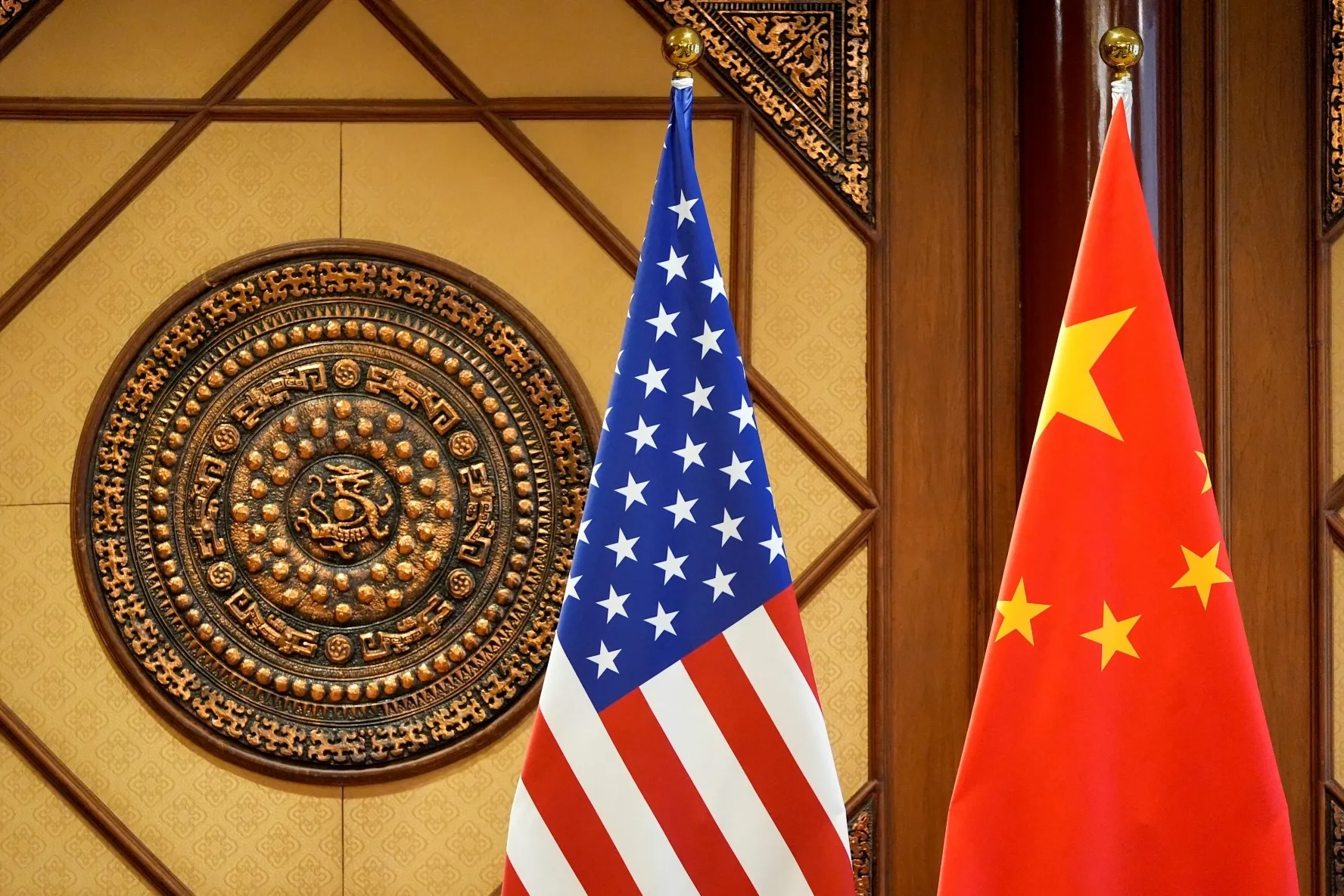
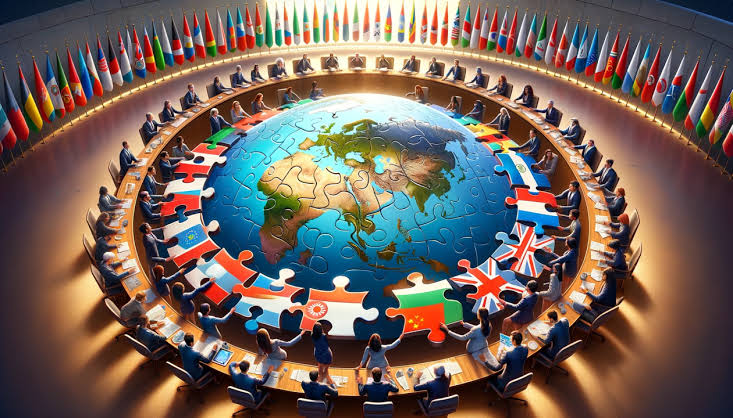
Category: Borders & Borderlands

  • China and the Sunset of the International Liberal Order

    China and the Sunset of the International Liberal Order


    Rise of Multipolar World Order – www.newsvoyagernet.com

           The irrational amounts that the Soviet Union allocated to its defense budget not only represented a huge burden on its economy, but imposed a tremendous sacrifice on the standard of living of its citizens. Subsidies to the rest of the members of the Soviet bloc had to be added to this bill.

             Such amounts were barely sustainable for a country that, as from the first half of the 1960s, was subjected to a continuous economic stagnation. This situation became aggravated by the strong decline of oil prices, USSR’s main export, since the mid 1980s. The reescalation of the Cold War undertaken by Jimmy Carter and Ronald Reagan, particularly the latter, put in motion an American military buildup, that could not be matched by Moscow.
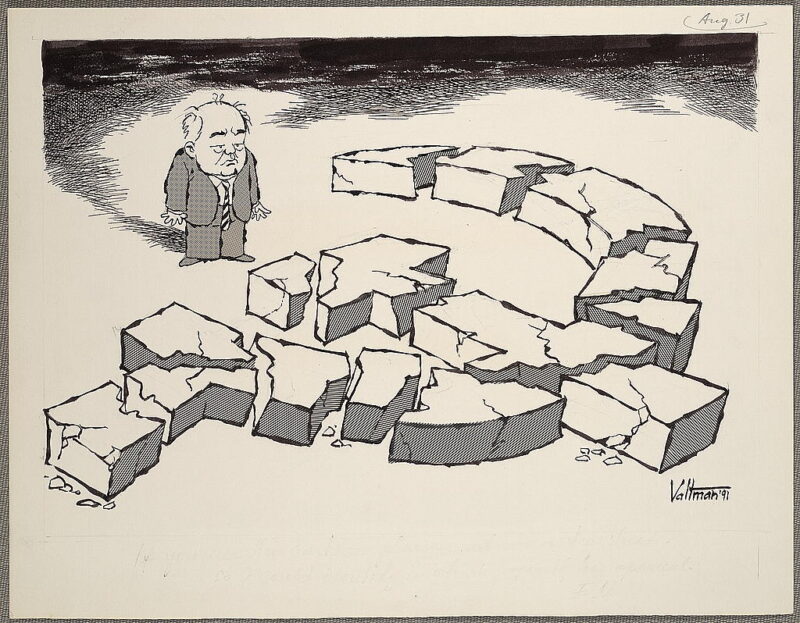
             With the intention of avoiding the implosion of its system, Moscow triggered a reform process that attained none other than accelerating such outcome. Indeed, Mikhail Gorbachev opened the pressure cooker hoping to liberate, in a controlled manner, the force contained in its interior. Once liberated, however, this force swept away with everything on its path. Initially came its European satellites, subsequently Gorbachev’s power base, and, finally, the Soviet Union itself. The Soviet system had reached the point where it could not survive without changes, but neither could assimilate them. In other words, it had exhausted its survival capacity.

              Without a shot being fired, Washington had won the Cold War. The exuberant sentiment of triumph therein derived translated into the “end of history” thesis. Having defeated its ideological rival, liberalism had become the final point in the ideological evolution of humanity. If anything, tough, the years that followed to the Soviet implosion were marred by trauma and conflict. In the essential, however, the idea that the world was homogenizing under the liberal credo was correct.

             On the one hand, indeed, the multilateral institutions, systems of alliances and rules of the game created by the United States shortly after World War II, or in subsequent years, allowed for a global governance architecture. A rules based liberal international order imposed itself over the world. On the other hand, the so-called Washington Consensus became a market economy’s recipe of universal application. This homogenization process was helped by two additional factors. First, the seven largest economies that followed the U.S., were industrialized democracies firmly supportive of its leadership. Second, globalization in its initial stage acted as a sort of planetary transmission belt that spread the symbols, uses, and values of the leading power.

             The new millennium thus arrived with an all-powerful America, whose liberal imprint was homogenizing the planet. The United States had indeed attained global hegemony, and Fukuyama’s end of history thesis seemed to reflect the emerging reality.

    But things turned out to be more complex than this, and the history of the end of history proved out to be a brief one. In a few years’ time, global “Pax Americana” began to be challenged by the presence of a powerful rival that seemed to have emerged out of the blue: China. How had this happened?

             Beginning the 1970s, Beijing and Washington had reached a simple but transformative agreement. Henceforward, the United States would recognize the Chinese Communist regime as China’s legitimate government. Meanwhile, China would no longer seek to constrain America’s leadership in Asia. By extension, this provided China with an economic opening to the West. Although it would be only after Deng Xiaoping’s arrival to power, that the real meaning of the latter became evident.

             In spite of the multiple challenges encountered along the way, both the United States and China made a deliberate effort to remain within the road opened in 1972. Their agreement showed to be not only highly resilient, but able to evolve amid changing circumstances. The year 2008, however, became an inflexion point within their relationship. From then onwards, everything began to unravel. Why was it so?

             The answer may be found in a notion familiar to the Chinese mentality, but alien to the Western one – the shi. This concept can be synthesized as an alignment of forces able to shape a new situation. More generally, it encompasses ideas such as momentum, strategic advantage, or propensity for things to happen. Which were, hence, the alignment of forces that materialized in that particular year? There were straightforward answers to that question: The U.S.’ financial excesses that produced the world’s worst financial crisis since 1929; Beijing’s sweeping efficiency in overcoming the risk of contagion from this crisis; China’s capability to maintain its economic growth, which helped preventing a major global economic downturn; and concomitantly, the highly successful Beijing Olympic games of that year, which provided the country with a tremendous self-esteem boost.

             The United States, indeed, had proven not to be the colossus that the Chinese had presumed, while China itself turned out to be much stronger than assumed. This implied that the U.S. was passing its peak as a superpower, and that the curves of the Chinese ascension and the American decline, were about to cross each other. Deng Xiaoping’s advice for future leadership generations, had emphasized the need of preserving a low profile, while waiting for the attainment of a position of strength. In Chinese eyes, 2008 seemed to show that China was muscular enough to act more boldly. Moreover, with the shi in motion, momentum had to be exploited.
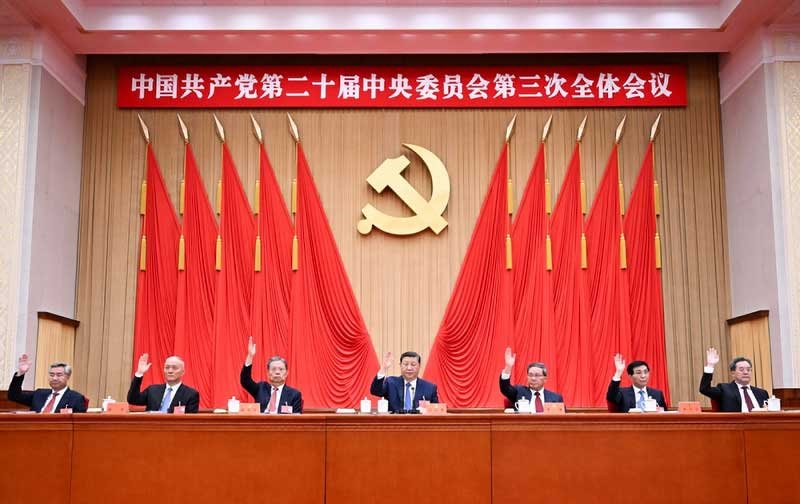
             Beijing’s post-2008 assertiveness became much bolder after Xi Jinping’s arrival to power in 2012-2013. China, in his mind, was ready to contend for global leadership. More to the point within its own region, China’s centrality and the perception of the U.S. as an alien power, had to translate into pushing out America’s presence.

    Challenged by China, Washington reacted forcefully. Chinese perceptions run counter to the fact that the U.S.’ had been a major power in East Asia since 1854, which translated into countless loss of American lives in four wars. Moreover, safeguarding the freedom of navigation in the South China Sea, a key principle within the rules based liberal international order, provided a strong sense of staying power. This was reinforced by the fact that America’s global leadership was also at stake, thus requiring not to yield presence in that area for reputational reasons. The containment of Beijing’s ascendancy, became thus a priority for Washington.

             However, accommodating two behemoths that feel entitled to pre-eminence is a daunting task. Specially so, when one of them feels under threat of exclusion from the region, and the other feels that its emergence is being constrained. On top, both remain prisoners of their history and of their national myths. This makes them incapable of looking at the facts, without distorting them with the subjective lenses of their perceived sense of mission and superiority.

             War ensuing, under those circumstances, is an ongoing risk. But if war is a possibility, Cold War is already a fact. This implies a multifaceted wrestle in which geopolitics, technology, trade, finances, alliances, and warfare capabilities are all involved. And even if important convergent interest between them still remains in place, ties are being cut by the day. As a matter of fact, if in the past economic interdependence helped to shield from geopolitical dissonances, the opposite is the case today. Indeed, a whole array of zero-sum geopolitical controversies are rapidly curtailing economic links.
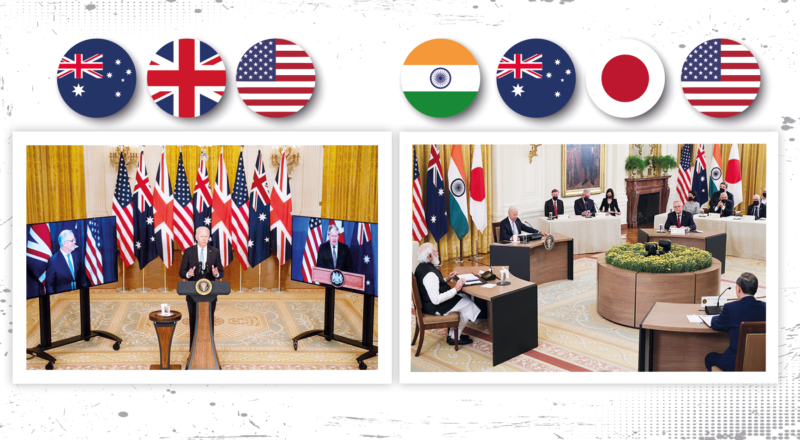
             The U.S., particularly during the Biden administration, chose to contain China through a regional architecture of alliances and by way of linking NATO with Indo-Pacific problems and selective regional allies. The common denominator that gathers them together is the preservation of the rules based liberal international order. An order, threatened by China’s geostrategic regional expansionism.


    However, China itself is not short of allies. A revisionist axis, that aims at ending the rules based liberal international order, has taken shape. The same tries to throw back American power and to create its own spheres of influence. This axis represents a competing center of gravity, where countries dissatisfied with the prevailing international order can turn to. Together with China two additional Asia-Pacific powers, Russia and North Korea, are part of this bloc.

    Trump’s return to the White House might change the prevailing regional configuration of factors. Although becoming more challenging to Beijing from a trade perspective, he could substantially weaken not only the rules based liberal international order, but the architecture of alliances that contains China. The former, because the illiberal populism that he represents is at odds with the liberal order. The latter, not only because he could take the U.S. out of NATO, but because his transactional approach to foreign policy, which favors trade and money over geopolitics, could turn alliances upside down.

    The rules based liberal international order, which became universal over the ashes of the Soviet Union, could now be facing its sunset. This, not only because its main challenger, China, may strengthen its geopolitical position in the face of its rival alliances’ disruption, but, more significantly, because the U.S. itself may cease to champion it.

    Feature Image Credit: www.brookings.edu
     

  • Propaganda Blitz: How Mainstream Media is Pushing Fake Palestine Stories

    Propaganda Blitz: How Mainstream Media is Pushing Fake Palestine Stories

    Biased media reporting and propaganda with fake news is now a major strategy to create polarised perceptions worldwide. This type of reporting is now led by leading media houses of the West, whose only aim is to create a narrative that suits their foreign policy and economic objectives. Truth is a big casualty in the bargain, along with innocent lives, communities, and nations. The ongoing Israel-Hamas conflict is mired in heavy propaganda. It is important for the world to re-examine the past, extract the truth and history, and the current geopolitical machinations to understand this long-drawn Middle East conflict properly. TPF endeavours to provide, through select articles and accurate analysis, the right analysis and perspective of the Israel-Palestine issue. In the article below, Alan Macleod clearly describes how mainstream media pushes many false narratives to obfuscate the true nature, causes, and victims of the conflict.         – Team TPF


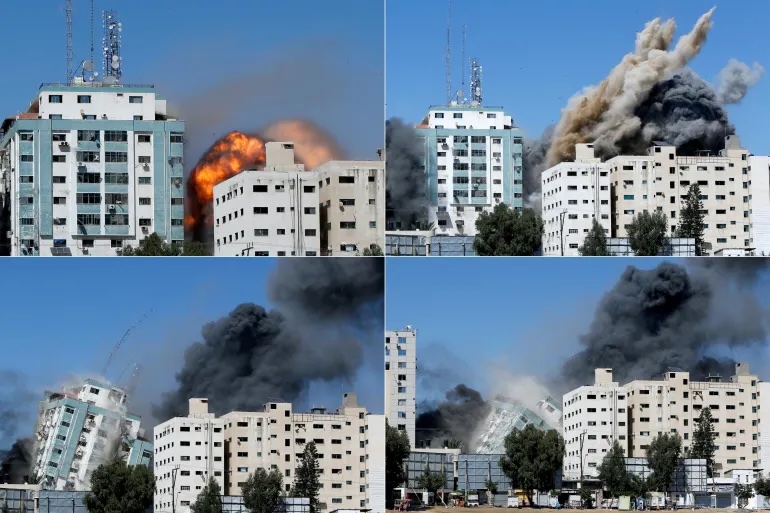
    After Hamas launched a surprise attack on Israel, IDF forces responded with airstrikes, levelling Gazan buildings. The violence so far has claimed the lives of more than 2,500 people. Western media, however, show far more interest and have much greater sympathy with Israeli dead than Palestinian ones and have played their usual role as unofficial spokespersons for the Israeli Defense Forces (IDF).

    EXTRAORDINARY CLAIMS, ZERO EVIDENCE

    One case in point is the claim that, during their incursion into southern Israel, Hamas fighters stopped to round up, kill and mutilate 40 Israeli babies, beheading them and leaving their bodies behind.

    The extraordinary assertion was originally reported by the Israeli channel i24 News, which based it on anonymous Israeli military sources. Despite offering no proof whatsoever, this highly inflammatory claim about an enemy made by an active participant in a conflict was picked up and repeated across the world by a host of media (e.g., in the United States by Fox NewsCNNMSNBusiness Insider, and The New York Post)

    Meanwhile, the front pages of the United Kingdom’s largest newspapers were festooned with the story, the press outraged at the atrocity and inviting their readers to feel the same way.

    Extraordinary claims should require extraordinary evidence, and a story like this should have been met with serious skepticism, given who was making the claim. The first question any reporter should have asked was, “Where is the evidence?” Given multiple opportunities to stand by it, the IDF continually distanced itself from the claims. Nevertheless, the story was simply too useful not to publish.

    The decapitated baby narrative was so popular that even President Biden referenced it, claiming to have seen “confirmed” images of Hamas killing children. This claim, however, was hastily retracted by his handlers at the White House, who noted that Biden was simply referencing the i24 News report.

    The story looked even more like a piece of cheap propaganda after it was revealed that the key source for the claim was Israeli soldier David Ben Zion, an extremist settler who had incited race riots against Palestinians earlier this year, describing them as “animals” with no heart who needs to be “wiped out.”

    Manipulating the U.S. public into supporting the war by feeding them atrocity propaganda about mutilating babies has a long history. In 1990, for instance, a girl purporting to be a local nurse was brought before Congress, where she testified that Iraqi Dictator Saddam Hussein’s men had ripped hundreds of Kuwaiti babies from their incubators and left them to die. The story helped whip the American public up into a pro-war fervor. It was later revealed that it was a complete hoax dreamed up by a public relations firm.

    THE MURDERED GIRL WHO CAME BACK TO LIFE

    Another piece of blatantly fake news is the case of Shani Louk. Louk attended the Supernova Festival, ambushed by Hamas. It was widely reported that Hamas murdered her (e.g., Daily MailMarcaYahoo! NewsTMZBusiness Insider), stripped her, and paraded her naked body trophy-like through the streets on the back of a truck. Louk’s case incited global anger and calls for an overwhelming Israeli military response.

    There was only one problem: Louk was later confirmed to be alive and in hospital, a fact that suggests the videos of her on the back of a truck were actually images of people saving her life by taking her to seek medical assistance.

    Few of the outlets irresponsibly publishing these wildly incendiary stories have printed apologies or even retractions. The Los Angeles Times was one exception: after publishing a report claiming that Palestinians had raped Israeli civilians, it later informed readers that “such reports have not been substantiated.”

    LIONIZING ISRAEL, DEHUMANIZING PALESTINIANS

    Few readers, however, see these retractions. Instead, they are left with visceral feelings of anger and disgust towards Hamas, priming them to support Western military action against Palestine or the wider region.

    In case their audiences did not get the message, op-eds and editorials in major newspapers hammered home this idea. The Wall Street Journal ran an op-ed entitled “The Moral Duty to Destroy Hamas”, which insisted to readers that “Israel is entitled to do whatever it takes to uproot this evil, depraved culture that resides next to it.” Thus, the outlet implicitly gave Israel a free pass to carry out whatever war crimes it wished on the civilian population, whether that is using banned chemical weapons, cutting off electricity and water, or targeting ambulances or United Nations officials.

    The National Review’s editorial board was of a similar mind, stating that “Israel needs a long leash to destroy Hamas.” This long leash, they explained, meant giving Israel far more time to carry out the destruction of Gaza. Western leaders would have to refrain from criticizing Israel or calling for calm and peace.

    The message was clear: international unity was paramount at this time. Mere trifles such as war crimes must be overlooked. And while Israel and its people were treated with special sympathy (e.g., Washington Post), the other side was written off as bloodthirsty radicals. While the phrase “Palestinian terrorists” could be found across the media spectrum (e.g., Fox NewsNew York PostNew York Times), its opposite, “Israeli terrorists” was completely absent from corporate media. This, despite casualties on the Palestinian side, outnumbering Israelis.

    Underlining the fact that Israeli lives are deemed more important is the way in which deaths from each side are reported. The BBC, for example, told its readers that Israelis have been “killed” while people in Gaza merely “died,” removing any agency from its perpetrators and almost suggesting their deaths were natural.

    CONTEXT-FREE VIOLENCE

    Missing from most of the reporting was the basic factual background of the attack. Few articles mentioned that Israel was built upon an existing Palestinian state and that most of the inhabitants of Gaza are descended from refugees ethnically cleansed from southern Israel in order to make way for a Jewish state. Also left unmentioned was that Israel controls almost every aspect of Gazan’s life. This includes deciding who can enter or leave the densely populated strip and limiting the import of food, medicine and other crucial goods. Aid groups have called Gaza “the world’s largest open-air prison.” The United Nations has declared the conditions in Gaza to be so bad as to be unlivable.

    One of the principal reasons that this crucial context is not given is that it could influence Western audiences into sympathizing with Palestinians or supporting Palestinian liberation. Giant media corporations are largely owned by wealthy oligarchs or by transnational corporations, both of whom have a stake in preserving the status quo and neither of whom wish to see national liberation movements succeed.

    https://twitter.com/AlanRMacLeod/status/1712797752709566763?ref_src=twsrc%5Etfw%7Ctwcamp%5Etweetembed%7Ctwterm%5E1712797752709566763%7Ctwgr%5Eb05f8d7d7e0b67196918b4e46787442438501a6b%7Ctwcon%5Es1_&ref_url=https%3A%2F%2Fscheerpost.com%2F2023%2F10%2F14%2Fpropaganda-blitz-how-mainstream-media-is-pushing-fake-palestine-stories%2F

    Some media outlets make this explicit. Axel Springer – the enormous German broadcaster that owns Politico – requires its employees to sign its mission statement endorsing “the trans-Atlantic alliance and Israel” and has told any staff members that support Palestine to leave their jobs.

    Other outlets are slightly less overt but nonetheless have Israel red lines that employees cannot cross. CNN fired anchor Marc Lamont Hill for calling for a free Palestine. Katie Halper was fired from The Hill for (accurately) calling Israel an Apartheid state. The Associated Press dismissed Emily Wilder after it became known that she had been a pro-Palestine activist during her college years. And The Guardian sacked Nathan J. Robinson after he made a joke mocking US military aid to Israel. These cases serve as examples to the rest of the journalistic world. The message is that one cannot criticize the Israeli government’s violent apartheid system or show solidarity for Palestine without risking losing their livelihoods.

    Ultimately, then, corporate media play a key role in maintaining the occupation by manipulating public opinion. If the American people were aware of the history and the reality of Israel/Palestine, the situation would be untenable. For those wishing to maintain the unequal state of affairs whereby an apartheid government expels or imprisons its indigenous population, the pen is as important as the sword.


    This article was published earlier in scheerpost.com and is republished under the Creative Commons Attribution-NonCommercial-NoDerivatives 4.0 International license

    Feature Image Credit: aljazeera.com


  • Migrant or native, we are all out of Africa

    Migrant or native, we are all out of Africa

    No human group can make a concerted claim as regards nativism and try to make an ‘other’ an immigrant, foreigner or outsider

    Why, and how, does Mizoram get involved in the ongoing ethnic (and religious) strife that has been on for over three months in Manipur? The Kukis and Zomis in Manipur are ethnically related to the Mizos, the dominant community in Mizoram. The Mizos, in turn, are ethnically related to the Chins in Myanmar and the Kuki-Chins in Bangladesh.

    Together they all belong to the greater Zo community, speak a similar language, have common ancestry and parallels as regards their cultures and traditions. These latter groups are predominantly Christian and hence have a strong bond with the Mizos in Mizoram, a ‘Christian state’, like Nagaland. The Chief Minister of Mizoram, Zoramthanga, is a Mizo.

    In Manipur, the Meiteis, a Hindu community, are the majority and overwhelmingly numerically dominant. But it is interesting that the Meiteis are found in small numbers in Mizoram too, and many have started fleeing from the state. A similar fleeing of the Kukis from Manipur to Mizoram has happened. Also, there are the Naga groups in different pockets of Manipur. The neighbouring state of Nagaland has 17 officially recognised Naga groups.

    It is exasperating, and quite disquieting, to note the presence of ethnic groups that are dominant in one state, being minorities in a neighbouring state. Such existence has given rise to very foreboding situations and added to the already prevailing ethnic conflicts in India’s North-East.

    It is not just that the Indian states in the region share common borders. There are international borders too in the area, as Bangladesh and Myanmar adjoin the Indian states. Different communities/tribes/groups of people have lived in the regions that are the focus of our discussion for aeons. Such inter-state and international habitations of ethnic groups across states/countries are come across elsewhere in the world too.

    One of the most interesting and classic instances of a single ethnic group, who regard themselves as a single nation, and inhabit more than one country, is that of the Bedouin (found in Syria, Algeria, Morocco, Libya, Egypt, Israel, and so on). Such situations come about because free-ranging groups of people, or partially or fully settled groups of people, got divided into different states or countries because of the coming in of boundaries and division of territories.

    What would have been the scenario if these borders between states and countries had not come up? We would undoubtedly have diverse groups living in enclaves, either quite separated or adjoining each other either as small groups or larger ones, but sans the borders dividing them; the question of majority/minority or dominance/subservience would not, probably, have had the same kind of meaning or effect as has happened due to the drawing of borders between states and countries.

    Borders that formed between enclaves of diverse inhabitants and made groups of people dominant and/or majority groups have resulted in hegemony, where the traditions, customs, practices, and mores of that group have gained significance. These traditions and customs prevail extensively when compared to the practices of the smaller groups in that same area. Invariably, the dominant group makes claims to being the ‘original inhabitants’ and the ‘natives’ of the state/country concerned.

    Quite often co-habitants develop similar institutions and social and cultural practices despite the differences and diversity between them, and this is quite apparent in multicultural societies. Amitav Ghosh argues that “it is … the vitality of the place itself that creates commonalities between the people who dwell in it, no matter what their origin” (The Nutmeg’s Curse, page 221). But sadly, it is the differences that often come to the fore, and similarities remain latent.

    Here, it is pertinent for us to dwell on the facets of claims that groups make as regards being the autochthons and natives of a given state/country. By extension, the non-dominant groups are labelled ‘immigrants’, ‘foreigners’, and ‘outsiders’. Prior to ‘Out of Africa’, and the spread of Homo sapiens to the different parts of the world, somewhere between 80,000 and 50,000 years ago, there were no fully evolved human beings in any part of the world. Subsequent to a group of them leaving Africa, different parts of the Earth got populated gradually.

    All the physiognomic and phenotypical differences that we find among humans today, including skin colour, hair texture, and colour of the eyes came about as a result of where people settled.

    To put it tersely, no human group can make a concerted claim as regards nativism and try to make an ‘other’ an immigrant, foreigner or outsider. Ghosh endorses this when he says “Except for one small part of Africa, nowhere on Earth can people be said to be truly native, in the sense of having come into being on that soil” (The Nutmeg’s Curse, page 221).


    This article was published earlier in Deccan Herald.

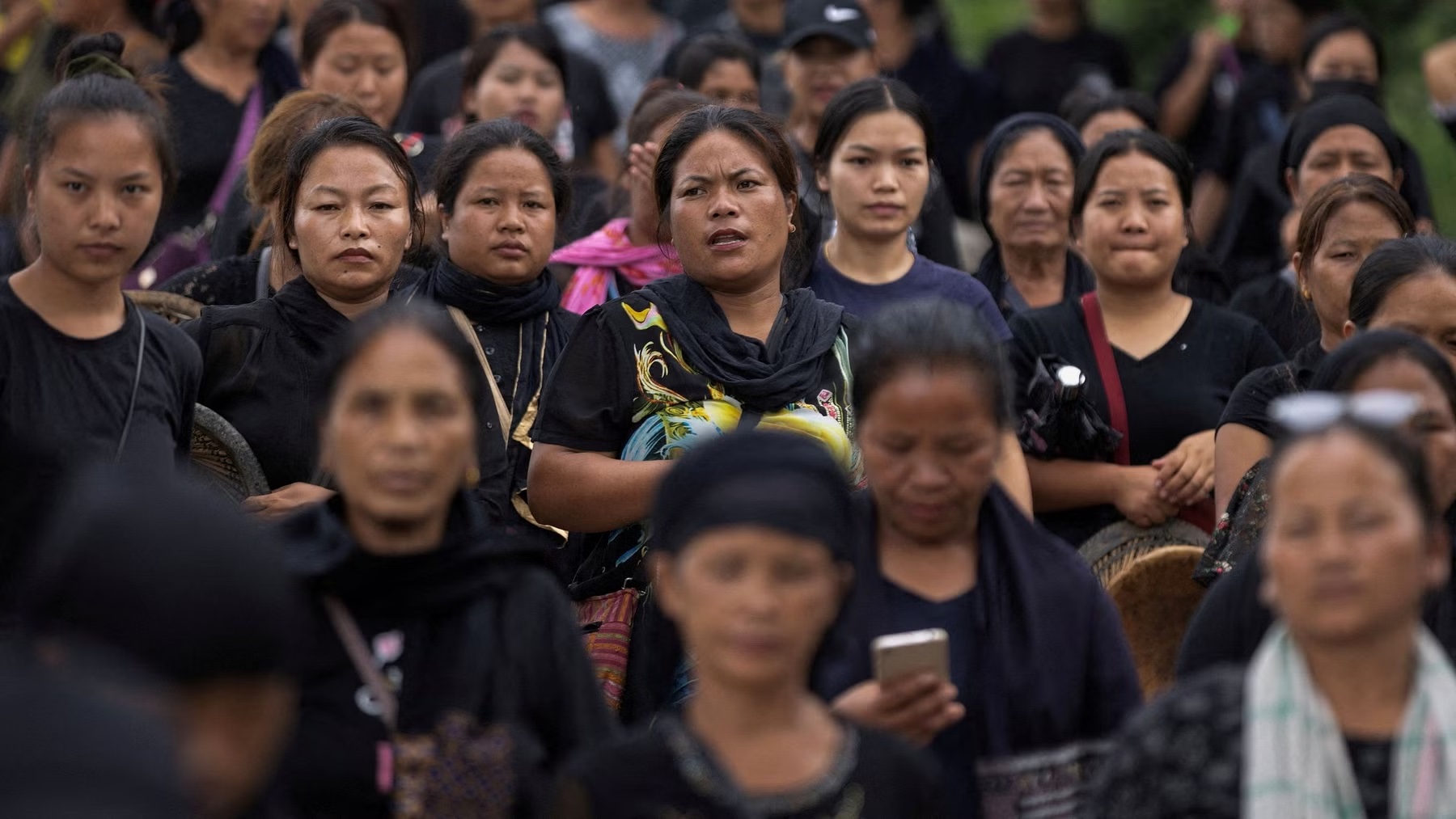
    Feature Image:Kuki women leave after attending a protest against the alleged sexual assault of two tribal women, in Churachandpur district in Manipur. Credit: Retuers Photo


  • Putin’s statements suggest the Ukraine conflict could last for years

    Putin’s statements suggest the Ukraine conflict could last for years

    Most likely, the fighting will continue into 2023, and quite probably beyond, until either Moscow or Kiev is exhausted, or one side claims a decisive victory. For the US, Ukraine is a matter of principle; for the Kremlin, the matter is simply existential – the conflict with the West is not about Ukraine, but about the fate of Russia itself.

    Last week, Russian President Vladimir Putin commented, during a meeting with soldiers’ mothers, that he now regards the Minsk agreements of 2014 and 2015 as a mistake. This confession was stark in the context of the possibility of peace negotiations to end the fighting in Ukraine.

    Russian President Vladimir Putin commented, during a meeting with soldiers’ mothers, that he now regards the Minsk agreements of 2014 and 2015 as a mistake.

    It is worth remembering that in 2014, Putin acted on a mandate from the Russian parliament to use military force “in Ukraine,”not just in Crimea. In fact, Moscow did save the cities of Donetsk and Lugansk from being overrun by Kyiv’s army, and defeated Ukraine’s forces, but rather than clearing the whole region of Donbass, Russia stopped, and agreed to a cease-fire brokered in Minsk by Germany and France.

    Putin explained to the mothers that at the time, Moscow did not know for sure the sentiments of the Donbass population affected by the conflict, and hoped that Donetsk and Lugansk could somehow be reunited with Ukraine on the conditions laid down in Minsk. Putin might have added – and his own actions, as well as conversations with then-Ukrainian President Pyotr Poroshenko, confirm it – that he was prepared to give the new Kyiv authorities a chance to settle the issue and rebuild a relationship with Moscow. Until rather late in the game, Putin also hoped that he could still work things out with the Germans and the French, and the US leadership.

    Admissions of mistakes are rare among incumbent leaders, but they are important as indicators of lessons they have learned.

    Admissions of mistakes are rare among incumbent leaders, but they are important as indicators of lessons they have learned. This experience has apparently made Putin decide not that the decision to launch the special military operation last February was wrong, but that eight years before, Moscow should not have put any faith in Kyiv, Berlin, and Paris, and instead should have relied on its own military might to liberate the Russian-speaking regions of Ukraine.

    In other words, agreeing to a Minsk-style ceasefire now would be another mistake which would allow Kyiv and its backers to better prepare to resume fighting at the time of their choosing.

    The Russian leader realizes, of course, that many nations in the non-West, those who refused to join the anti-Russian sanctions coalition and profess neutrality on Ukraine, have called for an end to hostilities. From China and India to Indonesia and Mexico, these countries, while generally friendly toward Russia, see their economic prospects being impaired by a conflict that pits Russia against the united West. The Western media also promote the message that global energy and food security is suffering because of Moscow’s actions. Russia’s arguments and protestations to the contrary have only limited impact since Russian voices are rarely heard on Middle Eastern, Asian, African, or Latin American airwaves.

    Be that as it may, Moscow cannot ignore the sentiments of the larger part of humanity, which is now increasingly referred to in Russian expert circles as the Global Majority. Hence, official Russian statements that Moscow is open for dialogue without preconditions. However, any Russian delegation to talks would have to take into account the recent amendments to the country’s Constitution, which name the four former Ukrainian regions of Donetsk, Lugansk, Kherson, and Zaporozhye as part of the Russian Federation. As Foreign Minister Sergey Lavrov has put it, Russia will only negotiate on the basis of existing geopolitical realities. It should be noted that the Kremlin has not retracted the objectives of the military operation, which include the demilitarization and denazification of Ukraine, which means ridding the state and society of ultra-nationalist, anti-Russian elements.

    As for Kyiv, it has gone back and forth on the issue. Having nearly reached a peace agreement with Moscow in late March, it later reversed course to continue fighting (the Russians believe this was done on Western advice). Having achieved operational successes on the battlefield this past fall, Ukrainian President Vladimir Zelensky had all contacts with the Kremlin formally banned and formulated extreme demands which he addressed to Putin’s successors, whenever they may emerge. For the West, this was bad from the perspective of public relations, and Zelensky was asked to make it appear as if he was open for talks, but in reality, nothing changed.

    The reality is that the principal parties involved in the conflict in Ukraine, namely Washington and Moscow, do not consider the present, or the near future, as a good time for negotiations.

    The reality is that the principal parties involved in the conflict in Ukraine, namely Washington and Moscow, do not consider the present, or the near future, as a good time for negotiations. From the US perspective, despite the unprecedented sanctions imposed on Russia by the West and the recent setbacks that the Russian Army has experienced in Kharkov and Kherson, Moscow is far from being defeated on the battlefield or destabilized domestically. From the Kremlin’s perspective, any truce or peace that leaves Ukraine as an ‘anti-Russia’, hostile state, is tantamount to a defeat with highly negative consequences.

    Instead, both sides believe they can win. The West, of course, has vastly superior resources in virtually every field that it can use in Ukraine. But Russia is working to mobilize its own substantial reserves in both manpower and the economy.

    Where Moscow has an advantage is in escalatory dominance. For the US, Ukraine is a matter of principle; for the Kremlin, the matter is simply existential – the conflict with the West is not about Ukraine, but about the fate of Russia itself.


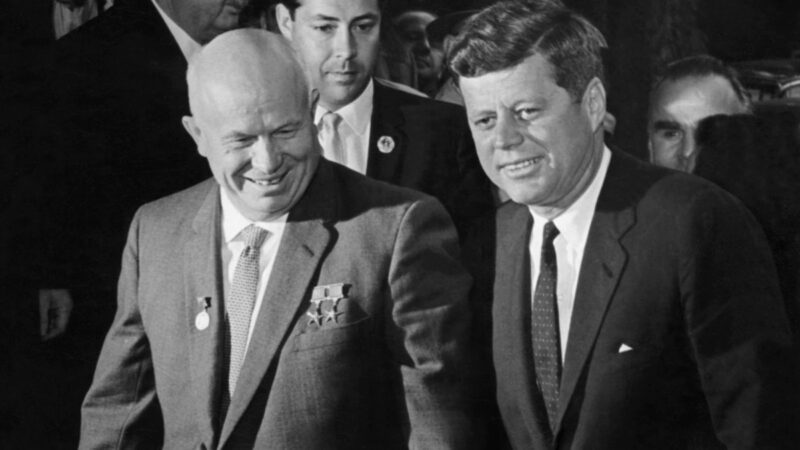
    It looks as if the war will continue into 2023, and possibly beyond that. Talks will probably not start before either side is prepared to concede due to exhaustion, or because both parties have reached an impasse. In the meantime, the death toll will continue to mount, pointing to the essential tragedy of major power politics. In the fall of 1962, then-US President John F. Kennedy was ready to walk to the edge of the nuclear precipice in order to prevent the Soviet Union from turning Cuba into its missile base. Sixty years later, Russian President Vladimir Putin ordered a military action to make sure that Ukraine does not become an unsinkable aircraft carrier for America.

    Whatever Soviet leader Nikita Khrushchev thought about his right to counter US missiles pointed at Moscow from Turkey with weapons of his own targeting Washington and New York from Cuba (with Havana’s consent), and whatever successive US presidents thought about their right to expand the NATO military bloc to include Ukraine (at Kyiv’s wish), there is always a horrendous price to pay for the failure to take into account the rival power’s security interests.


    There is a lesson to be learned from this. Whatever Soviet leader Nikita Khrushchev thought about his right to counter US missiles pointed at Moscow from Turkey with weapons of his own targeting Washington and New York from Cuba (with Havana’s consent), and whatever successive US presidents thought about their right to expand the NATO military bloc to include Ukraine (at Kyiv’s wish), there is always a horrendous price to pay for the failure to take into account the rival power’s security interests. Cuba went down in history as a narrow success for common sense. Ukraine is an ongoing story, with its outcome still hanging in the balance.

    Feature Image: rt.com

    Image: Khrushchev and Kennedy – rferl.org

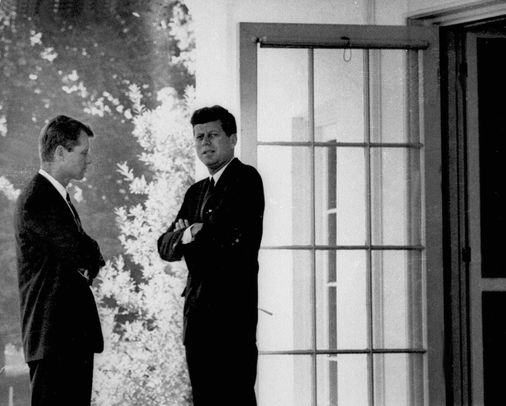
    Image: Robert and Jack Kennedy – bostonglobe.com – The most important lesson of the Cuban Missile crisis.

  • India, China, and Arunachal Pradesh

    India, China, and Arunachal Pradesh

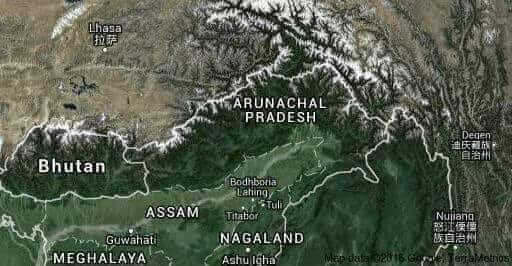
    The satellite picture below brilliantly depicts the geographical separation of Arunachal Pradesh (called Lower Tibet by the Chinese) and Tibet. The McMahon Line more or less runs along the crest line of the Himalayas.

    The Chinese have never been quite explicit on how much of Arunachal they seek.  I once saw an official map displayed in a travel agents office in Lhasa that showed only the Tawang tract as Chinese territory. In other maps they have their border running along the foothills, which means all of Arunachal.

    The Chinese have based their specific claim on the territory on the premise that Tawang was administered from Lhasa, and the contiguous areas owed allegiance to the Dalai Lama, the spiritual and temporal ruler of Tibet. Then the Chinese must also consider this. Sikkim till into the 19th century a vassal of Tibet and Darjeeling was forcibly taken from it by the British! By extending this logic could they realistically stake a claim for Sikkim and Darjeeling? Of course not. It would be preposterous. History has moved on. The times have changed. For the 21st century to be stable 20th century borders must be stable, whatever be our yearnings.

    At the crux of this issue is the larger question of the national identities of the two nations and when and how they evolved. The Imperial India of the Mughals spanned from Afghanistan to Bengal but did not go very much below the Godavari in the South. The Imperial India of the British incorporated all of today’s India, Pakistan and Bangladesh, but had no Afghanistan, not for want of trying. It was the British who for the first time brought Assam into India in 1826 when they defeated Burma and formalized the annexation with the treaty of Yandabo.

    It was only in 1886 that the British first forayed out of the Brahmaputra valley when they sent out a punitive expedition into the Lohit valley in pursuit of marauding tribesmen who began raiding the new tea gardens. Apparently the area was neither under Chinese or Tibetan control for there were no protests either from the Dalai Lama or the Chinese Amban in Lhasa. Soon the British stayed put.

    Tibet remained in self imposed isolation and the race to be first into Lhasa became the greatest challenge for explorers and adventurers in the second half of the 19th century. Not the least among these were the spies of the Survey of India, the legendary pundits. The most renowned of these was the Sarat Chandra Das whose books on Tibet are still avidly read today. As the adventurers, often military officers masquerading as explorers began visiting Tibet the British in India began worrying. Reports that the most well-known of Czarist Russia’s military explorers, Col. Grombchevsky was sighted in Tibet had Lord Curzon, the Governor General of India most worried.

    In 1903 Curzon decided to send a military expedition into Tibet led by Grombchevsky’s old antagonist, Col. Francis Younghusband. A brigade strong mixed force of Gurkhas and Tommies went over the Nathu La into the Chumbi valley and advanced unhindered till Shigatse. A Tibetan military force met them there but offered what can only be described as passive resistance. Not a shot was fired back as the British Indian troops rained bullets on them. It was a forerunner to Jallianwalla Bagh. From Shigatse Younghusband made a leisurely march into Lhasa. The British got the Tibetans to agree to end their isolation and having extracted trade concessions withdrew in 1904, the way they came.

    In 1907 Britain and Russia formally agreed that it was in their interests to leave Tibet “in that state of isolation from which, till recently, she has shown no intention to depart.” It may be of interest to the reader to know that the Great Game nevertheless continued. In 1907 Col. Mannerheim then of the Russian Army, later Field Marshal Mannerheim and first President of Finland, led a horseback expedition from Kyrgyzstan to Harbin on China’s northeast to identify a route for the cavalry.

    The next important year was 1913 when the Tibetans declared independence after the collapse of the Qing dynasty and the establishment of a Republic in China under Sun Yat Sen. They attacked and drove the Chinese garrisons in Tibet into India over the Nathu La. Also in 1913 the British convened the Simla Conference to demarcate the India-Tibet border. The British proposed the 1914 McMahon Line, as we know it. The Tibetans accepted it. The Chinese Amban however initialed the agreement under protest. But his protest seemed mostly about the British negotiating directly with Tibet as a sovereign state and not over the McMahon Line as such.

    Things moved on then. In 1935 at the insistence of Sir Olaf Caroe ICS, then Deputy Secretary in the Foreign Department, the McMahon Line was notified. In 1944 JP Mills ICS established British Indian administration in NEFA, but excluding Tawang which continued to be administered by the Lhasa appointed head lama at Tawang despite the fact that it lay well below the McMahon Line. This was largely because Henry Twynam, the Governor of Assam lost his nerve and did not want to provoke the Tibetans. In 1947 the Dalai Lama (the same gentleman who is now in Dharamshala) sent the newly independent India a note laying claim to some districts in NEFA/Arunachal.

    On October 7, 1950 the Chinese attacked the Tibetans at seven places on their frontier and made known their intention of reasserting control over all of Tibet. As if in response on February 16, 1951 Major Relangnao ‘Bob’ Khating IFAS raised the India tricolor in Tawang and took over the administration of the tract. The point of this narration is to bring home the fact that India’s claim over Arunachal Pradesh doesn’t rest on any great historical tradition or cultural affinity. We are there because the British went there. But then the Chinese have no basis whatsoever to stake a claim, besides a few dreamy cartographic enlargements of the notion of China among some of the hangers-on in the Qing emperor’s court. The important thing now is that we have been there for over a hundred years and that settles the issue.

    Arunachal Pradesh has a very interesting population mix. Only less than 10% of its population is Tibetan. Indo-Mongoloid tribes account for 68% of the population. The rest are migrants from Nagaland and Assam. As far as religious affinities go Hindus are the biggest group with 37%, followed by 36% animists, 13% Buddhists. Recent census figures suggest a spurt in Christianity, possibly induced by pocketbook proselytizing. In all there are 21 major tribal groups and over 100 ethnically distinct sub-groupings, speaking over 50 distinct languages and dialects. The population of about a million is spread out over 17 towns and 3649 villages. With the exception of a few villages of Monpas who live north of the McMahon Line, it is an ethnically compact and contiguous area.

    In fact in future boundary negotiations India could make a case for inclusion of the few Monpa villages left behind north of the McMahon Line? Many knowledgeable observers suggest that the area south of the Huangpo/Brahmaputra from the Pemako gorge till it enters the Subansiri division of Arunachal would be a logical boundary as the raging and hence un-fordable and unbridgeable river ensures hardly any Chinese administrative presence in the area.

    It is true that historically India never had a direct border with Tibet till the British took Kumaon and Garhwal from Nepal in 1846 and extended its domain over Arunachal in 1886. On the other hand the formidable Himalayas were always culturally a part of India and formed a natural barrier against ingress from the north, whether Tibetan or Chinese. But times have moved and technology and mankind’s great engineering powers now make it possible for even the most hostile terrain to be subjugated. The Himalayas are no longer the barrier they once were. As China and India emerge as the world’s great economies and powers can India possibly allow China a strategic trans-Himalayan space just a few miles from the plains?

    The view from the Chinese side about what exactly constitutes China is no less confused. Apparently like the British, the Manchu’s who ruled China from the 17th to the early 20th century had a policy of staking claim to the lands that lay ahead of their frontiers in order to provide themselves with military buffers. In a recent article in the China Review magazine, Professor Ge Jianxiong, Director of the Institute of Chinese Historical Geography at Fudan University in Shanghai writes: “to claim that Tibet has always been a part of China since the Tang dynasty; the fact that the Qinghai-Tibetan plateau subsequently became a part of the Chinese dynasties does not substantiate such a claim.” Ge also notes that prior to 1912 when the Republic of China was established the idea of China was not clearly conceptualized. Even during the late Qing period (Manchu) the term China would on occasion refer to the Qing state including all the territory that fell within the boundaries of the Qing Empire. At other times it would be taken to refer to only the eighteen interior provinces excluding Manchuria, Inner Mongolia, Tibet and Sinkiang.

    Professor Ge further adds that the notions of “Greater China” were based entirely on the “one-sided views of Qing court records that were written for the courts self-aggrandizement.” Ge criticizes those who feel that the more they exaggerate the territory of historical China the more “patriotic” they are. In this context I would like to recall a recent conversation I had with the then Chinese Ambassador to India, Sun Yuxi. Ambassador Sun said that while he was soundly castigated in India for his unintended comment, he gained a major constituency in China. The mandarins in the Beijing would do well to take heed to Ge Jianxiong’s advice: “If China really wishes to rise peacefully and be on solid footing in the future, we must understand the sum of our history and learn from our experiences.” The same holds true for the babus in South Block and ‘the having writ move on’ media pundits. If we don’t then we know who will be laughing!


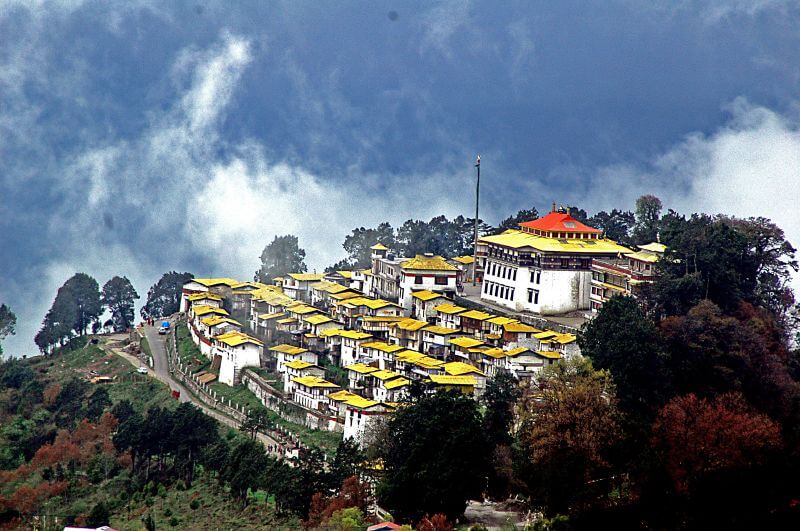
    Image Credit: Tawang Monastery

  • India-China Border Stand-Off

    India-China Border Stand-Off

    On the 5th and 6th May 2020, Chinese incursions were reported at a very large frontage along the Line of Actual Control (LAC); starting from Naku La in north Sikkim, in Finger area of Pangong Tso, in Galwan Valley, Hot springs and Gogra heights located north-east of Galwan Valley. These incursions were a little different from all previous border standoffs. This time the Chinese incursion has been at multiple places and also, they had come prepared with weapons, vehicles and tents. They had come in large numbers with an intent to dig in.
    The issue came to light when scuffles were reported by the media on 10 May that some Chinese had intruded into the Muguthang Valley at Naku La and asked Indians to vacate the area as they claimed that it was their land. A scuffle ensued . According to PTI, the incident involved 150 soldiers. During the incident, the two sides threw stones at each other.

    Download Full Paper