Category: Books/Book Chapters

  • Milan Kundera’s ‘remarkable’ work explored oppression, inhumanity – and the absurdity of being human

    Milan Kundera’s ‘remarkable’ work explored oppression, inhumanity – and the absurdity of being human


    Milan Kundera, that remarkable novelist, essayist, poet, philosopher and political critic, has died at the age of 94. It feels too soon, perhaps because in everything he wrote, he opened up new ways of thinking, writing and reading. In his literary presence, the world seemed tuned to a higher frequency.

    Kundera was born with immaculate timing, on April 1 (1929): April Fool’s Day. From the start, he was exposed to, and immersed in, the absurdity of human culture. He grew up in Nazi-occupied Czechoslovakia, then lived under Stalinist rule, where he was an active member of the Communist Party.

    I have been reading him, quoting him and teaching from his writings for decades, after bumping into his work in 1988. I was living then on an isolated sheep station in the Western Australian outback, a world of bleak beauty.
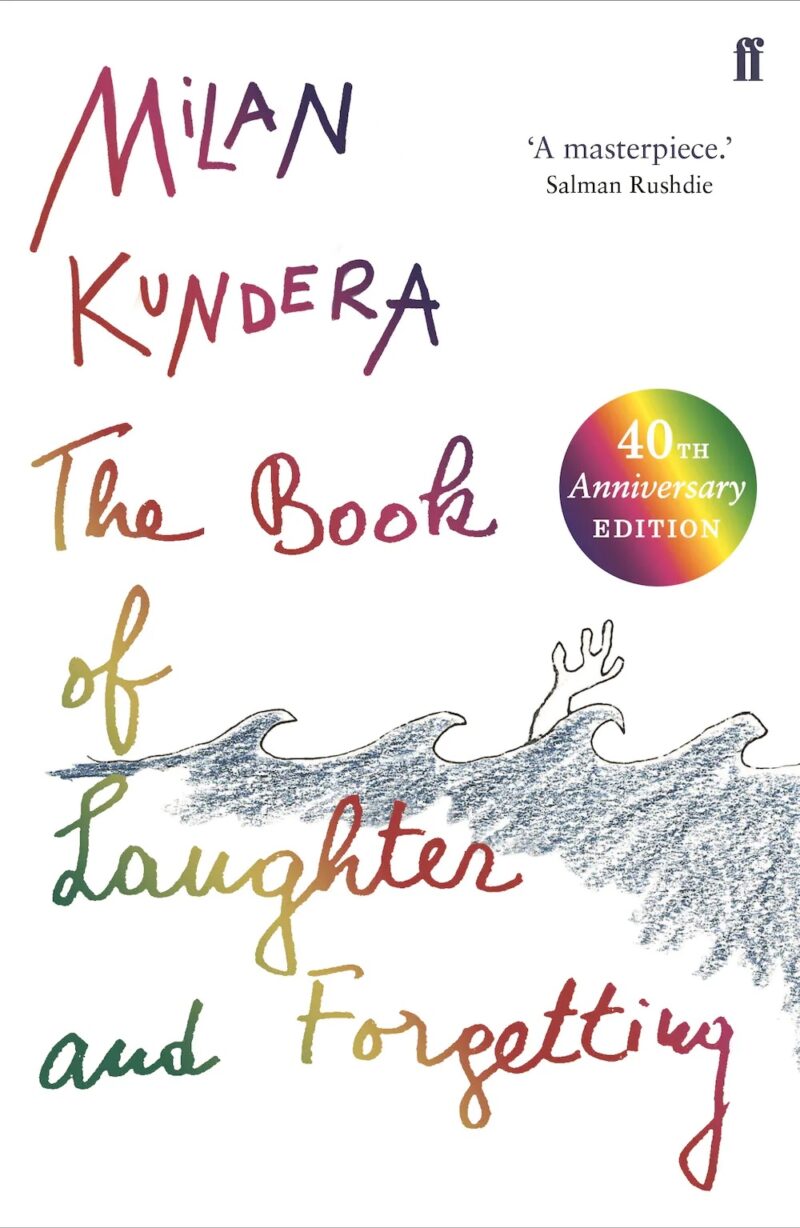
    Someone visiting the property pressed on me a copy of The Book of Laughter and Forgetting, and I was immediately and utterly captivated. This, Kundera’s third novel, affirmed my own anxiety of the absence of a stable truth, and of my incapacity to resist the longing to belong, even to the most damaged society.

    In one section of the novel, a group of the Communist faithful, dancing together in a circle, rise into the air and soar over the city. They laugh the laughter of angels while below them, the executioners are killing political prisoners. Says the narrator of this section, who necessarily cannot be part of that group:

    I realized with anguish in my heart that they were flying like birds and I was falling like a stone, that they had wings and I would never have any.

    Interrogating totalitarianism, with humour

    Kundera knew about oppression and inhumanity. His first collection of (not very good) poetry, Man, A Wide Garden (1953) – published when he was only 24 – was decidedly Soviet in tone and content.

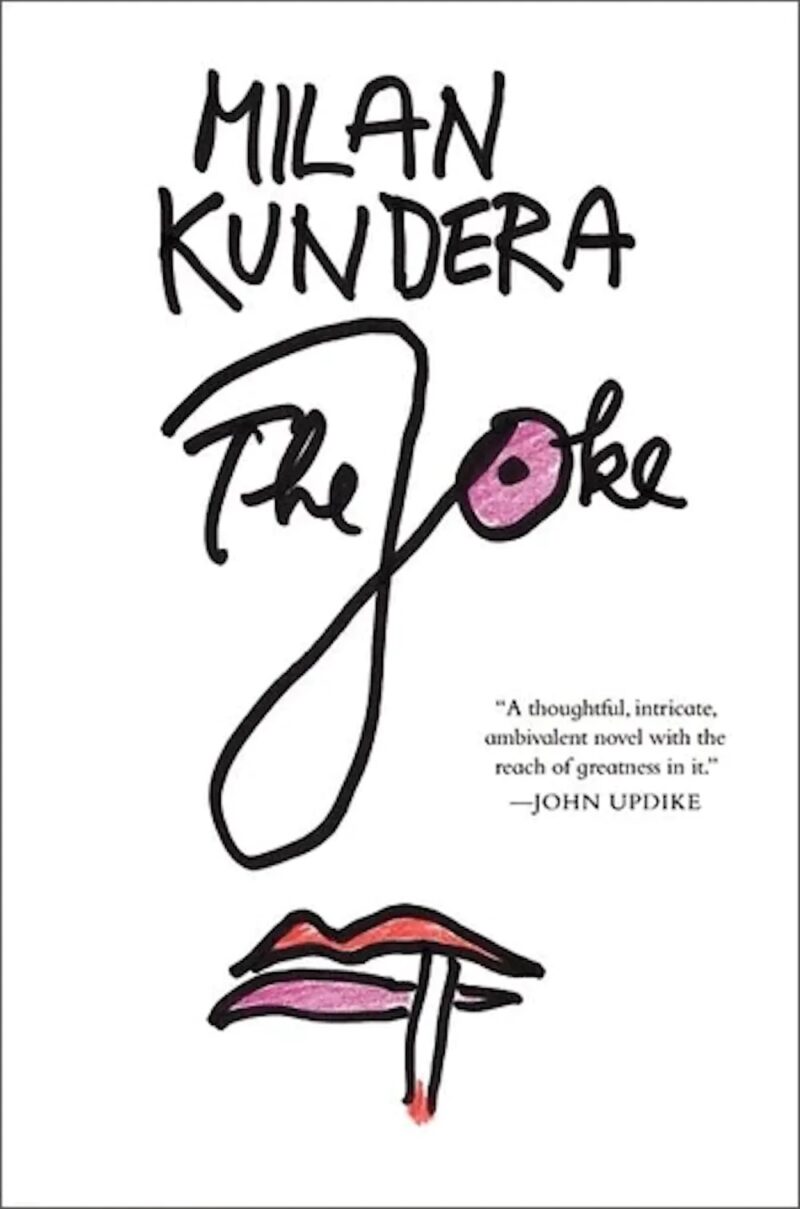
    But when he wrote his first novel, The Joke in 1967, then wrote Life is Elsewhere in 1969 (published in 1973), both of them shot through with political satire, and he was expelled from the Communist Party and subsequently fled into exile.

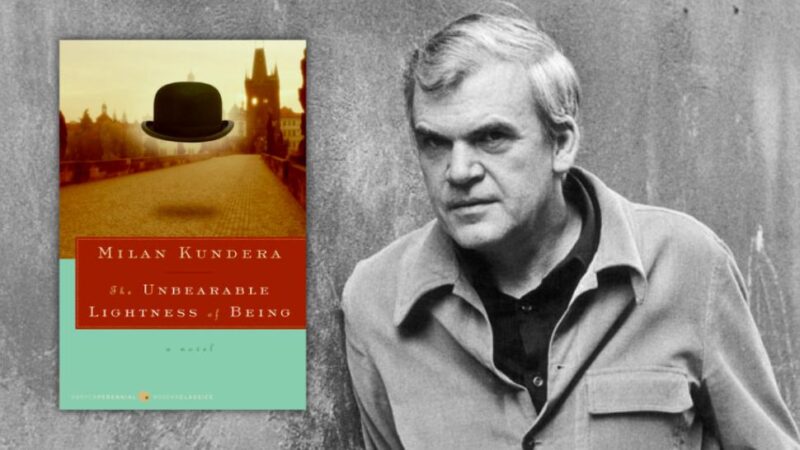
    In what is perhaps his best-known novel, The Unbearable Lightness of Being (1984) – adapted in 1988 as a movie starring Daniel Day-Lewis and Juliette Binoche – he continues his interrogation of totalitarian politics, exploring the Prague Spring and the brutality of Soviet control of Czechoslavakia.
     

    This theme sounds deeply earnest. But in each novel, Kundera offers some humour – often bitter, but capable of leavening the otherwise bleak, and densely reported, content.

    In Unbearable Lightness, for example, the narrator discusses Nietszche’s doctrine of eternal recurrence – the possibility we live the same life over and over. But he also develops an erotic narrative that seems to suggest lighthearted sex can allow us to live fully in the moment. We can exchange the weight of eternal recurrence for the lightness of being alive, here and now.

    Weight and lightness, laughter and forgetting, repetition and change, politics and sex: his first four novels incorporate such dualities. Perhaps this capacity to hold contradictory thoughts can be explained by something he said to Philip Roth:

    Totalitarianism is not only hell, but also the dream of paradise – the age old drama of a world where everybody would live in harmony.

    Author in exile

    His dream of paradise was not realised, of course. In 1975, he fled his home for exile in France, and continued writing works of fiction that mostly followed the signature structure he first developed in The Joke: multi-part, multi-voiced novels, where the narrator interpolates critique, commentary and philosophical statements in the text.

    This makes for a restless story, one that shifts to and fro across locations, times and contexts. Characters flicker in and out. The logic of beginning, middle and end is barely acknowledged. And the sorts of issues that appear so often in fiction – a quest for the self, the telling of a tale, the achievement of resolution – are set aside.

    The focus of Kundera’s novels is their wrestle with questions of knowledge, the complexity of being and a constant uncertainty. This can be an unsettling style: a disruption, rather than a simple pleasure or an aesthetic experience. For a 21st-century woman, too, his tone and style in the writing of sex scenes – and the representation of women more generally – can present as outdated masculinity.

    I vacillate between feeling offence at what feels like misogyny, and reading it as a searing critique of misogyny. And I’m not alone in this.

    ‘Things are not as simple as you think’

    Where I uncomplicatedly follow Kundera’s lead is not in his novels, but in his essays. Here, his deep understanding of the background to what we now know as the novel, or the long traditions and changes that characterise artistic practice, genuinely illuminate the field.
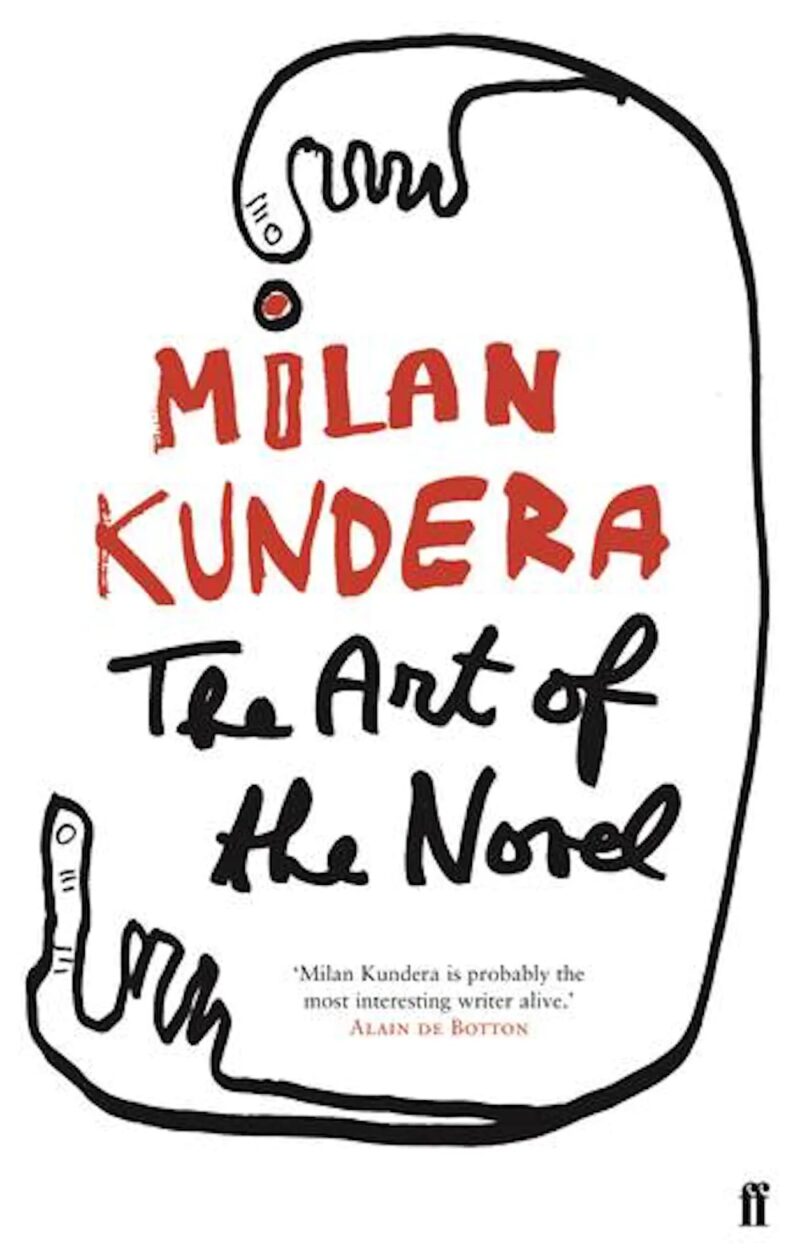
     

    In The Art of the Novel (1986), he outlines a history of how novelists unpacked various dimensions of existence. He starts with Miguel de Cervantes and moves through the lists of generative fiction writers to fellow Czechs Franz Kafka and Jaroslav Hasek – who, he claims, show that a strength of fiction is that it tolerates uncertainty, in a way politics and religion cannot. For Kundera, what fiction does so well is say to the reader: “Things are not as simple as you think.”

    For Kundera, the novel is a technological object that allows new ways of seeing, and of making meaning. And this seeing and meaning is embedded in its context. For example, in The Curtain: An Essay in Seven Parts (2006), he points out what fiction can do that earlier forms could not.

    Homer never wondered whether, after all their many hand-to-hand battles, Achilles or Ajax still had all their teeth. But for Don Quixote and Sancho teeth are a perpetual concern – hurting teeth, missing teeth.

    Writers like Cervantes (author of Don Quixote), Henry Fielding (Tom Jones) and Laurence Sterne (The Life and Opinions of Tristam Shandy, Gentleman) introduce the small things of everyday life, and illuminate the meaning and import they have on us, Kundera points out.

    But, he hastens to observe, contemporary writers cannot and should not write as those giants did: rather, writing is a matter of continuity (in terms of form, voice and style in a particular period) and discontinuity (finding something new).

    In these essays, too, he offers a workshop in how to write. How to manage voice, perspective, temporality. How to have fun with language and form – and let the imagination run wild. And how to deal with thought and concept, materiality and politics.
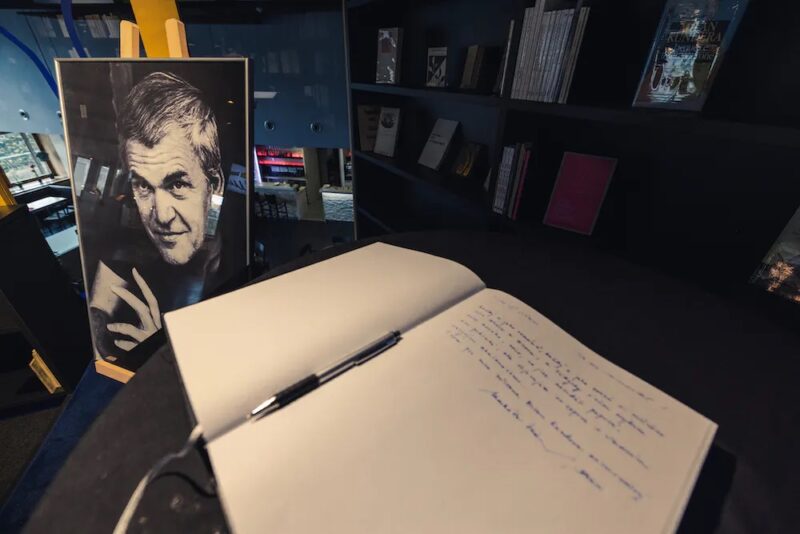
     

    A condolence book and portrait of late writer Milan Kundera at the Milan Kundera Library in Brno Czech Republic T. Tomas Skoda/EPA

    Teller of inconvenient truths

    A writer of such gravitas and such technical brilliance should, one might imagine, have won the Nobel Prize in Literature at some point in his long life. He won other prizes, after all, among them the Jerusalem Prize in 1985 and the Herder Prize in 2000.

    Perhaps it was his writing style that meant the Nobel committee saw him nominated on a number of occasions, but never awarded him the prize.

    After the last novel he wrote in Czech – Immortality (1991), which teases out questions of sexual and personal relationships – he wrote four more novels, which garnered less attention, less critical reception. So, in Slowness (1995), Identity: A Novel (1999), Ignorance (2000) and finally The Festival of Insignificance (2014), you can see his star begin to fade.

    This is not because they are less “good” books. Robin Ashenden suggests he “had become a teller of truths inconvenient to the modern age”, and maybe there is something in that.

    He is terribly direct, very hard-hitting. And he refuses the consolations of sentimentality or morality, in favour of what he describes as the morality of knowledge: the imperative to see and say what previous writers did not/could not see, or say. And to build fresh understandings of the world.

    This article was first published in The Conversation and is republished under Creative Commons license.
  • Value Of Everything: Making And Taking In The Global Economy

    Value Of Everything: Making And Taking In The Global Economy

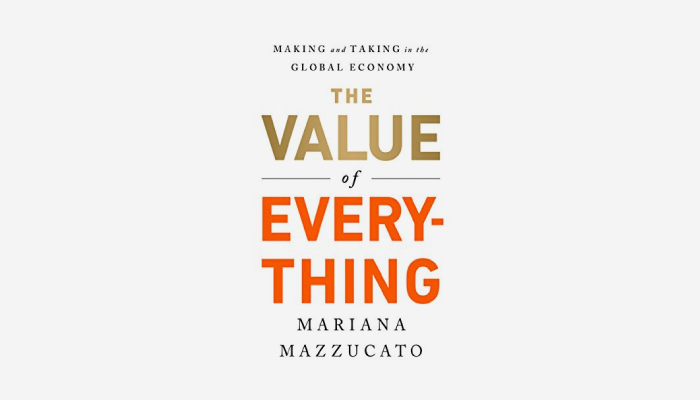
    Title : Value of Everything: Making and Taking in the Global Economy

    Winner of the 2018 Leontief prize for advancing the frontiers of economic thought ─ “Value of Everything: Making and Taking in the Global Economy” by Mariana Mazzucato is an extremely important addition to the contemporary debates in development economics. Fundamental ideas presented in the book are very relevant in the current pandemic environment as it gives us an opportunity to reframe approach to policy making. Limitations in the state’s capacity to handle a crisis of this scale might be true but the larger objective to ensure an economic and social value based ecosystem is the main idea that emerges from this book.
    The core focus of the book is on the ‘understanding of value’, as Mariana states – “much of what is passing for value creation is just value extraction in disguise”. By examining what is value the book leads us to understanding who creates value.
    Initial chapters set out to explain the core interpretation of ‘value’ adopting a historical framework by discussing influential economists. Beginning with Mercantilists in an inchoate system that was not linked with any theories to explain the creation of wealth, they believed trade creates wealth and hence, ‘value’ lies within trade. A group of 18th century French economists developed a formal economic theory ‘physiocracy’ that prioritized agriculture and land to be the ultimate source of value. There was a clear production boundary that was developed during the time of physiocrats with agriculture being productive and household, government, service, industry packed together as unproductive. Countering the Mercantilists, Adam Smith theories became prominent to understand the idea of value where wealth creation lies in an optimal economic policy encouraging surplus revenue to be reinvested in production for the nation to become richer. The author points to the theories put forth by Smith to be ambiguous yet made progress in building the concept of wealth creation. David Ricardo– a British political economist extensively wrote about rent and assumed land to be a fixed factor. As opposed to Physiocrats, Ricardo’s theory on value was beyond the production boundary and placed emphasis on financing the surplus into productive spending. The author briefly evaluates the classical theories including Marx’s labour value theory and the recent development of Marginalists under the neoclassical economics. It is worth contesting the idea of value in the marginalist approach where the price is equated to value and individual utility is studied over collective public utility . Although the theories in principle might not be relevant today but the evolution of value in the history of economic thought is a prerequisite to identify the flaws in our structure.
    A key focal point that grabs attention of the reader is the ambiguity present in determining the value of products and services. Reluctance to debate the idea of value with the current system has caused trouble in various sectors and the book reflects Mazzucato’s effort to place value in the centre-stage. She begins to make her case by lucidly explaining the fundamental shortcomings in finance deregulation. In the context of the 2008 financial crisis, much of the blame is on the finance market with excessive mortgaging strategy. Although finance is not a categorical reason for the crisis, the real estate bubble was artificially inflated by the short term objectives of finance companies and clearly proved to be unsuccessful. There are two relevant points that the author notes that will hold relevance across the waves of industrialization. First, economic value added by a finance sector largely remains disproportionate to the value added by other sectors. As a resource facilitator, she asserts, banking corporations are required to invest in productive business that adds further economic value in the society. Mere exchange of financial instruments does not guarantee increased output or welfare in an economy. It has taken a crisis for us to understand the need for steering the discussion on ‘Value Creation’. Second, financial markets bolstering private businesses model prioritizes immediate gains with limited attention paid to the long-run sustainability of the business.
    The book is a scathing indictment of the current global financial system. In the authors view the finance entrepreneurs are overrated, and contrary to popular perception they are not ‘value creaters’ but are ruthless ‘value extractors’ and parasitic. Professor Mazzucato finds the shareholder driven model to be problematic for business innovation and proposes a wider concept of stakeholder based operations. An unequivocal argument is presented to question ‘value extraction’ in the 21 century economy- in public choice theory it would mean rent seeking, a concept of increasing existing share of one’s wealth without creating more wealth. Although the author did not specifically mention the Asian countries, in Indian context, value extraction is much difficult to identify given the informality in credit market, labour market and commodities. But the unsustainable mode of executing business is evident in a corporate company that is motivated to spend on company image than Research and Development. Most importantly, the government bears the cost to repair the system with social tension and inequality that follows the failure of excess financialization. The author’s discussion on development and welfare throughout the chapters encourages readers to view the economy beyond numbers and growth rate– a propensity stemming from modern heterodox economics school of thought
    Mariana Mazucatto, founder of the Institute for Innovation and Public Purpose, draws attention to value extraction prevailing in the innovation economy. She illustrates three sources of innovation; cumulative innovation, uncertain innovation and collective innovation. She clearly articulates the engaging role of the public sector in facilitating innovation. Where most experts talk about innovation as an exclusive achievement of the private sector– Mariana challenges that notion and argues the risks of the innovation are borne by the public but the rewards are monopolized by the private business. It is impossible to deny the role of public sector in the process of innovation but it seems the author tends to credit the government more. All innovation need not create value- an extensive literature is presented to understand the way patents can be used to gain economically yet not create value. Highlighting the case of pharmaceuticals, she argues that most of the drug companies are monopolies that use the patent strategy and the rigid demand to inflate the prices for enormous profit although the production cost is a small percentage of the price. This process explains the high priced medicines in the USA and rekindles the fundamental flaw in pricing of a drug. An extreme private model with little clarity and transparency on value of the service has collapsed the healthcare system in the US, which is starkly evident in the current COVID-19 pandemic. To extend this idea, American healthcare contributes more to the Gross Domestic Product compared to the Japanese, yet citizens of the latter have higher life expectancy than of the former. The illusion of GDP contribution is more apparent when the system fails to serve the purpose it was designed for, like in the case of healthcare. Innovations in any industry can turn out to be unproductive; dismissing any single command approach from the government– the chapter ends by propounding a contract between public and private to adopt innovation as a means to achieve public value.
    In contemporary discourse, the author is concerned about the narrow definition of public sector as simply a saviour or a disturbance to private operations. A powerful narrative set to describe government to be inefficient and just an institution fixing market failure will deter the collective process of value creation. The recent economic stimulus announced by India is founded on the logic that public debt is bad, slashing interest rates would enhance business and privatization would lead to better economic growth. As Mazucatto argues, during an economic crisis public sector must seize the opportunity to invest in value creation simply because interest rates are neither market phenomena nor make firms sensitive to the change. The underrated value of the Keynesian ‘Multiplier Effect’ of public investment and considering the return on public investment to be zero are flaws in defining the role of government in contributing to growth of the economy.
    Prevailing public choice theorists’ fear of government failure over and above the threat posed by market failure runs the risk of ignoring the value created by the state. The author makes a compelling case to view government as an investor rather than spender and as a risk taker rather than a facilitator. She highlights the importance of the state’s part in the collective value creation process by disputing the marginalists definition of individual value in obtaining market value. Knitting back to the initial problem stated regarding price equal to value– identifying profit and rent becomes confusing thereby encouraging private players to extract or destroy value. The mainstream metrics used to assess the value also discourages actual value creators like the government to imitate the private sector. The government as a facilitator also faces the risk of lobbying from the private individuals and companies that hamper the process of development. The last chapter – ‘Economics of Hope’– summarizes the main ideas presented throughout the book and emphasises that the ultimate goal of the economy is to serve the people and ensure welfare along with sustainable and equitable development. The real challenge still lies in estimating the precise amount of government intervention in the process of value creation. Value of everything remains a convincing genesis of the debate on the central idea of value that could possibly be a dynamic tool to achieve the goals of an economic system.
    As Mariana Mazucato argues in this penetrating and passionate book, if we are to reform capitalism to radically transforman increasingly sick system rather than continue feeding it we urgently need to rethink where wealth comes from; who is creating it, who is extracting it, and who is destroying it. Answers to these questions are key if we want to replace the current parasitic system with atype of capitalism that is more sustainable, more symbiotic, that works for all.

  • Power Shift: Knowledge, Wealth, and Violence at the edge of the 21st Century

    Power Shift: Knowledge, Wealth, and Violence at the edge of the 21st Century

    Power Shift: Knowledge, Wealth, and Violence at the edge of the 21st Century” by Alvin Toffler, Bantam Books, 1990. New York

    Alvin Toffler

    Last book of the trilogy, ‘Powershift’ published in the 1990s still continues to be an impressive intellectual handbook to understand the transformation of power in a rapidly evolving technological, economic, and social environment. Toffler argues the nature of power in any epoch is determined by knowledge, wealth and violence. By acknowledging the inevitable emergence of new age knowledge economy, Toffler sets to describe the set of changes in the power dynamics at the turn of the 21st century. A gradual shift in power succeeds with knowledge through control of information in a super symbolic economy. Post third wave of industrialization, smoke stack industries would be replaced by decentralized industries with technology and information playing critical roles. China in the past few decades has designed its economy based on knowledge and gained technological sovereignty in Asia threatening the West’s global dominance. He asserts the pattern of powershift in politics, economics and business would be integrated and the hierarchy of power would get dissolved. A mosaic of power structure would emerge, ‘demassyifying’ production that determines the future of an economy. Recent developments in 3D printing, artificial intelligence etc have changed the paradigm of manufacturing – the country investing and comprehending the impact of innovation and disruptive technologies would gain economic superiority. By providing substantial case studies and thorough qualitative analysis, the futurist predicts millennials to redefine the defence for democracy with technology, information and knowledge. There exists a conspicuous relationship between power, wealth and knowledge since the beginning of the industrial revolution. While power has traditionally been symbolised by brute military power and economic power until the end of the world wars, the post 1945 transformation of power is contained in a triangle of military power, economic power, and knowledge (science and technology) power, Knowledge has now transformed the very notion and effectiveness of power. Power structure in the 21st century, according to the writer, will be redefined by knowledge.

    Power Shift: Knowledge, Wealth, and Violence at the edge of the 21st Century

    Violence and wealth function as important tools to consolidate power – politicians, bureaucrats and business people have always used violence & wealth to move up the hierarchy. Changing levels of technology and innovation has advanced knowledge to be a source of high quality power. Toffler firmly argued that power shift era will not be about competing nations or institutions for power, rather the dynamics between violence, wealth and knowledge would be the most intimidating transformation of power. Twenty odd years later it is clear that his analysis is spot on. An important note has been made on three key factors that bolster power accumulation – military, economic and technological power. Any country claiming superiority over these three could garner superpower status. Testing this hypothesis in the case of scandanavian countries proves that despite achieving superior economic and technological capabilities these countries could never realise great power status due to lack of strong military power. Toffler highlights, however, that the nature of military power now symbolises the critical influence of knowledge power. Tofflers’ concepts, also echoed by Joseph Nye as ‘smart power’ (combination of soft and hard power), justifies the end of the Cold-War era power struggle. Political values, culture and foreign policy were fundamental for soft power, traditional marxist and liberals considered economic might to be foundational to soft power. Global power centre of gravity shifting from west to east at the turn of the 21st century is a reflection of not just the rise of Asia but also the transformation of power and hence, the powershift. China’s ambitious Belt and Road initiative aims to consolidate its economic power within the western framework and then transform it. Undoubtedly, power transformation across the region and within a country is an outcome of increasing control of and access to advanced technology. A successful super symbolic economy would operate only in a country which manages to maintain monopoly of knowledge for a brief time frame until the knowledge can be commercialized to boost the economy further.Toffler has made assumptions by partially ignoring the role of domestic government structure in accumulating wealth by gaining access to control of knowledge. The inextricable link between local framework in materializing as an influential player in the global market cannot be ignored. Toffler’s following statement rings even more relevant today than ever before – “Knowledge itself … turns out to be not only the source of the highest-quality power, but also the most important ingredient of force and wealth. Put differently, knowledge has gone from being an adjunct of money power and muscle power, to being their very essence. It is, in fact, the ultimate amplifier. This is the key to the powershift that lies ahead, and it explains why the battle for control of knowledge and the means of communication is heating up all over the world.” By using the term knowledge liberally, author assumes a fluidity in defining knowledge as a tool in the era of powershift. Beyond logical thinking, knowledge is related to the ability of learning, unlearning and relearning. Any information and data can be reproduced with value as a product of passion and innovation. India at this juncture must position herself to strategically become a strong emerging power in a multi polar world. Counter balancing China’s growth in Asia, India has to permeate the knowledge economy by investing in technology and innovation. It might be fallacious to idealize China’s path, but it is critical to recognise the changing dynamics of knowledge in the current world order. An exhilarating text presenting an inspiring account of the future which we currently live in. The book remains germane as we experience knowledge of technology shaping the power structure and reiterates the dictum ‘knowledge is power’.

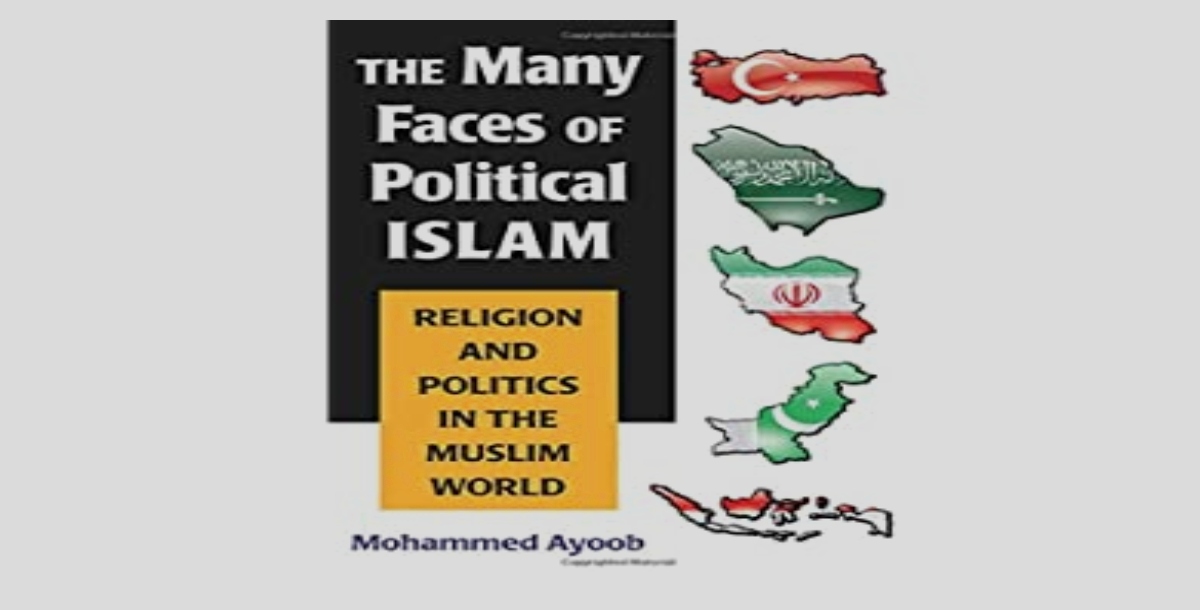
  • The Many Faces of Political Islam: Religion and Politics in the Muslim World

    The Many Faces of Political Islam: Religion and Politics in the Muslim World

    Click to Purchase

    Author: Mohammed Ayoob. The University of Michigan Press, 2007, 232 pp.

        One of the major misconceptions about Islam in the modern world, Mohammed Ayoob argues, is that it is a monolithic, inherently violent religion. The purpose of Ayoob’s book, in a nutshell, appears to be to rectify these misconceptions. He elaborates on the diverse nature of Islamist groups that currently exist or have existed in the past, shedding light on the divergent paths taken by them in order achieve their respective ideologies.

        A key argument brought forth is that a number of political groups with strict Islamist ideologies are turning towards pragmatism and opening up to the process of moderation and democratisation. Ayoob, a Distinguished Professor of International Relations at Michigan State University, repeatedly emphasises the importance of context, using meticulous case studies to augment his points. Additionally, he demonstrates how external factors, influences and interferences over the years have shaped the Middle East—specifically how the incomplete and forced process of state-making and nation-building is at the root of the unstable reality in a number of nations today.

    Style & Content

        The Many Faces of Political Islam provides a unique but crucial perspective that remains relevant today. It elucidates aspects commonly ignored by the mass media, and does so in a largely unbiased, objective manner. Ayoob, however, tends to downplay violent tendencies of the Islamist groups he talks about, including Hezbollah and Hamas. One might wonder why, but perhaps this is because it’s an aspect that audiences are already familiar with, having dominated global headlines particularly since 9/11.

        Incidentally, many historical aspects are presented in a summarised manner, such as the events leading up to the 1979 Islamic Revolution in Iran, or the characteristics of the Nasser, Sadat and Mubarak regimes and their respective relations with the United States. In this regard, basic knowledge about the region is required. Ayoob’s method of comparing and contrasting, his intricate detailing of the ‘where, when, why and how’ of various political groups and movements that have taken shape in the last couple of centuries further facilitates one’s understanding of the subject.

    Key Themes

        Ayoob states that the nature and intensity of the opposition depends upon and is directly proportional to the degree of repression created by the regimes in place. To reference one of the quotes employed in the book, one by Carrie Rosefsky Wickham: “political openings [even short of democratization] can encourage Islamist opposition leaders to moderate their tactics.” (p. 80, line 38)

        Several essential arguments, such as Islam being a non-monolithic religion, extremist factions being fringe elements whose agendas are only marginal to the pertinent issues that mainstream Islamist groups are concerned with, and how mainstream parties are moving in the direction of moderation and democratisation, are frequently recalled throughout the course of the book.

        Ayoob has produced a comprehensive, easy-to-follow analysis on the enormous diversity in a domain broadly categorised as political Islam. The book exemplifies how authoritative regimes, foreign occupation and external interference in the region have produced varied forms of opposition groups, and raises questions regarding the biased perception of Islam in present-day societies, particularly in the West. Those seeking to gain a nuanced understanding of the subject, as well as those harbouring opposing viewpoints, will find The Many Faces of Political Islam to be an enlightening read.