Category: Book Review

  • Book Review: Maritime Security in the 21st Century: Drivers and Challenges

    Book Review: Maritime Security in the 21st Century: Drivers and Challenges


    • Publisher ‏ : ‎ Routledge; 1st edition (April 28, 2014)
    • Author: Christian Le Mière – is a senior fellow for naval forces and maritime security at the International Institute for Strategic Studies, London.
    • Language ‏ : ‎ English
    • Hardcover ‏ : ‎ 160 pages
    • ISBN-10 ‏ : ‎ 0415828007
    • ISBN-13 ‏ : ‎ 978-0415828000


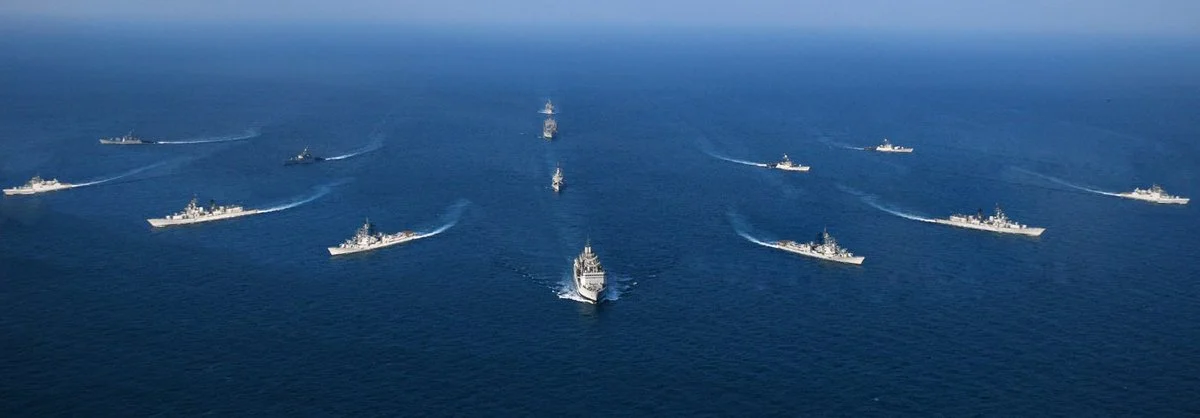
    Maritime diplomacy means using maritime capabilities, strategies, and policies to achieve diplomatic objectives and foster international relations. It encompasses various activities maritime nations conduct to promote their interests, maintain security, and manage disputes in maritime domains. Maritime diplomacy has evolved significantly over time, driven by changes in geopolitical dynamics, technological advancements, economic interests, and environmental concerns. Maritime diplomacy adapts to emerging issues, such as cybersecurity and environmental concerns, while balancing economic, security, and diplomatic interests. Christian’s book redefined the concept of maritime diplomacy, presenting it as a multifaceted approach to achieving diplomatic objectives and fostering international relations. In his interpretation, maritime diplomacy encompasses maritime nations’ activities to promote their interests, ensure security, and manage disputes within maritime domains.

    As a senior fellow for naval forces and maritime security at the International Institute for Strategic Studies, London, Christian Le Mière brings extensive expertise and insight to the field of maritime security.

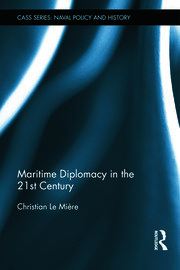
    “Maritime Diplomacy in the 21st Century,”[i] authored by Christian Le Mière, stands as a seminal work redefining the concept of maritime diplomacy in the contemporary era. Published in 2014, this book comprehensively explores maritime diplomacy’s significance, highlighting its relevance and utility amidst today’s complex geopolitical landscape. Le Mière’s analysis challenges conventional perceptions of maritime diplomacy, particularly debunking the notion of “gunboat diplomacy” as an outdated relic of the past. Instead, the book argues that coercive tactics persist in modern maritime affairs, profoundly shaping international relations.

    Le Mière’s emphasis on the distinction between “naval” and “maritime” diplomacy underscores a critical aspect of contemporary maritime affairs. Traditionally, the term “naval diplomacy” has been used to describe diplomatic activities conducted exclusively by naval forces. However, Le Mière expands this concept to include a broader range of actors and activities, recognizing the involvement of non-military agencies such as maritime constabulary forces and paramilitary agencies in maritime diplomacy.

    By incorporating these non-military entities into the framework of maritime diplomacy, Le Mière acknowledges the diverse spectrum of actors operating in maritime domains. Maritime constabulary forces, for example, are tasked with enforcing maritime laws and regulations, combating piracy, and conducting search and rescue operations. Paramilitary agencies, on the other hand, may be involved in maritime security operations or territorial defence activities.

    The involvement of these non-traditional actors highlights the complex interplay between various stakeholders in maritime diplomacy. Unlike traditional naval forces, maritime constabulary forces and paramilitary agencies often collaborate with civilian authorities, international organizations, and other non-state actors. Their participation in diplomatic endeavours at sea reflects the multifaceted nature of maritime diplomacy, which extends beyond military engagements to encompass a wide range of cooperative, persuasive, and coercive activities.

    The Book offers a rich exploration of the multifaceted nature of maritime diplomacy, drawing upon contemporary examples to illustrate its diverse spectrum of activities. One example highlighted in the book is Iran’s naval exercises, particularly the Velayat 90 exercises conducted in December 2011 and January 2012. These exercises showcased Iran’s naval capabilities, including anti-ship missiles and submarines, and were explicitly intended to signal Iran’s ability to exert control over the strategically vital Strait of Hormuz. Le Mière uses this example to underscore the continued relevance of coercive tactics in contemporary maritime affairs, emphasizing how such displays of naval power can have significant implications for global politics.

    Additionally, Le Mière examines US deployments in East Asia as another pertinent example of maritime diplomacy in action. Specifically, he discusses the participation of the USS Abraham Lincoln in naval exercises in the East Sea (Sea of Japan) and the Yellow Sea in response to provocations from North Korea. These deployments, accompanied by allied vessels from countries like Britain and France, signal Washington’s resolve and commitment to its regional allies while deterring further aggression from North Korea. Through these examples, Le Mière highlights the dynamic nature of maritime diplomacy, which encompasses a wide range of activities to achieve diplomatic objectives and maintain security in maritime domains.

    The book explores the theoretical underpinnings of maritime diplomacy, drawing upon insights from legal theorists like Wolfgang G. Friedmann. Le Mière argues that maritime diplomacy serves as a tool for signalling intentions, deterring conflicts, and promoting state interests but cautions that its failure can lead to unintended escalation.

    Chapters delve into the drivers and dynamics of maritime diplomacy, including its role as an indicator of global power shifts and a predictive tool for conflict prevention. Le Mière also explores the application of game theory to analyse maritime diplomatic incidents, providing insights into decision-making processes and strategies for managing potential escalations.

    It offers a multifaceted perspective on the evolving dynamics of maritime affairs and diplomatic engagements, making it a valuable resource across various domains. For scholars and researchers, the book provides a comprehensive analysis of maritime diplomacy, tracing its historical roots, examining contemporary manifestations, and proposing new theoretical frameworks. By delving into case studies and empirical data, scholars can gain insights into the complexities of maritime interactions and contribute to advancing knowledge in this field. Conversely, policymakers can leverage the book’s insights to formulate more informed maritime strategies, navigate geopolitical challenges, and promote international cooperation. With a nuanced understanding of the spectrum of maritime diplomacy, policymakers can effectively utilize naval deployments, diplomatic initiatives, and conflict resolution mechanisms to safeguard national interests and foster regional stability. The book offers practical guidance and real-world examples for practitioners engaged in maritime security and diplomacy, helping them navigate complex maritime disputes, leverage maritime assets for diplomatic purposes, and manage tensions in maritime regions.

    Moreover, students studying international relations, maritime security, or diplomacy can benefit from the book’s comprehensive coverage. It can be used as a textbook or reference material to deepen their understanding of maritime affairs and global politics. Ultimately, “Maritime Diplomacy in the 21st Century” is an indispensable resource, informing policy debates, guiding practical decision-making, inspiring further research, and educating future leaders in maritime diplomacy’s complex and dynamic realm.


    References:

    [i] Maritime Diplomacy in the 21st Century, n.d.


    Feature Image Credit: indiafoundation.in
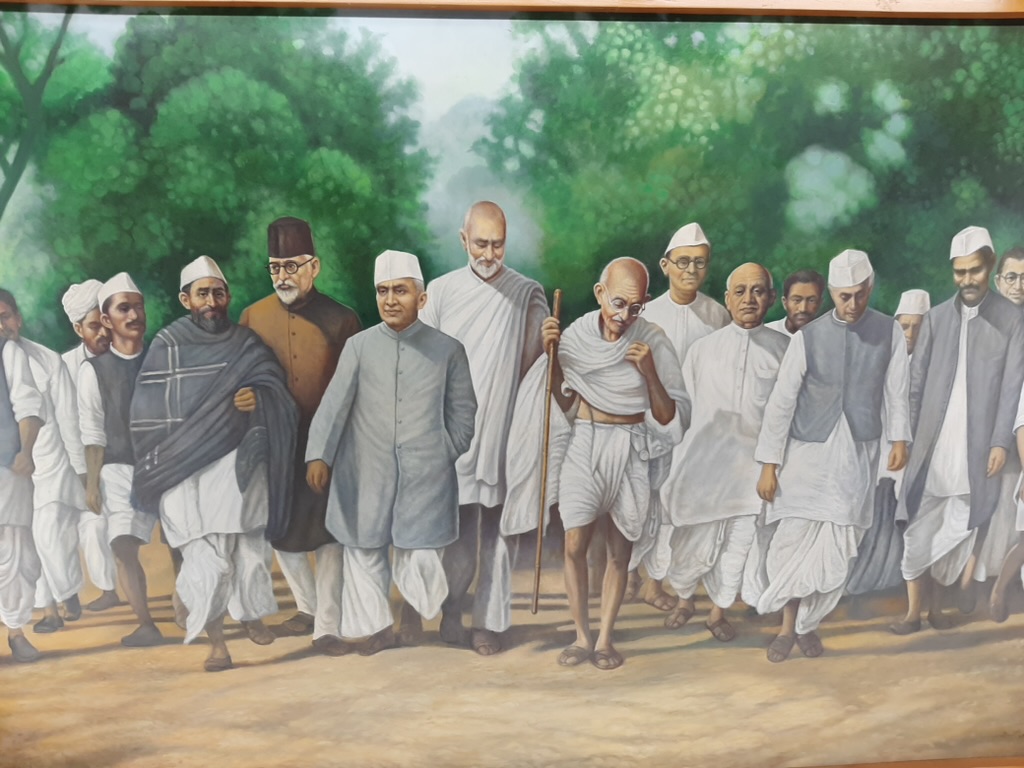
     

  • How viable is Gandhi’s village today?

    How viable is Gandhi’s village today?

    In a deeply troubled world, M.K. Gandhi’s vision for the village may offer a viable alternative, but is it too idealistic a solution?

    THE world is in flux. Climate change-induced extreme weather events such as cyclones, forest fires, droughts, and unseasonal heavy rains have increased in number and intensity. Old wars are becoming chronic and new ones are breaking out at a worrying pace. Inequality is becoming even more extreme, which is clearly visible.

    The world is looking for an alternative. Could Gandhian thought provide a way out?

    In this context, the Gramshilpi programme of Gujarat Vidyapith, based on Gandhian thought, is worth studying to understand whether a non-violent development path based on a bottom-up approach can provide a viable alternative.

    The author Neelam Gupta, a journalist by trade, was commissioned by Gujarat Vidyapith to study the programme and write about it. The book under review is the result of that effort.

    Gandhi, in Hind Swaraj, calling Western Civilisation “evil”, said that Indian civilisation could provide an alternative. He suggested that the alienating Western education system had to be replaced by ‘nai talim’ (new education).

    He set up Gujarat Vidyapith in Ahmedabad in 1920 to teach an alternative curriculum in tune with his conception of education. He believed that this could lead to more meaningful higher education in India. If it succeeded, it could be replicated and change India’s education system.

    The Gramshilpi programme of Gujarat Vidyapith based on Gandhian thought is worth studying to understand whether a non-violent development path based on a bottom up approach can provide a viable alternative.

    Did he succeed?

    In a world that is increasingly following the principles of marketisation that run contrary to Gandhian principles, the experiment has faced huge difficulties.

    Between 1920 and 1965–70, around 100 youth who graduated from the Vidyapith went to remote and backward areas and lit the flame of new thinking. After 1965–70, even though the number of graduates increased, fewer and fewer of them went to the villages and, finally, the flow stopped.

    The Vidyapith becoming a University Grants Commission (UGC) institution in the 1960s changed the composition of teachers as they had to be selected as per the UGC norms and often were not in tune with Gandhian ideas.

    The emergence of foreign-funded non-governmental organisations (NGOs) engaging in projects-based work changed the attitude of the students. They did not want to stay in the villages to bring about change through collective endeavours. Students from the villages who came to the cities did not want to go back. Even their parents did not want them to return to the villages.

    Start of the programme

    The triumvirate of Arun Dave, Sudershan Ayengar and Rajendra Khimani was in place in Vidyapith in 2005. They felt that an attempt should be made to change the thinking of the youth via appropriate training.

    The result was the start of the Gramshilpi Yojana in 2007. The Centre for Environment Education was also roped into the scheme since it had been working in the rural areas. The programme design evolved over the next five years to take its final shape.

    The scheme had three important components. First, the gramshilpi (literally village sculptor, as in, shaper of the village) would stay in a village of his choice for the rest of his life. Second, their expenses of stay would be borne by the village. Third, Gujarat Vidyapith would always stand by the gramshilpi. The goal of the scheme was to transform the village as per Gandhi’s vision of Gram Swaraj.

    Author’s experience

    The author has produced the book based on an extensive survey of the work of the Vidyapith and visits to the villages of the gramshilpis. The project started in 2018. She wanted to understand the motivation of these people who were foregoing a comfortable city life for one of struggle in a village.

    She faced difficulties in assessing the impact of the work of gramshilpis since there was no primary or secondary data. The gramshilpis did not remember the details of the work done earlier and language was a barrier in talking with the villagers to get their perspective.

    The Vidyapith assigned Praveen Dulera to travel with the author and help her. This, to an extent, helped overcome the language barrier. However, the villagers were often reluctant to talk or could not explain what they had in their minds.

    Gandhi, in Hind Swaraj, calling Western Civilisation “evil”, said that Indian civilisation could provide an alternative. He suggested that the alienating Western education system had to be replaced by ‘nai talim’ (new education).

    Three to four days were spent in the village of each gramshilpi. The author felt this was inadequate to interview the gramshilpi, and meet the villagers and the officials to get their feedback and perspective.

    Achievements of the programme

    Some of the achievements of the programme listed by the author are:

    a) Decrease in the dropout rate of children

    b) Higher retention by children

    c) Change in the way teachers teach

    d) Parents understanding the importance of education, especially for girls

    e) Positive impact on the life of abandoned children

    f) Reduction in poverty as a result of mixed cropping

    g) Reduction in indebtedness and suicide among farmers

    h) Improvement in the status of farmers as their income increased.

    This is an impressive list of impacts on the life of the villages where gramshilpis were working.

    The gramshilpis and their work

    Between 2007 and 2015, 52 people came to join the Gramshilpi programme, 37 took instructions, but only 10 became gramshilpis. Most left within two to three years, and a few were found to be unsuitable and asked to withdraw. Those who left did so since economic security was not assured and life would be one of struggle.

    Most of the pages of the book describe the experiences of the gramshilpis. It emerged that there was no one model of development that the gramshilpis followed since the situation faced by each of them varied from village to village. So, the programme for each had to be tailor-made to the prevailing village conditions.

    The work of nine of the gramshilpis is described in detail. Their personal challenges, the village situation and the challenges, and how they were met are well described.

    So, who are these courageous and determined people?

    Jaldeep Thakur and Dashrath Vaghela are based in North Gujarat in areas close to the Rajasthan desert. These are poor and backward areas. Ashok Chaudhury, Ghanshyam Rana, Jettsi Rathor, Gautam Chaudhury, Neelam Patel and Mohan Mahala are based in South Gujarat, which has plenty of rain and is hilly. This is also the area from where Gandhi emerged. Radha Krishna is based in Agra district of Uttar Pradesh.

    Assessment of the programme

    The author says that though the programme is only 13 years old, the period is long enough to assess it. The most important issue was, how much has the programme enhanced peoples’ awareness? Especially since the idea underlying the programme was to do social work via social involvement.

    She finds that the inspiration to join the programme came from Gandhi’s thought which the gramshilpis became aware of in the Vidyapeeth. The training turned the idea into a resolve to go to the villages. Broadly speaking, the gramshilpis worked on two fronts— social and economic.

    The emergence of foreign funded non-governmental organisations (NGOs) engaging in projects-based work changed the attitude of the students. They did not want to stay in the villages to bring about change through collective endeavours. 

    The education of children was a major component of social activity. Not only did this impact the children, but even the attitude of the parents changed. The educational programme was based on Gandhi’s nai talim.

    But the author rues that the education did not prepare the children to work in the forest and in agriculture and, through that make a living.

    Health and cleanliness was another important social issue. However, the author says that consciousness about keeping the entire village clean could not be created. On the health front also, there was a limited success, with women continuing to suffer and superstition (andhvishwas) persisting. Limited success was achieved in improving nutrition and reducing addiction to drinking and smoking.

    The work on the economic front helped improve family incomes and the way work was traditionally done. For instance, farming changed to mixed cropping. Consequently, indebtedness decreased.

    Adulteration of mustard oil decreased when one Radhakrishan set up a mill at home and sold the oil at a lower profit margin. Other suppliers changed their approach. A person named Jaldeep set up a women’s milk cooperative, which gave women self-confidence, and this changed the attitude of the entire village. Violence towards women declined, and in Gandhi’s words, ‘the mute got a voice’.

    Other economic activities included making pickles, producing organic manure, preparing youth for facing interviews for jobs, forming youth self-help groups for farming and creating minor irrigation facilities.

    However, the author points out that while the farmers came together, they did not get organised. Further, due to rising expectations, marketisation, taking of loans and changes in food habits increased.

    Conservation of water could not be made a part of good practices. Rather than making people independent, many became dependent on the gramshilpis for help. Though in some villages, the situation of women improved in totality, they remained at the margins.

    The author asks, “Gramshilpis have done great work, but why are there deficiencies?”

    She identifies several causes. Setting up trusts by gramshilpis for their work made the villagers dependent on outside donations.

    Next, she identifies several shortcomings in the training imparted to gramshilpis. First, they needed more hands-on experience in village life. Second, gramshilpis were not trained in self-assessment. They did not keep a diary of their work which could help them assess their progress and failures. Thus, they did not prepare an annual report. They did not often remember what they had done earlier. Third, they were not trained to become economically self-sufficient in the village. Finally, they did not develop a holistic perspective of village life.

    Conservation of water could not be made a part of good practices. Rather than making people independent, many became dependent on the gramshilpis for help. Though in some villages the situation of women improved in totality they remained at the margins.

    The author also points to the positives of the programme. First, the autonomy that the gramshilpis had in pursuing their goals. This helped in commitment, creativity, self-correction and leadership.

    Second, the flexibility of the programme. Gujarat Vidyapith kept changing its view as difficulties arose. For instance, initially, it had decided to support the gramshilpis for two years only, but later as difficulties arose, this period was extended.

    Third, guidance from Vidyapith was always available in case of difficulties. Three meetings of all gramshilpis are held annually to collectively exchange ideas and assess the difficulties.

    The author says that at the end of the process, she could appreciate the importance of Gandhi’s work. She also understood that with commitment and principles, even in today’s materialistic world, educated youth can work in the villages with the idea of service.

    Further, if the basis of development is swavalamban and atmanirbharta, solutions to the country’s and world’s problems can be found.

    The author says that at the end of the process, she could appreciate the importance of Gandhi’s work. She also understood that with commitment and principles even in today’s materialistic world, educated youth can work in the villages with the idea of service.

    The author offers constructive suggestions to improve the programme. These relate to improvements in training, arrangements for stay in the village, how to organise and create cooperatives, creation of leadership among women and how to improve marketing skills.

    There are also suggestions regarding education, health, nutrition, protection of the environment and an increase in local production.

    The book is about the difficulties in the present-day world in fulfilling Gandhi’s idea of creating swaraj due to the dominant process of marketisation. So, it is a must-read for all those interested in alternatives to the present systems.


    This Review was published earlier in theleaflet.in 

    Feature Image Photo: from Sabarmati Ashram Museum

  • Milan Kundera’s ‘remarkable’ work explored oppression, inhumanity – and the absurdity of being human

    Milan Kundera’s ‘remarkable’ work explored oppression, inhumanity – and the absurdity of being human


    Milan Kundera, that remarkable novelist, essayist, poet, philosopher and political critic, has died at the age of 94. It feels too soon, perhaps because in everything he wrote, he opened up new ways of thinking, writing and reading. In his literary presence, the world seemed tuned to a higher frequency.

    Kundera was born with immaculate timing, on April 1 (1929): April Fool’s Day. From the start, he was exposed to, and immersed in, the absurdity of human culture. He grew up in Nazi-occupied Czechoslovakia, then lived under Stalinist rule, where he was an active member of the Communist Party.

    I have been reading him, quoting him and teaching from his writings for decades, after bumping into his work in 1988. I was living then on an isolated sheep station in the Western Australian outback, a world of bleak beauty.

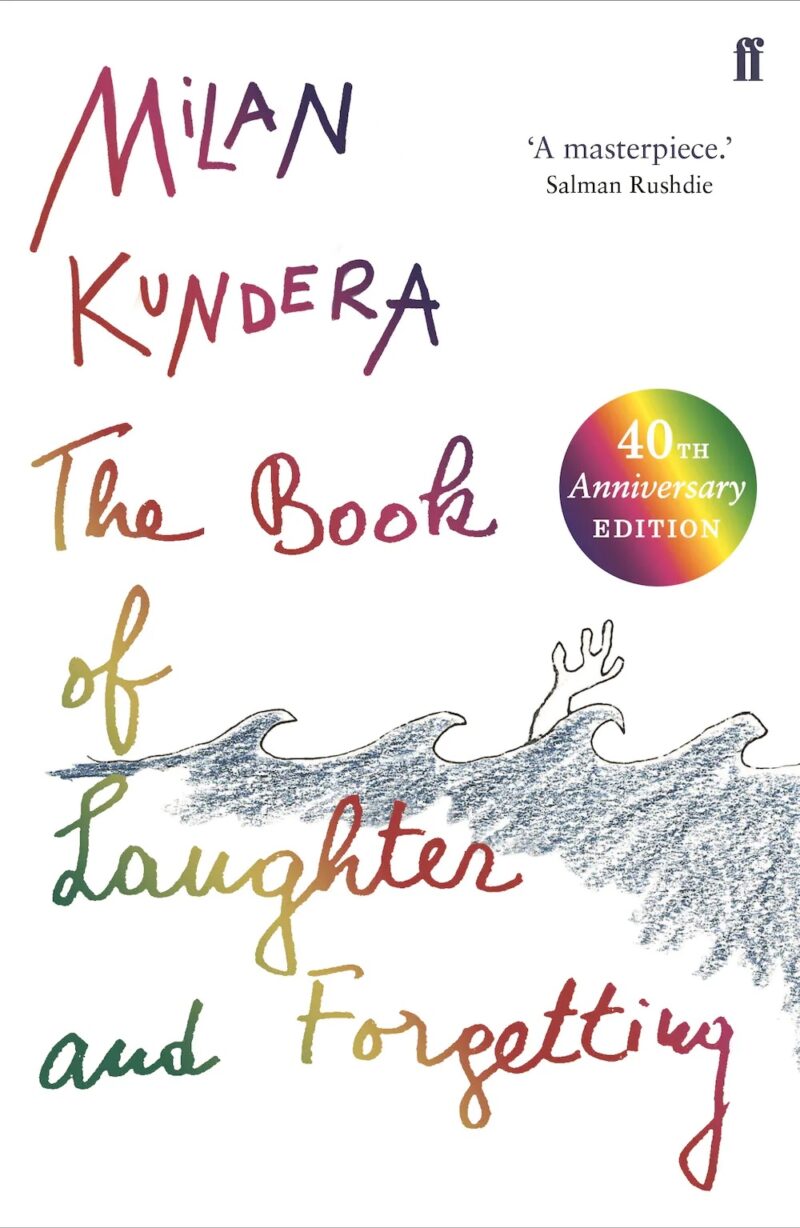
    Someone visiting the property pressed on me a copy of The Book of Laughter and Forgetting, and I was immediately and utterly captivated. This, Kundera’s third novel, affirmed my own anxiety of the absence of a stable truth, and of my incapacity to resist the longing to belong, even to the most damaged society.

    In one section of the novel, a group of the Communist faithful, dancing together in a circle, rise into the air and soar over the city. They laugh the laughter of angels while below them, the executioners are killing political prisoners. Says the narrator of this section, who necessarily cannot be part of that group:

    I realized with anguish in my heart that they were flying like birds and I was falling like a stone, that they had wings and I would never have any.

    Interrogating totalitarianism, with humour

    Kundera knew about oppression and inhumanity. His first collection of (not very good) poetry, Man, A Wide Garden (1953) – published when he was only 24 – was decidedly Soviet in tone and content.

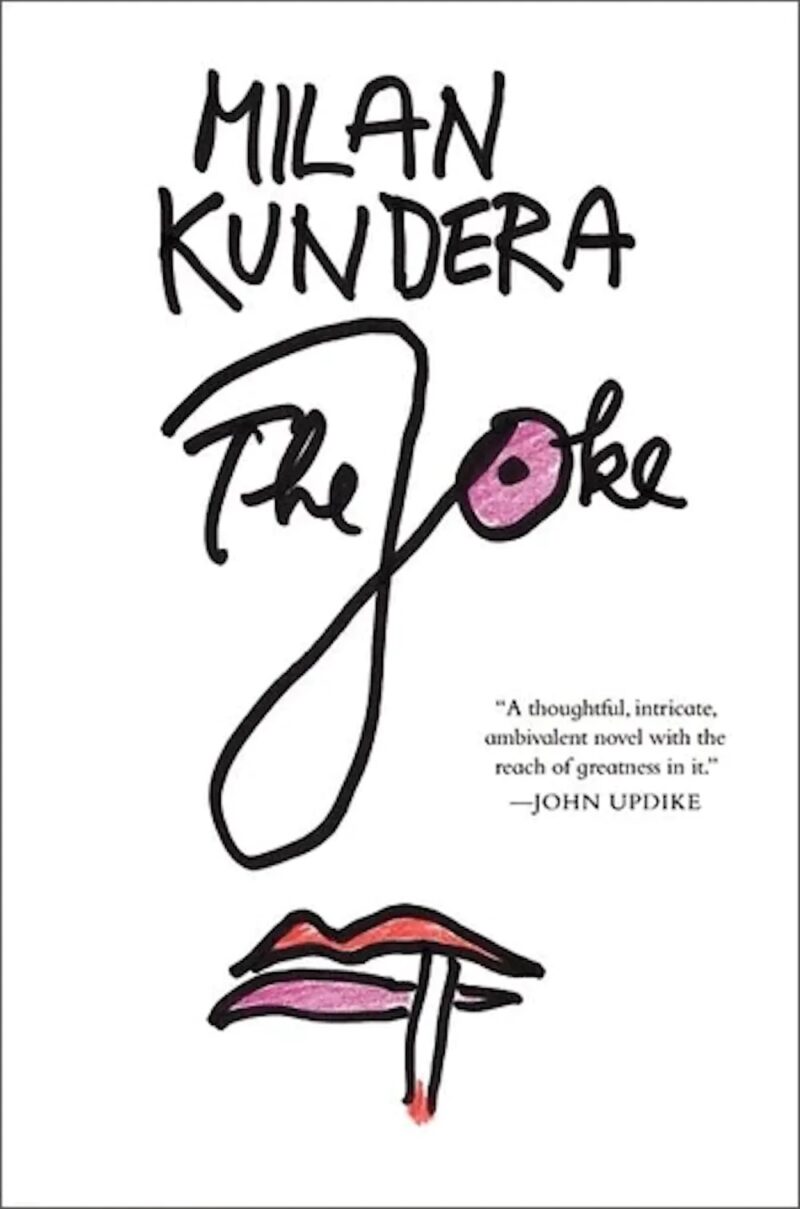
    But when he wrote his first novel, The Joke in 1967, then wrote Life is Elsewhere in 1969 (published in 1973), both of them shot through with political satire, and he was expelled from the Communist Party and subsequently fled into exile.

    In what is perhaps his best-known novel, The Unbearable Lightness of Being (1984) – adapted in 1988 as a movie starring Daniel Day-Lewis and Juliette Binoche – he continues his interrogation of totalitarian politics, exploring the Prague Spring and the brutality of Soviet control of Czechoslavakia.


    This theme sounds deeply earnest. But in each novel, Kundera offers some humour – often bitter, but capable of leavening the otherwise bleak, and densely reported, content.

    In Unbearable Lightness, for example, the narrator discusses Nietszche’s doctrine of eternal recurrence – the possibility we live the same life over and over. But he also develops an erotic narrative that seems to suggest lighthearted sex can allow us to live fully in the moment. We can exchange the weight of eternal recurrence for the lightness of being alive, here and now.

    Weight and lightness, laughter and forgetting, repetition and change, politics and sex: his first four novels incorporate such dualities. Perhaps this capacity to hold contradictory thoughts can be explained by something he said to Philip Roth:

    Totalitarianism is not only hell, but also the dream of paradise – the age old drama of a world where everybody would live in harmony.

    Author in exile

    His dream of paradise was not realised, of course. In 1975, he fled his home for exile in France, and continued writing works of fiction that mostly followed the signature structure he first developed in The Joke: multi-part, multi-voiced novels, where the narrator interpolates critique, commentary and philosophical statements in the text.

    This makes for a restless story, one that shifts to and fro across locations, times and contexts. Characters flicker in and out. The logic of beginning, middle and end is barely acknowledged. And the sorts of issues that appear so often in fiction – a quest for the self, the telling of a tale, the achievement of resolution – are set aside.

    The focus of Kundera’s novels is their wrestle with questions of knowledge, the complexity of being and a constant uncertainty. This can be an unsettling style: a disruption, rather than a simple pleasure or an aesthetic experience. For a 21st-century woman, too, his tone and style in the writing of sex scenes – and the representation of women more generally – can present as outdated masculinity.

    I vacillate between feeling offence at what feels like misogyny, and reading it as a searing critique of misogyny. And I’m not alone in this.

    ‘Things are not as simple as you think’

    Where I uncomplicatedly follow Kundera’s lead is not in his novels, but in his essays. Here, his deep understanding of the background to what we now know as the novel, or the long traditions and changes that characterise artistic practice, genuinely illuminate the field.


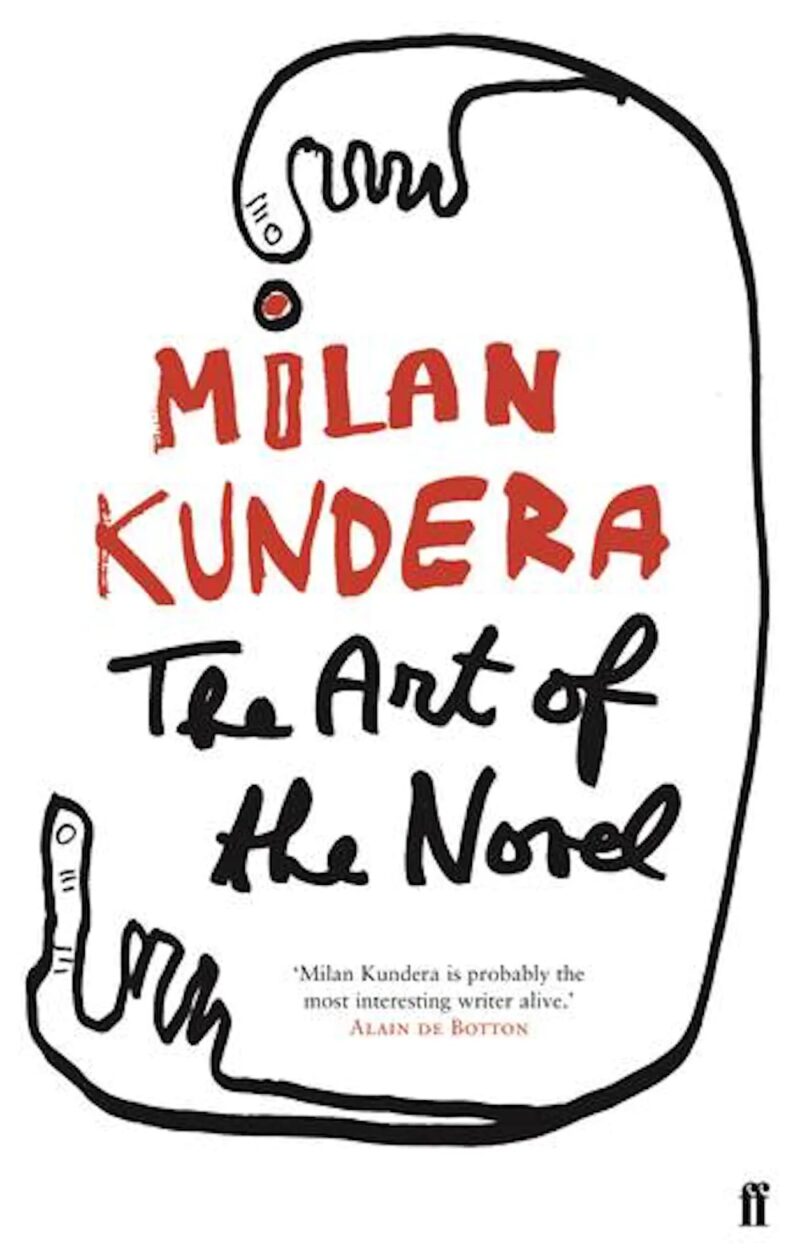
    In The Art of the Novel (1986), he outlines a history of how novelists unpacked various dimensions of existence. He starts with Miguel de Cervantes and moves through the lists of generative fiction writers to fellow Czechs Franz Kafka and Jaroslav Hasek – who, he claims, show that a strength of fiction is that it tolerates uncertainty, in a way politics and religion cannot. For Kundera, what fiction does so well is say to the reader: “Things are not as simple as you think.”

    For Kundera, the novel is a technological object that allows new ways of seeing, and of making meaning. And this seeing and meaning is embedded in its context. For example, in The Curtain: An Essay in Seven Parts (2006), he points out what fiction can do that earlier forms could not.

    Homer never wondered whether, after all their many hand-to-hand battles, Achilles or Ajax still had all their teeth. But for Don Quixote and Sancho teeth are a perpetual concern – hurting teeth, missing teeth.

    Writers like Cervantes (author of Don Quixote), Henry Fielding (Tom Jones) and Laurence Sterne (The Life and Opinions of Tristam Shandy, Gentleman) introduce the small things of everyday life, and illuminate the meaning and import they have on us, Kundera points out.

    But, he hastens to observe, contemporary writers cannot and should not write as those giants did: rather, writing is a matter of continuity (in terms of form, voice and style in a particular period) and discontinuity (finding something new).

    In these essays, too, he offers a workshop in how to write. How to manage voice, perspective, temporality. How to have fun with language and form – and let the imagination run wild. And how to deal with thought and concept, materiality and politics.


    A condolence book and portrait of late writer Milan Kundera at the Milan Kundera Library in Brno Czech Republic T. Tomas Skoda/EPA

    Teller of inconvenient truths

    A writer of such gravitas and such technical brilliance should, one might imagine, have won the Nobel Prize in Literature at some point in his long life. He won other prizes, after all, among them the Jerusalem Prize in 1985 and the Herder Prize in 2000.

    Perhaps it was his writing style that meant the Nobel committee saw him nominated on a number of occasions, but never awarded him the prize.

    After the last novel he wrote in Czech – Immortality (1991), which teases out questions of sexual and personal relationships – he wrote four more novels, which garnered less attention, less critical reception. So, in Slowness (1995), Identity: A Novel (1999), Ignorance (2000) and finally The Festival of Insignificance (2014), you can see his star begin to fade.

    This is not because they are less “good” books. Robin Ashenden suggests he “had become a teller of truths inconvenient to the modern age”, and maybe there is something in that.

    He is terribly direct, very hard-hitting. And he refuses the consolations of sentimentality or morality, in favour of what he describes as the morality of knowledge: the imperative to see and say what previous writers did not/could not see, or say. And to build fresh understandings of the world.

    This article was first published in The Conversation and is republished under Creative Commons license.

  • An Identity Crisis: Book Review of “The Battle of Belonging”

    An Identity Crisis: Book Review of “The Battle of Belonging”

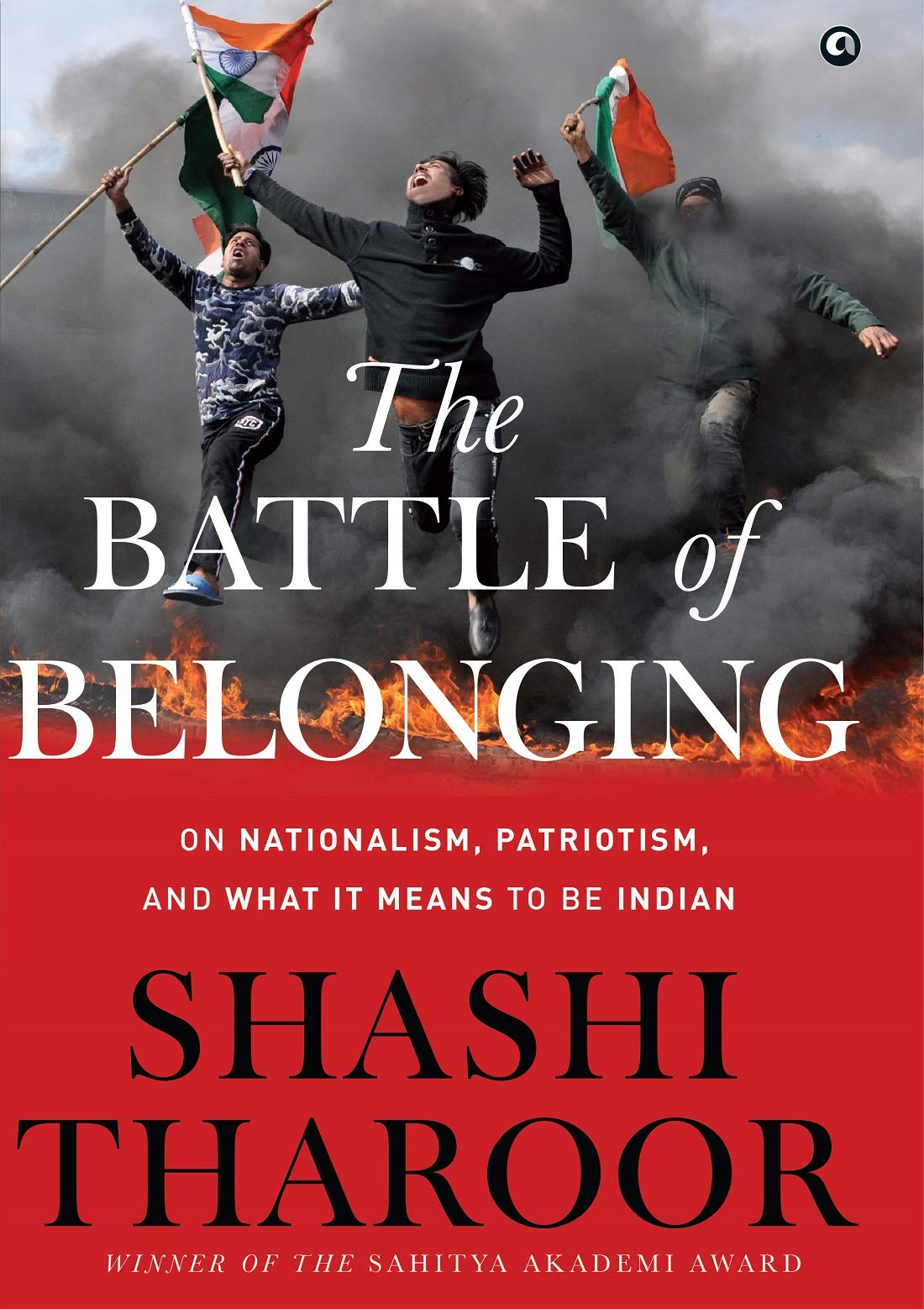
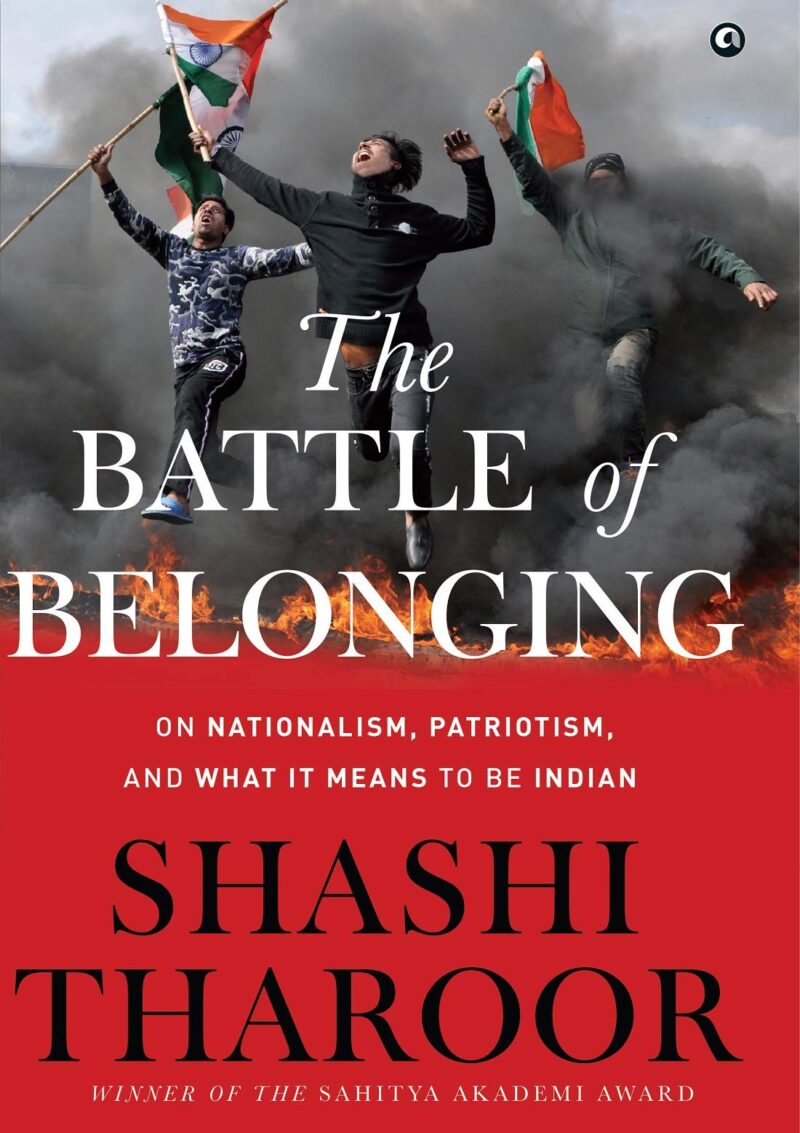
    Book Name: The Battle Of Belonging: On Nationalism, Patriotism, And What It Means To Be Indian

    Author: Shashi Tharoor

    Publisher: Aleph Book Company

    Year of Publication: October 2020

    Pages: 462


    The cataclysm of Right-wing extremism has seized global politics. From the United States to Britain and New Zealand, the agenda appears dominant. Among them, in the present context, India is no exception. From cow vigilantism to scathing attacks on minority groups, the question of what it means to be an Indian is contested and debated as never before. Dr Shashi Tharoor, Member of Parliament for the Tiruvananthapuram constituency, in his latest book, ‘The Battle of Belonging’ attempts to redefine what exactly it meant to be an Indian and addresses the present identity crisis in India. Dr Tharoor writes about the subtle mechanism which provides more space for civic nationalism in India in the present times.

    From multiple angles, The Battle of Belonging comes out as a sequel to his previous books, ‘Why I am a Hindu’ and ‘The Paradoxical Prime Minister’. In this book, Tharoor addresses the concept of nationalism and patriotism. According to him, the concept of nationalism in India is flawed unlike the concept of nationalism enshrined in the Indian constitution. Through this book, the author asks the readers to dive into the Indian constitution and understand its rationale. He raises key questions such as, ‘has India’s nationalism really been reshaped?’ and stresses the pitfalls that India would face in the future as the plague of extremism spreads. He also envisions a space for civic nationalism, as envisioned by Mahatma Gandhi, Jawaharlal Nehru, B R Ambedkar, and Rabindranath Tagore. The book is divided into six volumes and each section narrates the evolution of nationalism till the current phase.

    According to Tharoor, civic nationalism is cemented on the principles of liberal democracy and equality for all. However, ethnic nationalism or ethnocentric nations erode these principles and peddles a path for Majoritarianism.

    In the first phase, Tharoor unravels the evolution of the concept of ‘Nationalism’ and distinguishes it from the concept of ‘Patriotism’. To furnish a literary overview of the concept, the author espouses the visions of Kautilya, Thomas Hobbes, Ernest Hemmingway, Jawaharlal Nehru, Mahatma Gandhi, and Rabindranath Tagore. He also takes insights from his former diplomatic career. In this very section, Tharoor offers different typologies of nationalism. Among them ‘ethnic nationalism’ and ‘civic nationalism’ dominates the discourse. According to him, civic nationalism is cemented on the principles of liberal democracy and equality for all. However, ethnic nationalism or ethnocentric nations erode these principles and peddles a path for Majoritarianism. Throughout the book, he lashes out at the ruling Bhartiya Janata Party (BJP) for breaking the fabric of civic nationalism.

    The second section of the book is vast and extensively researched. In this section, the author gleans several facts on the concepts of unity in diversity. The book also extensively discusses the difference between Hinduism and Hindutva, where the Rashtriya Swayamsevak Sangh (RSS) is fabricating a new ethos of Hindu Dominance. The book also advances in a way all Indians are a minority in one way or other from a vantage point of view. The author raises the question of an individual’s right to choose his identity regardless of his caste, gender, or whatsoever criteria. 

    The third section explores the Hindutva version of India, investigating how right-wing fringe groups attempt to fabricate a dawn of Hindutva society, where minorities are pushed aside. Here in part, the author delves into the philosophies of Savarkar, Golwankar, and Deen Dayal Upadhaya and how they opposed the Indian constitution. B R Ambedkar envisioned a society that opened space for all. On the other hand, the aforesaid champions envisioned a ‘Hindu Rashtra’, that was contrary to the ideas of Gandhi, Nehru, Ambedkar, and Tagore. In this section, Tharoor speaks on one of his controversial comments, ‘Hindu Pakistan’. He expresses his prolonged anxiety about the possibility of India turning into an autocratic nation like Pakistan. Even though the concept is far-fetched, the ruling party’s majority in the lower house provides no guarantee in this matter.

    India has a prolonged history of accommodating persecuted minorities, whether it be Jews, Parsis and Bangladeshis, and offering them a platform to instil their roots in India and be a part of the nation.

    The fourth section of the book talks about recent events such as the abrogation of Article 370 in Jammu and Kashmir, the Citizenship Amendment Act (CAA), the issue of the National Register of Citizens (NRC), the act of imposing Hindi on the non-Hindi speaking states and the case of the Ayodhya Ram temple. Tharoor condemns the act of imposing Hindi onto the shoulders of non-Hindi speaking states. He also questions the flag bearers of Hindi on whether they will dare to take up the challenge of learning another language other than Hindi.

    The CAA and the NRC shook the nation, creating a wave of panic among citizens. The author claims that the freedom struggle of India was to secure a nation that accommodated all, regardless of their identity. India has a prolonged history of accommodating persecuted minorities, whether it be Jews, Parsis and Bangladeshis, and offering them a platform to instil their roots in India and be a part of the nation. It is also an evident reality that the documentation system is a flawed mechanism and that the poor and uneducated who are not aware of this mechanism are the ones who will suffer in the process of NRC. Tharoor claims that these acts of the ruling party are against the concept of liberal constitutionalism.

    He later discusses the much-debated Kashmir issue. This piece clearly indicates just how well-versed Tharoor is in the Constitution of India. Tharoor strongly condemns the act of abrogating Article 370 without consulting the cabinet members and the manner it was passed in the parliament. The author sees it as a clear violation of democracy. Subsequently, the author discusses the Ayodhya dispute. He sees the verdict as dubious, where the demolition of the mosque is condemned as ‘criminal vandalism’ and on the other side, the land is awarded to the ones who perpetuated the act. He also sees this act as remoulding India against the backdrop of Hindutva ideology.

    India is a nation that accommodates all sorts of diversity, and it is a sheer act of intolerance, where a majoritarian idea is imposed over a minority group.

    In the sixth section, the author addresses the ‘Anxiety of Nationhood’, where Indian nationalism is undergoing fundamental changes. Shashi Tharoor, in the first part of this section, narrates the stark contrast between the idea of Hinduism by Mahatma Gandhi and the current Hindutva ideology. Gandhi was a champion of inclusive nationalism.  He even went to the extent of declaring himself as an amalgamation of all religions. His views are very relevant in today’s climate of intolerance. Tharoor, then takes up the contest between the concepts of Bharat and India. The author strongly condemns fringe groups asserting their ideology. India is a nation that accommodates all sorts of diversity, and it is a sheer act of intolerance, where a majoritarian idea is imposed over a minority group. He also claims that the crux of Indian thought is liberal and tolerant in nature which accepts all faiths as its own.

    The author raises a key question on whether the constitution will be able to tame the Hindutva monologue in the present circumstances. Going further, Tharoor narrates how the right-wing groups condemned the constitution for being anglophone in context and their belief that the constitution does not resonate with the Hindu culture of India. Tharoor also raises his apprehension regarding a Hindutva infused constitution on the pile of a majoritarian ideologue. In the Conclusion, the author also explores how the internet has wrapped India into its network. It is indeed true that social media aids Indians to socialise and raise various issues with the public. However, on the flip side, the author also points out and condemns the social media groups that play an active role in spreading fake news and in inciting violence.

    In the final part, Tharoor speaks on how the soul of India can be reclaimed. Here, the author dwells on the ethos of Indian Nationalism that is built on the foundation of diversity and pluralism, and how it is now being tampered with, and how it can be retrieved. Tharoor raises the clarion call against ethno-religious nationalism, which would distort the future of India’s democracy. He also asserts that it is the responsibility of Indians to reclaim India’s diversity and plurality. He foresees an India that respects all regions with patriotism stemming from unity.

    Shashi Tharoor’s ‘Battle of Belonging’ would definitely interest those who love to analyse facts and information thoroughly. It is indeed a thoroughly researched book, and his arguments are supported by a vast amount of facts. The most interesting aspect of this book is the way Tharoor has sewed his thoughts with impeccable and strong language. To summarise, the book takes the reader through the soul and heart of India.

  • The New World and the Ukraine-Russia Breadbasket – Book review of “Oceans of Grain”

    The New World and the Ukraine-Russia Breadbasket – Book review of “Oceans of Grain”

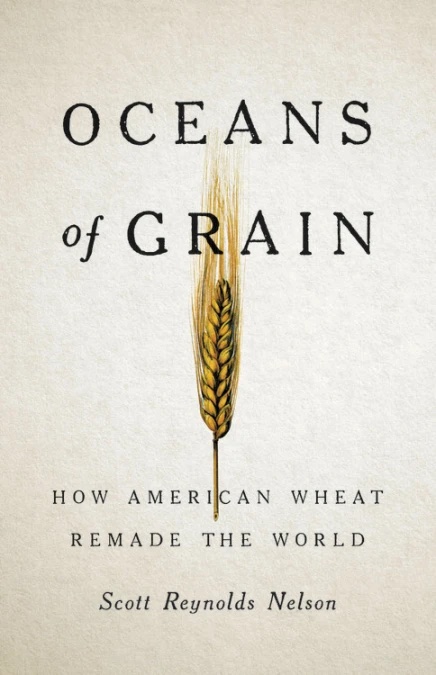
    To understand the rise and fall of empires, we must follow the paths travelled by grain—along rivers, between ports, and across seas. In Oceans of Grain, historian Scott Reynolds Nelson reveals how the struggle to dominate these routes transformed the balance of world power. Early in the nineteenth century, imperial Russia fed much of Europe through the booming port of Odessa, on the Black Sea in Ukraine. But following the US Civil War, tons of American wheat began to flood across the Atlantic, and food prices plummeted. This cheap foreign grain spurred the rise of Germany and Italy, the decline of the Habsburgs and the Ottomans, and the European scramble for empire. It was a crucial factor in the outbreak of the First World War and the Russian Revolution.
    A powerful new interpretation, Oceans of Grain shows that amid the great powers’ rivalries, there was no greater power than control of grain.

    Thomas Grennes reviews the book ‘Oceans of Grain’ by Scott Reynolds Nelson. The book is very timely, given the emerging food crisis as a result of the blockade of the Black Sea ports that hampers the export of grain from the major exporters,  Ukraine and Russia.


    Book Title – Oceans of Grain: How American Wheat Remade the World

    Author – Scott Reynolds Nelson

    Publisher – Basic Books

    Page Count – 368 pages

    Date Published – Feb 22, 2022


    The Russian invasion of Ukraine has reminded the world that war in Europe isn’t just the stuff of history books. It also demonstrates how war can affect the world’s food supply, as both Ukraine and Russia have long been major global suppliers of wheat and other grains.

    This makes the new book Oceans of Grain, by University of Georgia history professor and Guggenheim fellow Scott Reynolds Nelson, especially timely. Nelson has written five other history-oriented books, including the award-winning Steel Drivin’ Man: John Henry, the Untold Story of an American Legend and A Nation of Deadbeats: An Uncommon History of American Financial Disasters.

    Oceans of Grain covers some 14,000 years of human history, beginning with the origin of bread, with an emphasis on the era in which the modern wheat market developed, from the 18th century to the end of World War I.

    New World food / The book focuses on the breadbaskets of the United States, Russia, and Ukraine, though it also gives a little attention to Canada, Argentina, and Australia, and passing mention of South and East Asia. Nelson often writes as if Russia and Ukraine are one land, in part because the border between them has shifted many times throughout history. His use of the word “grain” is nearly synonymous with “wheat,” though he does offer limited discussions of corn (maize), oats, barley, and rice.

    Grain has been crucial to human life for millennia. Expressions such as “Bread is the staff of life” and prayers such as “Give us this day our daily bread” illustrate the historical importance of bread and wheat. Technical change that has raised productivity in grain production has increased the standard of living for hundreds of millions of people, and negative shocks to the grain sector have caused crises and wars.

    Expansion of grain production in the 19th century to the then-newly settled regions of the United States, Canada, Argentina, and Australia greatly benefited grain consumers around the world, but it harmed traditional producers in Russia and elsewhere. The benefits for Europe were previously described in a 1997 Journal of Economic History article by Kevin H. O’Rourke as the “distributional effects of Christopher Columbus.” According to O’Rouke, transport innovations such as steamships and railroads “exported New World land to Europe, embodied in New World food.”

    Geography and transport / Geography has been crucial to the location of grain production and the pattern of world grain trade. The fertile chernozem (Russian for “black soil”) of Ukraine, parts of Russia, and neighboring lands were conducive to early grain production. Ancient “black paths” used by oxcart drivers led from the interior of Ukraine to Black Sea ports. Centuries ago, grain was shipped through the Turkish Straits on both ends of the Sea of Marmara to the Aegean Sea and then onto the ancient Greek and Roman civilizations along the Mediterranean. Control of those straits, the Bosporus and Dardanelles, has long been crucial and has led to many wars involving Russia and Turkey. Even today, following the Russian invasion of Ukraine, access to the Turkish Straits by Russian ships is a crucial military issue.

    Transport innovations have had a major effect on the pattern of world trade. Improvements in navigation and sailing ships were followed by the transition to steamships. The development of Odessa on the Black Sea was a major contributor to Ukrainian grain exports. Grain ports have been described as the children of empires, and Nelson points out the Greek term emporion — “marketplace” — is the etymological root of both “emporium” and “empire.”

    Other innovations also played important roles. Improvements in communication, such as the telegraph and undersea cables, aided long-distance trade. Improvements in explosives (nitroglycerin) contributed to the construction of deep-water harbors that can handle bigger ships. Better explosives also helped build the Suez Canal. Completed in 1869, it reduced travel time from London to Calcutta from six months to 30 days. The shortcut from the Mediterranean Sea to the Indian Ocean permitted the bypassing of the southern tip of Africa.

    Grain policy / Government policies have had an important effect on the pattern of world grain trade.

    Russian Tsarina Catherine II (1762–1796), better known as Catherine the Great, sought to develop a more grandiose Russian empire by making the country a major grain exporter. Russia’s partitioning of the Polish–Lithuanian Commonwealth added territory from the Baltic Sea in the north to the Black Sea in the south that included fertile wheat-growing land.

    According to Nelson, Catherine was influenced by the French Physiocrats, led by François Quesnay, who thought that agriculture was the main source of wealth. Catherine believed that Russia’s becoming a large grain producer would free its citizens from having to rely on other countries for their basic food. She also admired the benefits received by Poles from transporting grain down the Vistula River to Gdańsk. By increasing Russian production and exports of grain from Black Sea ports through the Turkish Straits, Catherine expected to convert Constantinople to “Tsargrad.”

    She promoted Russian wheat production in various ways, including increasing the power of landlords over serfs that made the serfs more like slaves. She also followed the anti-Semitism of earlier tsars who restricted Jews from living in old Russia. Jews were underrepresented as grain growers and overrepresented as middlemen in the grain sector. According to Nelson, this made it easy for Catherine to believe they were “leeches” who profited off the work of others. She limited the area where Jews could live to an area called the Pale of Settlement, which mostly came from land recently acquired from the partition of Poland–Lithuania. The Pale included Ukraine, with its rich black soil for growing grain, and Odessa was founded during her reign. Adding the Jewish population of the Pale made Catherine the ruler of the largest Jewish population in the world.

    A grain “invasion” / At the time of Catherine, the United States had not become an important grain exporter. But after 1865, the American Great Plains were settled, the U.S. rail network expanded, and ships and communication improved. Those innovations contributed to the United States becoming a major producer and exporter of grain.

    O’Rourke’s 1997 article described the expansion of U.S. exports as a “grain invasion” of Europe. Train tracks substituted for the ancient black paths, carrying the Plains’ bounty to U.S. ports and then onto Europe. Development of multinational grain companies like Archer Daniels Midland, Bunge, Cargill, and Louis Dreyfus (known collectively as ABCD) also contributed to a major change in the pattern of trade. The migration of labor from Europe to the United States and other emerging exporters aided the production of the newly settled farmland.

    This grain invasion increased the world supply of land devoted to wheat. That harmed European landowners, and they sought protection from their governments. German landowners successfully lobbied Chancellor Otto von Bismarck, who responded with protectionism in the form of tariffs. He was supported in this by ultranationalist politician and history professor Heinrich von Treitschke, who blamed cheap imports for the fall of the Greek and Roman empires.

    This grain invasion increased the world supply of land devoted to wheat. Russian leaders, including Prime Minister Sergei Witte and Finance Minister Ivan Vyshnegradsky, sought to regain Russia’s export prominence. They promoted a long and costly railroad expansion through Siberia to Port Arthur in Manchuria, believing it would become a major port for Russian grain exports to the Pacific. Japan resented the Russian encroachment in their neighborhood and defeated Russia in the Russo–Japanese War of 1905. The defeat was an embarrassment to the government of Witte and Vyshnegradsky, and the Marxists used it in their calls for revolution. Frequently stated goals of the Bolshevik revolutionaries were “Peace, Land, and Bread.” Nelson suggests that the humiliating military defeat may have contributed to Russia’s participation in World War I and drove Russia into revolution.

    The United Kingdom was a prominent exception to grain protectionism. Parliament did impose the protectionist Corn Laws (“corn” in British English encompasses all grains) in 1815, but the beginning of the Irish Potato Famine (1845–1852) led to the laws’ repeal in 1846. British grain production fell as a result, but the broader economy prospered. Land devoted to grain production decreased and real wages rose. Many British cities, including London and Liverpool, doubled in size between 1845 and 1860. European workers gained from greater access to grain, and European socialist parties generally supported free grain imports.

    Parvus / Nelson illustrates the connection between developments in the grain sector and politics by following the colorful life of Israel Lazarevich Helphand (sometimes spelled “Gelfand”; 1867–1924), who used the pseudonym “Alexander Lvovich Parvus” or just “Parvus.” He was the odd combination of a widely-read journalist with a doctoral degree in political economy from the University of Basel, a Marxist theorist and practitioner, and a wealthy grain trader. According to Nelson, Parvus was the thinker whom Vladimir Lenin, Leon Trotsky, and Rosa Luxemburg most admired. Parvus was born in a shtetl in Belarus and his family moved to Odessa, where his father became a grain trader. Odessa was also the home of David Leontyevich Bronstein, who raised and traded grain. His son, Lev Davidovich Bronstein, would later take the pseudonym “Leon Trotsky.”

    Parvus has been rediscovered recently, and he was the subject of recent television series in both Russia (“Demon of the Revolution,” 2017) and Turkey (“The Last Emperor,” 2017–2020). Nelson claims that both series distorted and glorified Parvus’s true role in the Russian Revolution.

    Conclusion / Oceans of Grain is a good read. It is imaginative and bold in suggesting that shocks to the grain sector may have contributed to wars and revolutions. Relevant data are usually presented to support the hypotheses. Even though they are not always convincing, they do stimulate thought.

    There are inevitable omissions, but all good stories must leave out some details. Nelson’s extensive focus on the emergence of U.S. grain production and exports is appropriate given the resulting negative effects on European grain producers and positive effects on European grain consumers. However, his limited attention to Canada, Argentina, and Australia is disappointing because they contributed to those effects on Europe. Failing to examine the competing producers in some detail could exaggerate the effects of American grain exports to Europe.

    The current Russian invasion of Ukraine certainly gives this book special relevance. Putin aspires to control the territory of the old Russian Empire, and he considers Russia and Ukraine inseparable. Nelson tells the story of how the combined Russia/Ukraine once dominated grain trade with Europe, and how the United States and other newly settled grain exporters successfully challenged that dominance. Russia and Ukraine remain among the world’s largest wheat exporters today. The fertile black soil north of the Black Sea continues to be a major source of wheat and daily bread for millions of people.


    This review was published earlier by Cato Institute.

    Feature Image Credit: www.gtreview.com

  • Politics and Technology

    Politics and Technology

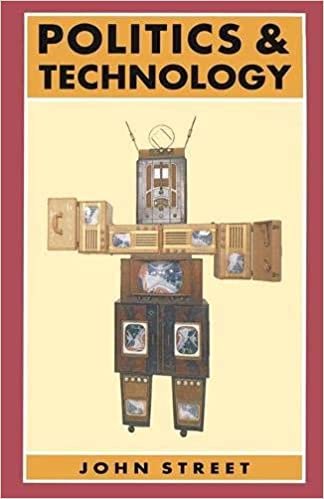
    Book Name: Politics and Technology

    Author: John Street

    Publisher: The Guilford Press

    Year of Publication: September 1992

    Pages: 224

    The eighties and the early nineties of the twentieth century witnessed seismic shifts like the globalisation of technology (viz. FAX machines) coupled with tumultuous political events like the Tiananmen protests, the Kuwait war etc. This highlighted the increasing significance of politics and technology, providing the backdrop for John Street’s work in the early nineties. However, Street departs from similar works by illustrating not merely how technology and politics are important but rather the diverse ways in which both are intricately enmeshed with each other.

    The relationship between technology and politics constitutes the major theme underlying this work. While the exponents of autonomous technology believe in a notion of technological rationality, technological determinists argue that technology influences the division of labour, which ultimately shapes state functions. On the other end of the spectrum, political determinists argue that politics is prior to technology, contending that the state functions as a customer, regulator and underwriter of technology. However, he is careful not to wade into simplistic conclusions, arguing that there are wide differences in the way states perform these functions, depending on their respective political structures. He uses a diverse range of examples from the UK and the US to Russia across a range of technological sectors from nuclear to medical.

    A second but interrelated theme in this book is the interrelationship between politics and science. This is illustrated using various aspects of science like the scientific method, the concerns, language and ideology of science, the interests of scientists etc. For instance, the feminist critique of science argues that science, in an ideological sense, is masculinist, marginalising the experiences of women. This interrelationship is linked to the larger normative question he seeks to address – how to ensure democratic control of technology. In order to answer this, he addresses the dual themes of the political implications of technology as well as the factors that confront us while making choices based on technology. He is not short of nuance here as well, arguing in detail how technology can result in myriad political manifestations in the respective spheres of dependence, choices, inequalities, experiences, side effects etc. The second theme of the choice of technology is conditional on institutional, evaluative and informational factors.

    Setting the backdrop for the question of democratic use of technology, he examines the two prevalent contrasting political approaches to technology. Devoting a detailed section to green politics, he underlines how this brand of politics is antithetical to technology to such an extent that it has to be either renounced or radically reformed. The opposing strand of the technical fix seeks to ensure the subservience of technology to politics.

    The theoretical contribution he makes to the technology-politics literature is an ‘eclectic’ third approach whereby he argues for an understanding of technological and political change in constant flux. Rather than providing definitive answers, he argues for a different approach, where he encourages the reader to question the very dichotomy between politics and technology. Using a powerful example of how supposedly technical notions like accuracy are political, he argues how technology in itself is shaped by politics. Similarly, in the context of mass communication in democracy, he argues that the democratisation of technology depends on the outcome, design and content of technology.

    What makes ‘Politics and Technology’ remarkable is the sheer breadth of his analysis. This extends not only to the myriad illustrations of technology to substantiate his arguments but also to the nuances related to the technology-politics interface. The illustrations are wide-ranging and colourful, encompassing technology from mere hedges (to block protests) to the various formal dimensions of technology like medical, biotechnology, information technology, nuclear technology etc. His treatment of politics is no different – embracing a wide range of both philosophical positions from Bell to Heidegger as well as ideological standpoints from feminism to Marxism.

    Those probing for definitive answers are likely to be disappointed. He addresses questions of politics and technology like a seasoned academic, exhausting the whole breadth of interactions between both while resisting simplistic conclusions. For instance, he resists the simplistic proclivity to link non-democratic regimes (e,g, Russia) to attitudes of secrecy on nuclear spillover, by highlighting contradictory attitudes of democratic regimes like the UK. He further grapples with notions like democracy, technology etc. which we take for granted, examining, unravelling and distilling nuanced, crystal-clear definitions in the process. This is evidenced by his detailed description of technology as having not merely material and intellectual dimensions, but a social aspect as well.

    However, barring exceptions like Tiananmen and the Bhopal tragedy, the illustrations used are overwhelmingly skewed towards the Global North. Further, through a critical lens, one could argue that the endeavour to explain the politics of science while exhaustive and enriching in itself, doesn’t offer much in his emancipatory democratic project.

    However, none of these glitches is significant enough to derail his larger project. In a society embarking on the Industrial Revolution 4.0 and the looming possibilities of “an AI war”, the fundamental normative project to democratise technology remains more relevant than ever. Even from a philosophical standpoint, his project remains relevant. The post-humanist strand of thought, which seeks to fuse the human-technology assemblage to conceptualise cyborgs and its relationship vis-à-vis the social-political realm, is based on very similar assumptions of dissolving the divide between the human and technology. Thus, it is safe to argue that ‘Politics and Technology’ remains one of the most relevant and exhaustive ‘gateway’ works for students probing the myriad and complex interconnections between politics, science and technology.

    About the Author:

    JOHN STREET is a professor of politics in the School of Politics, Philosophy, Language and Communication Studies. He is the author or co-author of seven books and some 80 articles. The third edition of his Media, Politics and Democracy was published in 2021. He is currently the Principal Investigator on an AHRC project: ‘Our Subversive Voice? The history and politics of the English protest song. The other members of the research team are Alan Finlayson (UEA), Oskar Cox Jensen (UEA), Angela McShane (Warwick University) and Matthew Worley (Reading University).

    He supervises PhD students working on a range of topics, including the politics of music, new forms of political communication, and participatory democracy. He is a member of the Political Studies Association, the Subcultures Network, the International Association for the Study of Popular Music, and MeCCSA. He is a Fellow of the Academy of Social Sciences and a Fellow of the Higher Education Academy. He was until recently an Honorary Professorial Fellow at the University of Melbourne.

  • America’s Two Cold Wars: Hegemony to Decline?

    America’s Two Cold Wars: Hegemony to Decline?

    Book Name: America’s Two Cold Wars: Hegemony to Decline?

    Author: Alfredo Toro Hardy

    Publisher: Palgrave Macmillan

    Year of Publication: March, 2022

    Pages: 305 


    The war in Ukraine has necessitated a recalibration of US foreign policy as tensions intensify between America, its allies and Russia. The US’s ‘pivot to Asia’ policy has taken a hit in the face of Russia’s aggression in Ukraine. As global attention, once again, shifts to the former Cold War superpower, China appears to be reaping all the benefits in the ensuing power vacuum.

    Alfredo Toro Hardy’s America’s Two Cold Wars: From Hegemony to Decline? is a timely addition, both in terms of what is unfolding presently and the literature that is emerging on the shortfalls of American foreign policy in its dealings with Russia and China. The former Venezuelan diplomat joins the intensifying debate on the emerging reality of a Cold War between the US and China and the broader debate surrounding America’s decline from being a global hegemonic power and its implications for the country’s international engagement with the rest of the world.

    The book offers a comprehensive diagnosis of American foreign policy by way of a comparative analysis of the US’s Cold War with the Soviet Union with the emerging one with China from the American perspective and seeks to answer two questions: one, how different a strategic competitor is China to the erstwhile Soviet Union and two, how different is the US of today compared to its former self when it confronted and won the Cold War with the Soviets.

    Hardy identifies five fundamental issues afflicting US foreign policy in its engagement with China – ideology (or lack thereof), squandered alliances, foreign policy-related inconsistencies, the country’s economic downturn and the containment strategy trap. The author’s key argument recurs throughout the book – that the US is confronting China in the emerging Cold War on a “wrong configuration of factors” (p. 168) and needs to “responsibly explore and analyse the options on the table” (p. 171).

    In acknowledgement of the deficiencies facing America’s foreign policy regarding China, the author sets the context and provides readers with a succinct account of the collapse of the Soviet Union, the emergence of the period of US hegemony and the rise of China in the first two chapters. Hardy rightly emphasises that America is threatened by China’s ascendence – citing research done by the Pew Research Center that showed that 73 per cent of Americans viewed China negatively. In the author’s words, “Washington is aggrievedly and forcefully reacting against what it perceives as an existential contention” (p. 7).

    Hardy also outlines the Chinese perspective and correctly concludes that Beijing is driven by its experience under imperialist powers during the ‘century of humiliation’ and economic mismanagement under Mao Zedong. Indeed, this coupled with the Tiananmen Massacre in 1989, controversy over Chinese dissident Fang Lizhi between 1989-1990, the Taiwan strait crisis in 1996, the bombing of the Chinese embassy in Belgrade (p. 23) by American forces and more recently, the independence movements in Hong Kong are insightful examples in understanding why the Party and now, Xi Jinping, are in pursuit of relentless centralisation of power and authority. Despite China’s adroitness in foreign affairs under Xi Jinping, the country’s great power ambitions are driven by domestic considerations and how the international community perceives these ambitions. The US’s belief in China’s disregard for a rules-based order is what the latter takes offence with – believing the former to be constraining it from taking its “rightful place in the world” (p.7). China eschews the American mindset of reverting to the Cold War mentality and instead argues for a more inclusive world where both states are mindful of their responsibilities.

    The author offers a penetrating account of US-China relations – moving from cautious partners with mutual strategic interests to strategic competitors. A pragmatic agreement was drawn up that was mindful of the other’s national interests – the US would recognize the Communist government in China and give it legitimacy and in exchange, China would not seek to limit or challenge the “US’s power projection in Asia” (p.22). China’s gains from this arrangement were enormous and translated into divestment from Mao’s model of productivity and economic self-sufficiency, a foothold in Western markets and a WTO membership. However, 2008 marked the inflexion point in their relations. The diplomat’s insightful analysis of the changing currents in China’s foreign policy and engagement with the US – the global financial crisis and China’s ability in tiding over it, the success of the Beijing Olympics, the US’s failures in the Middle East and disregard for its allies, China’s military build-up, the South China Sea and Xi Jinping’s leadership – is unparalleled and serves as an excellent prelude to why he thinks the two countries are in an “unavoidable collision course” (p. 35). China’s desire to forge a new status quo and challenge the US’s rules and the US’s and China’s “perceived sense of mission and superiority” based on their history and national myths as they look into the future, makes the prospect of a major conflict with spill over effects plausible. Here Hardy goes a step further and claims, based on the plausibility of a war between the two, that they are already in the midst of a Cold War (p. 36). In announcing its ambitions to the world, China may have lost the advantage of its hitherto low profile strategy and believes that American hegemony is on the decline.

    To be sure, the author’s analysis of the five deficiencies in American foreign policy forms the most important section of the book. His commentary on America’s notion of its exceptionalism and “crusader foreign policy” (p. 42) is particularly relevant when we look at its response to the war in Ukraine – the US’s network of financial institutions and media conglomerates have been “able to impose international patterns of credibility or ostracism depending on the acceptance or not of the prevailing liberal ideology” (p. 18).

    Alexis de Tocqueville’s Democracy in America described American democracy as a form of Christianity and there is more than a grain of truth to this when they believe they were ordained by God to undertake the responsibility of exporting democracy to the rest of the world, not unlike the colonial powers; as Hardy keenly points out – “the United States never stopped being what its puritan colonists wanted it to become” (p. 42). The ideological calculus worked in America’s favour during the Cold War with the Soviet Union. In confronting China, a country uninterested in exporting communism, in relentless pursuit of efficiency and economic development, the US falls considerably short. This section is a succinct account of the erosion of democracy domestically, the political establishment, poor performance in development indicators (specifically, education and infrastructure) and the labour market. As Hardy puts it – “efficiency is the catchword” (p. 53) and the name of the game in the Cold War between America and China.

    In building alliances to counter China, US foreign policy has a long road ahead as it recovers from the wars in the Middle East, the Trump presidency, its recent misstep in leaving Afghanistan to the Taliban and now, its conflict escalations with Russia. America’s inconsistencies in maintaining its alliances have put them on the back foot in confronting China and only served to better the latter’s position in the international community through cooperative multilateralism (p. 82). The author concludes that the worst-case scenario for the US would be a Russia-China alignment. Indeed, in the fourth iteration of the India-US 2+2 dialogue, the Russia-Ukraine war was the elephant in the room as joint statements from the US and India reflected a sentiment of ‘agree to disagree’. These joint remarks were widely acknowledged to be ‘tame’ in comparison to the statements several White House officials made of India’s position on the matter, most notably that of President Biden’s comment of India being “somewhat shaky” on the Quad and that of Deputy NSA Daleep Singh who warned of “consequences” should India continue to increase its imports from Russia.

    The author is critical of the growing divide between the Democrats and Republicans in the foreign policy establishment – referring to them as “inhabiting different foreign policy planets” (p. 105). Even the consensus on the containment strategy for China is shaky as Progressive Democrats call for restraint. China, on the other hand, is a different story. According to Hardy, China has its eggs in order – a sound national objective, well-rounded foreign policy, cooperative multilateral mechanisms and localised geopolitical ambitions for the moment. China exhibits unwavering focus as it marches towards what it believes is its destiny – to become a world power by 2049. The only downside that the author warns of in China’s strategy is Xi’s presence at the helm. The longer Xi stays at the top, the more the country’s policies will mould around his personality. In the event of his absence “China may find itself in big trouble” (p. 109).

    In comparing the Soviet Union and China’s economies, here too the US falls short. During the first Cold War, America had both economic and military advantages and possessed a technological edge that was unmatched. Today, the US might go toe to toe with China and still not emerge victorious. According to Hardy, China will surpass the US’s GDP in absolute terms and has already achieved the same in Purchasing Power Parity (PPP). It is very likely that China’s military expenditure will far exceed the US’s down the line. It has militarily caught up to the US through asymmetric “armament development” (p. 121) and other strategies. Its advantage also lies in the fact that its military deployment is closer to home compared to the US’s strategy of maintaining a standing presence around the world. However, the analysis in this section falls short of elaborating upon America’s weaponization of its financial power. A major factor in the US being a superpower has been the dollar hegemony it has enjoyed since the 1970s. This aspect is intrinsic to understanding US foreign policy, especially when global FOREX reserves in dollars have declined to 59 per cent from 72 per cent in the last two decades. Analysts argue that this reflects the decline of the dollar’s dominance in the face of other currencies. Indeed, China, Russia, India and Brazil are working to reduce their dependency on the dollar and shield themselves from Washington’s vagaries.

    Washington is playing catch-up with Beijing; inheriting the Cold War mentality and deploying used strategies against a competitor that almost evenly matches the US in all aspects. From Hardy’s commentary on the containment strategy that the US pursued against the Soviets, it is immediately evident that the same cannot be replicated in its confrontation with China. While appreciative of the consistency that the Obama, Trump and Biden administrations have shown in dealing with China, the author claims the lack of an overarching strategy and general cohesiveness will not deter China’s ambitions. Considerations of “economic preponderance and geopolitical feasibility” (p. 146) appear to be missing in devising a strategy to counter China. But the author astutely points to the viability of containing China in a region that is of significant geostrategic importance and has historically been its sphere of influence and rightly questions the US’s capability to respond when China has “firm control of the operational theatre” (p. 148) in the region.

    Hardy’s sections that delve into the US’s economy, while useful in the context of its military expenditure, do not adequately explain the sheer influence and entitlement that the country enjoys in international organizations like the IMF, World Bank, OECD, WHO etc. and its impacts in its engagement with China. Similarly, the US has historically turned to sanctions as punitive measures against their enemies – indicative of confidence borne out of the dollar hegemony. Insights into how effective sanctions are and why and how the US weaponizes this power would more forcefully drive home the well-rounded strategy that America has pursued as a hegemon. The Ukraine war is just one example in a long line wherein the US has exercised its power and unilaterally imposed severe sanctions on Russia – encouraging even its allies and partners to take the same measures against Russia. Increasingly, it is becoming evident that the US’s unilateral sanctions are having a negative impact on its credibility as a responsible superpower. Nevertheless, the book offers the general reader a comprehensive assessment of the US in the world order presently and more specifically, a comparison of its foreign policy strategies with the erstwhile Soviet Union and China.

    Overall, America’s Two Cold Wars: From Hegemony to Decline? is a thorough exposition of US foreign policy and draws from experts like Kishore Mahbubani, Mathew Kroenig, Francis Fukuyama, Henry Kissinger and John Mearsheimer and, unlike most literature on the topic, Hardy does not assume a fatalistic narrative that supports the US’s decline of power. Simply put, with the first Cold War, America had all the right configuration of factors in place. This seems to have changed in the second; if the US is facing China on the wrong configuration of factors (p. 168), then the results are only a product of successive administrations lacking coherency in putting together a sound strategy. The author, in a reflection of his experience and expertise, incisively concludes that the US must pursue alternatives to a Cold War with China for three important reasons: first, sharing global governance responsibilities would aid in building US credibility as a responsible superpower as well provide cooperative solutions to global problems like climate change; second, US strategy towards China needs to be a choice between adopting a China-centred policy or alliance centred policy geared towards building multilateral cooperation (p. 169) and third, the interconnectedness of the global economic system will ensure that everyone pays the price for an expensive war between the US and China. The US’s only recourse is to focus on building back its credibility, alliances and partnerships. At the same time, it must be realistic and reflect a deeper understanding of China’s national interests and strategic objectives. These two intentions must work in tandem if the US hopes to successfully counter China.

    About the Author:

    ALFREDO TORO HARDY is a Venezuelan retired diplomat, scholar and author. He has a PhD in International Relations from the Geneva School of Diplomacy and International Affairs, two master’s degrees in international law and international economics from the University of Pennsylvania and the Central University of Venezuela, a post-graduate diploma in diplomatic studies by the Ecole Nationale D’Administration (ENA) and a Bachelor of Law degree by the Central University of Venezuela. Before resigning from the Venezuelan Foreign Service in protest of events taking place in his country, he was one of its most senior career diplomats. As such, he served as Ambassador to the United States, the United Kingdom, Spain, Brazil, Singapore, Chile and Ireland.
    Hardy directed the Diplomatic Academy of the Venezuelan Ministry of Foreign Affairs, as well as other Venezuelan academic institutions in the field of international affairs. He is an Honorary Research Fellow of the Geneva School of Diplomacy and International Relations and has been a Visiting Professor at the universities of Princeton and Brasilia and an online Professor at the University of Barcelona. He has also been a Fulbright Scholar, a two-time Rockefeller Foundation Bellagio Center Resident Scholar and an academic advisor on diplomatic studies at the University of Westminster. He has authored twenty-one books and co-authored fifteen more on international affairs and history while publishing thirty peer-reviewed papers on the same subjects.

  • Book Review: Contesting the Global Order – The Radical Political Economy of Perry Anderson and Immanuel Wallerstein

    Book Review: Contesting the Global Order – The Radical Political Economy of Perry Anderson and Immanuel Wallerstein

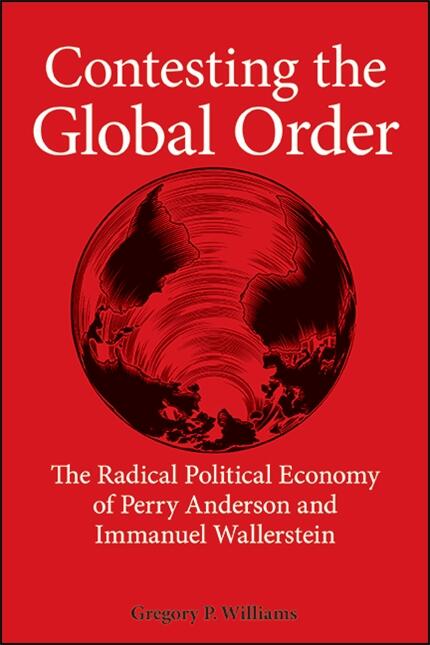
    Book Name: Contesting the Global Order – The Radical Political Economy of Perry Anderson and Immanuel Wallerstein

    Author: Gregory P Williams

    Publisher: SUNY Press, 2020

    Contesting the Global Order is a comparative intellectual biography of Immanuel Wallerstein and Perry Anderson, two leading and prolific intellectuals of the Left since the end of the Second World War. Williams opens the book by relating their ideas to two main explanations offered in the wake of the global crisis of 2008: the prevailing explanation and the unconventional explanation. The former, devised by mainstream economists and punditry, explains the crisis with reference to a number of recent factors. This implies that this was a crisis within capitalism and, as such, all that the system needed was a course correction, if perhaps a drastic one. The unconventional explanation, which the books’ protagonists subscribe to, holds that what happened in 2008 and after has been a crisis of capitalism. It is only the latest one among many in the history of this ever violently gyrating system, and it is most certainly not the last. Therefore, its explanation must be sought in long-term processes and at the macro-structural level.

    This opening move not only helps readers to relate the book’s subject material with contemporary debates on global capitalism and its crisis, but also associates Wallerstein and Anderson to the radical wing of the field of International Political Economy. Williams tells us that, as influential texts of Radical Political Economy, their works have repeatedly returned to three key issues: “totalities as an object of study; the origins and operations of capitalism; and the role of agency in determining behavior” (p.9). With these guiding themes of comparison at hand, Williams proceeds onto a chronological narrative analysis distributed over seven chapters and two ‘Intermissions,’ essentially one mini-chapter for each thinker that deals with a specific issue in their intellectual biography.

    Chapters 1 and 2 together provide an overview of Anderson’s and Wallerstein’s early years as scholars and the influences behind their ideas. In the first, Williams introduces their early intellectual formations against the backdrop of intellectual battles of interwar and postwar years. He defines these years as cosmopolitan beginnings for both. It appears that, for Williams, Anderson’s early intellectual journey and his involvement with the British New Left is more interesting than Wallerstein’s conventional academic career largely restricted to Columbia University, as the former receives almost twice as many pages dedicated to his story. The second chapter presents a very well-written account on the intellectual lineages of Wallerstein’s and Anderson’s theories. For the former, Williams shows the influence of Frantz Fanon, Fernand Braudel, and Karl Polanyi (and later Ilya Prigogine). In the case of Anderson, the key names listed are Edward Gibbon, Jean-Paul Sartre, Georg Lukács, and Lucio Colletti. An important point that we get from this chapter is that, while already established scholars in their thirties, Wallerstein and Anderson never ceased to learn from others throughout their careers.

    The momentous year of 1968 and the revolutionary energies it generated are at the center of Chapter 3. In Wallerstein’s experience, 1968 offered the development of an indigenous socialist tradition in the US and provoked him to theorize the connections between that and the decolonization movements. For Anderson, the flare for socialism was fired not at home, but across the channel. The scale of revolt in France amazed him and his New Left Review (NLR) colleagues; “the opportunity for socialism now seemed real” (p.62), even in an advanced capitalist society. It is with this energy and optimism that they turned to fashioning institutions that would help keep the revolutionary flame of 1968 going. If Wallerstein wanted universities as key institutions to encourage Third World movements, Anderson sought to turn the NLR into a vanguard organization for socialist politics. To achieve this, Williams notes in Chapter 4, they agreed on the premise that there was an urgent need to promote a “public and scholarly understanding of the historical processes that gave rise to the current historical order” (p.67). A sober sense of history was necessary for the building of a socialist future. To show how they did this, Williams takes the readers on a tour into the theoretical and historiographical building blocks of their magnum opuses published in 1974. If Chapter 3 is more about political agency, Chapter 4 delivers a sophisticated overview of the themes of totality and the origins of capitalism.

    In the following chapters, the question of agency, the future of capitalism and the prospects for socialism come back to the forefront, but this time in the context of vanishing revolutionary energies in the face of two momentous developments. The first is the rise of neoliberalism in the 1980s and the onslaught it brought on to organized labor and to Left-wing politics more generally. The second is the collapse of the East European communist regimes. While both acknowledged the scale of ‘the defeat,’ Wallerstein and Anderson held different sentiments towards it. For Wallerstein, being optimistic or pessimistic about the role of human agency undoing capitalism’s ills did not matter. He thought capitalism as a world-system was in crisis, hence what mattered was what human agency could do when it collapsed. Anderson, on the hand, holds a pessimistic view. Capitalism’s victory was comprehensive and the Left failed to match the simple and appealing political message of the Right. Yet, Williams shows that Anderson also believes that workers of the twentieth and twenty-first century have developed class consciousness through their accumulated experience in organization and strategy. In order to recapture the working-class votes from the Right, what the Left needs to do, Anderson and Wallerstein agree, is to develop “a compelling social narrative, an explanation for the present that took stock of the past” (p.175).

    Williams writes with clarity and economy, except perhaps in Chapter 5 where the analysis of Wallerstein’s world-systems theory could have been more concise. In certain points, Williams does not shy away from adding his input. For example, he casts doubt on the claim that Anderson’s third volume, successor to Passages and Lineages, never arrived because Robert Brenner (whose work Anderson has always held in high esteem) had dealt a decisive blow to the historical category of bourgeois revolutions (pp.113-114). There is also the occasional nugget produced by the meticulous archival work. We get to learn that in 1973 Robert Brenner requested a manuscript of the first volume of Wallerstein’s The Modern World-System and an exchange followed (p.170).

    Above all, its comparative investigation is what makes Contesting the Global Order a distinctive contribution to Radical Political Economy. Not only is this a relatively uncommon undertaking in the field, it is also a challenging one. Comparative intellectual biographies require their authors to master the intellectual trajectories and outputs of their subjects, and then make the critical decision of choosing the right axes of comparison. Even more crucially, the actual substance of comparison has to be parsimoniously presented in order to be effective. Williams does a great job on all these scores. He makes the reasonably specialized discussions on the origins of capitalism and the concept of totality accessible to his readers. The comparative analysis expertly documents and discusses the different life trajectories, the changing intellectual sensibilities and the evolving political visions of Anderson and Wallerstein. And he manages this feat while also highlighting the relevance of his subjects for the contemporary political scene.

    This Review is republished under the Creative Commons license.

    This was published earlier in E-INTERNATIONAL RELATIONS.

  • Book Review: The Entrepreneurial State: Debunking Public vs. Private Sector Myths

    Book Review: The Entrepreneurial State: Debunking Public vs. Private Sector Myths


    Book Name: The Entrepreneurial State: Debunking Public vs. Private Sector Myths
    Author: Mariana Mazzucato
    Publisher: Anthem Press (10 June 2013)
    Page Count: 266
    Price: INR 2,020.00


    Written against the backdrop of the recovery period of the financial crisis of 2008, Mariano Mazzucato’s ‘The Entrepreneurial State’, came at a critical point, arguing against the widely accepted belief of the self-correcting nature of the markets, and the austere state measures of limited intervention, which in the case of the financial crisis, referred to injecting large sums of capital in banks to rescue them from collapsing. The book is an expanded version of a 2011 report which laid down policy proposals for the UK government post the crisis.

    Divided into ten chapters, the book focuses on the need for the institutionalization of innovation and lays down two main arguments. First, state investment is a necessary pre-condition for any long-term innovation, and growth, and requires a steady flow of funds. Arguing that governments must move beyond spending solely on infrastructural development, Professor Mazzucato extensively explains how the state and the industry are interwoven together, and cannot be looked at, in isolation. She draws her examples from a wide spectrum of industries in the United States, covering the pharmaceutical companies, to big tech companies, while also linking the state and industry to public schools, and foreign and defence policies of the United States.

    Second, the book argues that the companies funded by the state should return a part of their profit to the state for investment in other innovative technologies. Here, it is important to note that while the book has been targeted by neo-liberals for suggesting socialization through increased state intervention in the market, the author, however, does not question the right of private companies to accumulate profits, and asks only a proportion of it to be redistributed to the state for further investment.

    A major part of the book is devoted to addressing the illusion that entrepreneurship and innovation come from the private sector alone. Debunking this myth, Professor Mazzucato cites extensive evidence of impatient venture capitalists who have historically depended upon the government support for expensive and ambiguous investment risk, and of companies that have historically preferred to repurchase their shares to increase their stock prices instead of investing in research. She highlights the role of the Defense Advanced Research Project Agency (DARPA) in the US which was set up to provide the country with technological superiority. Arguing that the agency played a critical role in funding computer and internet technology, she illustrates how its contribution to the success of companies in the Silicon Valley, is often overlooked by institutions seeking to get away from the long arm of the state’.

    The author draws inspiration from Keynes’ advocacy of increased government expenditures, and Karl Polanyi’s research on central organization and state’s policies of controlled interventionism, where he argued that it was the state-imposed conditions that made a conducive environment for markets to come into existence. She also draws some of her important arguments from Schumpeter’s idea of entrepreneurial innovation and experimentation which paves the way for innovation by constantly destroying the old ones. Throughout her book, Mazzucato argues for a symbiosis of Keynesian fiscal spending, and Schumpeter’s investments in innovation.

    The book challenges the widely promoted concept of a free market based on limited state intervention, by the United States. Claiming that the US has itself invested heavily into its research and industrial sector, the author looks into the role played by programs and agencies like DARPA, Small Business Innovation Research (required large companies to designate a proportion of their funding to small for-profit firms), the Orphan Drug Act (provides tax incentives, subsidies, and intellectual and marketing rights to small firms dedicated to developing products for the treatment of rare diseases) and the National Nanotechnology Initiative. Further, after comparing the data of several countries, the author argues that states like Portugal and Italy are lagging not because of high state presence, but rather due to lack of state investment in research and development.

    The author builds up her argument upon the foundation that the state lacks confidence in its abilities to fund innovation. She argues that an increasing number of research and financial institutions have wrongfully come to regard the state as the ‘enemy of the enterprise’, which should be kept away from meddling in the market to ensure efficiency. Although she does briefly mention that the citizens are often unaware of how their taxes foster innovation, her analysis does not delve into the reason behind the state’s lack of confidence in itself, making it difficult for the reader to grasp the reason behind the state’s as well as the society’s lack of trust in a public-funded healthcare system, despite most new radical drugs have been coming out of public labs.

    Writing on the importance of green technology, Mazzucato holds that any ‘green revolution’ would depend upon an active risk-taking state. While comparing the green economic policies of China, Brazil, the US, and Europe, she elucidates how the state investment banks in China and Brazil act as a major source of funding for clean and solar technology. On the other hand, Europe’s approach to clean technology funding has been weakened by its attempt to present ‘green’ investments as a trade-off for growth, consequently resulting in a lack of support.

    Towards the latter part of her book, Professor Mazzucato presents her hypothesis of the risk-taking state, where both the state, and the market are interwoven to generate growth, and innovation. Her proposal is supported by numerous examples of state-sponsored innovative technology which emerged in the last century, implying that the state may have always been entrepreneurial. However, she argues that countries like India have performed worse than others because of their over-expenditure on several small firms, which have low productivity and output. The focus of state investment, thus, should be placed not on its quantity, but rather on its distribution amongst different sectors of the economy.

    Mazzucato claims that since the traditional tax system cannot provide the state with funds to invest in the innovation system because of tax avoidance and evasion, she suggests a three-step framework to support state-funded innovation. First, the state should extract royalties from the application of a technology that was funded by the state itself, which should be put into a ‘national innovation fund’ for future investment. Second, the state should put conditions on the loans it offers, a part of which should be returned to the state when the company starts to earn profits. And finally, she argues for the establishment of a State Investment Bank, like those in China and Brazil.

    The relevance of her hypothesis increases significantly as one witness the market value of Apple moving past the mark of $3 trillion, and surpassing the GDP of countries like the UK, Italy, Brazil, and Russia.[i] The author debunks the overestimated role of the big private companies like Apple and Google being at the forefront of generating innovative technologies by themselves alone. In doing so, she argues that Apple has received state funds from various channels, including direct investments in their early stage of development under the government programs like the Small Business Innovation Research; through access to technologies that emerged primarily because of state funding; and through the tax policies which benefit the company. Most of the elements used by the Apple, including high-speed internet, SIRI, touch-screen displays have been a result of risky investments by the state.

    Scholars[ii] have argued that the book does not consider the ‘productivity paradox’, which reflects low productivity in times of emerging innovative technologies, as during the IT revolution of the 1970s in the United States. However, it is important to note, that Mazzucato argues against the endogenous growth theory, where the output is taken as a function of capital, and labour, with technology assumed as an exogenous variable. She targets the theory for assuming certainty in growth after investment in technology, and research and development. Taking inspiration from Schumpeter, she asserts that investment in technology and innovation involves high uncertainty, and the growth, thus, cannot be measured using a linear model like the endogenous theory, which does not take into account the social factors responsible for growth (education, design, training, etc.).

    One of the limitations of the book is its lack of analysis on the underlying structural inequality and the impact of technological change on income disparities. Instead of delving further into controversies of value creation, the author cites an example of the wage-disparity between Apple’s broader employee base and its top executives and observes that the process of innovation can go ahead simultaneously with inequality. In the case of Apple, the products of which are considered as global commodities, a major part of the workforce come from countries providing cheap labour. These offshore jobs mostly take place in the low-wage manufacturing industries, and the resulting profit margins are counted as ‘value added’ generated within the United States[iii]. While Mazzucato argues for redistribution of profit between Apple and the US government, her analysis ignores the role played by the globalized workforce in generating the said profits.

    Lastly, the case for a risk-taking entrepreneurial state has been made solely based on politically stable, high-income countries of the West. The author does not address whether high-scale state investments would be viable in situations where governments’ primary focus is placed on maintaining domestic stability and security, as in the case of Afghanistan, Somalia, or Yemen. Thus, one cannot be fully convinced about whether the prescribed model would fit well into the low-income countries of the South, many of which continue to witness high levels of instability, corruption, and violence.

    Overall, in using over three hundred different sources, Professor Mazzucato’s book provides the reader with an extensive critical insight into the working of the state, and the industry. By addressing the various myths associated with industries in each of her chapters, the author makes the reader question the fundamentals of the free-market system and makes one interrogate the existence of such a system. The book also attempts at breaking the cultural hegemony of the United States, by challenging their mainstream narrative of high-scale privatization and limited government presence. By covering a vast ground of industries, the book pushes the reader to delve into further research to investigate the role of the state in funding other technologies and innovations.


    [i] Bursztynsky, J. (2020, August 19). Apple becomesfirst U.S. company to reach a $2 trillion market cap. Retrieved August 20, 2020, from https://www.cnbc.com/2020/08/19/apple-reaches-2-trillion-market-cap.html  and Smith, Zachary Snowdon. (2022, Jan 03). Apple becomes 1st company worth $ 3 trillion – Greater than the GDP OF UK. Retrieved March 08, 2022, from https://www.forbes.com/sites/zacharysmith/2022/01/03/apple-becomes-1st-company-worth-3-trillion-greater-than-the-gdp-of-the-uk/?sh=6142c7b25603

    [ii] Pradella, L. (2016). The Entrepreneurial State by Mariana Mazzucato: A critical engagement. Competition & Change, 21(1), 61-69. doi:10.1177/1024529416678084

    [iii] Greg Linden, Jason Dedrick, and Kenneth L. Kraemer, Innovation and Job Creation in a Global Economy: The Case of Apple’s iPod, Personal Computing Industry Center, UC Irvine, January 2009, http://pcic.merage.uci.edu, 2.


    Feature Image Credit: Mariana Mazzucato Quartz

  • Book Review: Political Violence in South and Southeast Asia: Critical Perspectives

    Book Review: Political Violence in South and Southeast Asia: Critical Perspectives


    Political Violence in South and Southeast Asia: Critical Perspectives
    Editor: Itty Abraham, Edward Newman, Meredith L. Weiss
    Publisher: UNU Press, Tokyo, 2010. 224 Pages


    Written against the framework of persistent threats to human security, ‘Political Violence in South and Southeast Asia: Critical Perspectives’ is a volume of extreme relevance and consequence. The book brings together numerous political scientists and anthropologists with in-depth knowledge of the socio-political environment of the two regions. It aims at understanding the interaction between violent and non-violent politics, and in doing so, it defines political violence as consequential and strategic, as opposed to spontaneous and senseless. Intending to shift the narrative of understanding violence solely from the standpoint of terrorism, the book develops a critical understanding of violence by dwelling on its social and structural context.

    Divided into eight distinct chapters, the book takes cognizance of both state and non-state actors in a violent landscape. While concentrating on the local events of political violence in countries of South and Southeast Asia, the authors underline the significance of identities and the process of their consolidation, the character of states, geographic borders, external influences, and patterns of rebellion, in determining the manifestations of political violence.

    Arguing that the theories of economic greed, grievance, regime type, and state collapse are guilty of facile claims and problematic conceptualization of political violence, the authors critique the narrow construction of the concept and the premature assumptions regarding its victims and perpetrators. In doing so, they focus on exploring the aims, approaches, consequences, and conceptual dimensions of such violence, without dwelling deep into the causes of the same. In analyzing the different brands of violence, the authors place their focus on assassinations, riots, pogroms, ethnic cleansing, and genocides in the two regions.

    In his first chapter, Sankaran Krishna compares the assassinations of two political leaders in India – Mohandas Gandhi, and Rajiv Gandhi.  The author presents a key argument underlining the changing moral economy of political killing in South Asia. Highlighting the context in which the two killings took place, Krishna argues that assassinations in the region have shifted from being carried out in the name of a larger cause or principle (Godse’s idea of saving India) to ‘a consequence of a blowback’ – which represented India’s choice of active participation in the Sri Lankan civil war, in the case of Rajiv Gandhi. Buttressing his argument, the author also takes into account the killings of Benazir Bhutto and Indira Gandhi.  He does, however, present an uncomfortable and curious narrative by viewing these assassinations as attempts of suicide. Claiming that Gandhi’s insistence on fasting until death and refusal to be protected by the state, and Rajiv and Indira Gandhi’s deliberate lax in their security were rehearsals for eventual suicides, the author makes rather unsettling and complex arguments, one, defining Gandhi’s killing as a moral assassination, and two, by dwelling deep into the writings of Godse and portraying him as a man of rationality against the mainstream narrative of associating him solely with terrorism.

    Later, presenting one of the central arguments of the book, Paul Brass, in his chapter on forms of collective and state violence in South Asia, argues against violence being defined as senseless. Asserting that all kinds of violence have their strategic purpose, he lays down the critical concept of an Institutionalised Riot System, arguing that riots are systematic and organised. Claiming that riot production consists of different stages, which are usually analogous to a staged production of drama, Brass states that the first stage is that of rehearsal, followed by enactment, and interpretation. While the rehearsal stage consists of those who arouse sentiments, consisting of politicians, ‘respectable’ group of university professors, and the lower ‘unrespectable’ groups of informants, local party workers, and journalists, the stage of enactment consists of false and inflammatory media reports. It brings together, on the one hand, university professors and students forming a part of the local crowd, and on the other hand, criminals recruited to burn, loot and kill. The final stage of interpretation and explanation is especially crucial to understanding the sustenance of such violence, which involves attempts at making the riot appear as spontaneous, as opposed to planned. What is witnessed is an active shift in responsibility to those who are not directly involved in riots, and even those who vehemently oppose the idea of rioting. The author substantiates his claims by associating the Riot System with examples from Northern India, particularly citing the killings in Meerut in 1982 and 1987.

    The second half of the book is majorly devoted to a comparative approach to study mass violence and the impact of external influences in the region. The authors, in their respective chapters, provide detailed empirical evidence by dwelling deep into the case studies of different countries. Geoffrey Robinson, in his chapter, identifies three distinct ways in which the countries of Southeast Asia have witnessed violence. The states are either defined as principal perpetrators, as in the case of Indonesia in East Timor and the regime of Khmer Rouge in Cambodia; or as facilitating violence through propaganda and militia or inaction during mass violence, as with the case of Indonesia during the 1965-66 massacre. Finally, the state, according to Robinson, has also served as a vital link in the formation and spread of violent societal norms and modes of political action. He identifies the patterns and correlations between a level of violence and the character of states. An argument is made that because the military is designed to organize violence, any state where the military had an active role in the past has experienced more violence, as in the individual cases of Thailand, Philippines, Indonesia, or Burma. On the other hand, religious and ethnic violence, including riots, occurs almost always in newly democratizing states.

    While Naureen Chowdhury Fink points out the contestations surrounding the borders of Bangladesh, Natasha Hamilton-Hart lays down the extent of external influences on political violence in Southeast Asia. She identifies the first wave of such influence, in the form of overt support to principal perpetrators, starting with the large-scale military support by China and the Soviet Union to the Vietnamese communists after the conflict escalated to open warfare involving American troops from 1964. Citing the United States military support and its deliberate silence during the massacre in Indonesia, the author identifies a direct link between the United States and the ongoing political violence in Indonesia. She also cites the US’ support to the Philippine government’s suppression of the rebellion, and to non-communist insurgent groups in Cambodia, and the Western support to Khmer Rouge – where lethal weapons from China, the US, and the UK flooded the country. In citing these examples, the author presents the extent to which external support has been instrumental in sustaining violence in the region.  Later, external support is reported to have taken the form of training of police, militaries, insurgents, and other actors, along with a provision of intelligence and logistical support.

    Vince Boudreau, in his chapter on recruitment and attack in Southeast Asian collective violence, argues that the patterns of collective violence in the region are influenced by trade-offs between efforts to recruit supporters and strike at adversaries. He also identifies a correlation between the nature of violence and the mode and strategies used for targeting the victims. A riot, for example, even when purposely produced by professionals – will likely be less discriminate than a coordinated attack by guerrillas; or a bomb detonated in a marketplace will likely be less discriminating than one thrown into a church. Identifying five such degrees of discrimination, Boudreau ranks them in an order of descending brutality – from indiscriminate attacks to indiscriminate categorical violence which employs a strategy designed to hit anyone who belongs to a particular socio-cultural category. Then comes to discriminate functional, referring to a strategy that targets individuals playing a particular occupational or political role, followed by the third strategy – discriminate personal, implying attacks on specific individuals based on something they have done, and lastly attacks on property.

    Finally, towards the end of the book, an argument is made regarding the totalizing logic of sovereignty of the state, where the author takes into account different political movements and illustrates how these movements are perceived as subversive irrespective of their motive. The argument implies that the ideological movements because they embody a critique of the state, are much more difficult for the state to subsume without violence.

    By adopting a comparative approach to study violence perpetrated by both, state and non-state actors, the book successfully underlines the conceptual similarities that exist within the societies, with regards to patterns and dimensions of violence. Because the book employs detailed contemporary evidence in explaining its critical concepts, it becomes a rather pertinent reading providing a wide scope for further analysis of similar events. Further, it successfully illustrates the correlations that exist between the character of states and the level and modes of violence, and in the reviewer’s opinion, can successfully go beyond the regions of South and Southeast Asia, to explain behavioural politics in more violent societies of West Asia and Africa.