Category: Banking, Finance & Monetary Policy

  • Cryptos and CBDC: Is the RBI on the Right Track?

    Cryptos and CBDC: Is the RBI on the Right Track?

    “The history of money is entering a new chapter”. The RBI needs to heed this caution and not be defensive.

    Cryptocurrency will be discouraged by the government was the message from the FM during the budget discussion in parliament. There will be heavy taxation and no relief in capital gains for past losses. But, India has to contend with growing use of cryptos in these uncertain times. Russian kleptocrats are reportedly using cryptos to evade sanctions. Ukraine which has been a center for cryptos trading due to its lax rules is now using them to get funds.

    President Joe Biden recently signed an executive order requiring government agencies to assess use of digital currency and cryptos due to their growing importance. The Indian authorities have also been trying to bring legislation to deal with the issue since October 2021. Would the US clarifying its position help India also decide on cryptos?

    The SC has asked the government to clarify its position on the legality of cryptos. The FM in the Budget 2022-23 proposed taxing the capital gains and crypto transactions but did not declare them illegal. The RBI Governor was more expansive in February when he highlighted three things. First, “Private cryptocurrencies are a big threat to our financial and macroeconomic stability”. Second, investors are “investing at their own risk” and finally, “these cryptocurrencies have no underlying (asset)… not even a tulip”. Subsequently, a RBI Deputy Governor called cryptos worse than a Ponzi scheme and suggested that they not be “legitimized”. It is only recently that the RBI has announced that it will float Central Bank Digital Currency (CBDC)

    Difficult to Declare Cryptos Illegal

    The governor calling cryptos as cryptocurrency has unintentionally identified them as a currency. His statements indicate RBI’s worry about its place in the economy’s financial system as cryptos proliferate and become more widely used. This threat emerges from the decentralized character of cryptos based on the Blockchain technology which the Central Banks cannot regulate and which enables enterprising private entities (like, Satoshi Nakamoto initiated Bitcoins in 2009) to float cryptos which can function as assets and money.

    The total valuation of cryptos recently was upward of $2 trillion – more than the value of gold held globally. Undoubtedly, this impacts the financial systems and sovereignty of nations. So, the RBI rather than be defensive needs to think through how to deal with cryptos.

    Cryptos which operate via the net can be banned only if all nations come together. Even then, tax havens may allow cryptos to function defying the global agreement. They have been facilitating flight of capital and illegality in spite of pressures from powerful nations.

    The genie is out of the bottle. The total valuation of cryptos recently was upward of $2 trillion – more than the value of gold held globally. Undoubtedly, this impacts the financial systems and sovereignty of nations. So, the RBI rather than be defensive needs to think through how to deal with cryptos.

    Cryptos as Currency

    Source: Crypto-current.co

    Will a CBDC help tackle the emerging problem? Indeed not, since it can only be a fiat currency and not a crypto. However, cryptos can function as money. This difference needs to be understood.

    A currency is a token used in market transactions. Historically, not only paper money but cows and copper coins have been used as tokens since they are useful in themselves. But paper currency is useless till the government declares it to be a fiat currency. Everyone by consensus then accepts it at the value printed on it.

    So, paper currency with little use value derives its value from state backing and not any underlying commodity. Cryptos are a string of numbers in a computer programme and are even more worthless. And, without state backing. So, how do they become acceptable as tokens for exchange?

    Their acceptability to the rich enables them to act as money. Paintings with little use value have high valuations because the collectivity of the rich agrees to it. Cryptos are like that.

    Bitcoin, the most prominent crypto, has been designed to become expensive. Its total number is limited to 21 million and progressively it requires more and more of computer power and energy to produce (called mining like, for gold). As the cost of producing the Bitcoin has risen, its price has increased. This has led to speculative investment which drives the price higher, attracting more people to join. So, since 2009, in spite of wildly fluctuating prices, they have yielded high returns making speculation successful.

    Unlike the Tulip Mania

    The statement that cryptos have no underlying asset, not even a tulip refers to the time when tulip prices rose dramatically before they collapsed. But, tulips could not be used as tokens, while cryptos can be used via the internet. Also, the supply of tulips could expand rapidly as its price went up but the number of Bitcoins is limited.

    So, cryptos acquire value and become an asset which can be transacted via the net. This enables them to function as money. True, transactions using Bitcoins are difficult due to their underlying protocol, but other simpler cryptos are available.

    The different degrees of difficulties underlying cryptos arises from the problem of `double spending’. Fiat currency whether in physical or electronic form has the property that once it is spent, it cannot be spent again, except fraudulently, because it is no more with the spender. But, a software on a computer can be repeatedly used.

    Blockchain and encryption solved the problem by devising protocols like, the `proof of work’ and `proof of stake’. They enable the use of cryptos for transactions. The former protocol is difficult. The latter is simpler but prone to hacking and fraud. Today, thousands of different kinds of cryptos exist – Bitcoin like cryptos, Alt coins and Stable coins. Some of them may be fraudulent and people have lost money.

    CBDC, Unlike Cryptos
    Source: cointelegraph.com

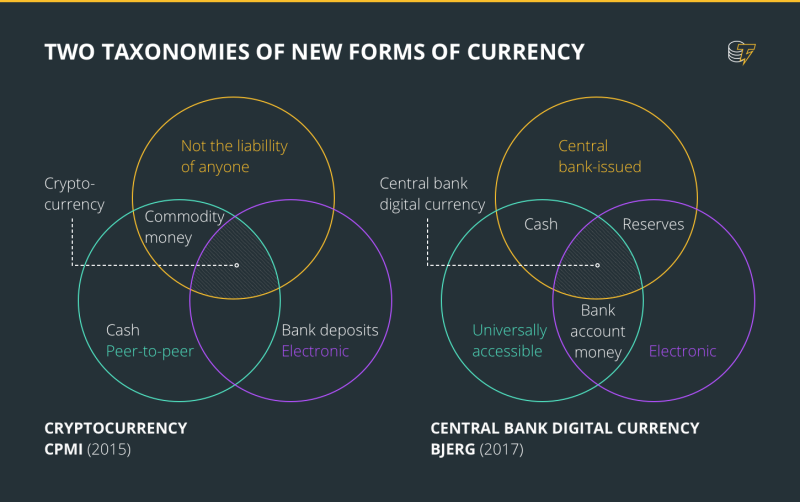
    Blockchain enables decentralization. That is, everyone on the crypto platform has a say. But, the Central Banks would not want that. Further, they would want a fiat currency to be exclusively issued and controlled by them. But the protocols mentioned above theoretically enable everyone to `mine’ and create currency. So, for CBDC to be in central control, solve the `double spending’ problem and be a crypto (not just a digital version of currency) seems impossible.

    A centralized CBDC will require RBI to validate each transaction – something it does not do presently. Once a currency note is issued, RBI does not keep track of its use in transactions. Keeping track will be horrendously complex which could make the crypto like CBDC unusable unless new secure protocols are designed. No wonder, according to IMF MD, “… around 100 countries are exploring CBDCs at one level or another. Some researching, some testing, and a few already distributing CBDC to the public. … the IMF is deeply involved in it ..”

    Conclusion

    Issuing CBDCs will not only be complicated but presently cannot be a substitute for cryptos which will eventually be used as money. This will impact the functioning of the Central Banks and commercial banks. Further, it is now too late to ban cryptos unless there is global coordination which seems unlikely. The rich who benefit from cryptos will oppose banning them. Can the US work out a solution? The IMF MD has said, “The history of money is entering a new chapter”. The RBI needs to heed this caution and not be defensive.


    Slightly shortened version of this article was published earlier in The Hindu.

    Feature Image Credit: doralfamilyjournal.com

     

  • Rethinking Monetary policy during a Crisis: Are Unconventional Policies here to Stay?

    Rethinking Monetary policy during a Crisis: Are Unconventional Policies here to Stay?

    With global crises such as the 2008 financial crisis and more recently the COVID-19 pandemic, monetary policy worldwide has increasingly ventured into uncharted territory. In the last 10 years alone, the world has seen 3 major crises that have affected financial markets extensively. Given the increasingly complex nature of economies and financial markets, central bankers have had to function under great uncertainty and shrinking policy space. Even as governments and policymakers worldwide leave no stone unturned in the fightback against crises, the traditional policy has often fallen short of its objectives. In light of growing limits of existing policy tools during a crisis, it has forced central banks to resort to unconventional measures such as negative interest rates (NIRP), quantitative easing, forward guidance and yield curve controls. Before the financial crisis of 2008, such unorthodox policies were relatively less commonplace. Today they are increasingly becoming key components of the monetary toolbox. However, much of these new policies is yet to be studied or tested in the real world. The long-term effect of such policies is still unclear. In this light, it becomes imperative to understand and analyse these unconventional policies to chart a course for monetary policy in the near to long term.

    What is Unconventional Monetary Policy?

    Under normal conditions, the most powerful weapon in a central banker’s toolkit is the policy interest rate. However, as global financial markets get more interconnected and complex, central bankers have to act under great uncertainty. As crises push traditional policy tools to their limits, central bankers have had to bank on more unconventional policies than ever before. As the governor of the Swedish central bank, Stefan Ingves puts it, “Monetary policy and the way we ‘do’ monetary policy has changed. All the time, we need to stand ready to develop new tools and make new kinds of analysis – If the world changes, we need to change with it”.


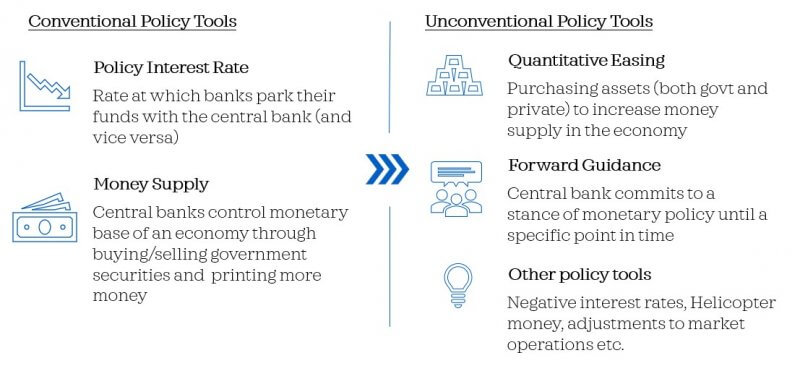
    Figure 1: Policy Tools Comparison

    Typically, interest rates and money supply are the two run-of-the-mill tools that central bankers resort to. Extreme versions of these policies, such as negative interest rates and quantitative easing, are termed unconventional monetary policies since they deviate from the traditional policy measures of a central bank. According to RBI’s Deepak Mohanty, “When central banks look beyond their traditional instrument of policy interest rate, the monetary policy takes an unconventional character”. Essentially, an Unconventional monetary policy is a set of measures taken by a central bank to bring an end to an exceptional economic situation. Central banks use these measures only in extraordinary situations when conventional monetary policy instruments cannot achieve the desired effect [1].

     Quantitative Easing

     Quantitative easing (QE) is a form of extreme and targeted control of the money supply in the economy. At its core, QE seeks to increase the money supply in the economy through the purchase of securities and bonds in the open market. When a central bank uses QE, it purchases large quantities of assets, such as government bonds, to lower borrowing costs, boost spending, support economic growth, and ultimately increase inflation.

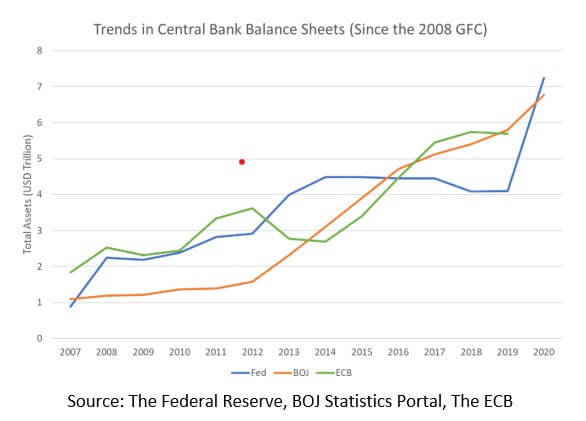
    Before the 2008 financial crisis, only one major economy, Japan, had implemented a significant Quantitative Easing program in the 1990s. Today, however, almost all major economies have some sort of QE or an asset purchase program. According to a report by Fitch Ratings, global QE asset purchases are set to hit $6 trillion in 2020 alone, which is more than half the cumulative global QE total seen over 2009 to 2018 [2]. As seen in the figure below, the balance sheets of major central banks have been expanding significantly since the financial crisis.


    Figure 2

    Quantitative Easing has been the cornerstone of the Fed’s crisis response since 2008. In the three rounds of QE post the 2008 crisis, the Fed balance sheets increased from $870 billion in August 2007 to $4.5 trillion in early 2015. Earlier this year, the Fed purchased a record $1.4 trillion worth of US treasuries in just six weeks in response to the COVID-19 crisis, speaking volumes of the role played by the unconventional policy during a period of crisis. Also, it’s not just the advanced economies that are resorting to extensive QE programs. Nearly 13 emerging market economies, including India, announced some form of a QE program following the crisis. In India, the RBI injected durable liquidity of ₹1.1 lakh crore through the purchase of securities under open market operations (OMOs) [3].

    Zero or Negative Interest Rates

    Quantitative easing was just the beginning of the long list of tricks central bankers pulled out of their sleeves. Closely accompanying QE policies were accommodative monetary regimes of ultra-low interest rates. In 2020 alone, interest rates have been slashed across the globe on 37 separate occasions [4]. Interest rates have been falling across the globe even before the crisis, and the current pandemic has only sped up this fall.

    While many economies have reached the theoretical zero lower-bound of rates, some have even dared to venture below the surface into negative territory. As of today, 5 economies in the world follow a Negative Interest Rate Policy. While the very concept of negative rates may seem baffling, it’s even more shocking to note that over $15 trillion worth of bonds is traded at negative yields globally [5]. This means that over 30% of the world’s investment-grade securities are traded in a manner such that lenders pay borrowers to use their funds. Central banks envisage that negative policy rates would induce increased spending and stimulate the economy in two ways – first, by forcing banks to hold lesser deposits with the central bank and channelling these funds into increased lending to households and businesses. Second, a cut in the policy rate would also lead to lower rates in the overall lending market, thus encouraging borrowing and spending.

    Forward Guidance

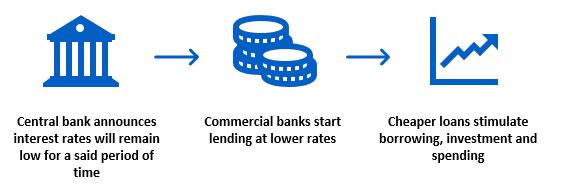
    Forward guidance refers to official communication from a central bank on the future course of monetary policy in the economy for a specific period. It is more of a monetary policy stance than a monetary policy tool. The key idea here is to keep markets informed and eliminate any form of uncertainty, which becomes especially imperative during times of crisis.


    Figure 3

    Gone are the days when central bank rate cuts and other announcements of secrets that were sprung upon the markets when they least expect it. With forward guidance, central banks provide communication well in advance about the likely future course of monetary policy in the economy, and this boosts the confidence of investors, consumers and companies. The US’s Fed was one of the major central banks to adopt this policy during the COVID crisis – providing clear forward guidance in June showing that it will probably keep rates low until at least 2022. The policy has been the cornerstone of the Eurozone’s crisis response since the sovereign debt crisis. In July 2012, at the height of the crisis, ECB President Mario Draghi adopted a form of Forward Guidance, stating that the ECB will do “whatever it takes” to save the euro. It is believed that these three words single-handedly turned around the eurozone crisis.

    Are Unconventional Policies Here to Stay?

    Apart from QE, NIRP and FG, there are several other unconventional policies in practice world over – Australia is experimenting with yield curve controls, the Fed is attempting to influence markets with forward guidance while Japan is considering printing helicopter money. There are so many extreme measures being adopted across the globe that policy commentators are now referring to these nations as swimming in an alphabet soup of unconventional policies (QE, NIRP, ZIRP, U-FX, NDR etc.). Post the 2008 crisis, when such policies were first being debated upon and economies were just dipping their toes in the ocean of unconventional policy, many warned of dire consequences such as hyperinflation and collapsing currencies. Luckily for central bankers, none of these predicaments came true. Most advanced economies are still struggling to combat deflation and extremely low levels of inflation despite adopting several unconventional policies. In this scenario, fears of hyperinflation seem to be unwarranted. While there have been studies documenting the potentially harmful effects of unconventional policies, economies still seem to stick with these policies. On one hand, central bankers have no better alternative tools, and second, the positive effects seem to fairly outweigh the negative externalities.

    Thus, unconventional policy tools are going to be around for the near future. As economies and global markets grow more complex, so will the policies and policy tools regulating them. Similar to how drastically monetary policy has changed within just 10 years after the financial crisis, it will keep evolving and adapting with time by developing new tools and analyses. Monetary toolbox a decade or two later will look radically different from what it is now. The important question then becomes not whether unconventional policies are here to stay, but how nations can make the most effective use of them.

    The new monetary tools, including QE and forward guidance, should become permanent parts of the monetary policy toolbox – Ben Bernanke, Ex-Fed Chair

    Need for Monetary Policy and Fiscal Policy to Work in Tandem

    While central bankers have no stone unturned in the fightback against crises, the success of unconventional policies has been fairly moderate. In Japan, for example, the NIRP has failed to stimulate spending and investment in the economy. Rather, negative rates have only forced a massive outflow of funds from the country in favour of foreign assets. In the Eurozone as well, the policy has achieved no significant impact, with banks continuing to pay billions of euros as negative fees to the ECB. While QE has fared slightly better than the rest as a policy tool, the experiences of various economies with it have been mixed.

    The experiences of several economies have shown that while unconventional policies may work better than conventional ones during a crisis, there are limits to their performance as well. One of the key failures of unconventional policies (and conventional policies) has been the inability to stimulate healthy inflation in recessionary economies. Policies such as QE and NIRP, despite increasing the monetary base of economies, have failed to spur spending and investments. As we have seen in Japan, a standalone monetary policy, no matter how accommodative, is insufficient to pull economies out of downturns. In this light, it is imperative that monetary policy, conventional or unconventional, be accompanied by temporary fiscal stimulus during recessions. Public investment in infrastructure could give economies a much-needed boost in the absence of a private appetite for investments. Infrastructure is an enormous economic multiplier, and governments would do well to work in tandem with monetary regimes to provide the initial spur in economic activity. Several studies have shown that public investment during crises can generate employment and increase output. Originally theorised by British economist J.M. Keynes, the ‘Keynesian Multiplier’ of government spending could be the magic potion that makes unconventional policies go from good to great.

    How does the Keynesian Multiplier Work?

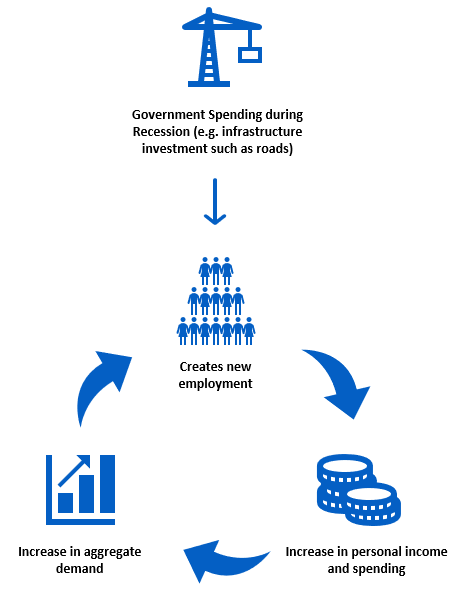
    During times of recession or economic downturn, government spending puts into action the Keynesian Multiplier. According to the Keynesian Multiplier, theorised by prominent economists such as Keynes, Kahn and Hicks, short term government spending boosts the economy by more than what is spent. Keynes was of the view that during a recession with a high level of unemployment, Governments should raise public spending to sustain effective demand and profits.


    Figure 4

    As seen from the figure above, an increase in government spending on large projects such as road building will lead to the creation of alternative employment. The increase in personal incomes and consequently aggregate demand in the economy will further stimulate economic activity and will create more employment than what was originally created by government spending. In effect, every unit of money spent by the government during a downturn increases GDP by a greater proportion than what was spent.

    Conclusion

    While unconventional policies are here to stay, they are a step in the dark. Economies are still experimenting and attempting to figure out the most effective use of these policies. Considering the fairly moderate performance of standalone unconventional policies, there is an established need for complementary fiscal policy to accompany monetary policy. An increase in infrastructure investment coupled with an accommodative monetary regime could help stimulate stagnant demand during a crisis. In developing economies, it can also help address structural bottlenecks subduing growth. These investments from the government, however, must be productive and efficient. Otherwise, they just end up adding on to already high levels of debt, especially during periods of crisis when governments have to borrow extensively for emergency requirements. It is also imperative that this investment is temporary and not permanent. Long-term government debt is unsustainable and can crowd out much-needed private investment.


    References


    [1] Central Charts. (2019). Definition of Unconventional Monetary Policy. Retrieved from

    https://www.centralcharts.com/en/gm/1-learn/9-economics/35-central-bank/976-definition-unconventional-monetary-policy

    [2] Fitch Ratings. (2020). Global QE Asset Purchases to Reach USD6 Trillion in 2020. Retrieved from

    https://www.fitchratings.com/research/sovereigns/global-qe-asset-purchases-to-reach-usd6-trillion-in-2020-24-04-2020

    [3] Reserve Bank of India. (2020). Policy Environment. Retrieved from

    https://www.rbi.org.in/scripts/PublicationsView.aspx?id=20269

    [4] Desjardins, J. (2020, March 17). The Downward Spiral in Interest Rates. Visual Capitalist.

    https://www.visualcapitalist.com/chart-the-downward-spiral-in-interest-rates/#:~:text=Global%20Rate%20Slashing,light%20of%20current%20oil%20prices.

    [5] Mullen, C. (2020, November 6). World’s Negative-Yield Debt Pile Has Just Hit a New Record. Bloomberg Quint.

    https://www.bloombergquint.com/onweb/negative-yielding-debt-hits-record-17-trillion-on-bond-rally#:~:text=The%20market%20value%20of%20the,it%20reached%20in%20August%202019.


    Image Credit: The Conversation

  • Examining the Policy Effectiveness of Negative Interest Rates: A Case Study on Japan

    Examining the Policy Effectiveness of Negative Interest Rates: A Case Study on Japan

    As a global health crisis ravages across the world, central bankers have rushed to lower rates to historic levels in an attempt to soften the economic blow of the pandemic. Since the crisis hit in early 2020, interest rates have been slashed across the globe on 37 separate occasions. Almost all major economies have cut their policy rates and many are at near-zero levels. In light of this economic climate, the debate on whether negative interest rates could prove effective in adverse conditions has come to the forefront again.

    As of today, 5 economies in the world follow a negative interest rate policy (NIRP).  In 2012, Denmark was the first country to announce negative rates, subsequently followed by the Eurozone, Switzerland, Sweden and Japan.

    The decrease in interest rates is not a new phenomenon, rates have been sliding globally for the last 30 years [1]. This trend has been more pronounced since the financial crisis of 2008. While many economies have reached the theoretical zero lower-bound of rates, some have even dared to venture below the surface into negative territory. As of today, 5 economies in the world follow a negative interest rate policy (NIRP).  In 2012, Denmark was the first country to announce negative rates, subsequently followed by the Eurozone, Switzerland, Sweden and Japan. While the very concept of negative rates may seem baffling, it’s even more shocking to note that over $15 trillion’ worth of bonds is traded at negative yields globally [2]. This means that over 30% of the world’s investment-grade securities are traded in a manner such that lenders pay borrowers to use their funds.

    Negative Interest Rates in Theory

    Interest rates have widely been regarded as the most powerful weapon in a central banker’s arsenal. Until very recently, their only limitation seemed to be the zero-lower bound beyond which bankers have had their hands tied. However, with Denmark’s policy rates going negative in 2012, this limit seems to have been breached. In theory, the NIRP is put in effect by central banks making the policy rate or repo rate (rate at which banks park their funds with the central bank) negative. While the negative rates directly apply only to banks, its effects are transmitted to the entire system by effectively lowering overall real interest rates. Central banks envisage that negative policy rates would induce increased spending and stimulate the economy in two ways – firstly, by forcing banks to hold lesser deposits with the central bank and channelling these funds into increased lending to households and businesses. Secondly, a cut in the policy rate would also lead to lower rates in the overall lending market, thus encouraging borrowing and spending.

    This policy, however, is riddled with several loopholes and works only under certain conditions. There has also been evidence of unwanted externalities associated with negative rates. The experience of the 5 economies which implemented the NIRP has been mixed and there is no consensus so far among economists and policymakers on the merits/demerits of the policy.

    Japan’s Tryst with Negative Rates: A Case Study

    In 2016 the Bank of Japan (BOJ), facing a relentless battle against deflation and a depreciating Yen, decided to venture into negative territory and has stayed there ever since.  The Japanese economy’s long downward spiral began with the real-estate asset bubble bursting in 1989-90. While Japan’s ‘lost decade’ is a widely known concept, many academics argue that Japan has lost more than a decade and has not fully recovered yet. The economy has been in first-gear ever since the crash – today, almost 30 years hence, the Nikkei 225 is still languishing at about 40% of its 1989 peak [3].

    Over the years, the BOJ has tried almost every trick in the trade – low rates, printing more money, rounds of quantitative easing, you name it and it has been done already. But much like a car stuck in the mud, the Japanese economy just seems to be spinning its wheels in one place. It is in this backdrop that the BOJ pulled out one last trick up its sleeve, announcing a negative interest rate regime.

    What Did Japan Hope to Achieve Through the NIRP?

    To combat deflation, the BOJ has long been involved in multiple rounds of aggressive bond-buying, hoping to inject more cash in the economy. According to data from the BOJ statistics portal, the central bank has been purchasing bonds worth 8-12 trillion Yen per month consistently. This has led to a mammoth increase in the bond holdings of the BOJ and also the monetary base of the Japanese economy. This has had two direct implications –

    • Japanese banks were now flush with money but this did not translate into increased lending activity. Rather banks were now parking this excess cashback with the central bank as reserves, thus defeating the purpose. It has been estimated that over 90% of the new money created by the BOJ since 2013 has ended up back with the central bank
    • The downside of this aggressive bond-buying policy was that Japan had now accumulated a mountain of debt. As of 2020, Japan was the most indebted nation in the world, with its debt accounting for over 234% of its GDP [4]

    The BOJ hoped that the NIRP would help address both these concerns. By announcing a 0.1% negative interest rate on excess reserves, it hoped to force banks to hold lesser reserves with the BOJ and use the money for lending purposes. On the other hand, negative rates would also help ease the burden of interest payments on the national debt.

    Reasons for Failure of NIRP in Japan

    While the NIRP did succeed in its immediate goal of reducing banks holdings with the BOJ, it has failed to stimulate bank lending. Instead, Japanese banks are now looking to park their funds elsewhere, to beat the low returns at home. With rates at historic lows in Japan and lacklustre borrowing sentiment from households and businesses, banks have turned to foreign investments to rake up profits. The NIRP, rather than stimulate the economy through increasing lending has instead spurred a massive outflow of funds in favour of overseas assets. As a result, Japanese banks hold nearly 20% of the world’s CLO’s (collateralized loan obligations) [5]. The foreign investments of the Japan Post Office Bank (owned by the government) alone stood at $630 billion as of 2020, showing glimpses into the outflow of reserves from the domestic economy.

    The NIRP, rather than stimulate the economy through increasing lending has instead spurred a massive outflow of funds in favour of overseas assets. As a result, Japanese banks hold nearly 20% of the world’s CLO’s (collateralized loan obligations).

    The failure of the NIRP to stimulate domestic spending and investments has shown that the Japanese economy faces several structural challenges that need to be addressed first. Given Japan’s ageing workforce, it will not be easy to discourage households from saving, especially in the current economic climate. Unless businesses and households are willing to spend or invest, the availability of cheap loans is redundant. No matter how low the BOJ pushes interest rates, the economy cannot be revived unless the structural bottlenecks subduing growth are addressed.

    Policy Shortcomings of the NIRP

    Japan’s case and the experiences of the other four economies have highlighted several loopholes in the NIRP. While it has been successful in reducing commercial bank holdings with central banks, it has not managed to translate this into lending activity. As in the case of Japan, banks can always find other ways to make use of excess funds. Even if banks manage to pass on the negative rates to the general public, households would continue to hoard cash in the form of mattress money, thus defeating the purpose of the policy. Take Sweden’s case for example – despite having negative rates, Sweden still has the 3rd highest household savings rate in the world.

    The NIRP has also been associated with several unwanted externalities –

    • Decreasing Bank Profitability

    Negative rates can destabilize the entire banking system by adversely affecting bank profits. In the Euro-zone alone, banks have transferred $24.2 billion to the European Central Bank (ECB) as negative fees in the five years since negative interest rates were introduced

    • Create asset bubbles

    A negative rate regime could also lead to the creation of property and other asset bubbles. Since rates are low (or negative) for cash holdings, people tend to invest in real estate or other tangible assets, thus driving up prices.

    • Erode Pension Funds

    Many academics believe that negative rates would hurt economies in the long run by eroding pension funds. This could potentially be a major cause for concern for countries like Japan which have an ageing population

    Is the NIRP here to stay?

    Despite its long list of flaws and potential side-effects, nations still seem to be sticking with the NIRP, with trends showing that even more may follow suit soon. Given the current economic climate, central bankers are left with no choice but to continue with low rates – that they do so despite its shortcomings speaks volumes of the precarious global economic conditions. The NIRP however, cannot be written off as a completely failed policy as it has shown that it can be successful under certain conditions. In Switzerland for example, the NIRP has been largely successful in helping depreciate the Franc (to keep exports competitive) and maintaining exchange rate parity in the face of large foreign inflows into the country. Switzerland’s experience is replicated in Sweden, with negative rates helping boost exports, although not substantially.

    Different nations have had different motives for venturing into negative territory – while countries like Japan wanted to stimulate inflation, others like Switzerland and Sweden were more interested in maintaining their exchange rates. Success or failure of the NIRP depends on the prevailing conditions of the economy and the desired end-goals that countries are after. Since it has been a relatively new policy, countries are still in the phase of experimenting with negative rates and it is too early to draw conclusions on their successes and failures.  On whether the NIRP is an effective policy tool, the jury is still out.


    References

    [1] Neufeld, D. (2020, February 4). Visualizing the 700-Year Fall of Interest Rates. Visual Capitalist. https://www.visualcapitalist.com/700-year-decline-of-interest-rates/

    [2] Mullen, C & Ainger, J. (2020, November 6). World’s Negative-Yield Debt Pile Has Just Hit a New Record. Bloomberg Quint. https://www.bloombergquint.com/onweb/negative-yielding-debt-hits-record-17-trillion-on-bond-rally#:~:text=The%20market%20value%20of%20the,it%20reached%20in%20August%202019.

    [3] Tamura, M. (2019, December 29). 30 years since Japan’s stock market peaked, climb back continues. Nikkei Asia. https://asia.nikkei.com/Spotlight/Datawatch/30-years-since-Japan-s-stock-market-peaked-climb-back-continues

    [4] World Population Review. (2020). Debt to GDP Ratio by Country 2020. Retrieved from https://worldpopulationreview.com/countries/countries-by-national-debt

    [5] Japanese banks own 20% of collateralized loans market – survey. (2020, June 2). Reuters. https://in.reuters.com/article/japan-economy-boj-loans/japanese-banks-own-20-of-collateralised-loans-market-survey-idUSL4N2DF1LP


    Image Credit: www.gulftoday.ae

  • Revamping PSUs in India – is Disinvestment the only way forward?

    Revamping PSUs in India – is Disinvestment the only way forward?

    Back in 1948 when India’s first Public Sector Unit (Indian Telephone Industries) was established, India was a newly independent agrarian economy with a weak industrial base. It was clear that the country needed to embark on a path of rapid industrialization if it was to improve the economic status and standards of living. The need was felt for large scale investment from the public sector that private players could not provide. It was in this backdrop that PSUs were first established in the country. It was envisioned that these state-run entities would jumpstart industrialization and spearhead development.

    Today, almost 70 years later, the country itself has come a long way. Once seen as the knights in shining armour come to rescue India’s economy, the same PSUs have come under fire for squandering crores of taxpayer money today. Far removed from their past glories, PSUs today are a cesspool of unproductivity where taxpayer money dies a slow painful death. The sorry state of PSUs in India has even warranted nicknames in the likes of ‘Zombie Companies’ and ‘Zombieland of Taxpayer Money’. While these nomenclatures may seem extreme, they are not without merit.

    The combined loss of these PSU’s amounts to over Rs. 31,635 crores in taxpayer money [1]. What’s more, this number is not inclusive of the losses reported by the dozen public sector banks, which would only add to the already huge mountain of debt.

    Current State of PSU’s in India

    Back in 1951, there were only 5 public sector enterprises in existence. Since then the government has gone on a spending spree, entering more and more businesses over the years. Today the government runs more than 300 PSUs across a plethora of industries ranging from hotels & watches to telecom and steel. It doesn’t come as a surprise that over 70 of these entities are running a net loss. The combined loss of these PSU’s amounts to over Rs. 31,635 crores in taxpayer money [1]. What’s more, this number is not inclusive of the losses reported by the dozen public sector banks, which would only add to the already huge mountain of debt. If the central public sector enterprises have fared poorly, the state-level public enterprises (SLPE) paint a bleaker picture. Barring certain states, the SLPEs of almost all the states in India report a net loss. The losses reported by these SLPEs are almost 3 times greater than the amount reported by their central counterparts.

    The PSUs which have not reported a net loss has not escaped public scrutiny either, with almost all of them losing value over the last decade. While some do report profits, their returns have been dwindling, save a few. The rate of return on capital employed (ROCE), widely used as a measure of profitability and efficiency, has been on a downward trend for PSUs. It has been reported that PSU efficiency has fallen by over 50% in the last decade [2]. In the last six years alone the total market cap of all public sector firms and banks fell by 36% even as the market cap of all BSE and NSE listed companies have almost doubled in the same period [3]. 

    The bad news is that this dismal performance of PSUs is only going to get worse, especially given the current economic climate. Despite years of turnaround efforts and crores of bailout money, these state-run entities have shown no signs of recovery, save a few. In this light, much of the discourse around PSUs has been focused on disinvestment. The government too seems to echo this sentiment as it has chosen to embark upon a long-drawn journey of divesting its holdings. Several sectors in India are already heading towards 100% privatization. With the sale of Air India, the civil aviation industry will become fully private. In the power sector, there has been a growing emphasis on private generation, with the centre reducing its stake in NTPC and BHEL. Sooner or later this sector is also headed for 100% privatization. In other sectors like telecom and health, the government has just a token presence, with much of the market being dominated by private players.

    Push for Privatization

    This push for privatization is welcome and much needed in sectors like civil aviation which lack strategic importance. The sorry state of Air India has made clear that the government simply cannot compete with private players in a highly commercialised industry like aviation. Air India in particular has been languishing for years and has eroded crores of taxpayer money in the process. This has been the case not just for India but for other developing economies like Brazil and Malaysia as well. Malaysia has been trying to turn around Malaysia Airlines for decades altogether with no end in sight. After years of struggle, it seems the government has finally decided to change tracks as it is now looking to give up its majority stake in the airline to private investors. The case with Brazil is no different – the failing national aerospace conglomerate Embraer was revived just in time with a dose of privatization.

    The Embraer turnaround model in particular offers some interesting lessons for India. What started off as a government entity in 1969 was privatised in 1994 in order to avoid bankruptcy [4]. Embraer then went from near bankruptcy to becoming the third-largest aircraft manufacturer in the world. What’s striking here is that the Brazilian government played its cards to near perfection – while it completely privatized the airline, the Brazilian government still holds a ‘golden share’ in Embraer giving it veto power over strategic decisions involving military programs and any change in its controlling interest. This model ensured a win-win situation for the Brazilian government and the rest, of course, is history. 

    Instead of divesting its bleeding PSU’s, the government is currently in the process of selling its 100% stake in 3 large profitable companies (BPCL, CCI, and the Shipping Corporation). While it’s tempting to believe this is a part of an extensive government masterplan, the stark reality is that the government has let fiscal pressures dictate its divestment strategy.

    The problem with the centre’s current disinvestment strategy, however, is that it is focused merely on balancing government books and lacks a long-term strategic vision. Instead of divesting its bleeding PSU’s, the government is currently in the process of selling its 100% stake in 3 large profitable companies (BPCL, CCI, and the Shipping Corporation). While it’s tempting to believe this is a part of an extensive government masterplan, the stark reality is that the government has let fiscal pressures dictate its divestment strategy. It appears the government is simply selling its stake in PSUs to make quick money and ease the fiscal books. There are also concerns that 100% privatization of entities like BPCL and HPCL will feed private monopoly and leave India’s energy security purely in the hands of private players. Even in the sale of loss-making entities the government has lacked a systematic plan, with divestment being carried out in penny packets. This sort of disinvestment just to stop the bleeding is a short term stop-gap measure and will surely have long term repercussions. 

    The case for Public Sector Presence

    While privatization plays are much needed in sectors like civil aviation, the same cannot be said for strategic sectors such as power, pharma, and health. A diluted public sector presence in strategic industries may not bode well for the economy, especially for a developing country like India. As the COVID-19 pandemic has shown, strong public systems are essential to absorbing global shocks. While proponents of disinvestment seek to cut the economic costs of bleeding PSUs, they often ignore the social costs involved in the process and the impact it will have on a developing economy like ours.

    In light of the current global economic climate, as more and more countries turn inward, the role of state-run entities has become all the more important. The experiences of other Asian economies like China and Singapore have shown that state-run units could be tools of economic growth if utilised effectively. Most of China’s industrial push, including the recent ‘Made in China 2025’ plan has been heralded by State-Owned Enterprises (SOE’s). Among the 124 Chinese companies in the Fortune Global 500 list, more than half were SOE’s [5]. Out of these, 3 of the Chinese SOE’s feature in the top 5 globally, speaking volumes of the role they have played in the growth of the country. China has effectively put SOE’s at the core of its vision to combat the challenges it currently faces, including the escalating trade war with the USA. China’s model is also noteworthy given the level of collaborative investments between SOE’s and private players. India can take a leaf or two out of China’s book on the successful use of SOE’s to drive its growth story.

    Turning around existing PSU’s – success stories 

    It is clear that the government simply cannot take the easy way out of simply divesting and washing its hands off the bleeding PSUs. In certain critical sectors (that first need to be recognized in line with the long-term strategy) the government still needs to work on repairing the damage and turning around its existing underperformers. While the task seems impossible given the current state of affairs, policymakers can take heart from the fact that it has been done before both in India and globally.

    One such global success story is that of the Kiwi national carrier Air New Zealand. In a world of post-privatization success stories, Air NZ stands out as one of the few lone dissenters to buck this trend. The NZ based company, privatised by the government in 1989, had to be re-nationalised again in 2001 after it ran into financial troubles. The fortunes of the New Zealand economy have been closely tied to that of Air NZ, with the country being heavily dependent on local and international tourism. Within just two years of nationalisation Air NZ was able to fashion a comeback from near ruin, and today is one of the biggest revenue earners for the NZ government. That a company that failed in private hands was able to be revived by the government offers a beacon of hope for struggling public enterprises worldwide.

    Back home in India as well such success stories do exist, albeit in a bygone era. Aptly recognised as one of the greatest public sector managers of India, Dr. V. Krishnamurthy is the mastermind behind these success stories. His unparalleled contributions to the public sector have earned him several monikers such as ‘the helmsman’ and ‘the man with the golden touch’. He has been largely credited with successfully turning around public sector giants like BHEL, SAIL, GAIL, and Maruti. At a time when public sector turnarounds were unheard of in India, Dr. Krishnamurthy managed to increase profits of BHEL from 17 crore rupees to 57 crores during his five-year tenure [6]. He also came to be widely regarded as the ‘Steel Man of India’ after his successful turnaround of SAIL in the late 1980s. 

    At Maruti he decided to take a different approach, inviting private sector participation through a JV. While many skeptics were against this move initially, the helmsman had the last laugh as Maruti went on to dominate the automobile market in India for decades. Maruti’s turnaround story is also a shining example of the merits of public-private collaboration – something which today’s policymakers have chosen to largely overlook. Maruti today is a 100% private company and is widely credited with creating the automobile industry revolution in India. 

    Way Forward – a two-pronged approach to fix PSU’s

    While such success stories may be scant and the field is mired with accounts of public failure, it is evident that such turnarounds are not impossible. As we have seen from the examples in India and elsewhere, with the right leadership any enterprise can be pulled out of the mud. What is clear is that there is no simple one size fits all answer to the woes of PSU’s in India. Several countries have taken different approaches to tackle this issue. While China has followed a model of strong public presence in several industries, countries like the USA hardly have a public sector presence. The United States government rather exercises its presence by closely regulating and monitoring the industry through effective policy mechanisms.  Other countries like Singapore have chosen to manage PSUs through sovereign funds and holding companies. Singapore plays in the public sector via its two sovereign funds, Temasek and GIC. The companies owned by these funds operate as commercial entities and are no different from private players. Such a model has ensured that the companies get the best of both worlds – public ownership but with private, commercial management.

    countries like Singapore have chosen to manage PSUs through sovereign funds and holding companies. Singapore plays in the public sector via its two sovereign funds, Temasek and GIC.

    While there are many such different models that India can take inspiration from, the verdict is clear that the government must stop the bleeding in the public sector quickly or face the wrath of taxpayers. Going forward, the government must adopt a two-pronged approach to fix PSUs – some need to be killed, while others deserve a chance at resurrection.

    Firstly, the government needs to shut down bleeding enterprises in sectors that have no strategic relevance. The government is present in sectors like biofuel, airlines, hotels, and watches despite making heavy losses every year. Public entities simply cannot compete in these industries nor is there any strategic need to do so. The logical step for the government would be to send these entities to the graveyard and stop the bleeding.

    The top 10 loss making PSU’s account for over 94% of the overall losses reported by all PSU’s together.

    Secondly, efforts must be made to turnaround/transform remaining entities in strategic sectors. The top 10 loss making PSU’s account for over 94% of the overall losses reported by all PSUs together. These large offenders would be the best places to start – the government would do well to either transform these entities in-house through fresh leadership or by inviting private partnerships.

    The above tasks are easier said than done and may take years of policy reform to become a reality. While the problem does seem formidable, it is not unique to India alone. Several economies around the world, developing and developed alike, are grappling with the issue of falling public sector productivity and the need to stay relevant. Indian policymakers and public sector managers have a long road ahead of them, especially given the current global socio-economic scenario. But they can definitely take inspiration (and some valuable lessons) from the several public sector turnaround stories globally and from India’s great helmsman himself.


    References

    [1] Department of Public Enterprises. (2019). Public Enterprises Survey 2018-19 (Volume 1, Statement 1). Retrieved from https://dpe.gov.in/public-enterprises-survey-2018-19

    [2] Rai, D. (2019, September 11). PSU returns fell 50% in the past decade; 44 new entities created. Business Today. https://www.businesstoday.in/current/corporate/in-depth-government-companies-almost-lost-half-of-their-efficiency-in-last-10-years/story/378508.html

    [3] How PSU’s market cap fell by 36% in 6 years under Modi govt, while stock market doubled theirs. (2020, October 30). The Print. https://theprint.in/opinion/how-psus-market-cap-fell-by-36-in-6-years-under-modi-govt-while-stock-market-doubled-theirs/533743/

    [4] Haynes, B & Boadle, A. Boeing willing to preserve Brazil’s ‘golden share’ in Embraer deal. (2018, January 19). Reuters. https://www.reuters.com/article/us-embraer-m-a-boeing-idUSKBN1F72XB

    [5] Fortune. (2020). Fortune Global 500 2020. Retrieved from https://fortune.com/global500/

    [6] Nayar, L. V. Krishnamurthy, SAIL, BHEL, Maruti. (20187, March 23). Outlook India. https://magazine.outlookindia.com/story/v-krishnamurthy-sail-bhel-maruti/298634