Author: Thierry Meyssan

  • Trump and Musk, Canada, Panama and Greenland, an old Story

    Trump and Musk, Canada, Panama and Greenland, an old Story

    Re-elected President Donald Trump has mentioned a possible annexation of the Panama Canal, Canada and Greenland. A crazy project that already appeared on a map, imagined in 1941 by a follower of the technocratic movement. However, it was the French branch of this movement that invented the transhumanism dear to Elon Musk, whose grandfather was responsible for the Canadian branch of the technocratic movement.

    When the technocratic movement considered annexing Greenland, it recalled that it is located on the North American continental shelf and based its decision on the importance of its natural resources. It holds precious rare earth minerals [4], as well as uranium, billions of barrels of oil and vast reserves of natural gas, previously inaccessible but increasingly less so.
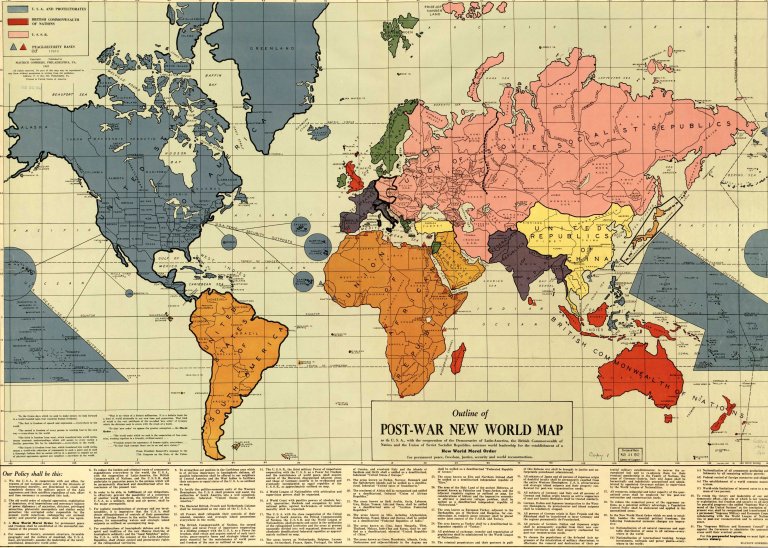
    The post-World War II world map, drawn by Maurice Gomberg in 1941. The United States extends from Canada to the Panama Canal and includes Greenland.

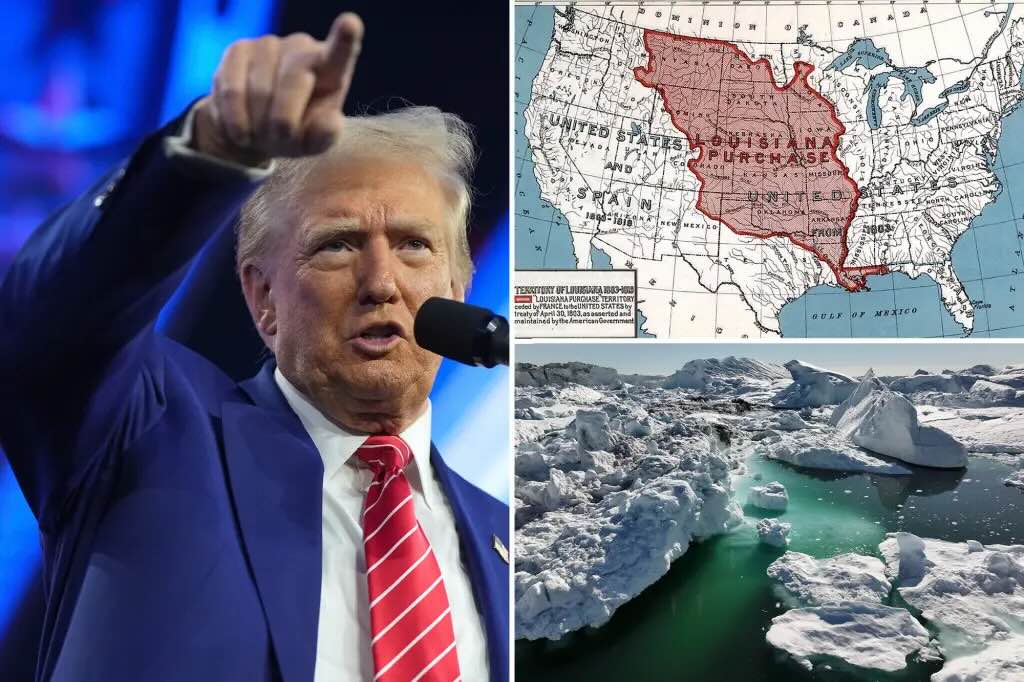
    The statements of the re-elected US President Donald Trump, before his inauguration, announcing that he intended to buy Greenland (which he had already compared in 2019 to a “big real estate deal”) and to annex both Canada and the Panama Canal have stunned us. No Western leader had made such statements since the Second World War. The US ruling class instead saw it as a “new frontier”, that is to say, new territories where their country could continue its advance.

    The Danish government, on which Greenland depends, has indicated that it is not for sale, that it is an “autonomous territory” owned only by the Greenlanders. German Chancellor Olaf Scholz called for “the principle of the inviolability of borders to apply to all countries… whether it is a very small one, or a very powerful one.” French Foreign Minister Jean-Noël Barrot commented: “There is no doubt that the European Union would not allow other nations of the world to attack its sovereign borders.” British Foreign Secretary David Lamy said Donald Trump “raises concerns about Russia and China in the Arctic, which concern the national economic security” of the United States. These are “legitimate issues.” Finally, for Italian Prime Minister Giorgia Meloni, these statements are “more of a message intended” to “other great powers rather than hostile claims against these countries. These are two territories where in recent years we have seen increasing activism by China. »

    Canadian Prime Minister Justin Trudeau, who was elected as Pierre Trudeau’s son and therefore as a defender of national independence, turned out to be nothing more than a follower of Washington. He therefore had nothing to say about what seems obvious: by joining the United States, his country would have nothing to lose that it has not already lost and everything else to gain. So he resigned.

    Concerning the Panama Canal, Donald Trump had insinuated that it was operated by the Chinese army. Panamanian President José Raúl Mulino responded: “The canal is not controlled, directly or indirectly, by China, the European Community, the United States or any other power. As a Panamanian, I firmly reject any expression that distorts this reality.”

    We will explain here that these ideas of annexation are not new, but date back to the 1929 crisis, and that they correspond to a coherent ideological corpus defended, until last week, by the only multi-billionaire Elon Musk whom we knew rather as an admirer of the Serbian engineer Nicolas Tesla and as a follower of transhumanism.

    During the “Great Depression”, that is to say the Wall Street crisis and the economic storm that followed, all the American and European elites considered that capitalism, in its then form, was definitively dead. Joseph Stalin proposed the Soviet model as the only answer to the crisis, while Benito Mussolini (former representative of Lenin in Italy) proposed, on the contrary, fascism. But in the United States, a third solution was proposed: technocracy.

    Criticizing the traditional reading of supply and demand, the economist Thorstein Veblen was interested in the motivations of buyers. He showed that the man who can afford leisure actually does so to reinforce his social superiority, and must therefore show it. Leisure is therefore not a form of laziness, but “expresses the unproductive consumption of time”. Consequently, in many situations, contrary to popular belief, “The more the price of a good increases, the more its consumption also increases” (Veblen’s paradox). It is therefore not prices, but group behavior and individual motivations that dictate the economy.

    Thorstein Veblen’s iconoclastic thinking gave birth, among others, to Howard Scott’s technocratic movement. He imagined that power should be given neither to capitalists nor to proletarians, but to technicians.

    This movement was exported to France around polytechnicians, notably the esoteric novelist Raymond Abellio (who founded the sect of which François Mitterrand was a member until his death) and Jean Coutrot, the inventor of transhumanism. Little by little, this movement would have engendered in the occult circles of Philippe Pétain’s regime a secret society, the Synarchy.

    Coutrot’s transhumanism foreshadows Elon Musk’s transhumanism. For Coutrot, it was about using technology to go beyond humanism. For Elon Musk, it is more about using technology to change man.

    This movement of ‘technocracy’ is based on a dominant challenge to the functioning of democracies. It professes not to engage in politics and to find technical solutions to all problems.

    Given this lineage, we understand that any reference to technocracy in France is discredited from the start. However, this movement is based on a dominant challenge to the functioning of democracies. It professes not to engage in politics and to find technical solutions to all problems. Whether we like it or not, it is present in the United States in the belief that it is technical progress that will solve everything.

    The fact remains that the technocratic movement, relying on statistical knowledge from the interwar period, was convinced that the North American continent constituted a unit in terms of mineral resources and industries.

    Joshua Haldeman

    The head of the Canadian branch of the movement, chiropractor Joshua Haldeman, was arrested during the Second World War because he defended neutrality towards Nazi Germany. He was indeed pro-Hitler and anti-Semitic [1]. After the war, he settled in South Africa, seduced by its apartheid regime. His grandson is none other than Elon Musk.

    It should be noted that the multi-billionaire’s position within the Trump administration is increasingly contested from within. Thus Steve Bannon was able to declare to Corriere della Sera: “Elon Musk will not have full access to the White House, he will be like any other person. He is really an evil guy, a very bad guy. I made it a personal thing to fire this guy. Before, because he put money in, I was ready to tolerate it, I am no longer ready to tolerate it.” [2].

    Elon Musk

    Maurice Goldberg envisaged a division of the world by civilizations. The United States would have been expanded to include all of North America, from Canada to the Panama Canal, and to many Pacific and Atlantic islands, including the Antilles, Greenland and Ireland.

    Some members of the technocratic movement gave great importance to the post-World War II world map drawn up in 1941 by an anonymous author signing under the pseudonym Maurice Gomberg. However, he envisaged a division of the world by civilizations. The United States would have been expanded to include all of North America, from Canada to the Panama Canal, and to many Pacific and Atlantic islands, including the Antilles, Greenland and Ireland. Like the French Synarchy, this map has been widely discussed in conspiracy circles. However, according to historian Thomas Morarti, quoted by the Irish press [3], this map resonated with President Franklin D. Roosevelt during his “Four Freedoms speech” (freedom of speech, freedom of religion, freedom from want, and freedom from fear) on January 6, 1941. Along the same lines, in 1946, President Harry Truman proposed that US troops not evacuate Greenland, which they had liberated from the Nazis, but buy it for $100 million.

    In 1951, Denmark authorized the establishment of two large US and NATO military bases in Greenland, at Sondreström and Thule. Elements of the US anti-ballistic system have since been installed there. The treaty authorizing these bases was co-signed by Greenland in 2004, that is, after it had acquired its autonomous status.

    In 1968, a US strategic bomber, which was taking part in a routine operation in the context of the Cold War, accidentally crashed near Thule, contaminating the region with a cloud of enriched uranium. It was learned in 1995 that the Danish government had tacitly authorized the United States, in violation of Danish law, to store nuclear weapons on its soil.

    The purchase of Greenland could, therefore, easily take place without money. All that would be required would be for the Pentagon to ensure the protection of Denmark, thus freeing it from a financial burden.

    Donald Trump Jr. and his team “on vacation” in Greenland.

    Giving reality to what seemed to be just empty talk, Donald Trump Jr., the son of the re-elected president, went on vacation to Greenland. Of course, on board a family plane and surrounded by a group of advisors. He did not meet, officially at least, with any political leader. During this trip, the NGO Patriot Polling conducted a survey. The majority of respondents (57.3%) approved of the idea of joining the United States, while 37.4% were against it. Of those surveyed, 5.3% remained undecided. Following the publication of these results, Múte B. Egede gave a press conference in Copenhagen that even if he had not spoken with the Trumps, he was open to “discussions on what unites us. We are ready to discuss. Cooperation is a question of dialogue. Cooperation means that you will work to find solutions.”

    When the technocratic movement considered annexing Greenland, it recalled that it is located on the North American continental shelf and based its decision on the importance of its natural resources. It holds precious rare earth minerals [4], as well as uranium, billions of barrels of oil and vast reserves of natural gas, previously inaccessible but increasingly less so. Rare earths are now almost exclusively available to China. However, they have become essential for high technology, particularly for Tesla cars. These natural reserves are not exploited due to the traditional opposition of the indigenous populations, the Inuit (88% of the population).

    Today, Greenland is above all a strategic issue. It would allow the United States to control the Northern Sea Route, which is now navigable. Since this is currently controlled by Russia and China, a change in the island’s ownership would transform the geopolitical equation. That is why Dmitry Peskov, the Kremlin spokesman, commented: “The Arctic is a zone of our national interests, our strategic interests. We want to preserve the climate of peace and stability in the Arctic zone. We are watching the rather spectacular development of the situation very closely, but so far, thank God, only at the level of statements.”

    References to the technocratic movement may have nothing to do with Musk and Trump, but they should be kept in mind as events unfold.


    Translated from French by Roger Lagasse’


    References:

    [1The International Conspiracy to Establish a World Dictatorship & The Menace to South Africa, Joshua Haldeman. Cité dans «The World According to Elon Musk’s Grandfather», Jill Lepore, The New Yorker, September 19, 2023.

    [3«United mates of America», Tom Prendeville, Irish Mirror.

    [4Greenland is only mentioned once in the Technocracy Study Course. Rare earths were ignored at the time.


    This article was published earlier in Voltairenet.org
    and is republished under Creative Commons (license CC-BY-NC-ND)

    Feature Image Credit: nypost.com
  • What International Order?

    What International Order?

    The recently concluded BRICS summit confirms the process of inevitable transformation of the international order. The US-led West, since the fall of the USSR, has increasingly demonstrated intolerance to their view of the world. The ongoing conflicts in UKraine and Gaza has exposed their duplicity and the entire Global South have come to realise the anamolies in international order and the so-called rules-based system. The West’s unabashed support to Israel’s genocide and babarism in Gaza, despite their peoples’ opposition makes the claims of democracy and humanism in the West sound hollow. Thierry Meyssan dealt incisively with this duplicity of the West, primarily the Ango-Saxon powers, in his speech last year in Magdeburg (Germany), at the conference organized by the magazine Compact, “Amitie avec la Russie”, on November 4, 2023.

    We reproduce the text of Thierry Meyssan’s speech, translated by Roger Lagasse’, and published earlier in voltairenet.org

    In it, he explains what, in his view, constitutes the fundamental difference between the two conceptions of the world order now clashing from the Donbass to Gaza: that of the Western bloc and that to which the rest of the world refers. The question is not whether this order should be dominated by one power (unipolar) or by a group of powers (multipolar), but whether or not it should respect the sovereignty of each. He draws on the history of international law, as conceived by Tsar Nicholas II and Nobel Peace Prize winner Léon Bourgeois.

    – Team TPF

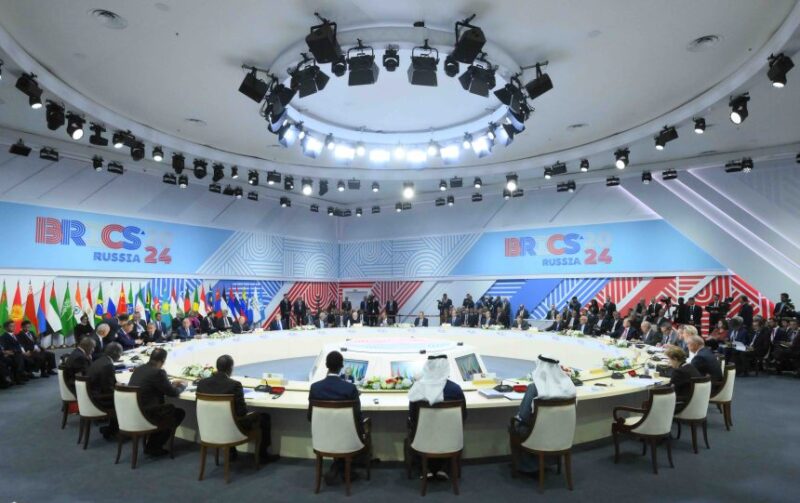
    BRICS Summit 2024 in Kazan, Russia, October 23,2024. Sputnik . Photo hosting agency brics-russia2024.ru

    What International Order?

    Thierry Meyssan

    We’ve seen NATO’s crimes, but why affirm our friendship with Russia? Isn’t there a risk of Russia behaving tomorrow like NATO does today? Are we not substituting one form of slavery for another?

    To answer this question, I would draw on my successive experience as advisor to five heads of state. Everywhere, Russian diplomats have told me: you’re on the wrong track: you’re committed to putting out one fire here, while another has started elsewhere. The problem is deeper and broader.

    I would therefore like to describe the difference between a world order based on rules and one based on international law. This is not a linear story, but a struggle between two worldviews – a struggle we must continue.

    In the 17th century, the Treaties of Westphalia established the principle of state sovereignty. Each is equal to the others, and no one may interfere in the internal affairs of others. For centuries, these treaties governed relations between the present-day Länder, as well as between European states. They were reaffirmed by the Congress of Vienna in 1815 when Napoleon I was defeated.

    On the eve of the First World War, Tsar Nicholas II convened two International Peace Conferences (1899 and 1907) in The Hague to “seek the most effective means of assuring all peoples the benefits of a real and lasting peace”. Together with Pope Benedict XV, he prepared them on the basis of canon law, not the law of the strongest. After two months of deliberation, 27 states signed the final proceedings. The president of the French Radical [Republican] Party, Léon Bourgeois, presented his thoughts [1] on the mutual dependence of states and their interest in uniting despite their rivalries.

    At the instigation of Léon Bourgeois, the Conference created an International Court of Arbitration to settle disputes by legal means rather than by war. According to Bourgeois, states would only agree to disarm when they had other guarantees of security.

    The final text instituted the notion of “the duty of States to avoid war”… by resorting to arbitration.

    At the instigation of one of the Tsar’s ministers, Frédéric Fromhold de Martens, the Conference agreed that, during armed conflict, populations and belligerents must remain under the protection of the principles resulting from “the usages established between civilized nations, the laws of humanity and the dictates of public conscience”. In short, the signatories undertook to stop behaving like barbarians.

    This system only works between civilized states that honour their signatures and are accountable to public opinion. It failed, in 1914, because states had lost their sovereignty by entering into defense treaties that required them to go to war automatically in certain circumstances that they could not assess for themselves.

    Léon Bourgeois’s ideas gained ground, but met with opposition, including from his rival in Georges Clemenceau’s Radical Party. Clemenceau did not believe that public opinion could prevent wars. Nor did the Anglo-Saxons, U.S. President Woodrow Wilson and British Prime Minister Lloyd George. At the end of the First World War, these three men substituted the might of the victors for the fledgling international law. They shared the world and the remnants of the Austro-Hungarian, German and Ottoman empires. They blamed Germany alone for the massacres, denying their own. They imposed disarmament without guarantees. To prevent the emergence of a rival to the British Empire in Europe, the Anglo-Saxons began to pit Germany against the USSR, and secured France’s silence by assuring her that she could plunder the defeated Second Reich. In a way, as the first President of the Federal Republic, Theodor Heuss, put it, they organized the conditions for the development of Nazism.

    As they had agreed among themselves, the three men reshaped the world in their own image (Wilson’s 14 points, the Sykes-Picot agreements, the Balfour Declaration). They created the Jewish homeland of Palestine, dissected Africa and Asia, and tried to reduce Turkey to its minimum size. They organized all the current disorders in the Middle East.

    Yet it was on the basis of the ideas of the late Nicholas II and Léon Bourgeois that the League of Nations (League) was established after the First World War, without the participation of the United States, which thus officially rejected any idea of International Law. However, the League also failed. Not because the United States refused to join, as some say. That was their right. But firstly, because it was incapable of re-establishing strict equality between states, as the United Kingdom was opposed to considering colonized peoples as equals. Secondly, it did not have a common army. And finally, because the Nazis massacred their opponents, destroyed German public opinion, violated the Berlin signature and did not hesitate to behave like barbarians.

    As early as the Atlantic Charter in 1942, the new U.S. President, Franklin Roosevelt, and the new British Prime Minister, Winston Churchill, set themselves the common goal of establishing a world government at the end of the conflict. The Anglo-Saxons, who imagined they could rule the world, did not, however, agree amongst themselves on how to go about it. Washington did not wish London to meddle in its affairs in Latin America, while London had no intention of sharing the hegemony of the Empire over which “the sun never set”. During the war, the Anglo-Saxons signed numerous treaties with Allied governments, including those in exile, which they hosted in London.

    Incidentally, the Anglo-Saxons failed to defeat the Third Reich, and it was the Soviets who overthrew it and took Berlin. Joseph Stalin, First Secretary of the CPSU, was opposed to the idea of a world government, and an Anglo-Saxon one at that. All he wanted was an organization capable of preventing future conflicts. In any case, it was Russian conceptions that gave birth to the system: that of the United Nations Charter, at the San Francisco conference.

    In the spirit of the Hague Conferences, all UN member states are equal. The Organization includes an internal tribunal, the International Court of Justice, responsible for settling disputes between its members. However, in the light of previous experience, the five victorious powers have a permanent seat on the Security Council, with a veto. Given that there was no trust between them (the Anglo-Saxons had planned to continue the war with the remaining German troops against the USSR) and that it was unknown how the General Assembly would behave, the various victors wanted to ensure that the UN would not turn against them (the USA had committed appalling war crimes by dropping two atomic bombs against civilians, while Japan… was preparing its surrender to the Soviets). But the great powers did not understand the veto in the same way. For some, it was a right to censor the decisions of others; for others, it was an obligation to take decisions unanimously.

    Except that, right from the start, the Anglo-Saxons didn’t play ball: an Israeli state declared itself (May 14, 1948) before its borders had been agreed, and the UN Secretary-General’s special envoy to oversee the creation of a Palestinian state, Count Folke Bernadotte, was assassinated by Jewish supremacists under the command of Yitzhak Shamir. Moreover, the seat on the Security Council allocated to China, in the context of the end of the Chinese Civil War, was given to Chiang Kai-shek’s Kuomintang and not to Beijing. The Anglo-Saxons proclaimed the independence of their Korean zone of occupation as the “Republic of Korea” (August 15, 1948), created NATO (April 4, 1949), and then proclaimed the independence of their German zone of occupation as “Federal Germany” (May 23, 1949).

    The USSR considered itself fooled, and slammed the door (“empty seat” policy). The Georgian Joseph Stalin had mistakenly believed that the veto was not a right of censure, but a condition of unanimity of the victors. He thought he could block the organization by boycotting it.

    The Anglo-Saxons interpreted the text of the Charter they had drafted and took advantage of the Soviets’ absence to place “blue helmets” on the heads of their soldiers and wage war on the North Koreans (June 25, 1950) in the “name of the international community” (sic). Finally, on August 1, 1950, the Soviets returned to the UN after an absence of six and a half months.

    The North Atlantic Treaty may be legal but NATO’s rules of procedure violate the UN Charter. It places the Allied armies under Anglo-Saxon command. Its Commander-in-Chief, the SACEUR, is necessarily an American officer. According to its first Secretary General, Lord Ismay, the Alliance’s real aim was neither to preserve the peace nor to fight the Soviets, but to “keep the Americans in, the Russians out and the Germans under control” [2]. In short, it was the armed wing of the world government that Roosevelt and Churchill wanted to create. It was in pursuit of this goal that President Joe Biden ordered the sabotage of the Nord Stream gas pipeline linking Russia and Germany.

    At the Liberation, MI6 and OPC (the future CIA) secretly set up a stay-behind network in Germany. They placed thousands of Nazi leaders in this network, helping them to escape justice. Klaus Barbie, who tortured French Resistance coordinator Jean Moulin, became the first commander of this shadow army. The network was then incorporated into NATO, where it was greatly reduced. It was then used by the Anglo-Saxons to interfere in the political life of their supposed allies, who were in reality their vassals.

    Joseph Goebbels’ former collaborators created the Volksbund für Frieden und Freiheit. With the help of the USA, they persecuted German communists. Later, NATO’s stay-behind agents were able to manipulate the extreme left to make it detestable. A case in point is the Bader gang. But as these men were arrested, the stay-behind came and murdered them in prison, before they could stand trial and speak out. In 1992, Denmark spied on Chancellor Angela Merkel on NATO instructions, just as in 2022, Norway, another NATO member, helped the USA sabotage Nord Stream…

    Returning to international law, things gradually returned to normal, until in 1968, during the Prague Spring, the Ukrainian Leonid Brezhnev did in Central Europe what the Anglo-Saxons were doing everywhere else: he forbade the USSR’s allies to choose an economic model other than their own.

    With the dissolution of the USSR, things began to get worse. The US Undersecretary of Defense, Paul Wolfowitz, drew up a doctrine according to which, to remain masters of the world, the United States had to do everything in its power to prevent the emergence of a new rival, starting with the European Union. It was in application of this idea that Secretary of State James Baker imposed the enlargement of the European Union to include all the former states of the Warsaw Pact and the USSR. By expanding in this way, the Union deprived itself of the possibility of becoming a political entity. It was again in application of this doctrine that the Maastricht Treaty placed the EU under NATO’s protection. And it is still in the application of this doctrine that Germany and France are paying for and arming Ukraine.

    Then came Czech-US professor Josef Korbel. He proposed that the Anglo-Saxons should dominate the world by rewriting international treaties. All that was needed, he argued, was to substitute Anglo-Saxon law, based on custom, for the rationality of Roman law. In this way, in the long term, all treaties would give the advantage to the dominant powers: the United States and the United Kingdom, linked by a “special relationship”, in the words of Winston Churchill. Professor Korbel’s daughter, Democrat Madeleine Albright, became Ambassador to the UN, then Secretary of State. Then, when the White House passed into Republican hands, Professor Korbel’s adopted daughter, Condoleeza Rice, succeeded her as National Security Advisor, then Secretary of State. For two decades, the two “sisters” [3]patiently rewrote the main international texts, ostensibly to modernize them, but in fact to change their spirit.

    Today, international institutions operate according to Anglo-Saxon rules, based on previous violations of international law. This law is not written in any code, since it is an interpretation of custom by the dominant power. Every day, we substitute unjust rules for International Law and violate our own signature.

    For example:

    • When the Baltic States were created in 1990, they made a written commitment to preserve the monuments to the sacrifices of the Red Army. The destruction of these monuments is therefore a violation of their own signature.
    • Finland made a written commitment in 1947 to remain neutral. Joining NATO is therefore a violation of its own signature.
    • On October 25, 1971, the United Nations adopted Resolution 2758 recognizing Beijing, not Taiwan, as the sole legitimate representative of China. As a result, Chiang Kai-shek’s government was expelled from the Security Council and replaced by that of Mao Zedong. Consequently, China’s recent naval manoeuvres in the Taiwan Strait do not constitute aggression against a sovereign state, but the free deployment of its forces in its own territorial waters.
    • The Minsk agreements were intended to protect Russian-speaking Ukrainians from harassment by “integral nationalists”. France and Germany vouched for them before the Security Council. But, as Angela Merkel and François Hollande have said, neither of them had any intention of implementing them. Their signatures are worthless. If it had been otherwise, there would never have been a war in Ukraine.

    The perversion of International Law reached a peak with the appointment, in 2012, of the American Jeffrey Feltman as Director of Political Affairs. From his office in New York, he oversaw the Western war on Syria. Using the institutions of peace to wage war [4].

    Until the United States threatened it by stockpiling weapons on its border, the Russian Federation respected all the commitments it had signed or that the Soviet Union had signed. The Nuclear Non-Proliferation Treaty (NPT) obliges the nuclear powers not to spread their nuclear arsenals around the world. The United States, in violation of its signature, has been stockpiling atomic bombs in five vassal countries for decades. They train allied soldiers in the handling of these weapons at the Kleine Brogel base in Belgium, the Büchel base here in Germany (Rhineland-Palatinate), the Aviano and Ghedi bases in Italy, the Volkel base in the Netherlands and the Incirlik base in Turkey.

    Then they say, by virtue of their coups de force, that this has become the custom.
    Now, the Russian Federation, considering itself under siege after a US nuclear bomber flew over the Gulf of Finland, has also played with the Non-Proliferation Treaty and installed atomic bombs on the territory of Belarus. Of course, Belarus is not Cuba. Placing Russian nuclear bombs there changes nothing. It’s just a message sent to Washington: if you want to re-establish the Law of the Strongest, we can accept that too, except that, from now on, we’re the strongest. Note that Russia has not violated the letter of the Treaty, as it is not training the Belarusian military in these weapons, but it has taken liberties with the spirit of the Treaty.

    As Léon Bourgeois explained in the last century, to be effective and lasting, disarmament treaties must be based on legal guarantees. It is therefore urgent to return to international law, failing which we will plunge headlong into a devastating war.

    Our honour and our interest lie in re-establishing international law. It’s a fragile construction. If we want to avoid war, we must re-establish it, and we can be sure that Russia thinks as we do, that it will not violate it.

    Or we can support NATO, which brought its 31 defence ministers together in Brussels on October 11 to listen to their Israeli counterpart announce, via videoconference, that he was going to raze Gaza to the ground. And none of our ministers, including Germany’s Boris Pistorius, dared to speak out against the planning of this mass crime against civilians. The honour of the German people has already been betrayed by the Nazis, who ultimately sacrificed you. Don’t let yourselves be betrayed again, this time by the Social Democratic Party and the Greens.

    We don’t have to choose between two overlords, but to protect peace, from the Donbass to Gaza, and, ultimately, to defend International Law.


    Source: “What international order?”, by Thierry Meyssan, Translation Roger Lagassé, Voltaire Network, 7 November 2023, www.voltairenet.org/article219965.html

    Republished under Creative Commons CC-BY-NC-ND

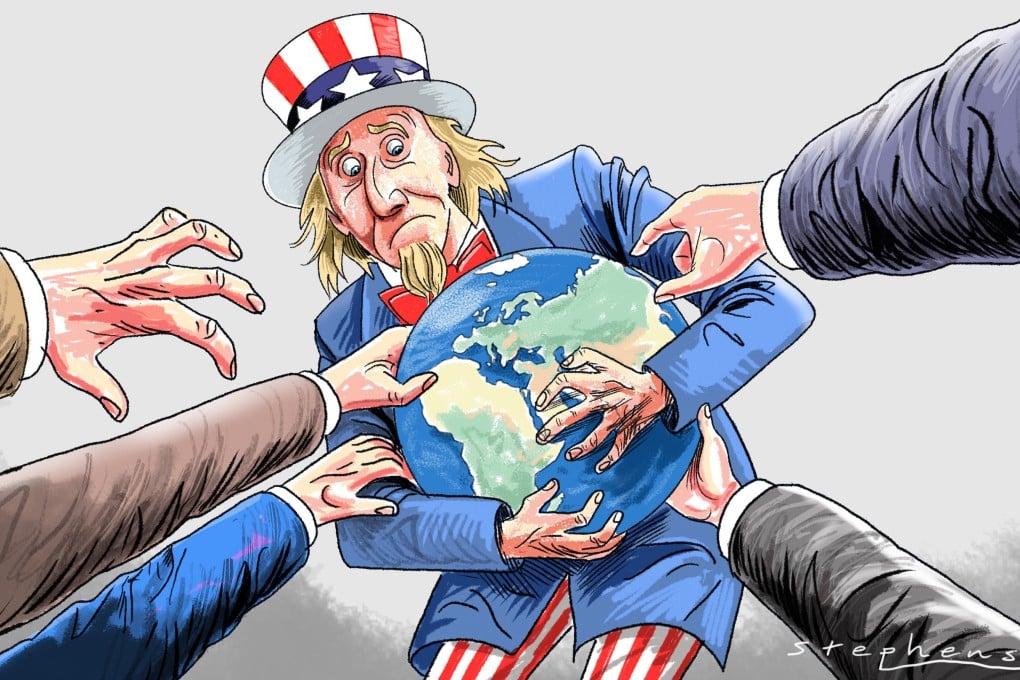
    Feature Image Credit: ‘Imagine a World free from the Oppression of a US-led global Order’ – www.scmp.com


  • The Meaning of War in the 21st Century

    The Meaning of War in the 21st Century

    War is, as Clausewitz said, a continuation of politics…or to be precise it is part of geopolitical machinations.  The complexity of the conflict in Ukraine can be understood only if one examines the many dimensions at play in 21st-century wars.  French journalist and political scientist, Thierry Meyssan delivers some thoughts on the evolution of the human dimension of war. The end of industrial capitalism and the globalization of exchanges do not only transform our societies and our ways of thinking but the meaning of all our activities, including wars.                                          – TPF Editorial Team


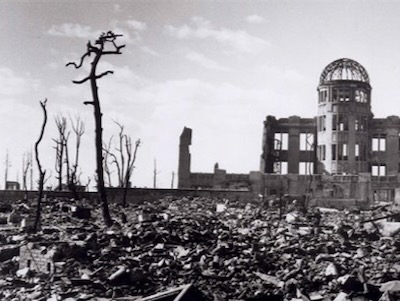
    The atomic bombings of Hiroshima and Nagasaki were not part of any military strategy. Japan had already intended to surrender. The United States just wanted them not to surrender to the Soviets who were beginning to pour into Manchuria, but to themselves.


    Since the end of World War II 77 years ago, Europeans (except for the former Yugoslavs) have known peace on their soil. They have forgotten this distant memory and discovered war with horror in Ukraine. The Africans of the Great Lakes, the ex-Yugoslavs and the Muslims from Afghanistan to Libya, passing through the Horn of Africa, look at them with disgust: for many decades, the Europeans ignored their sufferings and accused them of being responsible for the misfortunes they were suffering.

    The war in Ukraine started with Nazism according to some, eight years ago according to others, but it is only two months old in the consciousness of Westerners. They see some of the sufferings it causes, but they do not yet perceive all its dimensions. Above all, they misinterpret it according to the experience of their great-grandparents and not according to their own experience.

    Wars only a Succession of Crimes

     As soon as it starts, war forbids nuances. It forces everyone to position themselves in one of the two camps. The two jaws of the beast immediately crush those who do not comply.
    The ban on nuances forces everyone to rewrite events. There are only “good guys”, us, and “bad guys”, those on the other side. War propaganda is so powerful that after a while, no one can distinguish the facts from the way they are described. We are all in the dark and no one knows how to turn on the light.
    War causes suffering and death without distinction. It doesn’t matter to which side you belong. It doesn’t matter if you are guilty or innocent. One suffers and dies not only from the blows of those on the other side, but also collaterally from those on one’s own side. War is not only suffering and death, but also injustice, which is much more difficult to bear.
    None of the rules of civilized nations remain. Many give in to madness and no longer behave like humans. There is no longer any authority to make people face the consequences of their actions. Most people can no longer be counted on. Man has become a wolf for man.

    Something fascinating is happening. If some people turn into cruel beasts, others become luminous and their eyes enlighten us.

    I spent a decade on the battlefields and never went home. Although I now flee from suffering and death, I am still irresistibly drawn to those looks. That is why I hate war and yet I miss it. Because in this tangle of horrors there is always a sublime form of humanity.

    The Wars of the 21st Century

    I would now like to offer you some thoughts that do not commit you to this or that conflict and even less to this or that side. I will just lift a veil and invite you to look at what it hides. What I am about to say may shock you, but we can only find peace by accepting reality.

    Wars are changing. I am not talking about weapons and military strategies, but about the reasons for conflicts, about their human dimension. Just as the transition from industrial capitalism to financial globalization is transforming our societies and pulverizing the principles that organized them, so this evolution is changing wars. The problem is that we are already incapable of adapting our societies to this structural change and therefore even less capable of thinking about the evolution of war.

     War always seeks to solve the problems that politics has failed to solve. It does not happen when we are ready for it, but when we have eliminated all other solutions.

    This is exactly what is happening today. The US Straussians have inexorably cornered Russia in Ukraine, leaving it no option but to go to war. If the Allies insist on pushing her back, they will provoke a World War.

    The periods between the two eras, when human relationships must be rethought, are conducive to this kind of disaster. Some people continue to reason according to principles that have proven their effectiveness but are no longer adapted to the world. They are nevertheless advancing and can provoke wars without wanting to.


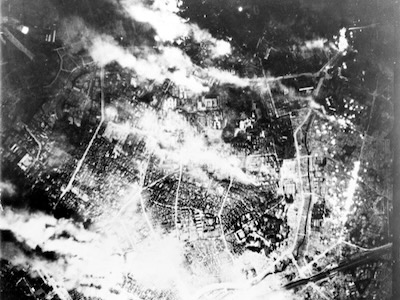
    On the night of May 9, 1945, the US air force bombed Tokyo. In one night more than 100,000 people were killed and more than 1 million were left homeless. It was the largest massacre of civilians in history.


    If in peacetime, we distinguish between civilians and soldiers, this way of reasoning no longer makes sense in modern warfare. Democracies have swept away the organization of societies into castes or orders. Everyone can become a combatant. Mass mobilizations and total wars have blurred the lines. From now on, civilians are in charge of the military. They are no longer innocent victims but have become the first responsible for the general misfortune of which the militaries are only the executors.

    In the Western Middle Ages, war was the business of the nobles and of them alone. In no case did the population participate. The Catholic Church had enacted laws of war to limit the impact of conflicts on civilians. All this does not correspond anymore to what we live and is not based on anything.

    The equality between men and women has also reversed the paradigms. Not only are soldiers now women, but they can be civilian commanders too. Fanaticism is no longer the exclusive domain of the so-called stronger sex. Some women are more dangerous and cruel than some men.

    We are not aware of these changes. In any case, we do not draw any conclusions from them. This leads to bizarre positions such as the refusal of Westerners to repatriate the families of jihadists they have let go to the battlefields and to judge them. Everyone knows that many of these women are far more fanatical than their husbands were. Everyone knows that they represent a much greater danger. But nobody says so. They prefer to pay Kurdish mercenaries to keep them and their children in camps, as far away as possible.

    Only the Russians have repatriated the children, who were already contaminated by this ideology. They entrusted them to their grandparents, hoping that the latter would be able to love and care for them.

    For the past two months, we have been receiving Ukrainian civilians fleeing the fighting. They are only women and children who suffer. So we do not take any precautions. However, a third of these children have been trained in the summer camps of the Banderites. There they learned the handling of weapons and the admiration of the criminal against humanity, Stepan Bandera.

    The Geneva Conventions are only a vestige of the time when we reasoned as humans. They do not stick to any reality. Those who apply them do so not because they believe they are obliged to, but because they hope to remain human and not sink into a sea of crimes. The notion of “war crimes” is meaningless, since the purpose of war is to commit successive crimes in order to achieve the victory that could not be obtained by civilized means, and in a democracy, each voter is responsible.

    In the past, the Catholic Church forbade strategies directed against civilians, such as the siege of cities, on pain of ex-communication. Besides the fact that today there is no moral authority to enforce rules, no one is shocked by “economic sanctions” affecting entire peoples, even to the point of causing murderous famines, as was the case against North Korea.

    Given the time we need to draw conclusions from what we are doing, we continue to consider certain weapons as prohibited while using them ourselves. For example, President Barack Obama explained that the use of chemical or biological weapons is a red line that should not be crossed, but his Vice President Joe Biden has installed a large research system in Ukraine. The only people who have forbidden themselves any weapon of mass destruction are the Iranians since Imam Ruhollah Khomeini morally condemned them. Precisely, they are the ones we accuse of wanting to build an atomic bomb, as they do nothing of the kind.

     In the past, wars were declared in order to take over territories. In the end, a peace treaty was signed to modify the land register. In the age of social networks, the issue is less territorial and more ideological. The war can only end with the discrediting of a way of thinking. Although territories have changed hands, some recent wars have resulted in armistices, but none in a peace treaty and reparations.

    We can see that, despite the dominant discourse in the West, the war in Ukraine is not territorial, but ideological. President Volodymyr Zelensky is the first warlord in history to speak several times a day. He spends much more time talking than commanding his army. He writes his speeches around historical references. We react to the memories he evokes and ignore what we don’t understand. To the English, he speaks like Winston Churchill, they applaud him; to the French, he reminds them of Charles De Gaulle, and they applaud him; etc… To all, he concludes “Glory to Ukraine!”, they do not understand the allusion which they find pretty.

    Those who know the history of Ukraine recognize the war cry of the Banderites. The one they shouted while massacring 1.6 million of their fellow citizens, including at least 1 million Jews. But how could a Ukrainian call for the massacre of other Ukrainians and a Jew for the massacre of Jews?

    Our innocence makes us deaf and blind.


    For the first time in a conflict, one side censored the enemy media before the war started. RT and Sputnik were shut down in the European Union because they could have challenged what was to come. After the Russian media, opposition media are beginning to be censored. The Voltaire Network’s website, Voltairenet.org, has been censored in Poland for a month by decision of the National Security Council.


    War is no longer limited to the battlefield. It becomes essential to win over the spectators. During the war in Afghanistan, US President George W. Bush and British Prime Minister Tony Blair considered destroying the satellite TV channel Al-Jazeera. It had no impact on the belligerents, but it gave pause to viewers in the Arab world.

    It is worth noting that after the 2003 war in Iraq, French researchers imagined that military warfare might turn into cognitive warfare. If the nonsense about Saddam Hussein’s weapons of mass destruction only lasted a few months, the way in which the United States and the United Kingdom managed to get everyone to believe it was perfect. In the end, Nato added a sixth domain to its usual five (air, land, sea, space and cyber): the human brain. While the Alliance is currently avoiding confrontation with Russia in the first four domains, it is already at war in the last two.

    As the areas of intervention expand, the notion of a belligerent is fading. It is no longer men who confront each other, but systems of thought. War is thus becoming globalized. During the Syrian war, more than sixty states that had nothing to do with this conflict sent weapons to the country, and today, twenty states are sending weapons to Ukraine. As we do not understand the events live, but interpret them in the light of the old world, we believed that the Western weapons were used by the Syrian democratic opposition while they were going to the jihadists and we are convinced that they are going to the Ukrainian army and not to the Banderites.

    The road to hell is paved with good intentions.


    This article was published earlier in voltairenet.org and is republished under Creative Commons License 4.0.

    Feature Image Credit: Proxy Wars and 21st Century Merchants of Death.