Over the last two decades, India’s education priorities have changed substantially. From a major focus on enrolment ratios and reducing drop-out rates, the priority is now on learning and skill outcomes and employability after education, thus stressing the importance of the development of ‘Human Capital’ for the country. The New Education Policy (2020)focuses majorly on this aspect of education, set in tune with the SDG4 of the United Nations Sustainable Development Goals that India adopted in 2015. The SDG4 seeks to ‘Ensure inclusive and equitable quality education and promote lifelong learning opportunities for all’, which forms a top priority in the 2030 Global Human Development agenda.
While inequality between rural and urban schooling is vast and the learning outcome levels of students from such schools are dismal, and there is a need for reform in rural education policies, literature shows that simply adding resources and ‘Best Practices’ including comprehensive assessments, detailed ratings, and customised improvement plans have no proven impact on student learning
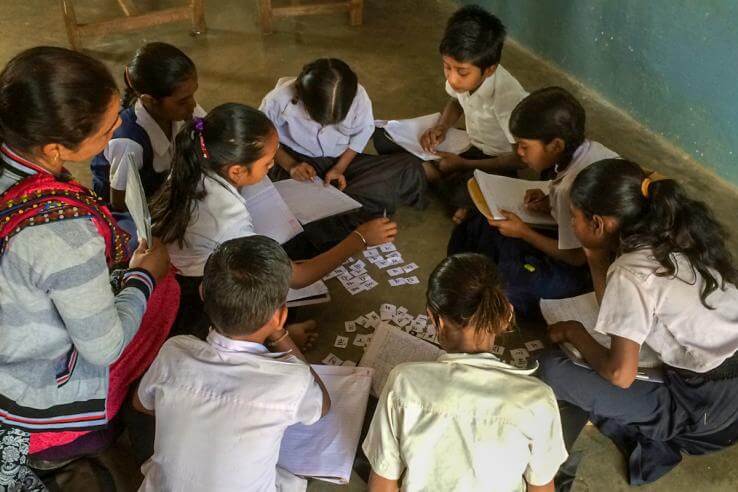
Yet, things are gloomy for India in terms of education. According to ASER 2019 National Findings, while more than 90% of young children are enrolled in some type of educational institution, a huge proportion of them are unable to perform basic numeracy and early language. Children from less advantaged homes are the worst affected. While inequality between rural and urban schooling is vast and the learning outcome levels of students from such schools are dismal, and there is a need for reform in rural education policies, literature shows that simply adding resources and ‘Best Practices’ including comprehensive assessments, detailed ratings, and customised improvement plans have no proven impact on student learning (K. Muralidharan, et al, 2020), (Pradhan et al. 2011). Evidence also shows that the right mix of teaching tools, pedagogy, and design can bring about an effective blended learning environment for students. ( M.J. Kintu, et al, 2017).
But why are policies not getting implemented efficiently? The heart of the whole problem seems to be the poor delivery of teachers, especially public school teachers, who taught less, are less qualified, and deliver dismal outcomes. While on the other hand, evidence (E.A. Hanushek, et al., 2012) also highlights the importance of ‘Teachers’ in delivering better outcomes, and consequently students attend college and earn some revenue. Thus, the only viable solution to better rural education is the betterment of teacher quality.
Teacher Pay and Job Satisfaction
Teacher absenteeism and lack of job satisfaction among the teachers have been the most discussed agendas while analysing dismal student performances in the rural areas, especially those from public schools. Teachers’ pay is the major chunk of all expenditure made on education in India. Teachers’ salaries make up around 80% of total non-capital expenditure on education. Around 50% of them get paid regularly despite their irregular attendance and lack of teaching or even deserting schools forever. While pay for teachers might seem like the right way to nudge them towards delivering better outcomes, that is certainly not the case with public schooling in India.
The dismal performance of Public-School teachers, even after a handsome pay can be related to their satisfaction from job security. Research shows that Public School teachers who report high job satisfaction are more likely to not be in class, and thus there can be inferred a negative correlation between the pay and satisfaction a teacher reports and the likeness of him/her to attend school, and even if attending school, to teach or not teach. Increasing teacher pay, in this case, might seem absurd but it is primarily due to a lack of accountability. But evidence also shows an increase in teacher performance, and incentives in pay tend to be more effective when accountability is well addressed.
The Public-Private Dichotomy
While financial incentives seem like a good gimmick to increase teacher performance, and in-turn student output, things yet seem gloomy in the public education system. Private School teachers in fact overwork and are underpaid, according to reports. Though learning and teaching outcomes are far better in the private education scenario, Public School teachers are the ones that enjoy the most benefit out of the rest.
Teacher pay in Public Schools across the country is higher than that of teachers from private schools. According to the Seventh Pay Commission, the basic salary of primary and high school teachers is between Rs. 29,900 and Rs. 100,000 with additional grade pay. While the teachers in various levels in Public Schools get paid their salary according to the scale, this is rarely the case with private school teachers. According to reports, 85% of private schools in Delhi don’t pay teachers as per the pay scale laid down by the commission. Non- Implementation of the seventh-pay commission recommendations, lack of balance between workload, outcome levels and pay disparity with the government or public schools haunt private school teachers, despite the various recommendations and policy amendments to correct the inequality.
Long-standing debates on whether the ‘Minimum Wage’ rule applies to private schools or not continue to remain ambiguous. In the last decade, when private schools paid a pittance to their teachers, legislative wings have denied the availability of a ‘Minimum Wage’ system to teachers in Private Unaided Schools. Up until today, there’s no such legislation that specifies a salary structure for teachers employed in private schools, except for the non-teaching staff who have coverage under the ‘Minimum Wages Act’. Even if prevalent in certain states the ‘Minimum Wages Act’ is openly violated by schools. The Government of Kerala, in the year 2019 sought to bring legislation to ensure minimum wages for school teachers, which wasn’t very successful. Other states including Karnataka have stressed the importance of paying better salaries to the teachers, by fixing a stipulated minimum monthly salary for teaching and non-teaching staff, and this might bring in more burden to parents in the form of fees; several extra and co-curricular activities must be made optional for parents to be able to leverage their fee burden, alongside quality education to the children.
While the private sector still stands as a model of performance-based pay, this is seen as a ubiquitous and powerful tool in the private sector. While teachers in public schools are already well paid, providing additional incentives would just weigh upon the already existing expenses on public education. This increased expenditure on teachers’ pay makes Public Schools more expensive than their private counterparts, with low teacher accountability. Interestingly, evidence shows that by implementing a performance-based policy, the government would have just saved under Rs. 2,000 Billion over the 25 years from 1987-2012. This again brings us to the question of whether increased financial incentives to public school teachers are any good and feasible?
Evidence on Performance-Based Pay
A study by Barrera, O and Raju, D(2017) relating to the first three years of a randomised control trial of a government-administered pilot teacher performance pay program in Punjab and Pakistan proves yearly cash bonuses to teachers in a sample of 600 public primary schools with the lowest mean student exam scores is linked to an increase in schools’ average student exam scores, increase in school enrolment ratio and the level of student exam participation in the school. A long term study by K. Muralidharan (2012) shows that students who completed their primary school under the performance-based pay programme performed better than their peers in control schools by 0.54 standard deviation in Mathematics.
However, interventions in the forms of performance pay had an impact neither on student performance nor on the teacher’s reported attitude or behaviour towards teaching and absenteeism. On the other hand, a study by Neal and Schanzenbach (2010) points out that performance-based pay might encourage ill practices such as cheating during exams, which doesn’t hold any good to both the entities. The cost-effectiveness of a performance-based pay model is studied by Muralidharan and Sundararaman(2011) and shows a relation between additional funds and performance-based pay.
Pay Design and other Models
The ‘Contract Teachers’ model can work well for public schools. In this Teachers employed for relatively shorter durations, bound by a contract that can be terminated easily, play an important role in extending education to an increased number of children in an affordable manner. Studies involving student learning in rural schools (Muralidharan and Sundararaman,2010) show that while contract teachers are relatively cheaper to acquire over the normal long-term teachers, their impact on students and their performance is comparatively better. While the evidence suggests that performance-based pay might be a difficult model to implement in the public education front, hiring ‘Contract Teachers’ might be the right way out. Recent trends emerging out of the pandemic suggests paying teachers based on the hours of work done. The pandemic disruption has given rise to online education but teaching online requires different skills. Additionally, paying teachers based on the number of hours they work on a day will also help in cutting costs and finances for the employer.
Constraints in revenues and a need to increase student learning makes ‘Tenure-track for teachers’ a viable option for schools.
On the other hand, an ideal model of performance-based pay would help in solving the basic problems and inequalities in the system. Constraints in revenues and a need to increase student learning makes ‘Tenure-track for teachers’ a viable option for schools. This model, largely in practice in the western universities, might just be what rural schools in India need. This model, somewhat similar to the ‘Performance Pay’ model, rewards teachers by extending their tenures based on their performance. Good on finances and learning, this model can be the next big thing in rural education, given the constraints in learning and teaching. On the contrary, the ‘Tenure-track’ model might only work in the presence of a good evaluation system to measure teacher and student performances. Given the state of public and rural education and evaluation in India, this might be daunting. Proper evaluation methods to measure and analyse teacher performance is imperative for this model to work in the country.
A best-fit pay model, with proper tools to measure student performance alongside teacher’s accountability, would do well with teachers all over the country. Alongside, proper publicity of such a pay model would make people familiar with the options. A study by Leaver, et.al.,(2019) shows that the impact of such programmes is higher when it is well advertised and familiar with the ones falling in the bracket.
Conclusion
This finally brings us to the question of whether the performance-based pay model might be the best fit for schools in rural India, that are mostly run and maintained by states and district administrations. Performance-based pay, though proven in increasing student performance, also contains a major loophole. Teachers may resort to malpractices like – letting students cheat during exams to show better results and malpractices during evaluation. In Rural India, where proper systems to evaluate the performance of teachers is not in place, the Performance-based pay model may become counter-productive given the lack of accountability and implementation challenges.
While performance-based pay models have earned good results in the developing nations alike, the remote corners of India might not be the best place for its implementation, until and unless the teachers and all the stakeholders are well-informed of its implementation and proper evaluation mechanism for both the teacher and the student. In India where most public schools are hampered by teachers’ absenteeism and dismal delivery, increasing the pay of the teachers would just result in increased risks of teachers staying at home, without actually resulting in any improvement in their commitment and work methodology. Besides, it may encourage malpractices to show improved performance of students.
Making teachers accountable to their performance and delivery is the first step towards effective policy change.
In conclusion, Performance-based pay models may not be a suitable model to increase teacher performance in public schools. Whereas, other methods, such as hiring contract teachers and tenure-tracking might work better in the long run, given a proper evaluation of teacher’s performance in schools. Making teachers accountable to their performance and delivery is the first step towards effective policy change. If proper mechanisms are in place, shifting to various effective models like – Tenure Tracking or Contract Teaching become easier and more effective.
Image Credit: Poverty Action Lab