Abstract
Globalisation is a phenomenon that has brought about an effective change in the nature of the economy of the world nations. An inevitable result of this has been industrialisation, from heavy industries like iron and steel to software industries that house recent developments like artificial intelligence. Garment Industries have been a part of this industrial surge and have significantly contributed to the country’s economic growth, involving significant exports. At the heart of this unprecedented growth, an often unsaid and silenced issue remains the labour and lives of millions of women. Women, especially in the so-called third-world countries like Bangladesh, Cambodia, and India, constitute more than 50% of the labour force in the garment sector. However, the gender inequality that persists within these industries exists in the form of a lack of safety standards, wage disparity, stringent maternity benefits and improper compensation packages. World organisations like the International Labour Organisation (ILO) have developed projects to ensure decent working conditions. Still, the resultant effect has been scant due to the lack of gendered understanding of the issues. This research aims to illuminate the consequences of organisational patriarchy in comprehending the issues faced by women in the garment sector and subsequent policy framing. The study is based on the assumption that the inclusion of women andan opportunity to voice their concerns is absent. Therefore, there is a need for a gendered lens in framing policies, their implementation and further monitoring. Thus, this understanding will not only enhance the awareness of the working conditions of women in the garment industry but also be an eye-opener concerning the effect of global policies on the female labour force.
Keywords: Female labour, Globalisation, Gender inequality
Introduction
The second five-year plan (1956-1961) in India had rapid industrialisation as one of its focuses and followed the Mahalanobis model of production of capital goods. This saw capitalism take the
reins of development, which later consolidated with globalisation and took the world economy by storm, making possible the impossible, i.e., connecting the global markets. The transnational phenomenon led to the import of frontier technologies, which are highly capital-intensive (Indira Hirway, 2012). The consequent effect was an improvement in technology and an increase in productivity accompanied by a decrease in employment intensity. This reduction affected the often underrepresented and discriminated group – women. Women’s growth was curtailed by ensuring that patriarchy was perpetuated in the organisational setup as well. The women in the lower strata of the industrial workforce faced the wrath of wage disparity, and the women in the higher echelons had a glass ceiling that prevented them from occupying managerial positions. They also had to endure the double burden of work and household chores, affecting the female labour force participation rate. Garment industries in developing countries like India, Pakistan and Bangladesh have witnessed large-scale employment of women as formal and informal labour to fulfil the needs of international buyers. In this paper, based on secondary research, I would like to traverse the historical aspects that led to globalisation, subsequent policies and the consequential effect it had on women, primarily focusing on export garment industries, which house the highest percentage of employed women.
Industrialisation and women
The post-independence era in India, from 1947 onwards, witnessed industrial growth. The employment of labour also saw a shift from traditional agriculture. “Gender was the primary axis along which industrial labour and the labour force were constituted.” Very few women worked in factories, and the support and protection they received were also poor compared to men. The policies that catered to labour protection, like the Factories Act (1948), The Minimum Wages Act (1948) and The Employees’ State Insurance Act (1948) that paraded gender neutrality were gender blind. The ensuing period of globalisation, which questioned the conservative market nature, also brought about changes in the perception of women’s labour. With the world markets creating an arena for exports, the need for developing countries like India to keep up with the race became necessary, and the viable solution was to employ women from the lower strata of the society, mostly Dalits, in the name of empowering them. They were bait in the corporate hawk culture. The governments also failed to visualise the consequences of liberal markets and the capitalists donning the crown.
As a part of the capitalist world, women were subject to both economic and emotional labour, which affected the female labour force participation rate, and the percentage of women in the informal sector became higher than women in the formal sector. However, there have been a lot of studies on the women employed in the informal sector, and there have also been time-use surveys conducted in this regard. Women’s labour in the formal sector has been consistently neglected due to the common belief that they enjoy the protection of an organised system. This may hold true to some extent, but in the case of garment or textile industries, which are a focus here, women are also the most penalised according to the reports by the International Labour Organisation (ILO).
Ministry of Labour and Employment, India – Statistics on Women Labour
According to the information provided by the Office of Registrar General & Census Commissioner of India in the 2011 Census, the total number of female workers in India is 149.8 million, of which 121.8 and 28.0 million are from rural and urban areas, respectively. Out of the total 149.8 million female workers, 35.9 million females work as cultivators and another 61.5 million as agricultural labourers. Of the remaining female workers, 8.5 million remain in households, and 43.7 million are classified as other workers.
As per Census 2011, the work participation rate for women is 25.51 per cent compared to 25.63 per cent in 2001. The female labour participation rate decreased marginally in 2011 but has seen an improvement from 22.27 per cent in 1991 and 19.67 per cent in 1981. The work participation rate for women in rural areas is 30.02 per cent compared to 15.44 per cent in urban areas.
As far as the organised sector is concerned, in March 2011, women workers constituted 20.5 per cent of total employment in the organised sector in the country, which is higher by 0.1 per cent compared to the preceding year. As per the last Employment Review by the Directorate General of Employment & Training (DGE&T), on 31st March 2011, about 59.54 lakh women workers were employed in the organised sector (public and private). Nearly 32.14 lakh women were employed in the community, social, and personal service sectors.
Feminist Analysis of Existing Laws
The labour laws in India have thoroughly focused on the idea of promoting growth along with social justice in tandem with the efforts of labour unions. However, despite the state and the unions’ consistent efforts, the laws’ ability to improve women’s living and working conditions was negligible, as described in the landmark report published in 1971, “Towards Equality”. It was an eye-opener to the dire circumstances in which women were surviving with patriarchy clawing its way into not just the domestic sphere but the workplace as well. While acts like the Maternity Benefit Act of 1961 offer relief to women on some levels, there is a lack of legal awareness among women workers. This is a contributing factor to their being taken advantage of by employers. An analysis of the allocation of Variable Dearness Allowance of Minimum Wages with effect from October 2022 has no separate mention of women’s labour. The general labour classification in this regard has been Unskilled, Skilled/Clerical, Semi Skilled and Highly skilled are the most probable categories in which women fall under unskilled due to a plethora of reasons. Despite the assumption that the New Labour Code is a relief to women labour across the country, measures must be taken to understand its effective implementation in both the public and private sector organisations.
Women in Garment Industries
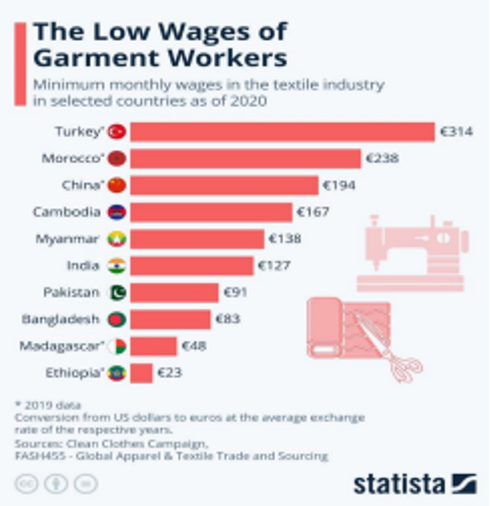
The garment industries in South Asian nations like India and Bangladesh have been significant contributors to their economies and increased the employment ratio of women in the labour force. “India’s ready-made garment industry contributes around 16 per cent to total export earnings and is the largest foreign exchange earner in the country” (WTO,2019). Post-1980 saw unprecedented growth of the export industry, and the growth chart statistics show that from $2 million in 1960-61 to $696 million in 1980-81, it then increased sharply to $2,236 million in 1990- 91 and to $4,765 million in 1999-2000. The vast wage disparity was the driving force behind the globalisation of the garment industry. Studies have shown that the hourly wage of Indian
labour is a meagre Rs.8 per hour, whereas a British worker performing the same work received around Rs.420. Thus, the capitalist tendency of the upper class and lower class is synonymous with the imperialist notion of civilised and barbaric groups pushing for cheap labour and higher production of goods.
The onus of cheap labour fell on women, mainly from the marginalised communities who were desperate for jobs that promised a stable source of income. The Indian state also firmly believed that this was a way to empower women and ensure financial freedom. However, the challenges were masked by the rosy nature of the benefits put forth by the employers. The actual reasons for the employment of women, which were different from the portrayed norms, were: i) the common notion that women in the developing regions were meek beings who would barely retort against any kind of discomfort and would succumb to the system, ii) women will not question the wage disparity for they are fed the patriarchal notion of the superiority of men iii) the stable source of income will not let them rise in protest despite the atrocities meted out to them.
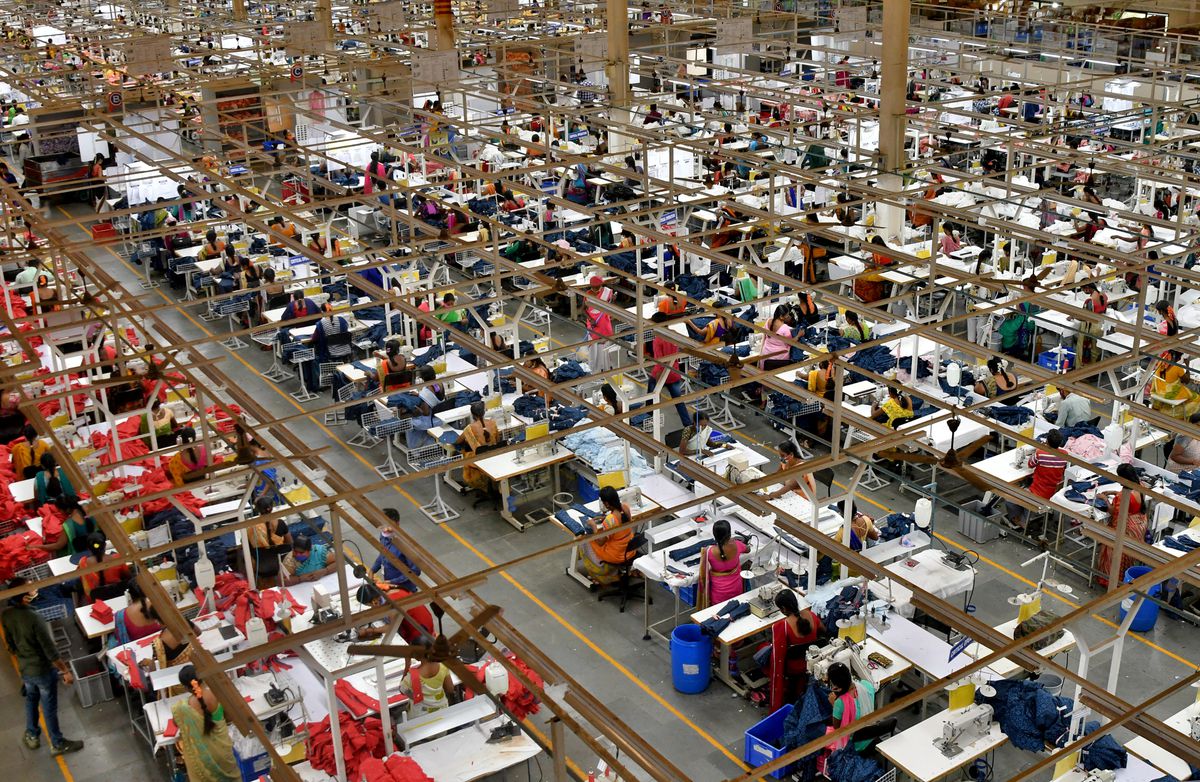
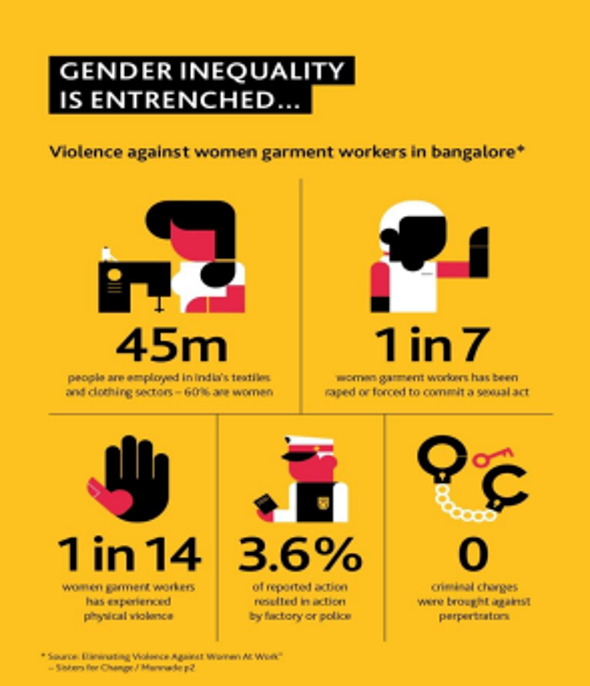
Here, I would like to discuss a study conducted in Bangalore, Karnataka, which houses more than 800 garment industries and has the largest workforce of women. The exploitative nature of the employment of women in the garment industry is well documented and needs no elaboration. Briefly, the large majority of women, whether working as skilled tailors or as unskilled helpers, do not get even the legally stipulated minimum wage. Workers are frequently required to work overtime, but since this is set against production targets, they are not paid for overtime work. Insecurity of work is one of the most widely reported problems, as employers frequently terminate a woman’s service just before the completion of five years to avoid payment of gratuity. Harsh production targets, sexual and verbal abuse, lack of maternity and other leave, lack of accident insurance, and absence of toilet and creche facilities are some of the commonly stated and widely known features of female employment in garment manufacture. This misery underpins the production of high fashion garments sold in chic stores in the first world and worn by middle and upper-class women who pay for a single dress at a price that exceeds several times the monthly income of a woman who produces it.
Challenges to women in the garment labour force due to Globalisation
The post-1991 era in India saw a massive difference in the treatment of women as the labour force in industries, especially the textile sector. Female workers typically migrate from rural areas to work in the garment industry to meet their financial needs. Women labour in the garment industry mostly come from households below the poverty line. Therefore, the proposition for the ’empowerment of women’ through employment in these capitalist industries was thought to pave the road for the emancipation of this vulnerable group. However, with the fast fashion industry booming and the convergence of interests among global consumers, there was and still exists a constant need to satiate consumer behaviour consistently. The mass production of goods became inevitable. This had adverse effects in that it created a hostile working environment, and reports suggest that it took a toll on the physical and mental health of women:
i) Impact on physical well-being: The study “Sewing shirts with injured fingers and tears: exploring the experience of female garment workers’ health problems in Bangladesh” found that physical health problems included headaches, eye pain, musculoskeletal pains and fatigue. It further revealed that garment work is also so physically demanding that women cannot work for more than ten years. These findings are consistent with other research, which found that the highest proportion of female workers quit factory work before they reach 40. The workers reported that getting sick and injured was an everyday phenomenon. The doctors thought that women in factories could not work for more than ten years owing to the stressful conditions. This study also described that since the manufacturing units have men as supervisors, it becomes difficult for women to voice their concerns, particularly those related to their menstrual health. Further, this gendered division of labour extends to their home life, where their husbands expect them to fulfil their domestic obligations despite long, physically demanding hours at work.
ii) Impact on mental well-being: The article “Mental Health Status of Female Workers in Private Apparel Manufacturing Industry in Bangalore City, Karnataka, India” steers the discussion in the direction of the importance of mental health awareness and the need for a safe work environment for women in garment factories. Mental health problems, including depression, have become a global health priority, and socially disadvantaged people are more vulnerable to suffering from mental health problems. There is evidence that scarcity of human resources, limited access to, and cost of mental health services are critical issues in most low- and middle-income countries. Separation from their children is an important issue for them. Most had left their children in their home villages, citing lack of time to care for them due to their long work hours and difficulties in paying for their children’s living costs in the city. They work from morning to night and during weekends, with nobody at home to look after their children. They get to leave only a few times a year, and the distance to their villages can be up to 10 hours of travel time. As such, they have no option but to leave their children in their village to live with their grandparents. However, avoiding long working hours is impossible, as they need money to provide for their impoverished families.
To improve the health and well-being of female garment workers, steps should be taken to develop health interventions to meet the needs of this important group of workers who contribute significantly to the country’s economic development.
Way Forward
Although women are at a disadvantage, the involvement of women in decision-making becomes indispensable. A developmental perspective based on male priorities and the male concept of the role of women in a patriarchal society such as ours cannot alleviate the lot of women already inhibited by traditional gender-role expectations. Stakeholder theory advocates that firms bear responsibility for the implications of their actions, and based on this, women come under the category of normative stakeholders to whom the industry has a moral obligation: an obligation of stakeholder fairness. Also, stress has to be placed on including women in the policy-making process, thereby increasing accountability of the framed policies. Illiteracy is a global problem and one of the reasons for the deterioration in the status of women and the feminisation of poverty. Ignorance of their rights- political, social, and economic- leads to the exploitation of women and their inability to converge to form a pressure group. The interface between the grassroots women and the activists must be used to build awareness and sensitise people, both men and women. Involving men who are sensitive to women’s issues is a healthy practice. It would benefit the cause of women if their struggle is seen as a fight for human rights, which it is, and not merely as a gender-based movement.
References
- Ahmed, F. (2004). The rise of the Bangladesh garment industry: globalisation, women workers, and voice. NWSA Journal, 16(2), 34–45. https://doi.org/10.2979/nws.2004.16.2.34
- Unni, J., Bali, N., & Vyas, J. H. (1999). Subcontracted women workers in the global economy: the case of the garment industry in India. http://www.sewaresearch.org/pdf/researches/subcontracted.pdf
- Saha, T. K., Dasgupta, A., Butt, A., & Chattopadhyay, O. (2010). Health status of workers engaged in the small-scale garment industry: How healthy are they? Indian Journal of Community Medicine, 35(1), 179. https://doi.org/10.4103/0970-0218.62584
- Baud, I., & De Bruijne, G. (1993). Gender, small-scale industry, and development policy. https://doi.org/10.3362/9781780442280
- Oonk, G., Overeem, P., Peepercamp, M., & Theuws, M. (2012). Maid in India: Young Dalit women continue to suffer exploitative conditions in India’s garment industry. Social Science Research Network. https://doi.org/10.2139/ssrn.2119816
- Carr, M. (2001). GLOBALISATION AND THE INFORMAL ECONOMY: HOW GLOBAL TRADE AND INVESTMENT IMPACT ON THE WORKING POOR. RePEc: Research Papers in Economics. http://info.worldbank.org/etools/docs/library/76309/dc2002/proceedings/pdfpaper/module6mcmc.pdf
- Hale, A., & Shaw, L. M. (2001). Women workers and the promise of ethical trade in the globalised garment industry: a serious beginning? Antipode, 33(3), 510–530 https://doi.org/10.1111/1467-8330.00196
- Mezzadri, A. (2014). Indian Garment clusters and CSR norms: incompatible agendas at the bottom of the garment commodity chain. Oxford Development Studies, 42(2), 238–258. https://doi.org/10.1080/13600818.2014.885939
- Sharma, L., & Srivastava, M. (2020). A scale to measure organisational stress among women workers in the garment industry. European Journal of Training and Development, 46(9), 820–846. https://doi.org/10.1108/ejtd-04-2019-0060
- Kabeer, N., & Mahmud, S. (2003). Globalisation, gender, and poverty: Bangladeshi women workers in export and local markets. Journal of International Development, 16(1), 93–109 https://doi.org/10.1002/jid.1065
- ANNUAL REPORT 2022-23. (n.d.). In Ministry of Labour and Employment. Ministry of Labour and Employment, Government of India.
Feature Image Credit: www.changealliance.in