Author: Manjari Balu

  • Value Of Everything: Making And Taking In The Global Economy

    Value Of Everything: Making And Taking In The Global Economy

    Title : Value of Everything: Making and Taking in the Global Economy

    Winner of the 2018 Leontief prize for advancing the frontiers of economic thought ─ “Value of Everything: Making and Taking in the Global Economy” by Mariana Mazzucato is an extremely important addition to the contemporary debates in development economics. Fundamental ideas presented in the book are very relevant in the current pandemic environment as it gives us an opportunity to reframe approach to policy making. Limitations in the state’s capacity to handle a crisis of this scale might be true but the larger objective to ensure an economic and social value based ecosystem is the main idea that emerges from this book.
    The core focus of the book is on the ‘understanding of value’, as Mariana states – “much of what is passing for value creation is just value extraction in disguise”. By examining what is value the book leads us to understanding who creates value.
    Initial chapters set out to explain the core interpretation of ‘value’ adopting a historical framework by discussing influential economists. Beginning with Mercantilists in an inchoate system that was not linked with any theories to explain the creation of wealth, they believed trade creates wealth and hence, ‘value’ lies within trade. A group of 18th century French economists developed a formal economic theory ‘physiocracy’ that prioritized agriculture and land to be the ultimate source of value. There was a clear production boundary that was developed during the time of physiocrats with agriculture being productive and household, government, service, industry packed together as unproductive. Countering the Mercantilists, Adam Smith theories became prominent to understand the idea of value where wealth creation lies in an optimal economic policy encouraging surplus revenue to be reinvested in production for the nation to become richer. The author points to the theories put forth by Smith to be ambiguous yet made progress in building the concept of wealth creation. David Ricardo– a British political economist extensively wrote about rent and assumed land to be a fixed factor. As opposed to Physiocrats, Ricardo’s theory on value was beyond the production boundary and placed emphasis on financing the surplus into productive spending. The author briefly evaluates the classical theories including Marx’s labour value theory and the recent development of Marginalists under the neoclassical economics. It is worth contesting the idea of value in the marginalist approach where the price is equated to value and individual utility is studied over collective public utility . Although the theories in principle might not be relevant today but the evolution of value in the history of economic thought is a prerequisite to identify the flaws in our structure.
    A key focal point that grabs attention of the reader is the ambiguity present in determining the value of products and services. Reluctance to debate the idea of value with the current system has caused trouble in various sectors and the book reflects Mazzucato’s effort to place value in the centre-stage. She begins to make her case by lucidly explaining the fundamental shortcomings in finance deregulation. In the context of the 2008 financial crisis, much of the blame is on the finance market with excessive mortgaging strategy. Although finance is not a categorical reason for the crisis, the real estate bubble was artificially inflated by the short term objectives of finance companies and clearly proved to be unsuccessful. There are two relevant points that the author notes that will hold relevance across the waves of industrialization. First, economic value added by a finance sector largely remains disproportionate to the value added by other sectors. As a resource facilitator, she asserts, banking corporations are required to invest in productive business that adds further economic value in the society. Mere exchange of financial instruments does not guarantee increased output or welfare in an economy. It has taken a crisis for us to understand the need for steering the discussion on ‘Value Creation’. Second, financial markets bolstering private businesses model prioritizes immediate gains with limited attention paid to the long-run sustainability of the business.
    The book is a scathing indictment of the current global financial system. In the authors view the finance entrepreneurs are overrated, and contrary to popular perception they are not ‘value creaters’ but are ruthless ‘value extractors’ and parasitic. Professor Mazzucato finds the shareholder driven model to be problematic for business innovation and proposes a wider concept of stakeholder based operations. An unequivocal argument is presented to question ‘value extraction’ in the 21 century economy- in public choice theory it would mean rent seeking, a concept of increasing existing share of one’s wealth without creating more wealth. Although the author did not specifically mention the Asian countries, in Indian context, value extraction is much difficult to identify given the informality in credit market, labour market and commodities. But the unsustainable mode of executing business is evident in a corporate company that is motivated to spend on company image than Research and Development. Most importantly, the government bears the cost to repair the system with social tension and inequality that follows the failure of excess financialization. The author’s discussion on development and welfare throughout the chapters encourages readers to view the economy beyond numbers and growth rate– a propensity stemming from modern heterodox economics school of thought
    Mariana Mazucatto, founder of the Institute for Innovation and Public Purpose, draws attention to value extraction prevailing in the innovation economy. She illustrates three sources of innovation; cumulative innovation, uncertain innovation and collective innovation. She clearly articulates the engaging role of the public sector in facilitating innovation. Where most experts talk about innovation as an exclusive achievement of the private sector– Mariana challenges that notion and argues the risks of the innovation are borne by the public but the rewards are monopolized by the private business. It is impossible to deny the role of public sector in the process of innovation but it seems the author tends to credit the government more. All innovation need not create value- an extensive literature is presented to understand the way patents can be used to gain economically yet not create value. Highlighting the case of pharmaceuticals, she argues that most of the drug companies are monopolies that use the patent strategy and the rigid demand to inflate the prices for enormous profit although the production cost is a small percentage of the price. This process explains the high priced medicines in the USA and rekindles the fundamental flaw in pricing of a drug. An extreme private model with little clarity and transparency on value of the service has collapsed the healthcare system in the US, which is starkly evident in the current COVID-19 pandemic. To extend this idea, American healthcare contributes more to the Gross Domestic Product compared to the Japanese, yet citizens of the latter have higher life expectancy than of the former. The illusion of GDP contribution is more apparent when the system fails to serve the purpose it was designed for, like in the case of healthcare. Innovations in any industry can turn out to be unproductive; dismissing any single command approach from the government– the chapter ends by propounding a contract between public and private to adopt innovation as a means to achieve public value.
    In contemporary discourse, the author is concerned about the narrow definition of public sector as simply a saviour or a disturbance to private operations. A powerful narrative set to describe government to be inefficient and just an institution fixing market failure will deter the collective process of value creation. The recent economic stimulus announced by India is founded on the logic that public debt is bad, slashing interest rates would enhance business and privatization would lead to better economic growth. As Mazucatto argues, during an economic crisis public sector must seize the opportunity to invest in value creation simply because interest rates are neither market phenomena nor make firms sensitive to the change. The underrated value of the Keynesian ‘Multiplier Effect’ of public investment and considering the return on public investment to be zero are flaws in defining the role of government in contributing to growth of the economy.
    Prevailing public choice theorists’ fear of government failure over and above the threat posed by market failure runs the risk of ignoring the value created by the state. The author makes a compelling case to view government as an investor rather than spender and as a risk taker rather than a facilitator. She highlights the importance of the state’s part in the collective value creation process by disputing the marginalists definition of individual value in obtaining market value. Knitting back to the initial problem stated regarding price equal to value– identifying profit and rent becomes confusing thereby encouraging private players to extract or destroy value. The mainstream metrics used to assess the value also discourages actual value creators like the government to imitate the private sector. The government as a facilitator also faces the risk of lobbying from the private individuals and companies that hamper the process of development. The last chapter – ‘Economics of Hope’– summarizes the main ideas presented throughout the book and emphasises that the ultimate goal of the economy is to serve the people and ensure welfare along with sustainable and equitable development. The real challenge still lies in estimating the precise amount of government intervention in the process of value creation. Value of everything remains a convincing genesis of the debate on the central idea of value that could possibly be a dynamic tool to achieve the goals of an economic system.
    As Mariana Mazucato argues in this penetrating and passionate book, if we are to reform capitalism to radically transforman increasingly sick system rather than continue feeding it we urgently need to rethink where wealth comes from; who is creating it, who is extracting it, and who is destroying it. Answers to these questions are key if we want to replace the current parasitic system with atype of capitalism that is more sustainable, more symbiotic, that works for all.
  • Covid 19: India uses Crisis to bring-in Economic Reforms as Package

    Covid 19: India uses Crisis to bring-in Economic Reforms as Package

    India’s four-phase lockdown of 68 days to deal with the Covid-19 threat has, while slowing the spread of the virus, come at huge economic costs. The lockdown for a vast majority of the people is, undoubtedly, the harshest in the world.

    The coronavirus triggered lockdown and its ensuing series of extensions have disrupted more than 60 percent of economic activities in the country, posing a huge threat to the  economy. The crisis was underway when the global economy was slowing down and India, in particular, had to deal with a poor health care system and an economy already under distress. Unemployment rate is estimated to be around 27 percent post lockdown and has resulted in nearly 12.2 crore people losing their jobs. In addition, a  severe slump in consumer demand is expected to persist for the next few quarters. Almost 85 percent of India’s workforce is engaged in the informal sector – quite naturally the government is under stress to implement effective policy reforms to counter the downturn. 

    In response to the contraction in the economy, the Prime Minister has announced a second round of economic package that stands at roughly around 10 percent of the Gross Domestic Product. The USA and Japan have announced relief packages of 13 and 21 percent of their GDP respectively. In comparison, India has seemingly provided a substantial Rs 20 lakh crore stimulus- highlighting the concept of ‘self-reliance’ as a way forward to deal with the economy post the pandemic. The stimulus package includes previous steps taken by RBI such as moratorium on loan repayments, interest rate cut, etc. In the five tranches of the stimulus package, the Finance Minister has announced a slew of measures to address the structural issues of Indian economy. However, it is estimated that the immediate fiscal boost will be only around 1 percent of GDP and most of the fiscal and monetary policies will attract long term capital with medium run  stabilization of the economy.


    Micro Medium and Small Scale Enterprises 

    Focusing on reviving the small businesses and micro enterprises, under this tranche Rs 3 lakh crore is allocated for collateral free loans for business enterprises. This package is estimated to be around Rs 5.94 lakh crore including RBI measures to improve liquidity in the economy. However, the direct fiscal cost for the government is around Rs 16,500 crore. For the stressed MSME units, the central government is planning to facilitate Rs 20,000 crore as subordinate debt and Rs 50,000 crore through equity infusion. Non Banking Finance Companies (NBFC) that serve the MSMEs will receive Rs 30,000 crore under investment guarantee scheme. While the six broad measures look attractive, the MSME sector in India is dominated by micro enterprises that are largely unregistered. However, these measures will not immediately benefit the micro business units with necessary working capital. Most of the enterprises and small business units are cash strapped and are on the verge of disappearing. Ninety-nine percent of the sector comprises micro enterprises – businesses with less than 10 working employees.

    Most of the enterprises and small business units are cash strapped and are on the verge of disappearing. Ninety-nine percent of the sector comprises micro enterprises – businesses with less than 10 working employees. 

    While the government has taken supply side measures to incentivize businesses, two important challenges remain intact. One, the large number of unregistered micro businesses might not benefit from the credit line offered by the government. Two, if the demand recovers slowly, it is likely the business sector especially small enterprises will suffer despite credit being infused. It is important to note that the supply and demand side has to be revived at the same rate to ensure sustainability of the MSME business. 


    Migrant labourers and Farmers: 

    Second stimulus of the Finance minister’s announcement was focused on migrant labourers and farmers. Close to 150 million internal migrants are present in India according to the latest census report.  Rs 3500 crores is to be spent on migrant labourers not covered under the Public Distribution System (PDS). Rs 5000 crore is set aside to facilitate easy access to street vendors. Funds worth Rs 6000 crore is planned for enhancing employment among adivasis and tribal groups. For the next two months, around 8 crore migrant labourers not covered under PDS will be provided 5kgs of grains per person and 1 kg chana per family in a month. ‘One Nation One Ration Card’ is a welcome move given the leakages present in the PDS, but the national coverage of this scheme is expected only by March 2021.  Additionally, in the National Food Security Act, 2013 , based on the 2011 census data, it is estimated that around 100 million people do not fall under this safety net accounting for growth in population over the past decade. The initiative to record and track the data on unregistered labourers is important for fiscal stimulus response to a COVID hit economy. National portability of ration cards is important but the execution is time consuming and does not address the problem of people being excluded from the ration card system. Universalizing PDS and decentralizing decisions to achieve food security with an efficient supply chain should be an immediate intervention. States with higher migrant labourers and people with less access to PDS should be targeted to universalise food distribution.  Acknowledging the shortcomings of the PDS and food supply channel, an emergency plan to ensure food supply to people below poverty line for the next six months needs to be prioritised.


    ‘One Nation One Ration Card’ is a welcome move given the leakages present in the PDS, but the national coverage of this scheme is expected only by March 2021. 


    Agriculture and Allied activities:

    Under the third tranche of the economic stimulus package, the government has taken bold measures to invest in agriculture and allied activities. Total package announced was worth Rs 1.63 lakh crores – relatively less compared to earlier stimulus packages. The main focus was on enhancing agriculture infrastructure, financing farm gate produce and improving post harvest supply.  A series of other funds were allocated for disease control for animal husbandry, promotion of herbal products and fisheries. Rs 10,000 crore was unveiled to support 2 lakh Micro Food Enterprises on a cluster based approach. 

    Lack of cold storage and supply chain was identified by the government to create an Agriculture Infrastructure Fund of Rs 1 lakh crore. A big push for agriculture reforms was spelled out by the decision to deregulate six commodities including cereals, pulses, oil and vegetables by amending  the Essential Commodity Act, 1955.

    Many experts believe the reforms undertaken were long due for India to enhance productivity of the agriculture  sector. But deregulation of essential products during the time of lockdown with poor food supply chains might not be beneficial especially for marginal farmers.  Almost 92 percent of the Food Supply Chain is controlled by the private sector and most of the farmers are not informed about Minimum Support Price and adopt unscientific farming practices. With liquidity constraint in the economy, demand for essential food is substantial. Factoring the drawbacks of PDS in supplying food items to the bottom section – a high probability of market failure is underway potentially hurting both farmers and consumers. Except for concessional credit for farmers and agriculture loans, the package has  limited scope to reduce the distress faced by the agrarian sector in near future. As far as the reforms are concerned, there was a clear bias towards post harvest investment. However, the productivity and scale of production has been the biggest problem in India that requires effective land reforms. India’s agriculture sector also suffers without adequate investment in Technology and Research & Development. During an unprecedented crisis, Indian government is pushing for big reforms but the structural issues of marginal-land farming are largely ignored. Even as a reform package─it is evident that it is likely to benefit primarily large farmers in the medium term.

    Except for concessional credit for farmers and agriculture loans, the package has  limited scope to reduce the distress faced by the agrarian sector in near future.

     Infrastructure, Defence  & Aerospace 

    Under this package, eight key sectors: coal, minerals, defence production, aerospace management, airports, power distribution, space and atomic energy were in the spotlight. In an effort to boost employment, a proclamation of structural reforms was stated in the fourth  tranche. The coal and mining industry is expected to receive an infrastructure development fund – making the sector self-reliant in production. The Foreign Direct Investment limit in defence has been increased from 49 percent to 74 percent to encourage foreign investment in production. In the aviation industry, India decided to open up 6 airports for auction. Additionally, three airports are to be operated under the Public Private Partnership model. Optimization of air space, building a hub for aircraft maintenance and overhaul are some of the important measures covered under this package. 

    Privatization and Globalization (New Economic Policy, 1991)- COVID-19 crisis has offered a space for the government to initiate certain radical measures to privatise a few industries.

    Private partnerships in the areas of space exploration and atomic energy offers an immense potential for private companies to get incubated for research and development. Sharing an economic pressure similar to the 1991 Balance of Payment crisis that resulted in Liberalization, Privatization and Globalization (New Economic Policy, 1991)- COVID-19 crisis has offered a space for the government to initiate certain radical measures to privatise a few industries. The measures will undoubtedly help the business ecosystem in India to develop in the medium term.  Though there seems to be a claim about substantial job creation this is not likely to happen immediately. 

    Rural Employment & Public Health

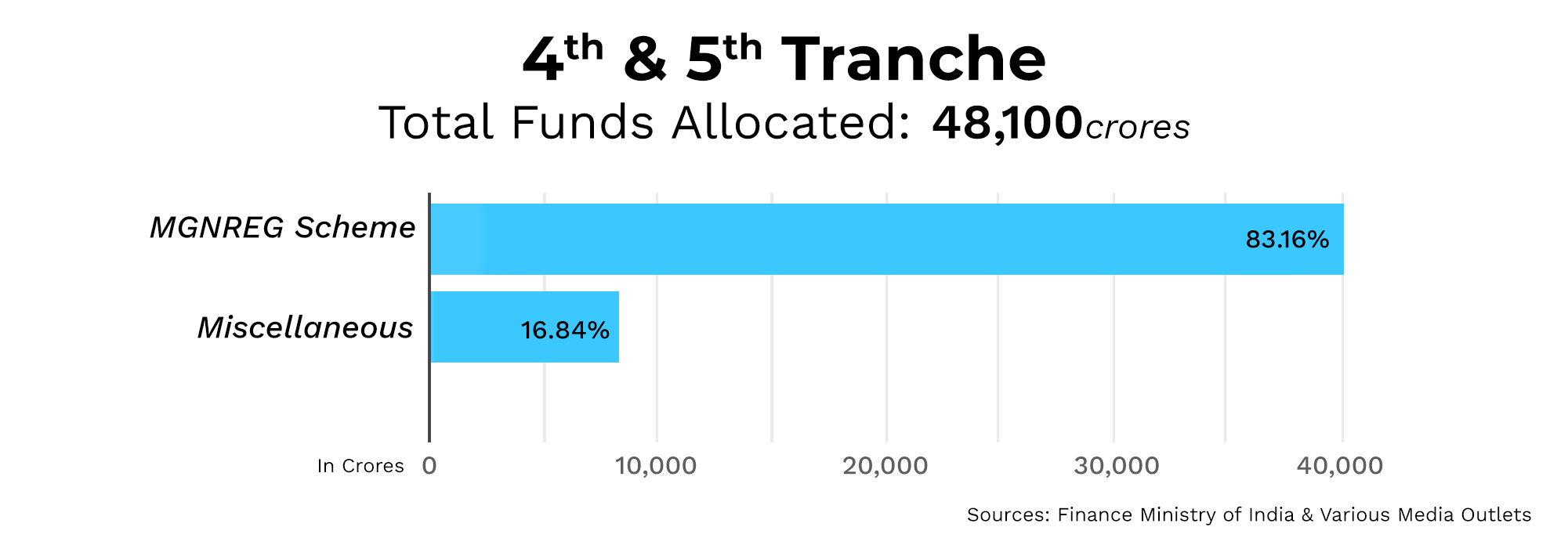
    In the final announcement, Rs 40,000 crore was allotted to Mahatma Gandhi National Rural Employment Guarantee Scheme (MGNREGS) to replace direct transfer from central government to migrant workers. Inadequate data about inter state informal labourers has placed limitations on policy formulation during the time of crisis. Under the Pradhan Mantri Garib Kalyan Yojna, Rs 50 lakh per person insurance cover will be applicable for health professionals. To ensure ease of doing business, non adherence to the Companies’ Act will be decriminalised. The government also committed to increasing health expenditure to face pandemics in the future. The finance minister also encouraged companies to entertain the idea of digital India to conduct meetings and businesses online. 

    The last two announcements together accounted for Rs 48,500 crore and experts criticize that most of them do not provide immediate relief for the people in distress. 

    Conclusion

    India has evidently seized the opportunity during the crisis to introduce reforms to boost the economy in the long run. The reform package undoubtedly is impressive on paper but in terms of immediate support to various sectors in distress it offers little. For example, a large part of the package – Rs 8.04 lakh crore- is additional liquidity injected by monetary policy in the last three months.  An investment bank has predicted that India will face a deeper recession in the short term but the economic stimulus would help the economy after a few quarters. As a consequence the real growth rate is to drop down by 5 percent year-on-year in 2020. Even after a massive package, the situation of poor and middle-class people remains bleak. The reforms might bear fruits in future but deferring the policy response to address current challenges will manifest into huge burden on vulnerable sections of the people. Current economic crisis has undoubtedly offered the central government to take advantage of the weak bargaining power of the stakeholders to push reforms but low attention is paid to immediate distress.

    The author was supported by Ms S P Bharani, on summer internship at TPF.

    Image Credit: Adobe Stock

  • COVID-19 Challenges for India: Tackling MSME Sector and Unemployment

    COVID-19 Challenges for India: Tackling MSME Sector and Unemployment

    The COVID-19 pandemic has shaken global markets as countries struggle to battle national and global health crisis. Indian government has announced an economic stimulus of  Rupees 20 lakh crore (Rs 20 trillion corresponding to $ 267 billion), roughly 10% of GDP for FY 21, in which six measures were framed for the Micro Small Medium Scale Enterprises (MSME). Government has allocated 3 lakh crore for collateral-free loans, additional debt and equity infusion with slew of other measures to protect the bruised MSME sector. The rise in the number of casualties and infected cases  all over the world present a grim picture. This is expected to result in a global recession that could lead to a loss of over $ 3 trillion to the global GDP. India, in an effort to contain the spread, has extended the lockdown at the cost of freezing almost 60 percent of its economy. Third extension of lockdown on May 3rd in order to flatten the curve will further contract the demand for next few quarters. IMF has revised India’s growth downwards to 1.9 percent for the year 2020 and 7.4 percent for the year 2021. Although the growth projection is not negative as in the cases of Eurozone and the US, India will need to overcome significant structural challenges to bring the economy back into a high growth trajectory. The cost of battling COVID-19 is not limited to the dip in growth but also includes the bleak prospects of a sizable percentage of the population being pushed below the poverty line.

    Apart from the virus, India faces two key challenges. Firstly, almost 80 percent of its labour force is part of the informal sector, which is expected to take major hit as a result of  the lock-down. Secondly, as India’s working age population will continue to expand  till 2055─ the cost of missing this demographic dividend will directly impact the future growth trajectory. Japan, China, South Korea and Singapore have capitalized on their demographic dividends and experienced double digit growths. The current disruption in the global economy will have a significant impact on India’s growth for the next few years. Therefore, diagnosing the systemic problems in the economy is crucial to developing a viable strategic economic policy. The Periodic Labour Force Survey (PLFS) notes that only nine percent of Indian workers are employed with organizations having more than 20 workers. Rest of the labour force are employed with small enterprises which have been forced to lay-off most of their employees due to the extended lockdown.

     Business Supply versus People Demand

    Contributing 30-35 percent of the GDP— Micro, Medium and Small scale industries face a higher risk of shutting down their production due to cash flow constraints. All India Manufacturers association reported that 43 percent of the MSMES will cease to operate with the lockdown extension. Around 99 percent of the MSMEs are dominated by Micro enterprises in which labour intensive production units are already under stress with restricted labour movements. Finance minister’s attempt at redefining MSME by including businesses with higher investment and turnover does not address the main problem of majority of unregistered micro enterprises shutting down due to less or nil operating capital.

    A total of 114 million people are employed in MSMEs and the shortage in working capital as a consequence of the lockdown would drive most businesses out of the market. Furthermore, an extended demand shock would curb the production and supply, as a result of which small industries with limited capital will most likely shut down. Additionally, 86 percent of the enterprises are unregistered and 71 percent of labourers have no written job contracts. Since most of the enterprises function in highly unorganised sectors, they would have been forced to lay off employees.  Thus relevant policies will need to be recalibrated in order to address the problem of unemployment– currently estimated to be 27.11 percent. The share of MSME exports is valued at $147.7 billion– showing an impressive jump from the previous value at $75 billion. The small number of exporting businesseswill be clamped down due to insufficient liquidity especially with weak global demand.  Hence, the policy must focus on balancing to keep the interest rates low in the long run and enhance discretionary spending to boost investors’ confidence. One of the six measures announced by the government is to protect the local MSMEs from unfair foreign competition. Pursuing a protectionist policy in the business sector before the recovery of domestic demand would imply higher risk of the economy being caught in a low demand cycle. Additionally, the recent exemption of labour laws threatens the workers’ income─ reducing the revival rate of consumer demand. According to a latest reading of the consumer demand risk map, casual labourers in both rural and urban areas are at highest risk of salvaging potential expenditure.

    Need to Reorganize MSME and Boost Employment

    Although strong relief packages are demanded, India has limited fiscal space. The slew of measures announced by the central bank to ease the liquidity will cushion the MSME sector during the lockdown period. However, incentivizing small scale businesses to operate amidst weak demand would need recapitalizing finance based on the firm’s productivity. A structural makeover of the business sector will call for measures beyond just monetary policy. While current economic stimulus aims at protecting the business sector, challenges remain in adopting a medium term policy given the unorganized structure. The OECD countries have broadly undertaken measures to reduce the impact on their Small and Medium Enterprises (SMEs) by providing wage subsidies, loan guarantees, direct lending and modified structural policies. The Reserve Bank of India (RBI) has similarly offered a much-needed loan moratorium, cuts in the Cash Reserve Ratio (banks minimum reserve requirement to be held with RBI) and working capital financing. Although the second round of relief package has focused on small industries, the expectation of a burgeoning fiscal deficit to 5.07 percent from revised estimate of 3.8 percent means that financial  stimulus is somewhat of a double edged sword.

    Even prior to the pandemic, unemployment was at a 45 year’s high at 8.5 percent and consumption was on downtrend. The economic response for India must factor in the welfare loss while assessing the economic consequence. In five out of the first ten years of entering its demographic dividend phase, Japan was experiencing double digit growth.  If India is not to lose out on growth momentum during the current stage of its youth bulge, it would require effective and radical policy measures to counter the problem. Economic relief packages during the crisis must be followed with strategies to provide economic security to the working age population across the country.

    To keep up with the growth of the working age population, estimates suggest that India must create 10 million jobs annually. Ease of doing business becomes a crucial factor in creating employment opportunities. Indian policymakers are tasked to identify the methods to sustain the operations of MSME sector post lockdown. The large workforce resulting from India’s youth bulge cannot be undermined by this crisis. Policy prescription to create rapid employment and facilitate business operations is the priority. For India, it is important to endeavour to balance the immediate financial response with continuous public and human capital investment. Biting the fiscal bullet is inevitable in a crisis situation but assessing the cost of growth foregone is crucial to strategize policies for future. The real challenge lies in the transition of role from being protective to promotional through structural operations by factoring in the consumption demand. Temporary infusion of money in businesses and renovation of MSME sector is much needed to realize the ‘Make in India’ dream.

    Image Credit: Adobe Stock

  • Need to Redefine MGNREGS: Response for a  post pandemic Economy

    Need to Redefine MGNREGS: Response for a post pandemic Economy

    The Union budget 2020 was heavily criticized for allocating only INR 60,000 crore on the UPA flagship program, Mahatma Gandhi National Rural Employment Guarantee Scheme (MGNREGA). Discontent continues even after the relief package mentioned INR 200 per person will be paid for the next three months. With 7.6 crore workers registered under MGNREGA program around one trillion (INR) would be required to fulfill the promise. The pandemic has disrupted almost every physical activity, thereby disrupting the physical labour economy. The unfolding crisis across the country and  the poor health infrastructure especially in rural areas poses a major challenge to combat the spread of the virus .  According to the National Health Report, India’s government hospitals average a low figure of one bed per 1844 patients.  The magnitude of the health crisis becomes apparent with the inadequacy in health infrastructure in rural India. The ongoing COVID-19 crisis is reshaping the entire global economy and is expected to be a stress test for government institutions. Even after the crisis, policy making and social programs will remain the key areas in which continuous revision must happen – to build a resilient economy in the long run. As the pandemic influenced financial crisis looms large, it is opportune to discuss public employment programs in bridging infrastructure gaps and financial losses. 

     Demand driven workfare programs intend to provide 100 days of employment for rural households. This scheme was launched with an objective to alleviate poverty and create public assets.   Recognising the vagaries of the agriculture sector to provide stable employment, the program sought to guarantee minimum income for subsistence level labourers and also internalized short term shocks in the rural economy. In principle, the ‘right to work’ element offered a legitimate progress in public-policy discourse by empowering women and marginalized communities to work. The laudable results of the employment program have more or less achieved its social objectives by increasing individual asset creation and enhancing savings rate. Almost 50 percent of the population dependent on agriculture fall back to government employment schemes in times of labour market failure. Low productivity, inadequate modern technology, high dependence on rainfall and bottlenecks to reach the market are primary sources of such failures. Execution of public employment in India is  plagued by rampant corruption and efforts to effectively implement the scheme faces hurdles and results in marginal progress. In the wake of economic slump with falling consumption in rural India and high unemployment rates, infusing cash in the hands of people is always the priority. However, marginal increase in budget allocation for public work programs has invited criticism from the economists – expecting the rural economy to struggle with slow recovery. With acute shortage of skilled labourers and an education system failing to impart quality skill education, a public employment program can be more dynamic in resolving the socio-economic and food security problems. The primary objective is to offset short term economic disturbance and smoothen consumption expenditure, but the development of the program in responding to the needs of the community is also important.  Successful implementation of an employment program must factor-in convergence with other departments, quality of assets created and skill levels imparted under the program. .The three-week lockdown due to covid-19, further extended by two weeks, has exposed the inadequacy of public health infrastructure, more so in rural areas and for informal labour groups, to address their health and the resulting financial hardship. Converging the needs of villages to enhance better response during a crisis with the employment program would result in bringing accountability and creating assets.

    India has experimented with a plethora of universal public programs such as Public Distribution System and Integrated Child Development Scheme (ICDS). In a similar vein, MGNREGS has been an important public work programme with the aim of reducing poverty and enhancing income levels. At this juncture, revising and reviewing MGNREGA scheme with the objective to reduce leakage in the system is a priority. A clear balance between the twin objective of providing employment and creating infrastructure has been missing in the literature. The gap between theoretical policy and reality has raised  concern and the need to review the current approach . The obvious gap in infrastructure requirements identified during the time of crisis must converge with public programs. Such carefully designed schemes with tangible objectives will provide economic security in the short run and improve rural infrastructure in the long run. 

    Work completion rate can be used as a proxy for productivity because individual labour productivity is hard to ascertain with heterogeneous work projects. Although the official MGNREGA website suggests an average of 90 percent of work completion, open government data shows a decline in work completion rate from 43.8 percent in 2008-09 to 28.4  percent in 2015-16. Financial support through employment should account for both quality of assets created and the process of such creation. This would internally check and balance the operation of the scheme and intuitively bring in accountability. At present, the scheme contains the above mentioned elements but has not been used to evaluate the execution of the program. Convergence between departments to create assets and the work completion rate might explain the effectiveness of a program in physical terms. 

    An efficient model should enhance the skill levels of rural youth and is more than necessary to counter the loss of jobs already happening due to coronavirus lockdown. Unskilled and semi-skilled labourers will face lay-offs as industries with the recent norm on social distancing adjust to capital intensive businesses. The percentage of rural population in the age group of 15-59 receiving vocational training has reduced from 1.6 percent in 2011 to 1.5 percent in 2015-16. Unemployment rate among rural youth (15 to 29) has increased from 5 percent in 2011 to 17.4 percent in 2017-18. Although the highest unemployment rate is observed among rural females, the employability of rural youth reduces as education increases. The paradox of educated unemployment is not complex to decode, but a significant skill gap is the fundamental problem from the labour supply side. The Expanded Public Works Program (EPWP) introduced in South Africa to address the skill gap among the youth has succeeded in reducing poverty and unemployment rates. The program has been designed to create labour intensive projects not limited to infrastructure but extends to social, cultural and economic activities. The percentage of young workers under this scheme witnessed a rise from 7.73 % in 2017-18 to 10.06 % in 2019-20 in reference to the low levels of employment. This would mean the nature of the guarantee program has shifted from giving opportunities for seasonal unemployed to educated unemployed. The change is indicative of the deeper crisis faced in the rural economy and calls for a sustainable plan to use public programs as a tool to also impart skill training for the rural youth. State’s increasing dependence on work programmes to create employment needs to be revised based on community requirements. While enhancing rural employment is the immediate concern, the process of achieving it suffers from various executive problems such as corruption among government staff and individual’s lack of willingness to work. Amidst the lockdown situation due to COVID-19, unemployment will increase sharply. A well-devised strategy to address economic losses on priority and emphasis on health infrastructure through public employment must resonate in policy-making after the impact of the coronavirus crisis subsides. 


  • Budget 2020: Rhetoric vs Reality

    Budget 2020: Rhetoric vs Reality

    Sharing structural similarities with the 1991 economic conditions, , the current decline in Indian economy is in desperate need  for radical reforms to energize the growth. Faced with severe fiscal constraints, the optimistic projection of revenue by the government   seems more of a challenge than realistic prospects for economic growth. Tax revenue is expected to fall short by INR 2.5 lakh crores in FY20 as the GDP records an 11- year low of 4.5 %.  As against the target of INR 24.6 lakh crores, there is likely to be a shortfall of INR 2 lakh crores for the current fiscal year. Expenditure cannot only depend on the expected revenue and fall in revenue collection will become a grave concern to achieve the fiscal deficit target set at 3.5 percent .  The budget is expected to balance deficit and growth by laying down a plan for fiscal consolidation and pushing the growth fundamentals. The Finance Minister in her speech mentioned three pillars under which the budgetary allocation has been rationalized. There is a need for deeper examination of budget proposals  beyond the slogans of the budget speech in order to comprehend the government’s long-term economic strategy.

    Aspirational India

    The agriculture sector with poor growth rate yet employing 50 percent of the workforce required significant capital infusion. 2.6 lakh crore has been allocated to agriculture & allied activities out of which 75,000 crores are dedicated to double farmers’ income. In reality, implementing a cash transfer scheme with a huge quantum of finance is a strenuous task facing  challenges on the ground. Schemes such as setting up solar panels and village storage run by Self Help Groups will act as a non monetary support measure. However, infusion of cash in rural credit structure and ease in acquiring credit facilities is largely ignored. The absence of  adequate investment for R & D in agriculture is a major shortfall in the budget. A target to increase the milk production capacity to 108 million tonnes is ambitious, yet no road map has been laid down to enhance the capacity in the current structure.  Weak consumption and high unemployment has contracted rural economic growth but the budget has failed to directly inject finance to increase effective demand. Sharp cuts in MGNREGA budget is giving rise to concerns as the total money in circulation in the economy continues to be low.

    Income insecurity will weaken the consumption demand for a few more quarters, arresting the medium-term growth. Healthcare Sector has been allocated  a total of 67,000 crores which is a significant increase of 10 percent compared to the last budget. The government’s flagship healthcare program, Pradhan Mantri Jan Arogya Yojana or  Ayushman Bharat, is allocated 6,400 crores which is the same as the previous year along with the National Rural Health Mission being allotted 28,000 crores. The Finance Minister has approved a Private-Public Partnership (PPP) between private medical colleges and hospitals in the country. The initiative is aimed to improve the skill levels of enrolled students to export their services abroad. Effectiveness of the PPP model in healthcare will depend on the amount of scrutiny and quality checks placed at the execution stage. Highest decline in funds was for Rashtriya Swasthya Bima Yojana from Rs 156 crores to Rs 29 crores, and Food Safety & Standards Authority of India was reduced to Rs 283.71.

    The draft of National Education Policy in 2019 invited multiple debates but achieving quality education has been the common goal across all levels of education. Human capital investment and skill development has been crucial to the 2020 budget with an allocation of almost 1 lakh crore for education and training. Breakup of funds for education under primary, secondary and higher education was not spelt out.  Finance minister citing the increase in gross enrolment ratio of girls in education has clearly missed the data on falling rates of women in labour force. The narrow lens of viewing enrolment number as a measure  women empowerment has to be revisited to achieve gender equality status. Encouraging apprenticeship and internships in rural areas for engineering and technical graduates is an important mention as the students lack experiential learning. Higher education population stands at around 36.6 million, surging the demand for  institutions offering graduate courses. The Government due to its limited fiscal capacity has allowed private institutions to address the demand for higher education. Despite this opening up tertiary education remains at only 25.8 percent of Gross Enrolment Rate. Quality in higher education is still a distant dream in India and it is important to dedicate funds to improve the quality of higher education in particular.

    Economic Development 

    Under Economic Development, promoting MSME sector and developing infrastructure have been the focus areas. Setting up NIRVIK scheme for higher export credit disbursement and facilitating investment clearance cells is a favourable move for medium and small scale business. Primarily, encouraging potential start-ups to equip their operations  with technology and managerial skills for creating export market demand must take precedence.

    National Logistic Policy is underway to revamp the transport infrastructure and new trains are to be operated under PPP. 100 new airports to be developed under UDAAN scheme is expected to create substantial employment in infrastructure sector. Linking basic Bharatnet services to 1 lakh gram panchayats is a notable initiative to improve the internet connection at local unit level. An exclusive direct investment in disruptive technology and artificial intelligence continues to be absent indicating India’s lag in becoming more competitive. Failure of the ‘Make in India’ initiative to materialize as expected is a relevant evaluation to reframe the fund allocation to accelerate indeginious production. Foreign trade of India presents a grim picture with exports slipping by 1.8 % in the last few months.  Although the political aspect of ditching Regional Comprehensive Economic Cooperation (RCEP) played well, quitting a multilateral trade deal has reduced the scope to upgrade domestic technologies. Frailty of the economy has clearly reduced the incentive for small businesses to invest in production and service despite schemes dedicated for this domain. Entrepreneurship culture in a favourable environment to undertake small businesses with insurance cover should aim at utilizing the existing human and capital resources through upgraded technology. A National Pipeline project has been proposed to ensure public spending on road, irrigation, power (conventional and renewable), railways and housing. Under this project, substantial funds are allocated for roads and least is for rural infrastructure. A prepaid  ‘smart metering’ system is to be substituted for conventional energy meters. On the financial front, tax concessions for corporate companies and foreign investment have been proposed. Reducing income tax slabs cheered the middle class but it has been a necessary and not sufficient condition to push the economy in a growth trajectory. Extension of tax holiday for real estate corporations would not qualify as fiscal stimulus with poor housing demand. As Dr Rathin Roy, economist suggests, either productivity should improve for pushing the demand at existing wage or minimum wage should increase. Decoding his post-Keynesian idea, structural crisis present in India offers much more complexity in practice. Land, labour and capital market reforms are inevitable to catch the growth momentum in the long run. Revising tax structure under Goods & Service Tax (GST) does not count for a structural reform to revive growth and scant attention has been paid for resolving systemic issues using budget as a tool. 

    Caring India

    The last pillar of the budget, emphasizing the importance of national and social security,  allocated funds for marginal groups, senior citizens and women, adopting a populist measure.  Over 6 lakh anganwadi workers are to be given smartphones and the budget estimate for nutritional related programs stands at 35,600 crores. Proposals were made to establish Indian Institute of Heritage and Conservation along with the development of 5 archaeological sites.  Major schemes like PM KISAN, Direct Benefit Transfer, Pradhan Mantri Awas Yojna and ICDS (Integrated Child Development Service) witnessed a jump from revised budget estimates of 2019-20. The Finance Minister in her budget had mentioned a number of schemes aimed at the Environment, Pollution and Climate Change. It includes 4,400 crores for the Clean Air Policy, 460 crores for Pollution Control and 3,100 crores for the Ministry of Environment, Forest and Climate Change. The last budget witnessed reduction in GST rates on Electric Vehicles (EV) and an annual tax reduction of up to 1.5 lakhs on interest paid to purchase EVs. However, the current budget has increased the custom duties to curb the import of cheap materials from China making the vehicles more expensive. National Adaptation Fund for Climate Change (NAFCC) is a central sector scheme set up to support concrete adaptation activities that mitigate the adverse effects of climate change. The Budget missed out on the replenishment of the much-needed NAFCC and has ignored it for two consecutive years. The overall fund allocation for Climate Change and Environment has increased by 5 per cent in the budget. Promoting sustainable business practices at micro levels is a key in tackling climate change. Accommodating the green budget would demand more involvement beyond mere budget allocation, effective plans need to be developed that can constantly track the progress of India’s climate change dialogue and advocacy.

    The defence budget for 2020-21 stands at 3.37 lakh crores, constituting 1.5% of the GDP, excluding pensions. Capital and revenue expenditure is valued at 1.18 and 2.18  lakh crores and pension at 1.33 lakh crores. This will affect several big projects taken up by the armed forces to build capabilities against Pakistan and China as there has been only a marginal increase in capital expenditure compared to previous year (1.08 lakh crores). Armed forces will be forced to cut down on arms and equipment purchases, thereby diluting the state’s priority on national security. However, with adequate government support there is scope for the private sector to bridge  the gap in areas of maintenance and logistics of the armed forces. Corporate tax cuts in the manufacturing sector, strategic disinvestment in Central Public Sector Enterprises (CPSE) and abolition of ‘angel tax’ for start-ups is appreciable. However, more involvement and sincere efforts should be undertaken by the Government to enhance private sector involvement in creating additional funding for developing a robust defence industry and meeting the needs of the armed forces at the same time.

     A recent study by Oxfam reported that 73% of the total wealth is owned by 1% of India’s population, as a result the number of billionaires has increased to 120 in 2019 from nine in 2000. A funding strategy that does not  attend to the growth of income among masses would lead to furthering the inequality and handicap the long term growth of an economy. Budget continues to be a powerful instrument to reallocate resources through fiscal policies and reduce economic inequality in a country. Facing a high risk of missing the demographic dividend, the budget was expected to make radical and structural reforms. Immediate measures to revitalise economic wealth among middle-class and rural residents is the need of the hour. The ostensible budget might garner popularity but the foundation to achieve India’s growth potential remains insufficient. Choice between managing fiscal deficit at the cost of reduced demand and initiating growth at the cost of huge fiscal deficit summarizes budget decisions. Biting the fiscal bullet, the finance ministry has assumed more accountability in explaining every component of expenditure but has failed to provide confidence for a resurgent Indian economy. Micro level assessment reveals a rosy picture but the exercise has undoubtedly choked the Indian economy in the short run.

    Contributions by

    Manjari Balu and Swaminathan S are Research Analysts with TPF.

    Aditya Balakrishna is an Intern with TPF.

    Views expressed are their own.

    Image Courtesy: Sanjay Rawat // www.fortuneindia.com

  • Falling Consumption Expenditure: Need for Labour Market Reforms

    Falling Consumption Expenditure: Need for Labour Market Reforms

    Government withholding consumption expenditure data on the grounds of data quality has stirred many criticisms from economists and other interest groups. Growing concern over falling rural consumption especially amidst economic slowdown has crystallized a categorical debate on the nature of slowdown. Irrespective of the validity of methodology employed, low consumption expenditure can sequel falling growth rates. Slowdown of the automobile industry as a case, sluggish growth and rising unemployment corroborate the unofficial claims on falling consumption expenditure. According to Business Standard report, the average amount spent per month by an individual declined from INR 1501 in 2011-12 to INR 1,446 2017-18. Although falling rural consumption expenditure evinces an economic malaise, issue of inefficient labour market has received less attention. Consumption is considered an important way to assess the health of an economy according to neoclassical economists. Multiple theories on income and consumption relationship are advanced in the field of economics. According to permanent income hypothesis, consumption expenditure varies in relation to the expected future income. In simple terms, an individual’s consumption will be distributed across their lifetime based on the permanent income they are expected to receive. Every theory has reiterated the central role of income in determining the consumption levels of the individuals. 

    Income insecurity in Informal sector

    A study conducted  on consumption spending in Ghana concluded that income and inflation had a long-run relationship on consumption expenditure. The Monthly Per capita Consumption Expenditure (MPCE) in 2011-12 revealed that urban MPCE was higher by 84 percent than rural MPCE. India, operating as a dual economy, considers casual wages and regular salaries as a proxies to study informal and formal sector. The wage differential among salary earning individuals operating in informal and formal sector was higher than casual labourers’ wages. Increasing number of regular employees working in informal sector shifted the concern to penetration of ‘informality’ across the labour market.  Post globalization labour market has theoretically encouraged organized sector but the wage employment in the organized sector has employed more casual labourers with no social security. A new layer of casual labours was created post reforms to cushion the weight from competitive prices. Fragmentation within the organized sector with growing contractual labourers has weakened the expected income levels which could directly affect consumption behaviour. Working-poor in India are highly concentrated in the organized sector as casual labourers and self-employed with a combined share of 51 percent of the total workforce as of 2012.

     A recent report on consumption expenditure points out that rural monthly consumption has fallen by 10 per cent from INR 643 to INR 580 indicating a need to accumulate more income in rural India. The main industries functioning under informal structure were construction, manufacturing and wholesale-trade employing majority of unskilled and semi-skilled labourers. In 2011-12, rural employment contributed 76 percent of total informal sector labourers in the three main sectors. Almost 80 per cent of rural workers are engaged in casual employment and despite a moderate growth in casual wages over the years; it amounted to only 36 percent of a regular worker’s earnings. Increasing share of informal employment within the organized sector coupled with poor social security has reduced expected financial flow of labourers. State induced social spending would propel consumption levels to a limited extent but the underlying crisis in the rural labour market would continue to contract long term consumption expenditure. Total social sector spending as a percentage of GDP has reduced from 2.7 per cent in 2000 to 2 percent in 2014. Reduced government spending and lack of labour market reforms are responsible for poor disposable income in the rural economy. 

    Rural labour market instability

    Casual labourers have constituted consistently 28 percent in Indian rural labour force since 1983. The periodic labour force survey report (2017-18) observed a decline in the share of self-employment in both rural and urban sectors. The unemployment rate in urban sector is 7.3 percent, comparatively higher than rural unemployment rates of 5.8 percent. A major portion of rural labourers are associated with the casual sector in rural areas with unstable income and weak social security. For instance, average earning per day in public workfare programme such as MGNREGA has fluctuating wage rates in rural areas, recording as low as INR 136 in 2018. Such a precarious structure in the labour market has diluted the spending capacity of rural residents in the recent times. According to the usual status in employment, there is a moderate increase in casual labourers and salary earners but the self-employment rates have been on the downtrend. In 1983, 60 percent were self-employed, which has gone down to 57 percent in 2018 despite the attractive loan schemes introduced by the government. 

    Female workers’ earnings play a vital role in determining the consumption health of an economy, a drastic fall in female work participation deserves an in-depth investigation. Falling participation rate could mean either women drop out due to social conditions or due to unavailability of jobs matching their skills. While sufficient literature studying these two areas are available, the first issue can be viewed with scepticism as earnings of men have increased significantly while women’s wages have stagnated. Although overall women in the workforce have reduced, 73 percent of women are engaged in agriculture as primary activity compared to 50 percent of men. A deceleration in agriculture and low investment on public infrastructure in the past few quarters have  decimated the consumption capacity of rural India. Women being the bigger component of agricultural labour force, and with factors of social discrimination, tend to have lower wage rates, thereby contributing significantly to reduced capacity for consumption and expenditure.

    Labour market reforms needed to revive long term consumption

    It would be erroneous to isolate the core economic problem to be categorical- the structural issue or cyclical slowdown can be both demand-side and supply-side driven. The whole economic apparatus is strongly integrated and a supply-side constraint can indirectly choke the demand which would, in turn, weaken the growth. Many economists have recommended the need for structural reforms; labour and capital relations have to be redefined as a measure to redistribute the resources. Further, the labour code on wages, 2019 has invited criticisms on grounds of poor protection for informal labourers and favouring corporate profit. Financial ecosystem requires corporates to make profits but a stagnant reinvestment convulses the cycle. Deepening crisis in the economy is conspicuous and falling consumption reiterates the need for better land and labour reforms. 

    Closer examination of the rural labour structure provides a bleak picture of low-income concomitant with minimum social and economic security, thus seriously impacting rural economic consumption. According to the PLFS report, the percentage of rural regular salaried employees with no job contracts increased from 58 percent in 2004 to 69 percent in 2018. Around 88 percent of rural female casual labourers against 84 percent of rural male casual labourers had no union or association. Absence of union is a proxy for weak bargaining power which eventually distorts the real market wages for the labour. Systematic labour market reform is critical especially for fixing the minimum wages and restructuring the labour market. Failure of manufacturing and service sectors to absorb the excess unskilled labourers from the agricultural sector has posed a major challenge. A short term cash transfer or providing welfare schemes should not be mistaken for structural reform. Enhancing the skill levels of rural labourers so as to enable their displacement to the manufacturing sector would augment employment and income. 

    Effect of demonetisation on the informal rural economy cannot be underestimated; removing 80 percent of currency from the economy damaged small and medium scale businesses operating on cash. ‘Make in India’ has not succeeded in accelerating business entrepreneurship in the country. Only 5 % of the adult population manages to establish a business that survives for longer than 42 months according to Global Entrepreneurship Monitor, a rate that is the lowest in the world. Financial investment in medium scale and small scale industries has been poor due to bureaucratic hurdles and unfavourable business environment leading to world’s highest business discontinuation rate of 26.4 %.

    From the supply side, low reinvestment despite a reduction in interest rate has exacerbated the falling consumption situation. Slowing automobile industry and consistent downtrend in manufacturing have contracted the capacity for employment generation in the industrial sector. CMIE has observed corporate profits to be more volatile than wages in the last two decades. The standard deviation of increased profit was recorded to be 32 percent as compared to 6.3 percent in the wage share. The erratic change in profit component implies entrepreneurs are more likely to be discouraged to invest in a business and play it safe. This invariably allows only the big corporate companies to survive. Low share of labour income in the economy is undoubtedly a structural phenomenon; the state’s apathy to induce private capital investment is detrimental to the labour market as well. 

    Reforms should have distinct rural and urban labour market strategies

    Departing from viewing economy in a political lens, a state must prioritize market reforms especially labour reforms. It is the state’s responsibility to ensure efficient allocation of resources and guarantee economic development and welfare of people. The slogan of ‘minimum government and maximum governance’ can be realised only through radical reforms and policy changes.

    The problem of shrinking consumption in rural areas is an outcome of constraints in the supply-side and unorganized labour market. Mere infusion of money as a solution is neither practical nor sustainable; a long term strategy to improve the structure of the rural economy is necessary to address the current economic crisis. Policies should be directed towards energising the informal sector, provide social security and economic dynamism that accelerates capital formation and induces private investment to support business growth. Consumption levels can be revived by making demand side and supply side changes simultaneously; increasing public gross capital formation and encouraging private investment by improving the investment climate would revive private consumption. A clear distinction has to be drawn between rural and urban labour markets, reforms to monitor the movement and prices will emerge as a structural reform to support both growth and development. 

    Manjari Balu is a Research Analyst with TPF. Views expressed are her own. 

    Image credit: www.newskarnataka.com

  • Power Shift: Knowledge, Wealth, and Violence at the edge of the 21st Century

    Power Shift: Knowledge, Wealth, and Violence at the edge of the 21st Century

    Power Shift: Knowledge, Wealth, and Violence at the edge of the 21st Century” by Alvin Toffler, Bantam Books, 1990. New York

    Alvin Toffler

    Last book of the trilogy, ‘Powershift’ published in the 1990s still continues to be an impressive intellectual handbook to understand the transformation of power in a rapidly evolving technological, economic, and social environment. Toffler argues the nature of power in any epoch is determined by knowledge, wealth and violence. By acknowledging the inevitable emergence of new age knowledge economy, Toffler sets to describe the set of changes in the power dynamics at the turn of the 21st century. A gradual shift in power succeeds with knowledge through control of information in a super symbolic economy. Post third wave of industrialization, smoke stack industries would be replaced by decentralized industries with technology and information playing critical roles. China in the past few decades has designed its economy based on knowledge and gained technological sovereignty in Asia threatening the West’s global dominance. He asserts the pattern of powershift in politics, economics and business would be integrated and the hierarchy of power would get dissolved. A mosaic of power structure would emerge, ‘demassyifying’ production that determines the future of an economy. Recent developments in 3D printing, artificial intelligence etc have changed the paradigm of manufacturing – the country investing and comprehending the impact of innovation and disruptive technologies would gain economic superiority. By providing substantial case studies and thorough qualitative analysis, the futurist predicts millennials to redefine the defence for democracy with technology, information and knowledge. There exists a conspicuous relationship between power, wealth and knowledge since the beginning of the industrial revolution. While power has traditionally been symbolised by brute military power and economic power until the end of the world wars, the post 1945 transformation of power is contained in a triangle of military power, economic power, and knowledge (science and technology) power, Knowledge has now transformed the very notion and effectiveness of power. Power structure in the 21st century, according to the writer, will be redefined by knowledge.

    Power Shift: Knowledge, Wealth, and Violence at the edge of the 21st Century

    Violence and wealth function as important tools to consolidate power – politicians, bureaucrats and business people have always used violence & wealth to move up the hierarchy. Changing levels of technology and innovation has advanced knowledge to be a source of high quality power. Toffler firmly argued that power shift era will not be about competing nations or institutions for power, rather the dynamics between violence, wealth and knowledge would be the most intimidating transformation of power. Twenty odd years later it is clear that his analysis is spot on. An important note has been made on three key factors that bolster power accumulation – military, economic and technological power. Any country claiming superiority over these three could garner superpower status. Testing this hypothesis in the case of scandanavian countries proves that despite achieving superior economic and technological capabilities these countries could never realise great power status due to lack of strong military power. Toffler highlights, however, that the nature of military power now symbolises the critical influence of knowledge power. Tofflers’ concepts, also echoed by Joseph Nye as ‘smart power’ (combination of soft and hard power), justifies the end of the Cold-War era power struggle. Political values, culture and foreign policy were fundamental for soft power, traditional marxist and liberals considered economic might to be foundational to soft power. Global power centre of gravity shifting from west to east at the turn of the 21st century is a reflection of not just the rise of Asia but also the transformation of power and hence, the powershift. China’s ambitious Belt and Road initiative aims to consolidate its economic power within the western framework and then transform it. Undoubtedly, power transformation across the region and within a country is an outcome of increasing control of and access to advanced technology. A successful super symbolic economy would operate only in a country which manages to maintain monopoly of knowledge for a brief time frame until the knowledge can be commercialized to boost the economy further.Toffler has made assumptions by partially ignoring the role of domestic government structure in accumulating wealth by gaining access to control of knowledge. The inextricable link between local framework in materializing as an influential player in the global market cannot be ignored. Toffler’s following statement rings even more relevant today than ever before – “Knowledge itself … turns out to be not only the source of the highest-quality power, but also the most important ingredient of force and wealth. Put differently, knowledge has gone from being an adjunct of money power and muscle power, to being their very essence. It is, in fact, the ultimate amplifier. This is the key to the powershift that lies ahead, and it explains why the battle for control of knowledge and the means of communication is heating up all over the world.” By using the term knowledge liberally, author assumes a fluidity in defining knowledge as a tool in the era of powershift. Beyond logical thinking, knowledge is related to the ability of learning, unlearning and relearning. Any information and data can be reproduced with value as a product of passion and innovation. India at this juncture must position herself to strategically become a strong emerging power in a multi polar world. Counter balancing China’s growth in Asia, India has to permeate the knowledge economy by investing in technology and innovation. It might be fallacious to idealize China’s path, but it is critical to recognise the changing dynamics of knowledge in the current world order. An exhilarating text presenting an inspiring account of the future which we currently live in. The book remains germane as we experience knowledge of technology shaping the power structure and reiterates the dictum ‘knowledge is power’.

  • Rural Development and Gender Equality: A reality check in Tamilnadu

    Rural Development and Gender Equality: A reality check in Tamilnadu

    Category : Agriculture/Rural Development/Gender Equality

    Title : Rural development and gender equality: A reality check in Tamilnadu

    Author : Manjari Balu 06.01.2020

    Tamilnadu continues to be one of the fastest growing states in India, despite some major declines due to political instability, rampant corruption, and populist measures at the cost of development. Despite significant progress in literacy, women’s education, and some aspects of social security, there are still major shortfalls with respect to rural employment, skill development, and gender wage inequality. Tamilnadu has to develop a policy framework to achieve employability through quality secondary education for women, shifting focus from only enrolment of girls in primary education. Manjari Balu analyses this issue in Tamilnadu.


    Read More

  • Gender Wage Inequality: A Core Problem in Rural Indian Economy

    Gender Wage Inequality: A Core Problem in Rural Indian Economy

    Growing unemployment rates, inadequate demand and low productivity in rural India is currently drawing significant attention particularly in view of the current economic slowdown. Debates on falling agriculture productivity and consumption in rural areas have partially ignored the gender dimension. The sexual division of labour in a rural production framework arbitrarily sets the female wages lower than men. Declining participation of women in labour force could relate to various socio-economic conditions, a sector wise analysis mirrors an intelligible dynamics of the problem.   Informal rural market already operating below the minimum wage exploits women as they are presumed to have poor bargaining power and social constraints blocking their employment migration tracks. While the dire status of marginal farmers and casual labourers are talked about, economic and social inequality across gender misses the radar.

    Optimism on gender grounds rose after the wage gap between men and women started reducing in rural labour market across India. A closer examination of the wage data among rural labour reveals the complex nature of female labour wages. More importantly, the seeming reduction in  wage gap in actuality is more due to  decline in male wage rates. The overall percentage of women in rural casual labour market has seen a marginal reduction from 35 percent in 1983 to 31 percent in 2017-18. Analysis of informal casual labour market reveals a pattern of women being paid low wages and with no social security schemes resulting in decline in already poor quality of living. Significantly, economic contribution of women is grossly underestimated in the current System of National Accounts (SNA). Time Use Survey captures all unpaid activities of men and women which would be more accurate to calculate. However, the problem of valuation remains an issue, and calculation of woman’s opportunity cost in a rural household is an arduous task.

    Complex pattern of decline in female work participation rate

    Female Workers Participation Rate (FWPR) in rural sector declined from 32 percent in 1972-73 to 17 percent in 2017-18. Studies suggest various reasons could be responsible for a fall in proportion of women in rural work force.  According to Census India 2001 and NSSO 2010, increasing number of women migrate from one rural area to other and round 64 percent of women migrants move because of marriage. A research study in Institute of Asian Studies observed an income effect, U shaped probability curve of female participation with the log of male income in the family. This means more women were working during the times of economic distress to support the family and participation rate gradually reduced with higher income earned by the men. However, with increase in income, there is also a pattern of women working to meet the increased consumption expenditure. Education is also considered an important component contributing to reduced percentage of women in labour force. As literacy rates grow, graduate women are aspiring to get employed in skilled jobs and voluntarily withdraw from the work force. However, proportion of women in primary sector has only declined from 89.7 percent (Krishnaraj & Kanchi, 2008) in 1972 to 83.6 percent in 2004. Evidently, majority of women in rural areas are dependent on primary sector for employment, a drop to 67 percent of men dependent on primary sector for employment is due to their shift to secondary and tertiary sectors. Employment in unorganised sector is beset with low wages, an exploitation by the employers.  Moreover, absence of social security cripples the income earning capacity of women. This deliberately places women in the lower strata of rural economy leading to poor socio-economic living conditions and has a direct impact on their inability to invest in education, health and nutrition.

    Women in informal sector and Poverty in rural India

    India’s rural sector is characterized by a large segment of informal labour force where 90 percent of the population is either self-employed or work for casual wage. Rural areas in particular operate in an informal economy and wages are mostly determined by the labour market where women are inherently considered less productive and paid less than men.

    As of 2011-12, 68 percent of female casual labourers were receiving less than National Minimum Wage of INR 122. Around 47 percent of men in rural India received less than the minimum wage indicating the unreliable nature of rural informal job market. Men, naturally with higher migration possibility, shift to informal urban sector jobs but women are left with depressed wages even as the labour demand remains high. Although the rural urban migration among women is higher than men, 60.8 per cent of women migrating to urban areas are due to marriage. As far as employment is concerned only 2.6 percent of women migrate as opposed to 52.7 percent of men. The decline in women participation in labour force is visible among educated women. Unskilled women in poor households tend to work for daily wages and have not substantially reduced from workforce. In rural India, where casual farm and nonfarm jobs are exploited it makes limited sense to use only wage gap to measure the gender equality.

    Agriculture, evolved from a traditional household structure, supports if not advocates, defined gender roles and discriminates women overtly through economic means. According to the recent NSSO report unemployment rates among rural females has increased from 1.8 percent in 2004-05 to 3.8 percent in 2017-18. However, an average of 5.4 percent of women had reported to be available for additional work in PLFS survey 2017-18. Unemployment is rampant across the country in all sectors but women labour supply for casual jobs especially in poor household still remains high pushing the daily wages further down. Intense land fragmentation has increased the percentage of marginal landowners to 85 percent but the demand for labour has reduced, forcing men to migrate into other sectors. Deepening crisis in agriculture also contributes directly to low wages among residual unskilled women labourers. Effectively the ‘informal labour’ market conditions has become a trap that exploits unskilled women as they are willing to work even at a lower wage rate. In effect, an increase in participation would not guarantee a better standard of living if the market is unregulated and exploitation based on gender continues.

    Why Government measures are only partially effective?

    Government initiatives for the rural economy have led to various policies to increase the income levels of marginal farmers and unskilled labourers. Women participation has been prioritized in such schemes and has shown to reduce poverty among rural households. National workfare program MGNREGS provides employment on demand and has managed to attract many women to participate by claiming to offer equal wages. As the Public employment program also mandates 33 percent of labours to be women, unskilled women are largely entering into the MGNREGS program. For the financial year 2011-12, 48 percent of women are engaged in this program from all the rural districts. However, wage gap exists even in a state intervention program- calculating from Annual Report of PLFS 2017-18, men on an average are reported to earn 152 INR per day while women are paid 143 INR from the state employment guarantee program. Further, in few states like Gujarat, Tamil Nadu, Punjab, Madhya Pradesh, Maharashtra and Telengana casual worker’s (both male and female) wage is below the notified wage for financial year 2017-18. State programs are accused of various leakages and operational inefficiencies, yet the participation remains high indicating a much serious problem in rural labour market. An important long term issue pertaining to state run workfare program is the stagnation of skill levels in rural India.  Women participation in secondary and tertiary sector is low; a possible explanation for unskilled women labourers’ compromise for low wages is because of lack of any other alternative. Skill augmentation is prerequisite to transform from an agrarian to an industrial society. A significant effort needs to be directed in training unskilled work force in rural sector, and government employment program has to be a seasonal support system.

    Skill development and Vocational Training to combat rural poverty

    The national average wage difference between men and women for casual employment other than MGNREGS work is calculated to be 55.02 INR for the year 2017-18 and states like Tamil Nadu, Kerala, Tripura and Andhra Pradesh are observed to have the highest gender wage difference. Ironically, these are the states with female participation (in casual labour force) higher than the national average of 25.5 percent, implying that wages (equal wages) are not the only driving force for influencing labour participation. In rural India, while socially defined roles result in unequal wages in labour market, women’s labour does not seem to follow the traditional backward bending labour supply curve. The natural withdrawal of women from workforce is not as serious as unskilled women remaining in informal sector even with lower wages. Real problem of women in rural economy is their diminishing bargaining power and skill stagnation or non-development of any skills due to informal structure and counterproductive state measures.

     A complete free market approach would deepen the wage difference as rural women are assumed to have low skills and weak bargaining power. State intervention to engage more women in labour market should not be limited to just providing 100 days of employment. Skill enhancement, vocational training demanded by industrial and service sectors needs to be imparted in rural areas. Residual women in rural areas are reserve army of labour available and usually are exploited for reasons given above. The gender wage gap is a consequence of a faulty design by the government and dyed-in-the-wool beliefs of people; solutions lie in the state prioritising proactive measures to reform the unorganized sector and improve market accessibility for women. Unequal remuneration in informal sector is a symptom of a fragile labour market. Women labourers end up bearing weights of both market and state failure with poor skills and low wages.

    Manjari Balu is a Research Analyst with The Peninsula Foundation.

    Image Credit:Photo by vishu vishuma on Unsplash.

  • Problems of Indian Agriculture: Low Incomes, Marginal Farmers , and lack of Modernisation

    Problems of Indian Agriculture: Low Incomes, Marginal Farmers , and lack of Modernisation

    Manjari Balu                                                                                                   August 23, 2019/Analysis

    Substantial fall in the number of farmers in the past decade with stagnant agriculture growth of 2.88 per cent corroborates the bleak condition of the Indian agriculture sector. The dire status of the agriculture assigns the state to either invest for agriculture (asset creation) or invest in agriculture (includes subsidized input). The ostensible manifestation for agriculture is visible during the union budget 2019 with falling public investment for agriculture even as budget expenditure rises. The number of cultivator has decreased by 7.5 per centfrom 2001 to 2011 but the number of labourers engaged in agriculture increased by 3.5 per cent for the same years. Contextualizing the movement of labourers with the ambitious plan of doubling the farmers’ income urges the need to investigate the income and wages which currently stands at INR 8931 per month. This figure includes both large landowners and marginal farmers   In the year 2018, waves of protests sparked off across the country, with disgruntled farmers demanding better support prices and waivers of loans. Fear mounted that frustrated farmers would jeopardise the electoral victory of the ruling party. In response, an annual cash transfer of INR 6000 to all marginal farmers was announced in the interim budget of 2019. The strategy paid off. Post-poll survey shows that around 68 per cent of Indian farmers were satisfied with the record of the BJP led government despite strong protests demonstrated earlier in the same year.

    Investments and Subsidies : Misplaced Priorities

    Marginal farmers account for 86 per cent of India’s total farmers. The government has proposed an allocation of INR 85,000 crore in the interim budget to directly support the small farmers and boost their income levels. The re-election of BJP to power is an approval from the agrarian society for idealistic pledges with an ultra-nationalistic manifesto.  But the party in power is resorting to increasing the quantum of spending on agriculture without addressing fundamental issues of the sector. Almost half of the population is engaged in agriculture and the sector accounts for nearly 17 per cent of total Gross Domestic Product (GDP). The 2019 budget has allotted INR 1,51,000 crores for agriculture and allied sectors; this constitutes a 75 per cent hike from the previous budget. Subsidies on fertilizers occupy a highly prominent position in the budget expenditure; INR 73,435 crores is budgeted for fertilizer subsidies for the year 2018-19. Fertilizer subsidy is increasing at an annual rate of 11.4 percent while the share of public investment in agriculture is a mere 0.4 percent of the total investment. The rationale behind large fertilizer subsidies is to reduce input cost and thereby increasing income margin of the farmers. However, a study conducted to assess the impact of different investment components on return on agriculture ranked subsidies below investment in Research & Development (R&D). The output elasticity of the States for expenditure varies from high-income states to low-income states. A state-wise subsidies plan has to be strategized to have a remunerative effect on the productivity and hence the income of the farmers.

                A disproportionate investment in subsidies might lead to short term rise in income but at the cost of long term productivity. The rising burden of liabilities to fertilizers companies is straining the government’s fiscal position. Comptroller Audit General India has criticized the recent budget for resorting to off-budget financing (to cover subsidies through bank loans) to reach the 3.3 per cent target of fiscal deficit. Such offset financing severely strains the government balance sheet and mounting liabilities would dent the future economy.

    Public investment in agriculture is much lower than private investment. In 2016-17, government spending on capital formation stood at only INR 45,981 crore while private spending was INR 2,19,371 crores. While overall public spending has been growing, the share of capital formation in the budget is relatively low.

    Agriculture Strategies in Indian and China: Difference is Technology and Modernisation

     An elementary comparison of India’s growth in agriculture with China highlights the divergent growth due to the different strategies adopted during their post-reformperiod. China focused on irrigation and invested in technology to attain efficiency in water management. The Total Factor Productivity (TFP) which measures the economic efficiency of inputs estimates China’s agriculture TFP to be growing at an average rate of 3.40 percent post the reforms. In contrast, India’s post reforms agriculture TFP stood at around 0.54 percent illustrating the deficiency in technology investment and excessive subsidies on credit, power and fertilizers. China’s indisputable focus was on rural spatial restructuringand land consolidation. Optimizing land-usepatterns and investing in rural regions to enhance productivity can be a transformative solution to address the problems created by industrialization. The remarkable success of China can also be attested to the stabilization of agricultural subsidies in the year 2009. Though input subsidies in 2004 were exponentially growing, the Chinese government conceded the inefficiency of resources allocated to the farmers.

    The principal justification behind institutionalising subsidies on credit, irrigation and fertilizers is to bolster marginal farmers in minimizing the difference between input costs and output prices. The input cost is primarily financed by short term agriculture credit; the short term crop loan has increased by 18 per cent from 2014 to 2018. Theoretically, a positive trend in the short term credit to farmers duplicates the function of subsidies to reduce the input cost. The dispensable expenditure on subsidies can be reduced if state prioritizes to streamline the credit flow to avoid leakages in the system. A fundamental task of the government is to channelize the gain from productivity and translate it to income and wages. Input cost reduction approach, in the long run, suffers from a potential threat of income being concentrated in the large land cultivators while labourers are discouraged to take up farm jobs.

    Income Wage paradox

    The average operational landholding reduced from 2.28 hectares in 1970-71 to 1.08 hectares in 2015-16 as a result of excessive land fragmentation with a swelling rural population. Farmers from India’s rural areas generate income majorly from cultivation and wages. Mahatma Gandhi National Rural Employment Guarantee Act is one such gambit to accelerate employment and incomes of the rural populace. Though the state intervention in the rural labour market has been acclaimed to the extent that it engages India’s unskilled labour force, the flaws of national workfare program are only too apparent with poor monitoring and supervision. A visible trend of farm labourers moving togovernment employment programs has contributed to the recent labour scarcity in agriculture. A shortfall of the labour force in labour-intensivecrops invariably inflates the wage even in the absence of skill augmentation and mechanization of agriculture. Rural workers are more attracted to employment programs as it offers fixed wages as opposed to volatile wage rates in agriculture.

    The union budget has provided an abstract roadmap to increase the income by hiking the Minimum Support Price (MSP) and reducing the input cost. Overall, the average daily wage rates of agriculture labourers in real terms are observed to be falling rapidly from 11.08 percent (derived from government data) in 2007-08 to 4.3 percent in 2018-19. The implication of government strategies to increase the farmers’ income and not that of the labour is based on the assumption that the profit is effectively channelized as wages. However, the discernible movement of the workforce from a labour-intensive agriculture sector to the service sector on account of surety implies the failure of State to stabilise income through agriculture. Indian agriculture has achieved only 40 percent of mechanization while the United States of America has 95 percent of farm mechanization. A transition to capital intensive production would justify a movement of labourers from the agriculture sector to the non-farmsector, but the majority of the farms being labour intensive faces low productivity due to the labour shift.  The disturbed labour market offers higher wages in agriculture but labourers choose to settle for the employment program due to less skill requirement and guarantee of a minimum wage. The farmers in need of labourers, work at a below optimal level with less productivity as it is hard to afford labourers at a higher wage. To untie the complex knot- dynamics of labourers and farmers, it needs to be thoroughly examined to achieve enhanced productivity through income. A mere cash transfer or subsidizing input cost would not guarantee higher income or efficient productivity in the long run.

    A quantitative study conducted to analyse income inequality in the agriculture sector concluded that there has been little change in the structural and distributional factors in the agricultural economy. The findings of the study stated that inequality in income is driven by the share of land ownership. The importance of examining income affected by land size is more relevant as the continuous land fragmentation gains logical attention with an income determined framework proposed by the government. Thus an important fact to be recognizedis that the marginal farmer households earn 9 percent of the total agriculture income while medium and large farmers earn 91 percent of the income. Evidence for growing income inequality based on the land size and land ownership implies the state expenditure has to be designed to redistribute the investment with a view to minimizing the disparity.

    Need for Effective Policy Alternatives

    There is a pressing need to consolidate land holdings and address the deteriorating quality of soil and incentivize farmers to specialize in production by cooperative farming. Self Help Groups is a success story for community-drivenentrepreneurship, a similar model can be experimented in agriculture, factoring the viability and feasibility. A revision of land reform policies to restructure the arable lands for achieving higher productivity needs to be factored in the entire spending formula. There should be a balance in capital and revenue expenditure for agriculture to avoid concentration of funds only on overheads. The state should facilitate a platform for a smooth transition from labour intensive to capital intensive agriculture from both sides. Incentivize farmers to own lands that can be mechanized and equip the residual labourers with skills to acquire jobs in the service and manufacturing sector. A prime target of improving productivity and maintaining the ecological balance has to be influenced to enhance the living standards of farmers.

    Three critical paradoxes that are driving Indian agriculture need to be studied in detail for  better fiscal and policy decisions. These are (i) problem of low productivity despite availability of abundant arable land with a tremendous history of agrarian community, (ii) Bulging population with increasing unemployment yet labour shortage in agriculture sector, and (iii) huge share of agriculture expenditure yet no substantial asset creation or returns on investment. Central government must assess the quality of natural resources and make initiatives for precision farming a priority component in respective states. A revision of labour wages based on productivity and employment programs have to be framed to engage workers in building agriculture infrastructure. The choice of viewing income as a means to achieve productivity or income as an end to beguile the voters during the election season lies with the government.

    Manjari Balu is a Research Analyst with The Peninsula Foundation.

    Photo : Small Farm in Vellore Dt, Tamilnadu, India.  Credit: M Matheswaran