Author: M A Kalam

  • Enjoy Enjaami | Did the message make the song go viral?

    Enjoy Enjaami | Did the message make the song go viral?

    Why and how do songs go viral on the social media? There are no clear or categorical answers, particularly because the languages in which the songs are originally sung touch and appeal to sections of populations across cultures and linguistic boundariesIt is pertinent to raise the issue of comprehensibility of the lyrics of the song.

    What seems to have made the song a humongous success is the stunning natural outdoors, constructed sets, and the fabulous costumes including the jewellery. But the intention of the production team in terms of the messages to be conveyed stand far from the visuals and remain embedded in the lyrics. That is where seems to be the rub

    While for Mahatma Gandhi the pronouncement of Krishna from the Bhagavat Gita: ‘Do your work, don’t expect the fruits of your labour’ would seem to be apposite, BR Ambedkar would certainly take up cudgels against such dictums, which can be propounded only by the elitist and advantaged sections of the society; sections that have just no perception or insight of what goes into manual labour. Hence, the stanza from the lyrics of Enjoy Enjaami.

    I planted five trees
    Nurtured a beautiful garden
    My garden is flourishing

    Yet my throat remains dry

    is not just profoundly revealing, but is also quite disturbing at one level.


    Click here

  • Let’s do away with marks, grades, and this façade of examination

    Let’s do away with marks, grades, and this façade of examination

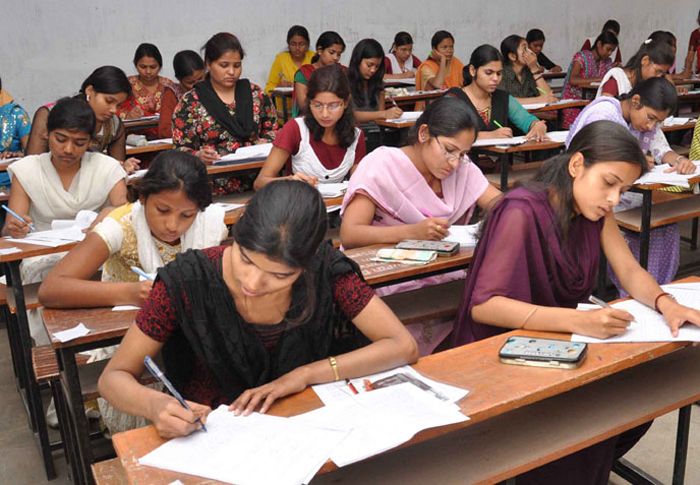
    The Central Board of Secondary Education (CBSE) has cancelled examinations for Class 10 and postponed the one for Class 12. This adds to the uncertainty that had gripped the education sector ever since the pandemic broke out. Add to that the cascading effect it will have on entrance examinations and graduate courses.

    Currently, stakeholders, namely, the higher educational institutions such as colleges and universities, state governments, high courts, students and their parents, and the University Grants Commission (UGC), are also embroiled in the exams dilemma. This has to do with whether exams are to be held or not; and if yes, then in what way? Virtually or physically?

    The Examination Train

    The manifest justification for holding examinations are to test the pupils, award them marks/grades, rank them in an order of ‘merit’, or segregate them as per mediocrity. Away from the rather narrow confines of academics, who cares for marks/grades in the world outside? Hardly an organisation/institution gives any credence to marks awarded by colleges and universities. Public sector and private sector organisations, including the banks, the Union Public Service Commission (UPSC), and what have you, conduct their own examinations/tests to recruit personnel.

    If nobody outside of the academic realm cares for marks/grades and recruiting organisations devise their own way of assessing graduates, why do we go through the examination rigmarole? 

    The only thing they look for is the minimum qualification. Generally, graduation, at the most. Also, they have their own in-house training, orientation/refresher courses or workshops. Significantly, the UPSC has prescribed just graduation as the minimum qualification for the highly-desired and coveted civil services, to recruit personnel for the foreign, administrative and police, and other allied central services.

    Even ardent followers of Mahatma Gandhi who have passionately and zealously travelled in the ‘Third Class’ all through their academic careers, are eligible to appear at the prelims or the CSAT (Civil Services Aptitude Test) that the UPSC conducts. These Gandhians as well as those who have a second class, qualify in large numbers, and are in no way inferior to the self-styled first class passengers of/on our examination trains.

    Cracks and Fissure

    There appears to be hardly any correlation between the marks/grades/class awarded by our colleges and universities and those who get through the CSAT and make it to the civil services. Are there, going by what is obtained above, any chinks in the system that is so highly-skewed in favour of rote-learning, examination-based structure of our educational set-up? Of course, there appear to be multiple cracks and fissures, to say the least.

    Just look at the countless students awarded A+ or O (outstanding) grades, lots having secured 90 to 95 percent at the Master’s level (MA/MSc/MCom) struggling, if not failing, to get through the National Eligibility Test (NET) to become eligible for an assistant professor’s job.

    The UGC, the overarching Big Brother that avidly extends its leash over the state and central universities (also the deemed ones), itself has very little faith in marks/grades awarded by its various constituents. There is ample empirical evidence to uphold the misgivings of the UGC on this count. Just look at the countless students awarded A+ or O (outstanding) grades, lots having secured 90 to 95 percent at the Master’s level (MA/MSc/MCom) struggling, if not failing, to get through the National Eligibility Test (NET) to become eligible for an assistant professor’s job.

    It is another matter that many state governments contrived their own ways to dilute the stronghold of the UGC’s NET by devising alternative routes called SET (State Eligibility Test) and SLET (State Level Eligibility Test), and have succeeded in browbeating the UGC as regards recruitment to teaching posts in state/central universities.

    The Merit Myth

    Years back, the UGC wrote to various universities that those with really high marks at the postgraduate examinations performed abysmally in the NET. Moral of the story is that in spite of the UGC lurking in the background and looking over the shoulder, its affiliated constituents have been happy in dispensing the largesse of grades/marks over-generously. Unfortunately, this is perceived as merit.

    The facade of examinations that has taken generations of students, parents, and society in general, for a ride needs a serious revisit.

    The facade of examinations that has taken generations of students, parents, and society in general, for a ride needs a serious revisit. If nobody, virtually nobody, in the real world outside of the academic realm cares for the marks/grades and classes dished out by our universities, and each recruiting organisation assiduously tests and devises its own way of assessing our graduates and postgraduates (and doctorates too), why do we go through the examination rigmarole?

    Marks to what avail?

    Why not just handover certificates, listing courses/papers taught/learnt and assignments completed. At the end of the required term just make them qualify for the degree sought by them sans the drama staged pertaining to examinations. Some educational institutions, such as the Ducere Global Business School, in Melbourne, Australia, award graduate and postgraduate degrees without exams. It has been pointed out that “assessment is articulated through solution finding, improvisation, interrogation, interaction, integration and imagination — all of which shape change”.

    The agencies interested in employing these candidates have their own manner of assessing them through written, oral and associated tests. That they have been doing, anyway, for years, even to those students who have obtained grade sheets and marks cards testifying that they have been placed in A+, or had 90 to 95 percent and have been rank holders, or have obtained a first class.

    Are we ready and willing to deliberate and debate examinations and allied issues at different levels? For a start we could wake up the UGC to shed its lethargy and set it on an examination reform and course correction path.

    This article was published earlier in www.moneycontrol.com
    Featured Image: thewire.in


  • Sedition Law: Sensitivity and trepidations of the State

    Sedition Law: Sensitivity and trepidations of the State

    This article was published earlier in moneycontrol.com

    A few activists and intellectuals, some of them octogenarians, are in jail for varied periods having been arrested for sedition. A question being asked since then is: can intellectuals and activists who fight for the rights of the deprived, underprivileged and downtrodden be seditious and subversive? The law of sedition is a remnant from the days of colonial rule in India.

    Should the State feel helpless and orphaned if the law of sedition is to be repealed? The fact that for seven decades and more the State has staunchly held on to this law suggests so

    The (British) colonial administration was constantly apprehensive and on tenterhooks that the ‘natives’ (the dominated subjects) would rebel against it in conduct, speech, or action. Hence, the sedition law was introduced through Clause 113 of the Draft Indian Penal Code in 1837 by Thomas Macaulay.

    The colonialists wanted to guard themselves against any kind of protest. Any activity that was unpalatable to the colonialists was conceived of as ‘treason’ and ‘subversion’. In order to maintain an untrammeled stronghold on the populace, the colonial administration thought it essential to promulgate a sedition law; an overarching law to protect what it thought was its sovereignty and suzerainty.

    Interestingly, in the 1860 Indian Penal Code (IPC) the law of sedition was not included. However, due to an ‘increase’ in ‘revolutionary’ activities and ‘unrest’ on the part of the Indian ‘rebels’, in 1870, the British inserted Section 124A and amended the IPC to include the law.

    Suppression and subjugation through draconian measures were resorted to by the foreign power for its political and economic gains and ends, in a system that was tyrannical, authoritarian, and dictatorial, and ran through its course till 1947

    Though the Constitution of India (with its oft-quoted Preamble) was to come a bit later, India did become a sovereign, socialist, democratic republic when it got rid of the colonial yoke. So, how come the Law of Sedition got carried over into a republic that became a free country and a democratic political entity?

    On the one hand, why the need for a law of sedition in a free, sovereign country. On the other hand, a look at the way sedition is being interpreted currently.

    In 1929, Mahatma Gandhi called sedition a “rape of the word law” and asked the people to go in for a countrywide agitation to demand the repeal of Section 124A. He said, “In my humble opinion, every man has a right to hold any opinion he chooses, and to give effect to it also, so long as, in doing so, he does not use physical violence against anybody.”

    Subsequently, after Independence, during the debate on the first amendment to the Indian Constitution in 1951, then Prime Minister Jawaharlal Nehru, called the law of sedition fundamentally unconstitutional and declared “now so far as I am concerned [Section 124A] is highly objectionable and obnoxious and it should have no place both for practical and historical reasons. The sooner we get rid of it the better.”

    Intriguingly, the Law of Sedition was not repealed, as it should have been, ideally, during the first Parliament session itself; and has been retained during Nehru’s government and subsequent governments too.

    Should the State feel helpless and orphaned if the law of sedition is to be repealed? The fact that for seven decades and more the State has staunchly held on to this law suggests so; more so today as during the last nearly seven years the number of times that the State has resorted to the use of this law is disturbing, to say the least. Besides, the State is arming itself with yet another draconian handle in promulgating the Unlawful Activities (Prevention) Amendment Act (UAPA).

    Was there ever such a low in independent India in terms of lack of tolerance on the part of the State? Any sort of criticism against the government seems to automatically get interpreted as anti-national. This manufactured binary — anti-government equals anti-national — has been the dominant credo ever since the Bharatiya Janata Party (BJP) came to power in 2014.

    In a recent article, Amartya Sen says, ‘The confusion between “anti-government” and “anti-national” is typical of autocratic governance’.

    Intellectuals, opposition leaders, activists in different realms, are all swept into the hold-all like sedition law. Also, international voluntary organisations, as also Indian NGOs, have been targeted and attempts are made to stifle them whenever there has been any criticism of the government, however, legitimate or valid the censure be.

    The government’s actions have prompted UN Human Rights Chief Michelle Bachelet to raise issues of a crackdown on CAA protesters, UAPA, Hathras case, and marching orders given to Amnesty International. New Delhi’s response in its lame defence to the criticism has been: ‘The framing of laws is obviously a sovereign prerogative. Violations of law, however, cannot be condoned under the pretext of human rights.’


  • Some Crucial Lessons as we Prepare for ‘Lock Down 3.0’

    Some Crucial Lessons as we Prepare for ‘Lock Down 3.0’

    Category : Democracy & Governance/Public Health
    Title : Some Crucial Lessons as we Prepare for ‘Lockdown 3.0’
    Author : M A Kalam  02-05-2020Covid-19 is a jolt to the way we work and live. India has been under, what IMF has called, “The Great lockdown”. As India moves into ‘Lockdown 3.0’, M A Kalam explores, in his opinion piece, the challenges faced by different segments of the Indian population. The economic impact is seen to be huge, and as we return to work and business gradually, we will witness huge behavioural changes that will necessitate how we address the new economic challenges.

    Read More

  • COVID-19: Coronavirus highlights the class divide in India

    COVID-19: Coronavirus highlights the class divide in India

    It would indeed be revealing, as well as quite embarrassing, particularly for the privileged middle and upper classes, if a survey is undertaken to locate and spot the residential blocks in the different cities of India where the instances of COVID-19 cases have occurred. That will also show how and from where the infection is spreading to other people and other localities. It is not at all difficult to do that; mapping through GIS is an easy exercise

    Needless to say, almost all of these cases surely are in the neighborhoods inhabited by the richer and privileged sections of the society, and most of them are those who have a travel history of having been abroad. After their return they have infected those who have come in contact with them.

    Fine, many of them have been isolated or quarantined, if not actually hospitalised, and as a consequence of the lockdown have the extravagance of ‘work from home’ (it is another matter that post-lockdown the TV viewership has increased sharply). Many of them also have the advantage of drawing their regular, guaranteed salary at the end of the month.

    At the other polar opposite of the class edifice, at the bottom of the pyramid, are the multitude of hapless groups of people, sections of our own society, the ‘others’, who for absolutely no fault of theirs, not to talk of any crime committed, have overnight been thrown out of everything — jobs, wages, shelters, source of income, and the like. This was because a nation-wide lockdown was imposed as a result of the overseas excursions of those at the other end (the upper end) of the class hierarchy.

    Besides the urban homeless and the needy, those who have been made to bear the brunt of this lockdown are the migrant labour who have become, during the last few years, a given in most of our cities and town. These migrant workers (aka ‘guest’ workers) are reluctantly accepted in many places; mainly because they come cheap and the ‘locals’ mostly refrain from doing certain kinds of jobs in the vicinity of their own habitations and locales (they may, however, do more demeaning jobs away from their own dwellings, say in West Asia/Gulf or other overseas contexts). These ‘guests’ are now being thrown to the wolves and the weather.

    As the State had no contingent plan for these migrant labour, an institution-created famine-like situation has arisen due to the starvation that they have been facing. After five days of lockdown the central government woke up to the misery of these souls and directed the state governments and the union territories to provide shelter and food to them. In the interim these people had a choice; either starve to death or risk breaking the physical distance barrier and get susceptible to the virus. Hopefully, now that their plight has been highlighted, things will get better for these ‘guests’.

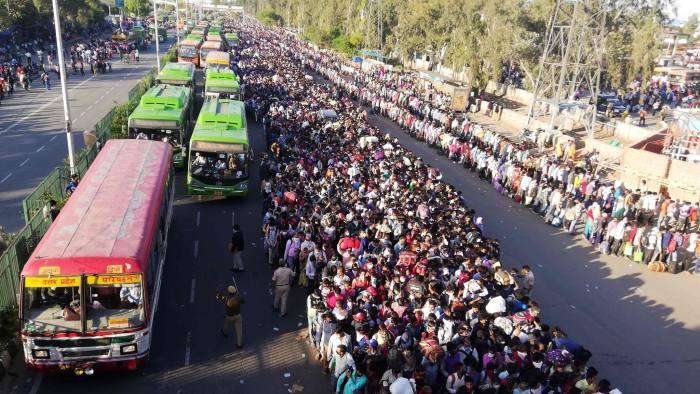
    The luxury of the so-called social distance does not operate in their ambit as lower class habitations as also other allied spaces that pertain to them are extremely dense by definition. Almost all seem to have chosen the option of reaching their respective homes going by the thronging witnessed at bus stops and highway halting points for buses and trucks. However, to no avail as the states in their wisdom have shut all borders for them by suspending all forms of transport.

    During Partition in 1947, people moved due to issues between the two countries. Now the mass movement of people is also because of a partition — a partition between the rich and the poor, within the national borders, across state borders wherein each state is guarding its territory with vehemence. The State has failed utterly on two counts; one, in not anticipating such an event, and second, in not being able to either prevent or combat the movement.

    It is really poignant that the choice is between death by hunger and death by the virus. Given such a choice, the poor feel it is better to die in their native place than in a strange locale. Also, if they do beat starvation death and live, the chances of recovery and survival from the virus appear to be higher even if they are infected. It is death by starvation that is most galling for them as evidenced by empirical responses that are obtained by sources that are interacting with them.

    It is such an unfortunate thing that all crises always seem to impact the poor in the worst negative way possible. Floods, droughts, hurricanes or what have you invariably target the less privileged. It is utterly ironical that the present crisis that has emerged among the upper echelons in India due to Covid-19 too does so.

    It is also pertinent to point out as to how the ilk of the original carriers of the virus, the upper classes, are planning their strategies in combating the absence of their domestics, cooks, drivers as can be ‘seen’ from the debates and dialogue of the resident welfare associations and similar bodies on social media. The dominant narrative is ‘no work, no pay’. Those who say they will pay, are making it sound as if they are achieving martyrdom by their act.

    This article was published earlier by “Moneycontrol

    Views expressed are the author’s own.

    Image Credit: www.ft.com