Author: Vaishnavi K S

  • Elections and Democracy: Germany’s Mixed Member Proportional System

    Elections and Democracy: Germany’s Mixed Member Proportional System

    It is now well-established that the First Past The Post system of elections followed in Indian democracy is thoroughly unsuited to Indian conditions, as it is more feudal and less of democracy. The German mixed system is better suited to India to ensure a more representative system of elections and accountability.   

    When it comes to choosing an electoral formula, the world often takes extreme positions which range between any variant of the Majoritarian System or that of the Proportional Representation. Proportional representation, to a great extent, has been an apt choice for ethnically divided societies with scholars such as Arend Lijphart asserting that it would strengthen the consociational approach in the political system. Yet, it has been criticized for the unstable governments it may produce and its inability to connect a voter with its representative. On the other hand, Majoritarian systems while praised for their simplicity and ability to produce stable governments, lack inclusivity, and induce tactical voting due to wastage of votes. However, the Parliamentary Council of Germany structured a mid-point for the two extremes to meet, which was initially considered provisional but has remained unchanged. It follows the Mixed-Member Proportional System.

    The Mixed-Member Proportional System combines First Past The Post (FPTP) system (Majoritarian System) with Closed-Party List System (Proportional Representation) and thereby, enables the formation of a Government that is inclusive, stable, and remains connected with the voters.

    Understanding how MMP works in Germany
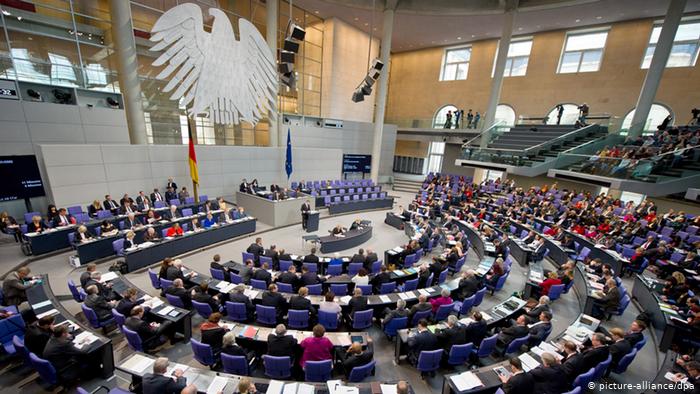
     The Bundestag (the German Parliament), elected for a four-year term, has 598 seats, distributed among the 16 federal states in proportion to the states’ voting population. Out of the 598 seats, 299 seats are filled through the FPTP system and the other 299 through the Closed-Party List System. This means that every voter has two votes on the day of the election: a constituency vote and a party-list vote. The first vote of electors decides the 299 representatives to be elected through the FPTP system, won based on a plurality of votes, and the second vote decides the proportional number of seats each party would get in the national assembly.

    Once the FPTP seats are filled, the second votes are totalled. Those parties that obtained 5% of votes at the national level or have three representatives elected directly through the single-member constituencies are considered for the allocation of PR seats. The PR seats are allotted in proportion to each party’s vote share using the Sainte-Laguë formula.

    The Sainte-Laguë formula divides the parties’ total votes using a series of divisors (i.e., 1,3,5,7,9….) to form a table of averages. The seats are then allotted to the parties with the highest averages in the table.
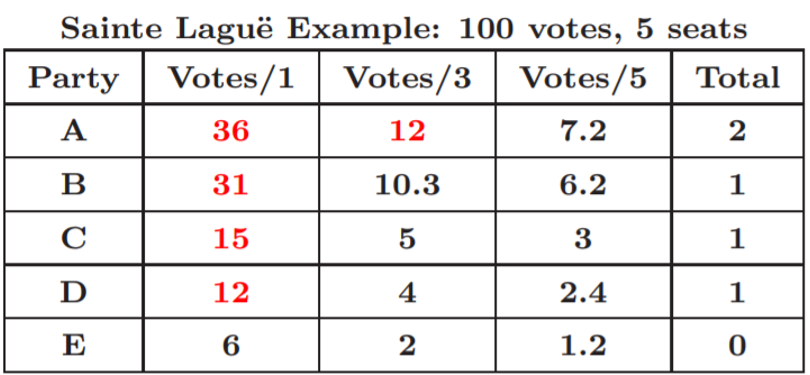
    source: Washington university

    Furthermore, these allotted seats are then subtracted from the respective party’s FPTP seats, and the remaining seats are the actual number of party-list seats allocated in the Bundestag. Often, the number of seats allocated to a party through FPTP is greater than those allocated through the Party List and these surplus seats are then kept by the party leading to an increase in the number of seats in the Bundestag for that governing year.

    Implications of the electoral formula

    • Electoral participation

    Over the years, scholars have suggested that Proportional Representation tends to increase the voter turnout in a country. This is said to stem from the fact that the disproportionality between the number of votes received and seats allotted is significantly lower thereby reducing vote wastage, which encourages more voters to go and vote. Unlike FPTP’s ‘winner takes all’ formula, PR provides a chance to even smaller parties to secure their representation in the legislative council. This encourages their support base to vote and at the same time provides an incentive to the party to not limit their campaigning to specific areas (Blais & Carty, 1990). Germany’s electoral participation was 78.5% in 1949 and escalated to 86%, 87.8%, 86.8%, 91%… in successive elections. The lowest turnout was in 2009 with 70.8% and escalated slightly to 76.2% in 2017.

    • Gallagher index

    The Gallagher index created by Michael Gallagher is a statistical analysis methodology used to measure an electoral system’s relative disproportionality between votes received and seats allotted in a legislature. While countries following the PR system do generally tend to do well, Arend Lijphart points out that the German system, which is a mixed system, does exceedingly well compared to pure PR variants.

    Germany scored an average of 1.95 in the 2017 national elections and has consistently maintained a low average in terms of disproportionality in comparison to others. Their highest average was 7.83 for the year 2013. On the other hand, countries that continue to use FPTP such as Canada, Bangladesh, and India record pretty averages of 12.01 (2015), 21.38 (2001), and 16.06 (2019) respectively.

    • Representation

     PR systems generally enable conditions for a more representative legislative council because political parties no longer restrict their discourse and activities to the interests of the dominant communities, given winning a plurality of votes is no longer a deciding factor in their pursuit to secure a seat in the parliament. This provides an incentive for them to look appealing to a larger voter base.

    Germany has seen a steady increase in the percentage of women representatives in the Parliament, starting from 7% in 1949 to 31% in 2017. The need to encourage ethnic minorities to cast a vote provides an incentive to political parties to field candidates who are non-German in origin, and this has enabled the participation of candidates originating from Turkey, Poland, Austria, Romania, and so on.

    • Effects on the Far-Right

    Lisa Harrison in her paper ‘Maximizing Small Party Potential: The Effects of Electoral System Rules on the Far Right in German Sub-National Elections’ writes that far-right or extremist parties see limited success at the national level elections, but they may play a significant role at the sub-national level elections. A major hindrance that keeps these far-right parties away from the Bundestag is Germany’s minimum threshold of votes policy, which allows only those parties that have won 5% votes or 3 FPTP seats to claim representation in the parliament.

    This however changed in 2017 when Alternative for Germany became the first nationalist far-right party to secure seats in the German Parliament since World War II. They received 12.6% of votes, translating into 94 seats in the Bundestag. The rise of the party coincides with the rise of hate crimes against immigrants. In March 2021, it was reported that Germany’s domestic intelligence forces have kept the party under surveillance on the suspicion of trying to undermine the democratic constitution.

     Conclusion

    Electoral systems don’t come up in a vacuum. Rather, they are selected and implemented within the socio-political conditions of a particular nation. This implies that there is no electoral system that is universally applicable. Depending upon the suitability, countries could either side with the Majoritarian system or the Proportional Representation system or could apply both, as in the case of Germany. Germany’s Mixed-Member Proportional System catered to the needs of a constituent assembly which was divided over the question of an apt electoral system and at the same time has continued to do the two things that the constituent members hoped for, maintain stability and remain inclusive.

    As India enters the 75th year of its independence, and as the world’s largest democracy, its electoral experiences of the last seven decades point to the unsuitability of the present FPTP system. Given the large population and the diversity of India, the FPTP system has proved to be a complete failure. The FPTP system does not truly reflect the principle of “one person one vote”, according to which each ballot should have ‘equal force’ in the sense of the share of seats in the parliament. Indian elections system has resulted in a skewed system of vote-bank politics, endemic corruption, and the feared majoritarian tyranny in the name of democracy.  The German model of a mix of Proportional Representation and the FPTP system is what India needs at this to revive and strengthen its democracy.


    References:

    Gallagher, M., & Mitchell, P. (2008). The Politics of Electoral Systems (Illustrated ed.). Oxford University Press.

    Zittel, T. (2017). Electoral systems in context: Germany. Oxford Handbooks Online. Published.

    https://doi.org/10.1093/oxfordhb/9780190258658.013.37

    https://www.statista.com/statistics/753732/german-elections-voter-turnout/

    https://www.tcd.ie/Political_Science/people/michael_gallagher/ElSystems/Docts/ElectionIndices.pdf

    https://blogs.lse.ac.uk/europpblog/2017/09/21/measuring-the-diversity-of-each-partys-candidates-in-the-german-election/

    https://www.statista.com/statistics/753494/seat-distribution-bundestag-germany/

    https://www.thehindu.com/news/international/how-serious-is-germanys-far-right-problem/article30952770.ece

    https://www.reuters.com/article/us-germany-security-afd-idUSKBN2AV1M3


    Feature Image: angusreid.org
  • How Representative is the Representative Democracy in India?

    How Representative is the Representative Democracy in India?

    India’s transition from an erstwhile British colony to an independent, sovereign state meant, for her people, a change in their status from being mere subjects to citizens bestowed with adult suffrage. The ultimate authority, therefore, now rests with the citizens. India’s large and complex population made it impossible for this authority to be discharged directly and therefore, the citizens elect their ‘representatives.’ This act of electing their representatives is called ‘elections’ and the set of rules that determine how the elections are conducted and the results ascertained is called the ‘electoral system.’ The electoral system adopted by the Constituent Assembly, through the debates on the constitution for the adoption of the parliamentary democracy, is a variant of the majoritarian system known as the ‘First Past The Post System.’ The fundamental principle underlying the system is that for the candidate, to cement his/her electoral victory, does not need a majority of the votes polled, but only a plurality of votes would suffice. The basis for the decision of the Constituent Assembly members to opt for the FPTP system lies in its simplicity and its promise of producing a stable government. Dr. B.R. Ambedkar when speaking in the assembly said, “Now, I have not the least doubt in my mind that whatever else the future government provides for, whether it relieves the people from the wants from which they are suffering now or not, our future government must do one thing, namely, it must maintain a stable government and maintain law and order. I am therefore very hesitant in accepting any system of election which would damage the stability of the government.”

    Legislative bodies aren’t merely law-making authorities, they are mini societies in themselves that reflect and react to the issues plaguing the citizenry at large. Labelling legislative bodies as mini societies emphasizes the fact that the composition of the representatives reflects the diversity of social groups and shades of opinion present within the country. The divisions and prejudices that exist in the Indian subcontinent based on caste, class, and religion were a primary point of reference for the members of the constituent assembly when debating over whether the various provisions of the constitution would be functional in the country. In this sense, the decision to choose the FPTP system over other electoral formulas signifies an attempt to alleviate the fears of the members of a further divided subcontinent. Yet, as we enter the 75th year of our freedom with entrenched unresolved issues, it brings us back to the question that the constituent members struggled with: how efficient and representative is the present electoral formula?

    Loksabha Elections – 2019

    Regional representation

     A post-election analysis by IndiaVotes showed that the two major alliances – National Democratic Alliance and United Progressive Alliance won 45.2% and 27.5% of votes respectively and the rest was shared among parties including All India Trinamool Congress, Yuvajana Sramika Rythu Congress Party, Biju Janata Dal, Bahujan Samaj Party, Telangana Rashtra Samithi and so on. With 45.2% votes, the NDA led by the BJP satisfied the requirements laid down by the FPTP allowing it to take charge of the government formation. However, what the vote percentage implies is that the current regime isn’t exactly a popular choice given more than fifty percent of the voters chose to vote against them. In their paper ‘Minoritarian Rule: How India’s Electoral System Created The Illusion of a BJP Landslide’, Macdonald and Moussavi call India a “minoritarian” democracy wherein ‘ a plurality of voters selects the majority of representatives in Parliament.’

    Furthermore, the success was concentrated within the states of central and western India which includes- Gujarat, Uttar Pradesh, Rajasthan, Madhya Pradesh, Bihar, Chhattisgarh, Maharashtra, and Jharkhand. These are also few of the states with the highest number of Lok Sabha seats- Gujarat (26), Uttar Pradesh (80), Rajasthan (25), Madhya Pradesh (29), Bihar (40), Chhattisgarh (11), Maharashtra (48) and Jharkhand (14). Given how diverse the country is culturally and linguistically, how do we compensate for the lack of the same in the union government?

    Minority representation

     The total minority representation in the 2019 Lok Sabha stands at 9.2%, including Muslims, Christians, Sikhs, and other religious minorities. This means over 90% of the MP’s are Hindus in a country where the minorities make up 19.3% of the total population (Census 2011).

    Kazi Syed Karimuddin when speaking against the efficacy of the FPTP system in the constituent assembly had feared the dilution of minority representation and had said, “Therefore my submission is that the present system as it stands does not guarantee a majority rule as people commonly suppose and does not guarantee a representation to minorities, not necessarily religious, even the political minorities.”  To this Dr. B.R.Ambedkar felt that while the country may not be ready for a complex electoral formula but to ensure minority representation he suggested reserved constituencies for the minorities as an alternative and in this regard, he said, “If any particular minority represented in this House said that it did not want any reservation, then it would be open to the House to remove the name of that particular minority from the provisions of article 292. If any particular minority preferred that although it did not get a cent percent deal, namely, did not get a separate electorate, but that what it has got in the form of reservation of seats is better than having nothing, then I think it would be just and proper that the minority should be permitted to retain what the Constituent Assembly has already given to it.”

    The Constituent Assembly finally decided on reserved constituencies for the communities of Scheduled Castes and Scheduled Tribes only.

    Reserved constituency

     The constitution has reserved 131 out of 543 seats for Scheduled Castes and Scheduled Tribes (84 for SC’s and 47 for ST’s). In the present Lok Sabha out of the 543 MP’s, 138 come from SC/ST communities implying that only 7 MP’s from SC/ST communities have been elected in unreserved constituencies. The situation would have been grimmer had their representation not been secured through reserved constituencies.

    The major loophole in the practice of securing representation through reserved constituencies with the use of FPTP is that it is the Non-SC/ST communities that majorly get to decide who the representative for the SC/ST communities would be. Given SC/ST populations are spread across regions rather than being concentrated in a few, it is then the dominant communities with their muscle and money power that decide on where the votes go. This keeps outspoken and assertive leaders from marginalized communities outside legislative bodies and in a way excludes these communities and their issues from mainstream political discourse. Hence, Macdonald and Moussavi observe, “District boundaries are therefore fundamentally important. Their shape determines the population size and ideological composition of the electorate facing each party.”

    Mainstream political discourse

     With FPTP’s ‘winners take all’ formula, it so happens that political parties restrict their discourse and activities to the interests of the dominant communities as they become the deciding factor in the contestants getting the plurality of votes. Douglas Amy in her paper ‘Proportional Representation: Empowering Minorities or Promoting Balkanization’ says, “The claim that winner-take-all elections are inherently more capable of bridging political divides does not bear up under scrutiny. For example, the requirement that winning candidates appeal to the majority of voters has done little to discourage factionalism. Indeed, it has merely encouraged candidates to attack minority groups to win over the majority.”

    This has not only further marginalized the already marginalized but also hinders the Socio-Economic and Political progress of the country as spaces for discussing “actual” issues shrink and real development can’t be equated to the progress and well-being of a minute population.

    Effect on voters

    Wastage of votes, a definite consequence of the FPTP system as it often discourages voters from turning up to vote. Furthermore, voters indulge in ‘tactical voting’ wherein instead of voting for a candidate/party who aligns with their values and ideals, they end up voting for one of the major parties or the lesser of the two evils whom they think have more chances of winning. In a way, the voter is making no real impact in the making of the government (Singh & Sharma, 2019).

    Conclusion

    The Law Commission, in their reports in the year 1999 and then again in the year 2015, had recommended that the government look into alternative electoral methods and examine how well they’d work out for the country. However, this has remained a recommendation only on paper with governments taking no active interest in the same. Carles Boix in his paper ‘Setting the Rules of the Game: The Choice of Electoral Systems in Advanced Democracies’ (1999) states that “as long as the electoral arena remains the same, and favours the ruling parties, the electoral system is not changed. If there is a change in electoral dynamics due to the coming of new voters or alterations in voter’s preference, then the ruling party reshapes the electoral setup to suit their choices.” Hence, we still do not see electoral reforms being a part of the mainstream political discourse. However, to make our political system more inclusive, diverse, and efficient, it is about time we give electoral reforms a serious thought.


    References

    Amy, D. J. (1995). Proportional Representation: Empowering Minorities or Promoting Balkanization? The Good Society, 5(2).

    Boix, C. (2000). Setting the Rules of the Game: The Choice of Electoral Systems in Advanced Democracies. SSRN Electronic Journal. Published. https://doi.org/10.2139/ssrn.159213

    Macdonald, G., & Moussavi, B. (2015). Minoritarian Rule: How India’s Electoral System Created The Illusion of a BJP Landslide. Economic and Political Weekly. Published.

    https://www.constitutionofindia.net/constitution_assembly_debates/volume/7/1949-01-04?paragraph_number=186%2C185%2C12%2C176%2C33%2C189%2C170%2C11%2C7%2C5%2C215%2C196%2C195%2C180%2C179%2C177%2C172%2C122%2C102%2C99%2C98%2C97%2C58%2C57%2C54%2C34%2C6%2C4

    https://www.indiavotes.com/alliance/partyWise/17

    https://scroll.in/latest/924583/elections-2019-bjp-alone-got-more-than-half-the-votes-in-13-states-and-union-territories

    https://en.wikipedia.org/wiki/List_of_constituencies_of_the_Lok_Sabha

    https://www.hindustantimes.com/lok-sabha-elections/from-faith-to-gender-and-profession-to-caste-a-profile-of-the-17th-lok-sabha/story-Mnp5M4pRX3aUji1UFFVy2N.html

    https://www.minorityaffairs.gov.in/sites/default/files/MsDP%20%28FAQs%29.pdf

    https://www.indiaspend.com/governance/reservation-scheduled-castes-tribes-representation-social-justice-755256

    https://theprint.in/opinion/17th-lok-sabha-looks-set-to-confirm-ambedkars-fears-no-vocal-dalits-in-parliament/232383/


    Image Credit: www.aa.com.tr