Author: Benolin Kannadasan

  • The Gated Republic: India’s Public Policy Failures and Private Solutions

    The Gated Republic: India’s Public Policy Failures and Private Solutions

    Book Review
     
    The Gated Republic: India’s Public Policy Failures and Private Solutions
    Author: Shankkar Aiyar
    Publisher:  Harper Collins India
    Date: 01 September 2020
     

    India has always been statist. All its political parties are Statist in one way or the other; from Jawaharlal Nehru to Narendra Modi, the State has been thought of as the most important player in economic and social affairs. However, even with all this undue importance, the Indian State has failed to deliver even basic goods to its citizens in more than seventy years since independence. Political journalist and author Shankkar Aiyar analyses these government failures and explores the private solutions offered for such problems in his new book The Gated Republic: India’s Public Policy Failures and Private Solutions.

    Without engaging in the debate on how small or big a government should be, the author asserts that providing basic amenities is a moral obligation of the State to its citizens. The basic amenities namely Water, Health, Education, Power and Security are the titles of the chapters where he analyses issues surrounding each one of them individually. The issues are well researched, and every argument is substantiated with facts, so much so that one might find the sheer number of facts overwhelming.

    Shankkar Aiyar, however, does not stop with just facts, he gives us anecdotal stories on how failed government policies affect real people. And disproportionately such affected people are poor. Aiyar argues that this is because ‘those who can find solutions- where they find them and when they can pay for them- have already migrated to private solutions. Two conclusions can be deduced from this analysis. One, the poor are left out without even basic amenities of life, thereby increasing inequality. And two, the people who can pay for private solutions are ‘paying for services they have already been taxed for’. Either way, the author argues that the government has let down its citizenry.

    The fact that there is a rationed hourly quota for water in Mawsynram, the region of the highest rainfall in India and that even after seventy-three years after independence, less than 50% of class V students can read class II level text is a testament to the magnitude of the failures of the government.

    The State is, however, not ignorant of these issues. ‘Every decade saw a new committee’ and Aiyar lists out all of them from various sectors, sometimes even from the British period. In public policy, it is said that what gets measured gets managed but even with so many committees, there have not been desirable improvements. The fact that there is a rationed hourly quota for water in Mawsynram, the region of the highest rainfall in India and that even after seventy-three years after independence, less than 50% of class V students can read class II level text is a testament to the magnitude of the failures of the government. It is not that the government is not doing anything, but this dire situation is the result of sloth-like bureaucracy and something Aiyar calls the ‘announcement approach’ of the politicians. Aiyar argues that successive governments have stopped themselves with lucrative announcements and rebranding of old schemes with new slogans instead of rectifying ill-thought-out policies. For example, he talks about the Accelerated Rural Water Supply Program (ARWSP) which was introduced in 1973. Through the years it has gone through different transitions from being included in the twenty point program during the emergency to Technology Mission on Drinking Water in 1986, Rajiv Gandhi National Drinking Water Mission in 1992, becoming a separate Department of Drinking Water under Ministry of Rural Development in 1999, morphing into the Department of Drinking Water and Sanitation in 2010 and finally becoming Drinking Water and Sanitation Ministry in 2011. Now the ministry is renamed as the Ministry of Jal Shakthi. Even after all these measures, clean piped water is still a distant dream to many Indians.

    In a democracy, incompetent policies and politicians should be punished in the polls but Aiyar argues that there is a ‘divorce of authority from accountability’. He does not dwell too deep into why such a gap between government failures and electoral politics exists because the question, although imminent to understand this state of affairs, is beyond the scope of the book. However, he points out at various places in the book where such a gap exists and how ‘normal’ it has come to be. For example, the use of tanker lorries by the governments to ferry and provide water to its citizens is a shift from the actual problem of the lack of capacity to provide piped water. And the fact that water tankers are a ‘normal’ in reality is a testament to how public policy failures are divorced from electoral politics.

    Although people have not kept the State accountable, they have come up with solutions to address government failures on their own. There is an opinion echoed by many others that in India that problems are solved not by the government but despite the government. Aiyar explores so many places where the above statement holds. We get to know about ‘Bisleri’, the first bottled water and how its name evolved, the story of Apollo group of hospitals, many budget private schools and teaching fellowships, the ubiquity of inverters, private security firms who grossly outnumber police force 83:17 and so on. Each private solution is the result of incompetent government services and inefficient public policies. Aiyar dives deep into how the solutions came to be and how it has helped normal people. Take, for example, the power sector. Even though India is the world’s third-largest electricity producer, not every household has electricity. And inverters, diesel and battery, have made a huge impact on households. So much so that, in 2011, the sixty-eighth National Sample Survey (NSS) report created a new entry for inverters in household consumption of goods and services. Aiyar discusses many other problems and their private solutions in the book.

    What is interesting is that people, even poor people, prefer private solutions though it is costlier. For example, the author points out that about ‘78% of rural and 81% of urban Indians’ preferred private hospitals. This shows a lack of faith in government services. These are the symptoms of decades of ill-thought-out public policies that do not address the root cause of the issue.

    What is even more interesting is that now, these private solutions are rebranded as government initiatives. The Adoption of water purifiers and dispensers in government offices and public places is an example of such rebranding. More recently, NEET coaching classes by government schools in Tamilnadu can also be boxed into that category. While both measures are desirable, they are only short-time fixes that address the symptoms of government failure. Through these measures, the author argues that the tragedy of the issue is lost, and the irony is ignored.

    the book paints a rather gloomy picture of the state of affairs where people are exiting from government services for private solutions. Although this ‘exodus’ is natural for rich people, abject government failures are pushing everyone into private solutions irrespective of affordability.

    To summarize, the book paints a rather gloomy picture of the state of affairs where people are exiting from government services for private solutions. Although this ‘exodus’ is natural for rich people, abject government failures are pushing everyone into private solutions irrespective of affordability. The book argues that people are assembling themselves into gated communities where these failures of government policies are taken care of by private solutions. The author has accomplished what he has set out to do- to show us in a platter, the sorry state of public policies and the many failures that it begot. It remains for the civil servants, politicians and the voting citizens on what their line of action will be.
  • Poor Economics: Rethinking Poverty & The Ways To End It

    Poor Economics: Rethinking Poverty & The Ways To End It

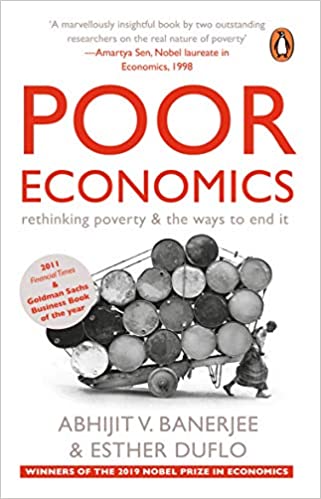
    I finished Poor Economics: Rethinking Poverty & the Ways to End it, by Nobel laureates Abhijit Banerjee and Esther Duflo, this past week. Before getting on with the review, it must be said that this is an old book written almost a decade ago. A few suggestions made in the book are now being implemented as government schemes and others by private enterprises. Nevertheless, the book stands the test of time because of its focus on the fundamental approach on how to think about poverty and the factors that help sustain it.

    While the extremes are always loud, the truth mostly lies somewhere in between or somewhere that is unrelated to the needless binary. The authors understand this and try to stay away from the one-size-fits-all arguments to bring people out of poverty. Instead, they try to find solutions on a case by case basis, researching the problem on the ground and coming up with specialized and localized solutions. This problem solving is achieved with the help of the numerous Randomized Control Trials (RCTs) that have been done in eighteen countries of the developing world including India, Indonesia and countries in Sub-Saharan Africa.

    The book contains ten chapters divided into two sections, namely Private Lives and Institutions. In private lives, the authors dwell on the private problems of poor people including immunization, nutrition, education and so on. And in Institutions, they deal with social institutions of credit facilities, entrepreneurship and the politics of policymaking, which the authors feel, has a tremendous impact on the private lives of the poor.


    Early on, they introduce two graphs namely the ‘S-shaped’ graph and the ‘inverted L-shaped’ graph. The S-shaped graph represents a world with a poverty trap which the poor will not be able to get out of unless there is an intervention, through government or foreign aid.

    On the other hand, the inverted L-shaped graph represents the worldview which does not believe such a poverty trap exists. This graph posits that there is potential for growth if liberty and markets are allowed to flourish. And that foreign aid will only act as an incentive for the corrupt governments of poor countries to not provide free markets for their people.

    Although the book goes on to deal with other problems dealing with poverty, the running theme of the book is the examination of these two graphs with real-life problems faced by the poor. The readers might find themselves marking ‘S’ or ‘L’ on their book at various places (unless you’re a puritan who does not mark their book, in that case, at least you would think of ‘S’ or ‘L’). The authors argue that while there are problems where a poverty trap is obvious, there are also areas where there is no trap per se and therefore even well-intentioned interventions can prove to be counterproductive. They substantiate their claims with an eighteen-country data set which they have collected over the years through field research.

    To really answer the question of whether there are poverty traps, we need to know whether the real world is better represented by one graph, or by the other. And we need to make this assessment case by case

    The authors tell us stories of Pak Sudarno’s big family of nine children, Ibu Tina’s woes due to a robbery, Jennifer Auma’s saving method and so on. These identified lives help the reader understand the decision-making process of the poor; for example, why a poor family spends money on ‘rich food’ rather than spending money on nutrient-rich food even though their children are malnourished, or why a fruit vendor drinks an extra tea even when he is aware that saving money would mean less high- interest debt. The book goes on to provide insights on various problems including the lack of self-control, poor’s relationship with risk-taking, the present bias leading to undesirable future repercussions and so on.

    Although there is no one silver bullet to rid the poor of all their problems, the authors argue that they ‘do know a number of things about how to improve the lives of the poor’. They give us five key lessons to understand the poor better. One, they believe there is a market failure of asymmetric information wherein the poor ‘often lack critical pieces of information’. Two, the poor are responsible for too many aspects of their life; for example, think of drinking water- a poor person has to decide if he has to use chlorine in water as opposed to a richer person for whom clean water is made available by other people, therefore less decision making. Psychological researches say that the quality of the decision erodes if we have to decide so many things (thus successful geniuses and trademark attire).

    Three, there are ‘good reasons that some markets are missing for the poor or that they face unfavourable prices’, for example, the poor pay higher rates on their loans. Four, the failures in a poor country have less to do with ‘some grand conspiracy of the elites’ to maintain the status quo and more to do with avoidable flaws in the designing of public policies. And finally, five, a vicious circle of low expectations and low growth.

    To make use of these lessons, there has to be dynamic politics willing to get rid of the societal sin of absolute poverty. But the authors argue that politics and governments are, unfortunately, infested with what they call ‘three Is’- Ideology, Ignorance and Inertia. Nevertheless, the authors believe that good policies will help realise good politics. Although one could understand the pragmatism and the optimistic hue of such an argument, bad politics should not be underestimated. Bad politics could stagnate even good policies and create even further problems.

    The authors understand the complex issues of poverty and know that there is ‘no lever guaranteed’ to eradicate it. Therefore, they bank on small changes to bring about big effects, for example, one additional year of deworming for kids in Kenya brought about a 20 per cent increase in income when they became adults. In a sense, the book works itself through small steps to bring an understanding of the poor into mainstream policymaking. But as the authors acknowledge, fighting poverty is not a sprint, it is a marathon, one that is worth running. They are willing to commit to the marathon, but will governments of the developing world show such commitment? Such suspicion should last until absolute poverty is completely eradicated.

  • The DNA Bill And State Capacity

    The DNA Bill And State Capacity

    Aristotle suggested that transmission of heredity was essentially the transmission of information. And this information was used to build an organism from scratch inside the female womb. Although the science is primitive, he was right in how information is transmitted from parents to their offspring. Modern genetics is built on studying such information, which has been coded into each cell as DNA. Scientists can now sequence the DNA and extract valuable information about each individual and the human species. They have been able to use such information to understand humans better; for example, the identification of BRCA mutation responsible for cancer has nudged great strides in cancer biology. Another important application which has varied implications in society is the use of DNA in forensics. Although already in use since its discovery in 1995, the exponential rise in the significance of information extracted using DNA Profiling warrants regulation.

    All major nations which use DNA Profiling have legislation in place to regulate the use of the technology. However, in India, the technology is unregulated even though successive governments have worked on such legislation since 2003.

    DNA Technology Bill

    All major nations which use DNA Profiling have legislation in place to regulate the use of the technology. However, in India, the technology is unregulated even though successive governments have worked on such legislation since 2003. If global examples are not enough, the 2017 Puttaswamy judgement has made such legislation necessary. The judgement asserted that privacy is a fundamental right guaranteed by the Indian Constitution and that the right to privacy includes protection over the physical body. Therefore, for the State to collect or store DNA data, a legislative mechanism principled on necessity and proportionality is requisite.

    DNA testing is being done on a very limited scale in India. About 30-40 DNA experts are working in 15-18 laboratories. They can process only about 2-3% of the total need, and even such limited testing is unregulated and unmonitored. According to the NCRB data for 2018, although 85% of rape accused have been charge-sheeted, the conviction rate for rape is just 27.2%. This technology, however, has an excellent record of increasing conviction rates; for example, a 2006 UK parliamentary report suggested that detection of crime increased from a mere 26% to a healthy 40% after they loaded DNA samples into a national database. Apart from crime detection, the technology will also help in the identification of over six million missing persons in India. Thus, legislation facilitating DNA technology to help expedite justice is long overdue.

    The DNA Technology (Use and Application) Bill 2019 is the latest form of the DNA bill and is at the parliamentary committee stage for further deliberations. The bill talks of a national DNA data bank and a DNA regulatory board to store DNA data and regulate DNA technology used in criminal and civil cases. The bill in its current form has raised many concerns including privacy issues concerning the use of DNA data, the ‘perfunctory consent’ clause which makes it hard for an individual to deny permission to collect his/her data, ethical issues in collecting and storing DNA data in DNA banks, the fear of caste-based criminal profiling because of the endogamous nature of Indian society and so on. But the biggest concern is one of state capacity, which in a way umbrellas other concerns.

    The bill in its current form has raised many concerns including privacy issues concerning the use of DNA data, the ‘perfunctory consent’ clause which makes it hard for an individual to deny permission to collect his/her data, ethical issues in collecting and storing DNA data in DNA banks, the fear of caste-based criminal profiling because of the endogamous nature of Indian society and so on.

    Problems with State Capacity

    In young nations like India, the State, although large and bloated, is not highly efficient. This may cause even government interventions with noble intentions to backfire. Therefore, it is necessary to identify places where a lack of state capacity could cause worry for the legislation to work effectively.

    We could sum three basic concerns up from the DNA Technology bill concerning state capacity. First, the high cost of technology and the lack of basic technical training regarding data collection in a crime scene. Second, the backlog burden in the Justice system. And finally, the lack of clarity in the bill as to what is being collected and stored.

    The India Justice Report 2019 published by Tata Trusts reveal important information on the Justice system in India. Over the last five years, only 6.4% of the police force has been provided in-service training. For advanced technology like DNA fingerprinting, frontline police should have basic training and knowledge of the technology. It starts with how to read and deal with the crime scene. And without awareness, the technology cannot be exploited desirably. To go from training 6.4% to at least half the police force will be a herculean task which should be contemplated before implementing the legislation. The DNA bill gives the responsibility of developing training modules to the DNA Regulatory Board, which will be set up. But it does not provide a realistic road map to reach the desired level of training to better use the technology.

    The report also suggests that on average, per capita police spending in 2017 was Rs 820. No big or medium-sized state has spent more than Rupees 1160 per person, and Bihar has spent as low as Rupees 498. Only one state has made 100% use of the modernization funds allocated for capital expenditure and technology up-gradation. But DNA fingerprinting technology is a costly affair. Each test could cost as much as Rupees 10,000. Even if only high-profile cases use DNA tests, a robust database of DNA has to be present for effective identification from the three indices mentioned in the bill. And such collection and storage of DNA samples could become another strain in the public exchequer. The bill also mandates the use of DNA testing for criminal as well as civil cases, which could again flood the system.

    Second, DNA technology could increase the backlog burden of the already burdened system. In the US, with relatively strong state capacity, DNA backlogs are in the thousands. The National Institute of Justice (USA) reports that the current backlog of rape and homicide cases is 350,000. It also estimates that there are ‘between 500,000 to 1 million convicted offenders’ samples that are owed but not yet collected’. The FBI has a backlog of approximately 18,000 convicted offender samples. Therefore, in India with an already strained Justice system, DNA backlogs could cause worry. Also, because of the significance of DNA information, backlogs could also invoke privacy concerns.

    Finally, there is a lack of clarity. This concern, however, is not one of lack of state capacity but one of potential overreach by the State.

    The lack of strong data protection legislation in place couples such concern. As the parliamentary committee suggests, the bill can also be termed ‘premature’ regarding data protection.

    Non-coding DNA is used for identification. The bill, however, does not restrict DNA Profiling to only use non-coding DNA which cannot be used for determining personal and medical characteristics. Given that the bill mandates data from all criminal and civil cases to be stored in the National data bank, concerns of privacy impingement cannot be hushed away. The lack of strong data protection legislation in place couples such concern. As the parliamentary committee suggests, the bill can also be termed ‘premature’ regarding data protection.

    Although the bill is creating a strict code of ethics regarding collection, storage and accessibility of DNA information, it is ambiguous on the removal of data. Clause 31(3) says that DNA data will be removed if a person requested in writing to the DNA bank, given that such a person is ‘neither an offender nor a suspect or an under-trial’ and whose DNA information has entered the bank ‘through crime scene index or missing persons’ index’. But it is not clear on what will happen if they do not remove such data. It is important to answer these questions due to the significance of DNA information and the fact that the bill does not restrict banks to store only non-coding DNA. Also, these questions could raise concerns about state capacity in safeguarding important data of its citizens.

    Conclusion

    To address these concerns, building state capacity is the key. A staggered implementation of DNA technology could help in building capacity and credibility for the technology. For example, if the bill provides a roadmap of implementation- say, starting with addressing the identification of missing persons and further developing capacity for criminal and civil investigation, the allocation of resources could be streamlined. This limited implementation could also help in addressing additional issues that could arise during implementation. These details cannot be let out to be decided by a regulatory body because of the importance of DNA data and the breach of fundamental rights in collecting and storing it.

    It is said that one has to cross the river by feeling the stones. The stable rule of law and a robust data protection regime which will make sure the technology is used judicially are basic requisites for technology with societal implications. Even though DNA profiling has huge potential to expedite justice, implementation of such complex technology has to be step by step. The Parliamentary Committee on Science and Technology has been scrutinizing the bill rigorously, contemplating the varied problems that might befall the implementation of the bill. But it remains to be seen if the government will heed to such advice and not dismiss them altogether; that is if it will feel the stones or deep dive into the river without contemplating the consequences.

     
    Image Credit: DNA Helix Material – Gerd Altmann from Pixabay

  • Vocal about Local: Empowering local Governance Structures to deal with the Pandemic

    Vocal about Local: Empowering local Governance Structures to deal with the Pandemic

    Urban centres in times of the Pandemic 

    India is a rapidly urbanizing state. The 2011 census estimates that 31% of Indians live in urban areas. It counts 4041 statutory towns, 3892 census towns and 474 urban agglomerations as urban areas. These numbers however are quite outdated in 2020 and also there is considerable consensus among experts that there is an underestimation of urban spaces owing to the outdated definition of ‘urban’ in India. For example, the Joint Research Centre (JRC) of the European Commission, based on satellite data, reports that at least 54% of India’s population lived in cities or large urban areas in 2015 and the World bank using the Agglomeration Index finds out that 55.3% of India’s population lived in urban-like spaces in 2010. Regardless, the fact remains that these urban spaces should be governed democratically with the spirit of the 74th amendment. The COVID-19 situation further reasserts the importance of such governments and their role in Indian society.

    Cities and urban spaces have emerged as hotspots of the Coronavirus. It is from the cities that the coronavirus subsequently spread to other rural areas.

    Cities and urban spaces have emerged as hotspots of the Coronavirus. It is from the cities that the coronavirus subsequently spread to other rural areas. Throughout history, pandemics have originated and perpetuated from cities, therefore it is not irrational to predict another pandemic perpetuated from cities in today’s close-knit global village. This warrants a greater need to safeguard the cities which are the essential links that connect nation states to the globalized world. The first step in this direction would be to empower urban governments for efficient crisis management and prevention of communicable diseases by assuring basic public goods.

    Subsidiarity

    The principle of subsidiarity advises that the Central authority should have a subsidiary function, performing only those tasks which cannot be performed at a more local level. The principle therefore asserts the sovereignty of the citizen in a democracy and places her at the center of decision making.

    In line with the principle, everything that can be done better locally, including providing basic services like safe drinking water and ensuring public goods like clean air, should be done by the local governments. The rationale being that, one, it increases efficiency and promotes self-reliance; two, it provides legitimacy to democracy and three, it creates awareness among people and develops responsible citizens. And another obvious reason is that it is most effective in understanding the local problems and in ensuring a pragmatic feedback loop.

    All these reasons become much more clearer in times of crisis such as the Covid-19 pandemic when local assessment and rapid service delivery become difficult. Urban Local Bodies (ULBs) neither have properly delineated functions to perform nor do they have the finances to do so. The 12th schedule of the Indian Constitution lists a group of 18 subjects on which the local governments can act upon, but only if the States ‘may’ wish to assign those functions by virtue of another State legislation. Even when legislated, States usually encroach into the domain of the purview of the local governments.

    The Veerappa Moily commission’s sixth report dealing with local governance sums it up perfectly.
    “Confusion, unnecessary duplication, inefficiency, wastage of funds, poor outputs and outcomes are the result of this organisational jungle. The local organisations which should be the ones most directly and fully concerned are at best treated as a small part of the implementation, occasionally consulted but, in most cases, by-passed and ignored”.

    Furthermore, the establishment of parastatals has reduced the functions of the local governments. The Parastatals perform specific functions which are supposed to be performed by ULBs and are accountable only to the State government thereby circumventing the ULBs. In addition, the Union government also takes a share of the implementation space with centrally sponsored schemes thereby making proper delineation of powers impossible for ULBs.

    The Veerappa Moily commission’s sixth report dealing with local governance sums it up perfectly.
    “Confusion, unnecessary duplication, inefficiency, wastage of funds, poor outputs and outcomes are the result of this organisational jungle. The local organisations which should be the ones most directly and fully concerned are at best treated as a small part of the implementation, occasionally consulted but, in most cases, by-passed and ignored”.

    Now, when experts ask for decentralized governance to efficiently deal with the pandemic and to decentralize decision-making regarding lockdown measures, all they get is a dysfunctional organisation jungle where local governments do not have the wherewithal to function as self-governing institutions.

    Disaster Risk Reduction

    Strong local governments are of great importance, especially during disasters and pandemics. Experts suggest that a sound bottom-up governance approach has been more successful in the wake of disaster response. For instance, in a UNDP study on disaster risk reduction in Bangladesh, they point out the importance of local governance.

    The report suggests that local governments are crucial because they ‘play the greatest role in sustaining ongoing, participatory disaster risk reduction at local community level’. The report goes on to summarize that the key lesson learnt from the study is that decentralization of authority and decision making is essential to effectively deal with the disaster.
    “Decentralization of authority to local governments is vital to ensure local ownership of disaster risk reduction and the local implementation of the Hyogo Framework for Action. Local authorities should have the responsibility of implementing disaster risk reduction, and be accountable to the community they represent in doing so”.

    Much has been written about why governments closer to the people are more effective but what is equally important is that when decision making is decentralized, citizen satisfaction and responsibility is increased (for example, see this study done in Indonesia). This becomes important in times of the Covid-19 pandemic where individual responsibility is necessary to stop the spread of the virus. Also with lives and livelihoods pitted against each other, citizen satisfaction is important to make hard decisions which might deter personal freedom in the short term.

    Considering all this, the National Disaster Management Act, 2005, which was used by the Union government to impose lockdown measures, seems to lack the involvement of local governments in disaster risk reduction. V N Alok in his article for the Financial Express, deals with this complaint. He argues that there is only a passing reference to local government in the Act and even when referenced, functions are mostly subsidiary to the District authority headed by the Collector/Magistrate which is controlled by the State government. On the other hand, there is no ambiguity in assigning functions to the State and Union governments.

    India is often referred to as the ‘flailing state’, which is strong and sound in the centre, with no reliability at the grass-roots. Local governments can provide the missing link that could hinge the State to the people.

    This again echoes Veerappa Moily Commission’s concern that there is no proper delineation of powers for the local governments. Article 243 N and 243 ZF mandated that all laws inconsistent with parts IX and X of the Indian constitution shall be changed accordingly within a year of passing the 73rd and 74th Amendments. But most States have still not identified and changed all statutes conforming to the idea that local governments are self-governing institutions. This shows India’s hesitation to look at local governments as self-governing institutions capable of dealing with problems.

    India is often referred to as the ‘flailing state’, which is strong and sound in the centre, with no reliability at the grass-roots. Local governments can provide the missing link that could hinge the State to the people.

    Its importance is felt during the pandemic more so than ever, especially in cities where the institution is weak compared to rural India. An integrated approach, with involvement from the local government, would prove to be more effective than centralized decision making. But before relying on ULBs and locally elected leaders, they have to be empowered-politically, functionally and financially. The first step towards such empowerment could be by including local governments in conversations regarding governance and decision making; to be more vocal about local governments.