Author: Abraham (Avi) Loeb

  • Our Nearest Neighbours

    Our Nearest Neighbours

    In anticipation of a holiday gift, I kept asking members of my research team every week whether they noticed any anomalous object among the nearly hundred thousand objects imaged by the Galileo Project Observatory at Harvard University over the past couple of months. The reason is simple.

    Finding a package from a neighbour among familiar rocks in our backyard is an exciting event. So is the discovery of a technological object near Earth that was sent from an exoplanet. It raises the question: which exoplanet? As a follow-up on such a finding, we could search for signals coming from any potential senders, starting from the nearest houses on our cosmic street.
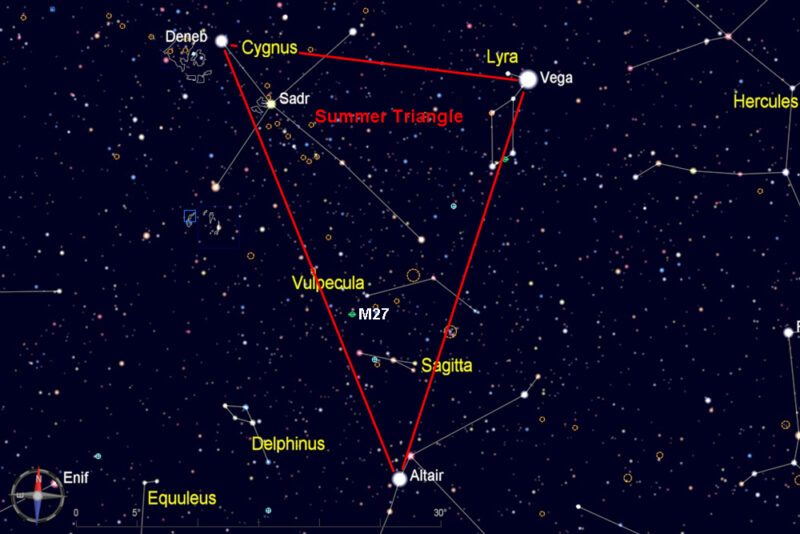
    Summer Triangle, which consists of the three of the brightest stars in the sky–Vega, Deneb, and Altair. The Summer Triangle is high overhead throughout the summer, and it sinks lower in the west as fall progresses. For this star hop, start from brilliant blue-white Vega (magnitude 0), the brightest of the three stars of the Summer Triangle.
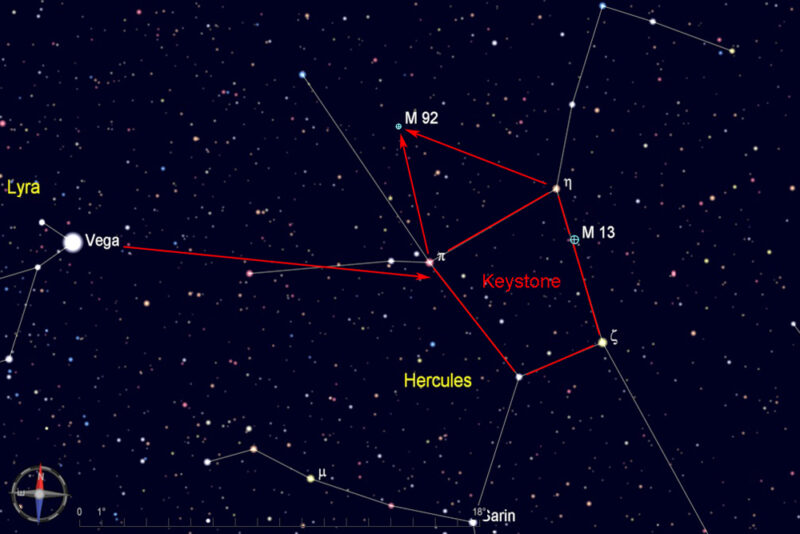
    From Vega, look about 15 degrees west for the distinctive 4-sided figure in the centre of Hercules known as the keystone. On the north side of the keystone, imagine a triangle pointing to the north, with the tip of the triangle slightly shifted toward Vega (as shown in the chart below). This is the location of M92.

    The opportunity for a two-way communication with another civilization during our lifetime is limited to a distance of about thirty light years. How many exoplanets reside in the habitable zone of their host star? This zone corresponds to a separation where liquid water could exist on the surface of an Earth-mass rock with an atmosphere. Also known as the Goldilocks’ zone, this is the separation where the temperature is just right, not too cold for liquid water to solidify into ice, and not too hot for liquid water to vaporize.

    So far, we know of a dozen habitable exoplanets within thirty light years (abbreviated hereafter as `ly’) from Earth. The nearest among them is Proxima Centauri b, at a distance of 4.25 ly. Farther away are Ross 128b at 11 ly; GJ 1061c and d at 11.98 ly, Luyten’s Star b at 12.25 ly, Teegarden’s Star b and c at 12.5 ly, Wolf 1061c at 14 ly, GJ 1002b and c at 15.8 ly, Gliese 229Ac at 18.8 ly, and planet c of Gliese 667 C at 23.6 ly. These confirmed planets have an orbital period that ranges between a week to a month, much shorter than a year because their star is fainter than the Sun. This list must be incomplete because two-thirds of the count is within a distance of 15 ly whereas the volume out to 30 ly is 8 times bigger. Given that the nearest habitable Earth-mass exoplanet is at 4.25 ly, there should be of order four hundred similar planets within 30 ly. We are only aware of a few per cent of them.

    But even if we identified all the nearby candidate planets for a two-way conversation, they would constitute a tiny fraction of the tens of billions of habitable planets within the Milky Way galaxy. Having any of the nearby candidates host a communicating civilization would imply statistically an unreasonably large population of transmitting civilizations for SETI surveys.

    Most likely, any visiting probe we encounter had originated tens of thousands of light-years away. In that case, we will not be able to converse with the senders during our lifetime. Instead, we will need to infer their qualities from their probes, similarly to the prisoners in Plato’s Allegory of the Cave, who attempt to infer the nature of objects behind them based on the shadows they cast on the cave walls.

    It is better not to imagine your neighbours before meeting them because they might be very different than anticipated. My colleague Ed Turner from Princeton University, used to say that the more time he spends in Japan, the less he understands the Japanese culture. According to Ed, visiting Japan is the closest he ever got to meeting extraterrestrials. My view is that an actual encounter with aliens or their products would be far stranger than anything we find on Earth.

    Personally, I am inspired by the stars because they might be home to neighbours from whom we can learn. The stars in the sky look like festive lights on a Christmas tree which lasts billions of years. A few days ago, a woman coordinated dinner with me as a holiday gift to her husband, who follows my work. At the end of dinner, they gave me a large collection of exceptional Japanese chocolates, which I will explore soon. In return, I autographed my two recent books on extraterrestrials for their kids with the hope that they would inherit my fascination with the stars.

    Here’s hoping that our children will have the opportunity to correspond with the senders of an anomalous object near Earth. During this holiday season, I wish for a Messianic age of peace and prosperity for all earthlings as a result of the encounter with this gift.


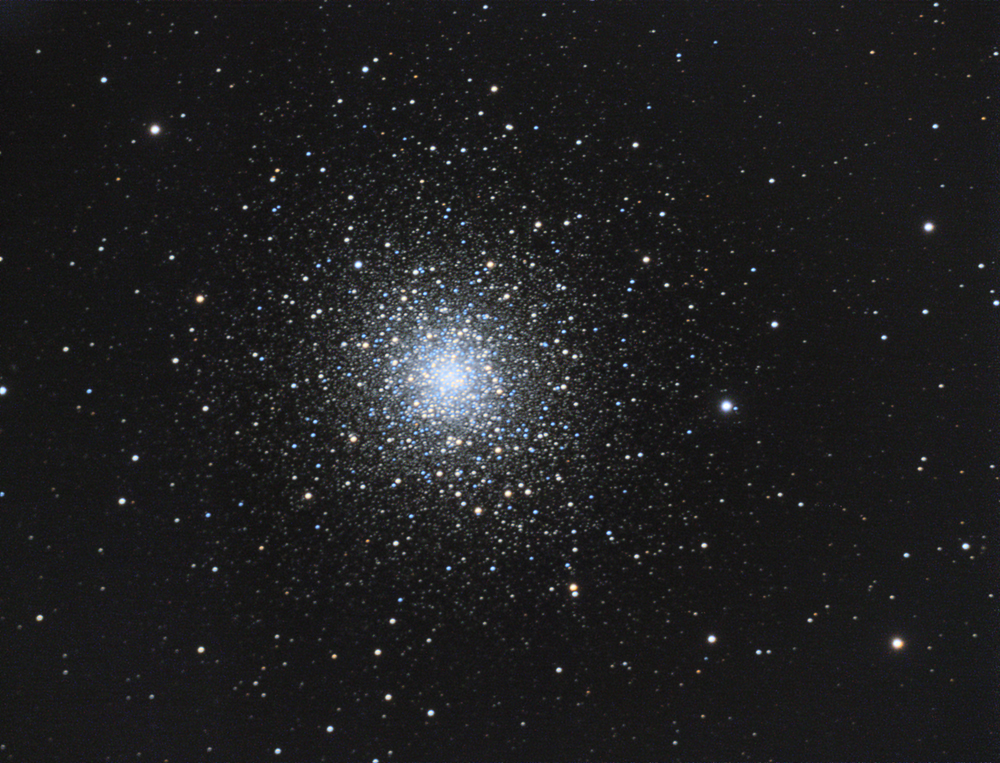
    Feature Image Credit: Messier 92 is one of two beautiful globular clusters in Hercules, the other being the famous M13. Although M92 is not quite as large and bright as M13, it is still an excellent sight in a medium to large telescope, and it should not be overlooked. The cluster is about 27,000 light years away and contains several hundred thousand stars. www.skyledge.net

    Other Two Pictures in Text: www.skyledge.net

    This article was published earlier in medium.com
  • The First Cosmic Bits that were Caught in Webb’s Web

    The First Cosmic Bits that were Caught in Webb’s Web

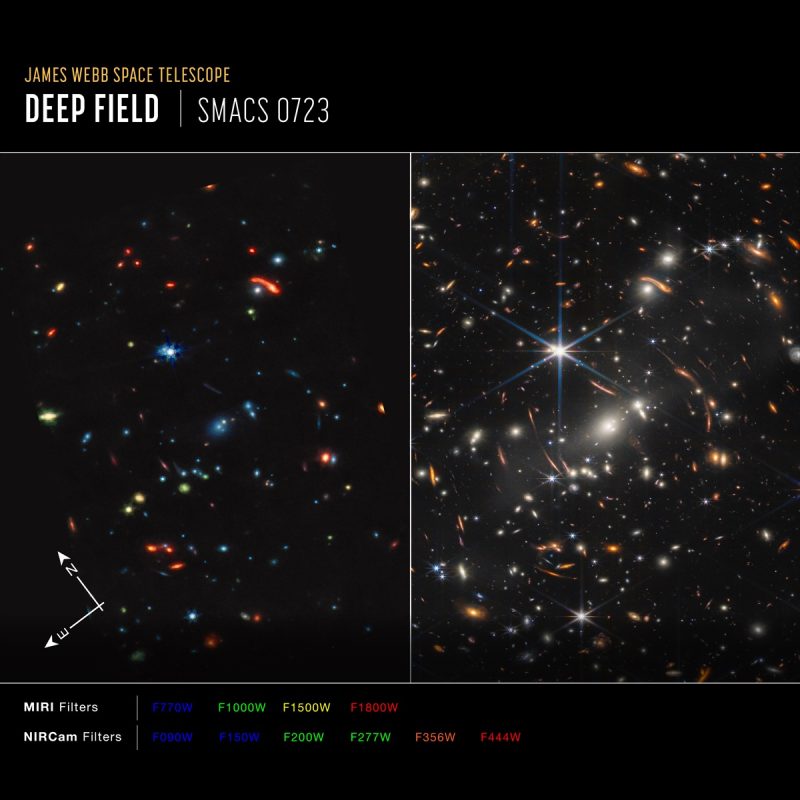
    Thousands of galaxies flood this near-infrared image of galaxy cluster SMACS 0723. High-resolution imaging from NASA’s James Webb Space Telescope combined with a natural effect known as gravitational lensing made this finely detailed image possible.

     Image Credit: NASA and STScI

    Professor Avi Loeb, head of the Galileo Project and founding Director of Harvard University’s – Black Hole Project writes about the first pictures from NASA’s revolutionary James Webb Telescope. This article is published earlier in Medium.

    From its vantage point L2, located a million miles away from Earth, the Webb Telescope just started to unravel new insights about the Universe. What is most exciting about the latest data caught in the “spider web” of the 18 hexagonal segments of its primary mirror?

    The new Webb data shows evidence for water vapor, hazes and some previously unseen clouds, on the gas-giant planet WASP-96b. The planet’s mass is half of Jupiter’s mass and it transits in front of its star every 3.4 days, allowing a small fraction of the star’s light to pass through its atmosphere and reveal its composition to Webb’s instruments. This planet is not expected to host life-as-we-know-it because it does not possess a thin atmosphere on top of a rocky surface, like the conditions on Earth.

    The image shows numerous red arcs stretched around a cluster of galaxies, named SMACS 0723, located about 5 billion light years away. NASA-administrator Nelson noted: “Mr President, we’re looking back more than 13 billion years”, an unusual statement to be heard in the household of DC politics which makes plans on a timescale of four years.

    But there was also a “deep image” of the cosmos that was released in a dedicated White House event, hosted by President Biden and vice-President Harris. The image shows numerous red arcs stretched around a cluster of galaxies, named SMACS 0723, located about 5 billion light years away. NASA-administrator Nelson noted: “Mr President, we’re looking back more than 13 billion years”, an unusual statement to be heard in the household of DC politics which makes plans on a timescale of four years.

    These amazingly sharp arcs were observed thanks to the unprecedented angular resolution of Webb’s optics. They feature ancient small galaxies from early cosmic times which happened to lie behind the cluster so that their images were deformed by the effect of gravitational lensing. Clusters of galaxies, like SMACS 0723, contain a concentration of about a thousand Milky-Way-like galaxies, buzzing around at five per cent the speed of light or a thousand miles per second. Most of the cluster mass is made of dark matter, an invisible substance which fills the dark gaps in Webb’s image. The luminous cores of galaxies are like fish swimming in a container filled with transparent water, bound together by gravity — which serves as the “aquarium” walls.

    Ever since Fritz Zwicky observed clusters of galaxies in 1933, we know that most of the matter in them is invisible. While Zwicky inferred that dark matter must exist in order to bind the fast-moving galaxies, the same gravitational potential well can be probed directly through its lensing effect on background galaxies.

    The Webb Telescope achieves unprecedented sensitivity to the faint galaxies that produced the first light during the dark ages of the Universe, hundreds of millions of years after the Big Bang. Its unprecedented ability to peer back in time stems from its observing site far away from the glowing terrestrial atmosphere, the area of its “light bucket” being 7.3 times larger than that of the Hubble Space Telescope, and its high sensitivity to the infrared band into which starlight from early cosmic times is redshifted.

    In its released “deep image”, the 10 billion dollars Webb Telescope, is aided by the natural gravitational lens of SMACS 0723, graciously provided to us for free. The cluster lens magnifies distant sources behind it by bending their light. The combination of the Webb telescope and the cluster’s magnifying power allows us to peer deeper into the universe than ever before.

    In a paper from 1936 titled “Lens-Like Action of a Star by the Deviation of Light in the Gravitational Field”, Albert Einstein predicted that a background star could be gravitationally lensed into a ring if it is located precisely behind a foreground star. This “Einstein ring” is an outcome of the cylindrical symmetry around the lens. A cluster of galaxies is not perfectly symmetric and so sources behind its center are lensed into a partial ring, or an arc — as evident from Webb’s image.

    In 1992, I entered the neighboring office of Andy Gould, a postdoctoral fellow at the Institute for Advanced Study at Princeton, where Einstein wrote his lensing paper. Andy worked extensively on gravitational lensing by compact objects, considering the possibility that the dark matter is made of them. I asked Andy whether he ever considered the contribution of a planet to the lensing effect by a star. Andy responded promptly: “planets have a negligible mass relative to their host star and so their impact on the combined lensing effect would be negligible.” I accepted the verdict of the local lensing expert and retreated quietly to my office. Ten minutes later, Andy showed up in my office and said: “I was wrong … the Einstein ring radius of planets scales as the square root of their mass and so their effect is measurable and could serve as a new method for discovering planets around distant stars. Let’s write a paper about that.” And so we did in a paper titled: “Discovering Planetary Systems Through Gravitational Microlenses.” Today, gravitational lensing is the main method by which planets are discovered around distant stars where the transit method is less practical because the stars are too faint.

    This anecdote from thirty years ago weaves together the themes of the two Webb images that were just unraveled.

    A decade ago, I wrote two textbooks, one titled: “How Did the First Stars and Galaxies Form?”, and the second co-authored with my former graduate student, Steve Furlanetto, titled “The First Galaxies in the Universe”. Both books described theoretical expectations for what the Webb telescope might find in the context of the scientific story of Genesis: “Let there be light”. Last year, I co-authored a textbook with my former postdoc, Manasvi Lingam, titled: “Life in the Cosmos”. There is no doubt that I would be glad if the forecasts in these textbooks will be confirmed by future Webb data. But even better, I would be thrilled if Webb’s data will surprise us with new discoveries that were never anticipated.

    Feature Image Credit: NASA

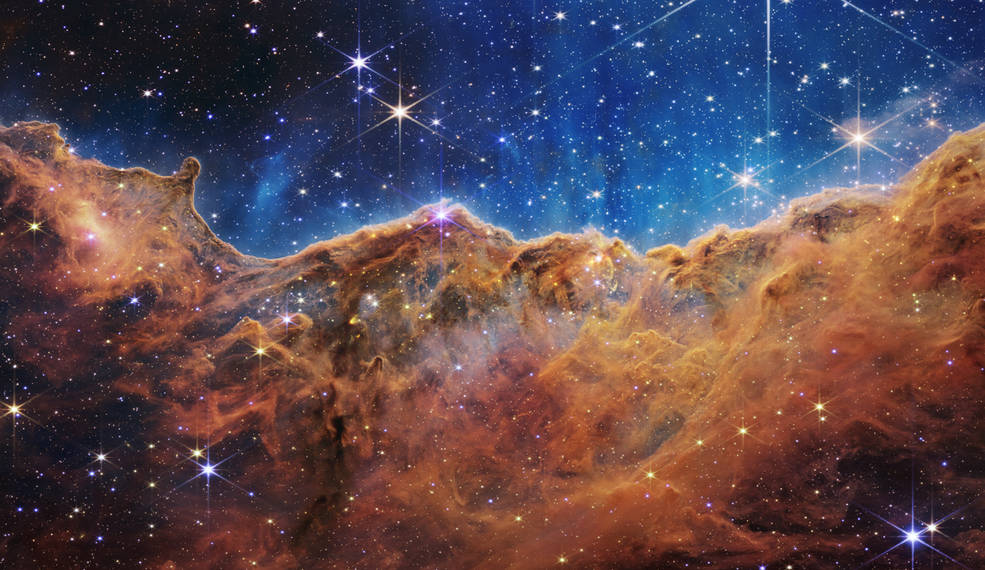
    This landscape of “mountains” and “valleys” speckled with glittering stars is actually the edge of a nearby, young, star-forming region called NGC 3324 in the Carina Nebula. Captured in infrared light by NASA’s new James Webb Space Telescope, this image reveals for the first time previously invisible areas of star birth.

    Called the Cosmic Cliffs, Webb’s seemingly three-dimensional picture looks like craggy mountains on a moonlit evening. In reality, it is the edge of the giant, gaseous cavity within NGC 3324, and the tallest “peaks” in this image are about 7 light-years high. The cavernous area has been carved from the nebula by the intense ultraviolet radiation and stellar winds from extremely massive, hot, young stars located in the center of the bubble, above the area shown in this image.