[powerkit_button size=”lg” style=”info” block=”false” url=”https://admin.thepeninsula.org.in/wp-content/uploads/2024/12/OCP-1-1-India-and-Myanmar-website-1.pdf” target=”_blank” nofollow=”false”]
Download
[/powerkit_button]


On 23 September 2024, Reuters published a news item quoting unnamed sources that said that India had ‘ invited political and military opponents of Myanmar’s ruling junta to attend a seminar in New Delhi. Even as the lack of corroboration of such a report puts it in the realm of conjecture, it is worthwhile mulling over the motivations or otherwise for such a seminal event to be even contemplated, especially in the light of implications for India’s Act East Policy.
TPF Occasional Paper: 10/2024
Recalibrating India’s Act East Policy: New Realities in Myanmar and Bangladesh
Maj Gen Alok Deb (Retd)

On 23 September 2024, Reuters published a news item quoting unnamed sources that said that India had ‘ invited political and military opponents of Myanmar’s ruling junta to attend a seminar in New Delhi’[i]. The item went on to specify that the shadow National Unity Government (NUG) and ethnic minority rebels from the states of Chin, Rakhine and Kachin bordering India had been invited to a seminar in mid-November, to be hosted by the Delhi-based Indian Council of World Affairs (ICWA), a foreign policy think tank funded by the Government of India. The piece was also carried by some major Indian newspapers with its origin attributed to Reuters. At the time of writing, there has been no acknowledgement or rebuttal of this report by any government agency. Neither has the ICWA posted this on its website as a forthcoming event. Even as the lack of corroboration of such a report puts it in the realm of conjecture, it is worthwhile mulling over the motivations or otherwise for such a seminal event to be even contemplated, especially in the light of implications for India’s Act East Policy.
A Summary of India’s Act East Policy
India’s ‘Act East’ policy of 2014 is an initiative that takes off from its earlier ‘Look East’ policy. ‘Act East’ envisages initiatives at multiple levels with the nations of ASEAN and the wider Indo-Pacific region. These initiatives are to be taken forward through a process of continuous engagement at bilateral, regional and multilateral levels, thereby providing enhanced connectivity in its broadest sense, including political, economic, cultural and people-to-people relations.[ii]
To successfully implement the ‘Act East’ policy, the Indian government is working to make the North East its strategic gateway to ASEAN. Accordingly, it has increased the allocation for the region’s development by more than four times over the last 10 years.[iii] The North East is also poised to benefit from initiatives from countries like Japan which earlier this year had proposed developing an industrial hub in Bangladesh with supply chains to the North East, Nepal and Bhutan.[iv]
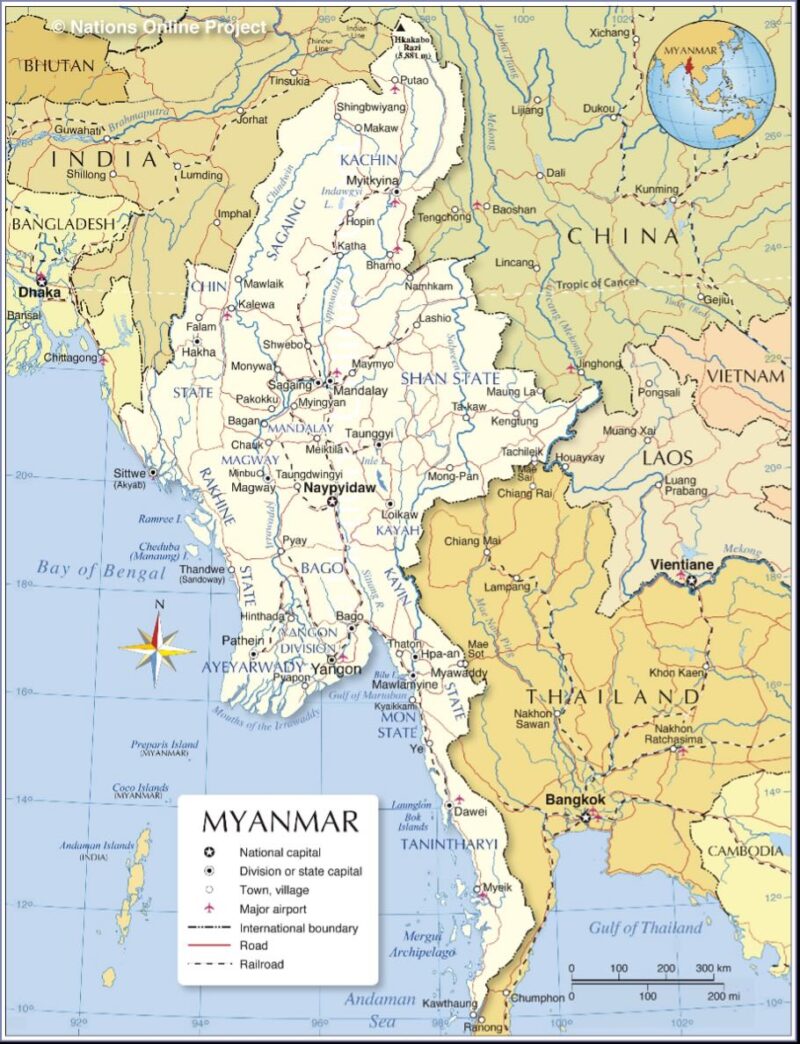
As the North East becomes India’s gateway to ASEAN, the centrality of Myanmar to our Act East becomes apparent. It is the key link in the road connectivity between India’s North East and other ASEAN nations whereby the free flow of inland goods, services and other initiatives to and from these nations to India can be ensured. The success or otherwise of Act East is thus directly affected by the security environment in Myanmar. Instability here will negatively impact our North Eastern states sharing borders with that country. The internal situation in Myanmar therefore becomes an area of prime concern for India, warranting close attention.
For similar reasons, another neighbour, Bangladesh, is equally important for the success of India’s Act East Policy. India’s North East has benefitted from good ties with Bangladesh, both security-wise and economically. Militancy in the North East has reduced over the last decade and a half. With Bangladesh agreeing to provide access to its ports in the Bay of Bengal for the movement of Indian goods, the North Eastern states have a shorter route to the sea. Additionally, states bordering Bangladesh such as Assam and Meghalaya have developed trade links with that country for mutual benefit. The BBIN (Bangladesh Bhutan India Nepal) Motor Vehicle Agreement for the Regulation of Passenger, Personal and Cargo Vehicular Traffic was signed in 2015 to ‘ promote safe, economically efficient and environmentally sound road transport in the sub-region and … further help each country in creating an institutional mechanism for regional integration’ is another mechanism for implementing our Act East and Neighbourhood First policies[v]. The role of Bangladesh here is pivotal.
State of the Civil War in Myanmar
Fighting in Myanmar is now in its fourth year. The military junta continues to suffer reverses on the battlefield. Large portions of Rakhine State and certain portions of Chin State are now under the control of the Arakan Army (AA). International Crisis Group has recently averred that ‘..in just a few months, the Arakan Army has created the largest area in Myanmar under the control of a non-state armed group – in terms of both size and population – and is now on the verge of securing almost all of Rakhine’[vi].
In Shan state to the North, the Three Brotherhood Alliance (TBA) of three Ethnic Armed Organisations (EAOs) had by December 2023, captured over 20,000 square kilometres of territory, including key border crossings and trade routes between China and Myanmar in Operation 1027[vii]. On 07 March 2024, the Kachin Independence Army (KIA) launched Operation 0307 and successfully captured certain military posts across Kachin State close to the Chinese border. This forced the Tatmadaw (Myanmar military) to redeploy, further thinning out forces[viii]. Fighting also continues in other states and regions across the country, notably Sagaing and Kayah.
Associated Press deduces that ‘.. the announcement of the measure on state television amounts to a major, though tacit, admission that the army is struggling to contain the nationwide armed resistance against its rule..’.The Junta has since conscripted Rohingya youth and deployed them against the Rakhines.
Notwithstanding these losses, there is no let-up in the Tatmadaw’s efforts to combat the rebels. The Junta has resorted to conscription to stem rising attrition, activating an old law in this regard. Associated Press deduces that ‘.. the announcement of the measure on state television amounts to a major, though tacit, admission that the army is struggling to contain the nationwide armed resistance against its rule..’ [ix] To further contextualise, the same article stated the rebel National Unity Government’s (NUG) claim that more than 14,000 troops have defected from the military since the 2021 seizure of power. The Junta has since conscripted Rohingya youth and deployed them against the Rakhines. The Chins fear that they too will be acted upon similarly.[x]
To overcome the asymmetry of force especially in artillery and airpower, the rebels have acquired large numbers of drones. These are being used to bomb military positions, contributing significantly towards the successes of the CNA’s operations[xi]. To summarise, Myanmar’s civil war continues to see-saw with no signs of ebbing. The Junta continues to make periodic peace overtures to the NUG with conditionalities that the latter is unwilling to accept[xii]. With the multiplicity of actors and issues involved, there are no clear indications of how and when the conflict will be resolved.
Impact of the Myanmar Conflict on India’s North-East
The impact of Myanmar’s internal situation on India’s border states has progressively worsened. Initially, after the Junta takeover, it was Mizoram which bore the brunt. The state government citing common ethnicity and humanitarian concerns accepted the influx of Chins from Myanmar as a moral responsibility and initiated rehabilitation measures. These refugees along with earlier refugees from Bangladesh recently joined Kukis from Manipur, number around 44000 and continue to remain in refugee camps.[xiii] The Central government has had to reconcile its policy of preventing infiltration across borders with the societal realities of Mizoram. A positive outcome of this approach is that there has been no violence in Mizoram.
In Manipur, by September 2024, the 18-month-long ethnic conflict had resulted in over 225 deaths and some 60,000 people displaced.[xiv] The administration has been derided by both sides, more so with recent warnings about impending threats to law and order[xv] followed by retractions[xvi]. People of either community have been uprooted from their homes and moved to safe areas separated by buffer zones guarded by security forces. So great is the mutual suspicion that on the clamour of the Meiteis to replace the Assam Rifles, two battalions of this central force have been withdrawn and replaced by the Central Reserve Police Force (CRPF), against the wishes of the Kukis[xvii].
Voices for an independent ‘Kukiland’ for the Kuki Zo peoples are being raised,[xviii] which are variously interpreted as a demand for greater autonomy within Manipur or for a separate union territory. The current happenings also dredge up the old ghost of ‘Zale’n-gam’ or Kuki nation, comprising the Chin Kuki Zomi peoples (including Mizos) residing across India, Bangladesh and Myanmar. Zale’n- gam has few takers and appears restricted to a YouTube channel[xix]. Today both sides fight each other with a variety of weapons including improvised rockets and drones. Hostage-taking is the latest tactic that has been adopted.[xx]
Tension between the Nagas of Manipur and other communities is discernible with some reports of violence against the former.[xxi] As of now Nagas have kept out of the Kuki-Meitei dispute; also, other than the insurgent National Socialist Council of Nagaland ( Isak Muviah) faction (NSCN-IM) that is observing a ceasefire with the Centre, no other party has demanded integration of all Naga inhabited areas in India ( Arunachal Pradesh, Assam, Manipur) and Myanmar – the idea of Greater Nagalim.
At the state level, the responses of Mizoram and Manipur to the Myanmar crisis vary. This can be best seen in their reactions to the Centre’s recent notification to fence the entire 1643 Km Myanmar border and its earlier decision to end the Free Movement Regime that permits movement on both sides of the border for up to a distance of 16 km.[xxii] While the Mizoram government and tribes living in both states oppose the decisions, the Manipur government clamours for its implementation. Currently, only around 30 Km of the border has been fenced.
Since the Tatmadaw now has limited control over its border areas, it has become imperative for India to commence a structured dialogue with other warring parties in Myanmar’s border regions. This, with a view to restoring the situation in Manipur (and on the border) through mutually acceptable solutions at least for the short to medium term, is necessary. Only then can a modicum of security on the border be guaranteed. This involves navigating a maze of ethnic, religious, historical and societal issues with great sensitivity. The importance of such a dialogue cannot be overemphasised, more so because of recent developments in Bangladesh.
The Impact of Bangladesh’s ‘Second Liberation’

The events of 5 August 2024 that witnessed the overthrow of Sheikh Hasina’s government have proved to be yet another watershed in India-Bangladesh relations. India has invested more in the India-Bangladesh relationship than with any other neighbour in South Asia. A glance at the website of our Ministry of External Affairs[xxiii], where details of various agreements and summaries from the last Prime Ministerial meeting in Delhi in June 2024 are provided, will suffice to show just how strong and all-encompassing this relationship has become.
Persons or organisations associated with the previous regime have either fled the country or been placed under arrest and assets confiscated. A few have been killed by mobs. Bank accounts of others have been frozen. Jamaat e Islami which collaborated with the Pakistan Army in 1971 has been resurrected. Extremists with proven murder charges against them have been freed from prison, as have political prisoners.

At the time of writing, it is two months since the interim government headed by Chief Advisor Mohammed Yunus assumed charge. The country continues to make efforts to reestablish the rule of law. All wings of the armed forces have been given magisterial powers[xxiv]. The functioning of the judiciary, higher civil services, local administration, police, security agencies, banking, economy, and higher education, is under review. Persons or organisations associated with the previous regime have either fled the country or been placed under arrest and assets confiscated. A few have been killed by mobs. Bank accounts of others have been frozen.[xxv] The Jamaat e Islami which collaborated with the Pakistan Army in 1971 has been resurrected. Extremists with proven murder charges against them have been freed from prison, as have political prisoners. Commissions have been set up to suggest reforms in the constitution, electoral system, police, judiciary, public administration and in tackling corruption. Elections do not seem to be on the horizon yet. The advisers ( as the ministers are currently known) are new faces, not well known in India.
While this paper does not attempt to be a study of India-Bangladesh relations, the polarised politics in that country coupled with a perception that the misdeeds of Sheikh Hasina’s government were conducted with impunity because of Indian backing, is sure to impact India’s portrayal here.
With the removal of Sheikh Hasina, the India-Bangladesh relationship is undergoing a major reset. Statements of certain public figures and sentiments of a section of the population in that country suggest that a different perspective on the evolution of Bangladesh as a nation from 1971 onwards is emerging. While this paper does not attempt to be a study of India-Bangladesh relations, the polarised politics in that country coupled with a perception that the misdeeds of Sheikh Hasina’s government were conducted with impunity because of Indian backing, is sure to impact India’s portrayal here. This will make it an arduous task for both countries to go back to the trusted, cooperative and mutually beneficial relationship that existed. As mentioned, the list of achievements for both countries is far too numerous – settlement of land and oceanic borders, road, rail and riverine connectivity (including use of ports), economy and business ( both government and private), education including educational scholarships, technology, disaster management, border management, maritime security, military to military cooperation, improved people to people contacts, culture and health. As per records, of the 16 lakh visas issued by India for Bangladesh nationals in 2023, 4.5 lakhs were for medical treatment alone[xxvi]. Economies are so embedded that everyday necessities like onions are exported regularly to Bangladesh ( approximately 6 to 7 lakh tonnes annually).
Even as the new regime provides assurances on the security of minorities and acknowledges India as an important neighbour, the enthusiasm with which it has interacted with official interlocutors from a host of nations worldwide especially China, Pakistan and the US is noteworthy and indicates where its newfound priorities might lie.
A parallel reality, however, is that negative perceptions about India have historically found space in sections of Bangladesh’s polity. These have received a huge fillip after the change of regime with even settled agreements prone to misunderstanding. A recent example pertains to a tripartite agreement dating back to the Hasina period whereby electricity is to be imported from Nepal via India to Bangladesh. The agreement was signed in Kathmandu in the first week of October 2024. Newspaper reports from Bangladesh indicate that there is palpable resentment over the condition that Indian transmission systems inside Indian territory be utilised for this purpose since it increases costs per unit of electricity in Bangladesh.[xxvii] Another issue currently bedevilling relations is the state of minorities in Bangladesh who have faced attacks on their homes, businesses and religious places with some loss of life, since the protests in July. India’s concerns in this regard have been conveyed at the highest level. Even as the new regime provides assurances on the security of minorities and acknowledges India as an important neighbour, the enthusiasm with which it has interacted with official interlocutors from a host of nations worldwide especially China, Pakistan and the US is noteworthy and indicates where its newfound priorities might lie.
Larger Implications for India
Bangladesh and Myanmar are pivotal for India’s Act East policy from the security, economic and connectivity angles. The issues pertaining to Myanmar and Manipur have been brought out earlier. A common concern affecting both nations and India is the Rohingya crisis. Despite international pressure and requests from Bangladesh for China to intercede with Myanmar on its behalf, there has been no positive response from Myanmar. Bangladesh, which currently hosts close to one million refugees,[xxviii] has publicly expressed its inability to accommodate any more Rohingyas and asked for a speedy ‘third country settlement’ [xxix]. A detailed report of the International Crisis Group (ICG) in October 2023[xxx]provides details of activities of militant organisations like the Rohingya Solidarity Organisation (RSO) and Arakan Rohingya Salvation Army (ARSA) which are involved in drug running from Myanmar along with Bangladeshi syndicates for sale of the product in that country. Their participation in violent crime and other illegal activity has become a pressing concern within Bangladesh. Rohingyas have infiltrated into India as well, and have been identified as far North as Jammu. The security implications of such migration for both Bangladesh and India are apparent. The insensitivity of the Myanmar Junta on this account is heightening security risks for India and Bangladesh and merits diplomatic intervention.
With the situation in Bangladesh evolving by the day, it is prudent for India to take a strategic pause as it weighs its options for pursuing its Act East policy. While giving the new regime in Bangladesh its due, India has to consider the impact of resurgent forces aided by inimical powers that aim to derail the India-Bangladesh relationship beyond repair. Even as both countries attempt to reestablish strong ties, the old adage preached by educated Bangladeshis in the context of support to Sheikh Hasina’s regime that ‘India should not put all its eggs in one basket’ resonates. While Myanmar geographically cannot provide the singular advantages that Bangladesh can, it is time for India to press for securing Myanmar’s cooperation to complete pending projects in that country, such as the Kaladan Multi-Modal Port Project (KMMPP) via Sittwe and Paletwa, that provides an alternate route to our North East, as well as the Trans Asian Highway (TAH) that provides connectivity with the rest of ASEAN, amongst others.
To summarise, two possible reasons for inviting rebel Myanmar groups to Delhi could be: first, the relative viability of either Bangladesh or Myanmar to help implement the Act East policy in light of the emerging situation in Bangladesh and the state of the civil war in Myanmar. The second, ensuring security on the India-Myanmar border, to prevent aggravating the situation in India’s border states.
Notes:
[i] ‘Exclusive: India extends unprecedented invite to Myanmar’s anti-junta forces, sources say’ Wa Lone and Devjyot Ghoshal Reuters September 23, 2024
[ii] ‘Govt aims to make Northeast gateway of ‘Act East Policy’: President Murmu’ Press Trust of India 27 June 2024.
[iii] Ibid.
[iv] ‘Japan to tie landlocked Northeast India with Bangladesh’ Saleem Samad The Daily Messenger 05 March 2024.
[v] Press Information Bureau Government of India Ministry of Shipping note dated 10 June 2015
‘Bangladesh, Bhutan, India and Nepal (BBIN) Motor Vehicle Agreement for the Regulation of Passenger, Personal and Cargo Vehicular Traffic amongst BBIN’
[vi] ‘Breaking Away: The Battle for Myanmar’s Rakhine State Asia Report N°339 | 27 August 2024’ International Crisis Group (Executive Summary).
[vii] ‘As Myanmar’s Junta Loses Control in the North, China’s Influence Grows’ Jason Tower, United States Institute for Peace, August 1, 2024.
[viii] Ibid.
[ix] ‘Facing setbacks against resistance forces, Myanmar’s military government activates conscription law ‘ Associated Press, February 12, 2024.
[x] ‘India’s ‘Forgotten Partition’ and the Myanmar Refugee Crisis’ Swapnarka Arnan The Diplomat 11 May 2024.
[xi] ‘We killed many … drones are our air force’: Myanmar’s rebels take on the junta from above. Aakash Hassan and Hannah Ellis-Petersen The Observer 20 January 2024.
[xii] ‘Armed Groups Snub Myanmar Junta ‘Peace’ Offer’ The Irrawaddy 28 September 2024
[xiii] ‘Centre provides 1,379 MT rice to Mizoram for Manipur, Myanmar, B’desh refugees’ Morung Express 25 September 2024.
[xiv] ‘Ethnic violence in India’s Manipur escalates, six killed’ Tora Agarwala Reuters September 7, 2024
[xv] ‘900 Kuki militants infiltrated Manipur from Myanmar, says Security Advisor’ India Today NE September 20 2024.
[xvi] ‘Input on infiltration by 900 Kuki militants could not be substantiated on the ground, says Manipur security advisor’ Vijaita Singh The Hindu 26 September 2024.
[xvii] ‘Kukis call removal of Assam Rifles from 2 Manipur areas ‘biased, appeasement’, Meiteis call it ‘victory’ Ananya Bhardwaj The Print 04 August 2024.
[xviii]‘ Manipur: Kuki-Zo organizations hold rallies, demand separate ‘Kukiland’ for peace by Northeast News
August 31, 2024.
[xix] YouTube channel titled ‘Zalengam Media’.
[xx] ‘Kuki militants seek release of ‘secessionist’ in Manipur’ Prawesh Lama and Thomas Ngangom Hindustan Times Sep 30, 2024.
[xxi] ‘Keep us out of your war, Manipur Naga body warns two warring communities’ The Hindu Bureau 06 February 2024
[xxii] ‘Government sanctions ₹31,000 crore to fence Myanmar border’ The Hindu
Published – September 18, 2024
[xxiii] Ministry of External Affairs, Government of India website mea.gov.in.
[xxiv] ‘Navy, the air force also granted magistracy powers’ The Daily Star September 30 2024
[xxv] ‘Bank accounts of Joy Putul Bobby frozen’ Dhaka Tribune 30 Sep 2024.
[xxvi] ‘Indian High Commission in Dhaka, facing protests & threats, returns 20,000 visa applicants’ passports ‘ Ananya Bhardwaj The Print 29 September 2024.
[xxvii] ‘Bangladesh delegation in Nepal to sign the contract to import 40 MW electricity’ Dhaka Tribune 30 September 2024.
[xxviii] Operational Data Portal of the United Nations High Commissioner for Refugees, for Bangladesh.
[xxix] ‘Bangladesh calls for faster resettlement process for Rohingya’ Ruma Paul Reuters September 8, 2024
[xxx] ‘Rohingya Refugees in Bangladesh: Limiting the Damage of a Protracted Crisis’ International Crisis Group Autumn Update 04 October 20223.
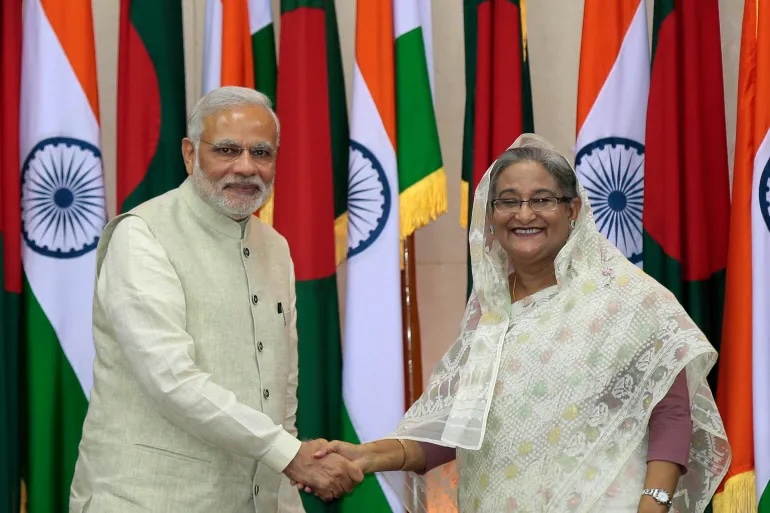
Feature Image Credit: What does Sheikh Hasina’s resignation mean for India-Bangladesh relations? – aljazeera.com
Map Credit: National Online Project
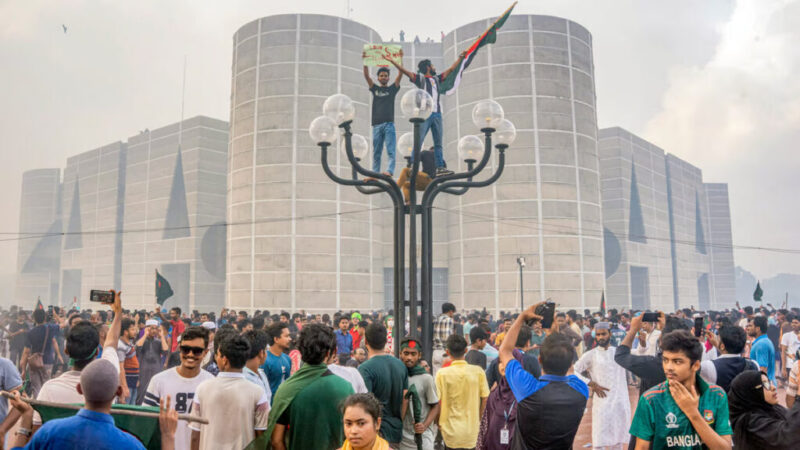
Bangladesh Parliament Image: The Shattered Identity of a Nation: From Liberation to Chaos – borderlens.com
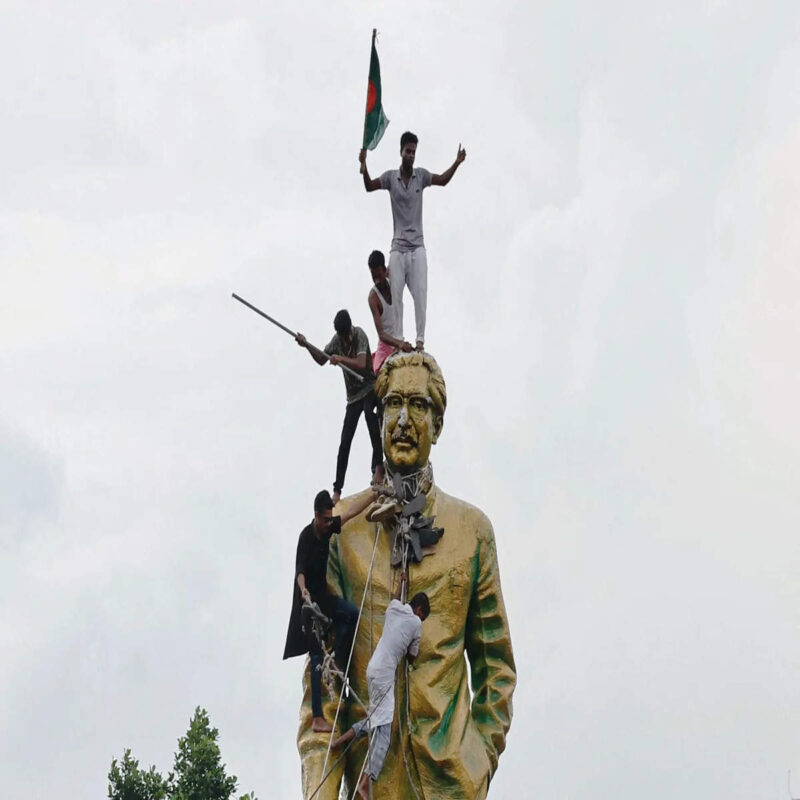
Sheikh Mujibur Rahman’s Statue: Bangabandhu to Toppled Statue: Mujibur Rahman’s contested legacy post Bangladesh upheaval – Economic Times

While much has happened in 2023, new developments in the security dynamic warrant a relook at the transformation process. India now has to be prepared to prosecute both short and prolonged wars. Clearly defined political aims must be translated into achievable military objectives on the borders.
2023 was an eventful year. In addition to ongoing conflicts in Africa, Afghanistan, Syria and Ukraine, it witnessed the start of yet another war in the Gaza Strip, which by early 2024 had expanded across West Asia. The Red Sea region is witnessing duels between the Houthis and the West. Israel and Hezbollah are skirmishing in Lebanon. Iran has carried out strikes in Iraq and Syria. The US has blamed Iranian proxies for causing the deaths of its service personnel in Jordan and retaliated accordingly across Iraq and Syria. Iran and Pakistan have carried out tit-for-tat missile strikes. While conflicts such as Nagorno Karabakh have ended for now, other potential trouble spots in the Balkans and South and East China Seas continue to make headlines.
This uncertain security environment has put trade, supply chains and, in some cases, national sovereignty at risk. At home, long-festering structural issues in the India-China relationship have come to a head. China’s belligerence is on full display along our Northern borders even as it makes further inroads in Bhutan, Bangladesh, Nepal and Sri Lanka. In 2024, Maldives has displayed a pronounced anti-India tilt. Pakistan’s intractability and support for terrorism, despite its precarious internal situation and volatile borders on its West, remains a cause for concern. In Myanmar, the civil war rages on, while the outcome of ethno-religious conflict, which has spilled across international borders in Manipur and Mizoram, poses a different challenge.
Despite 20 rounds of Corps Commanders talks, the Army is completing its fourth winter of ‘mirror deployment’ along the Line of Actual Control (LAC). Small-scale operations at the LAC have continued at least till 2022, as citations for gallantry in respect of individual soldiers on Republic Day indicate. The Chief of Army Staff (COAS) announced in his annual press conference in January that there will be no reduction in troop levels until the return to the ‘status quo ante as of mid-2020. Concurrently, the Army continues to battle terrorists on both sides of the Pir Panjal ranges in Jammu and Kashmir. The Air Force remains highly alert even as the Navy is committed full time in the Western Arabian Sea and East coast of Africa, successfully protecting Indian shipping ( and ships of other nations) from piracy and other threats. In sum, the Indian military is committed to ensuring the nation’s security full-time.
The Indian Army had labelled 2023 as its ‘Year of Transformation’, based on the five pillars of Force Structuring & Optimisation, Modernisation & Technology Infusion, Systems, Processes & Functions, Human Resource Management and Jointness & Integration. The Ministry of Defence (MoD), in its 2023 Year End Review, has listed various proposals totalling over Rs 3.50 lakh crores that were approved to enhance operational preparedness. These cover a wide range of equipment and upgrades – from procurement of light combat helicopters to indigenous upgradation of Su-30 MKI aircraft, purchase of medium-range anti-ship missiles for the Navy and acquisition of towed gun systems for the Army. Other notable items are procurement of Sea/ Sky Guardian drones (31 of these since approved for sale by the US State Department in February 2024), utility helicopters, light armoured multi-purpose vehicles, anti-tank guided missiles (ATGMs), Very Short Range Air Defence Systems (VSHORAD) and cadet training ships. Improvements in other spheres – progress towards Atmanirbharta, indigenisation, border infrastructure, roads, induction and career management of women, and welfare of veterans- have also been covered. The individual services have also listed their achievements in enhancing operational capabilities and overall efficiency.
While much has happened in 2023, new developments in the security dynamic warrant a relook at the transformation process. India now has to be prepared to prosecute both short and prolonged wars. Clearly defined political aims must be translated into achievable military objectives on the borders. The nature of these conflicts will be difficult to determine. With elements of both the conventional and non-conventional employment of weapon systems across all five domains with simultaneous conduct of information operations, they will be genuinely hybrid and constantly mutating, based on whichever element achieves more significant success.
As a first step, it becomes necessary to incorporate fresh thought and prepare a fully fleshed-out tri-service Indian military doctrine. The integrated doctrine issued by the Integrated Defence Staff (IDS) in 2017 requires review to incorporate analysis and lessons learnt from Nagorno Karabakh, Ukraine, Gaza and our current experiences on the Northern borders, with the ‘collusive threat’ now a reality. Given that doctrine is essentially a set of principles that tells us ‘how to do’, i.e. how to achieve desired effects and not specifically ‘what to do’, capability development logically flows from doctrine analysis. Here, there has to be a consensus between the services on capabilities necessary to fulfil the military’s mandate – new platforms or technology, organisational issues, enhancement of joint or single service logistic capability, training and human resource aspects or upgrades.
For the short to medium term, increasing focus on new technology must be balanced with the capacity to absorb technology and the context in which such weapons are envisaged to be employed. While incorporation of AI, quantum computing, electronic warfare, stealth technology, space warfare and the like will be very much on the cards, all these can truly be incorporated once there is greater clarity and broader consensus upon two issues – what is the right weapon mix for a country like India to have, in terms of the proportion of latest generation weapons vis a vis what remains in the inventory and can be employed effectively now and in the immediate future, to thwart the enemy’s perceived designs? This is especially important when we look at the options available to incorporate new technology in terms of the time required for indigenous self-development and the secretive mindset of foreign suppliers with respect to sharing the intricacies of technologies that power such costly weapon systems. Secondly, a holistic consideration of the number of technologies that need to be developed in this time frame as part of capability development becomes necessary when we analyse the weapon/capability mix required to defend against an attacker – including one whose political and military objectives at the start of a conflict remain opaque, and whose capabilities and pattern of operations are possibly more overhyped than actual.
The above issues become even more relevant when we look at the allocations for defence in the interim budget presented in Parliament on 01 February this year. Detailed analyses on the defence aspect will likely be published in days to come. In the context of this article, just two examples are highlighted. First, the 30 per cent higher allocation for Border Roads is hugely appropriate as it fits into future planning and enhances capability and capacities. Second, the deployment of the budget of Rs 23,855 crores to the DRDO and planned funding of a Rs 1 Lakh crore corpus for R&D projects, including ‘deep defence’ technology, while a positive step, must be carefully thought out, based on the aspects highlighted in the preceding paragraphs.Industry start-ups are doing a valuable job introducing the latest generation of weapons and technology to the military in concert with organisations like the Army Design Bureau. The incorporation of new technology and subsequent production of new weapons will be predicated on answers to these issues.
Organisational aspects are another area for the military’s focus in 2024. Work on integrated theatre commands continues and will surely see the light of day. Notwithstanding the non-availability of a National Security Strategy, the Integrated Defence Staff (IDS) has to list out with absolute clarity what the mission of each theatre command is, in synchronicity with national aims. How to ensure optimal efficiency of these integrated resources for mission accomplishment has to be carefully thought out through multiple iterations with all stakeholders. This will have to be subject to rigorous validation in several tabletop and ground variety exercises to arrive at a common and operationally validated solution.
Human resource issues will compete equally for the military’s attention. The Agniveer experiment has completed a little over one year. The performance of these soldiers in operations has been on par with their counterparts of yesteryears (of the same seniority). However, it is their performance in garrison soldiering that is yet to be fully gauged. As mentioned by the COAS, their assessment at multiple levels has to be continuously finetuned to remove any traces of subjectivity. Close monitoring of this scheme is necessary before pronouncing judgement on its success or otherwise, specifically its impact on regimental ethos and overall effect on unit efficiency. Employment of increasing numbers of woman Agniveers and woman officer intakes is another area which will occupy the minds of Commanding Officers (COs) of the three services. The recent decision of the Karnataka High Court in January 2024 striking down the provision of the Indian Military Nursing Services Ordinance 1943, which gives 100% reservation for women in nursing officer posts, is another spinoff in the battle for gender equality. This lends further urgency to the need to evolve an Indian model for the successful integration of women into the armed forces. Gender sensitisation of both sexes in uniform is of utmost priority.
Managing high quality men and women drawn from all corners of India mandates a high degree of personal and professional integrity, sense of balance, and strength of character in military leaders at every level, specially so in an era where misinformed (or deliberate) inputs on social media can wreak havoc in society.
Finally, as always, the military has to continue focusing on reinforcing institutional values. All militaries are dynamic. They must be nurtured and motivated by caring, professional and impartial leadership. A quote attributed to Sir Winston Churchill in his address to the House of Commons in 1923 says ‘…the armed forces.. are living things, if they are bullied, they sulk, if they are unhappy, they pine, if they are harried, sufficiently they get feverish, if they are sufficiently disturbed, they will wither and dwindle and almost die…’.Preserving the health of their respective services along with enhanced operational preparedness is the foremost task of the service chiefs. This comes about by careful selection of higher leadership, strict adherence to the culture, ethics and norms of the Indian military while forswearing all else at the altar of professionalism. Managing high quality men and women drawn from all corners of India mandates a high degree of personal and professional integrity, sense of balance, and strength of character in military leaders at every level, specially so in an era where misinformed (or deliberate) inputs on social media can wreak havoc in society. The responsibility of the Chiefs in this regard is onerous indeed and cannot be overemphasised. All else follows from this.
Feature Image Credit: scroll.in

On 21 November 2023, India’s Ministry of External Affairs advised Indian citizens to avoid nonessential travel to Myanmar, given the evolving security situation in that country. It further advised that those already living in Myanmar should take precautions and avoid travel to regions affected by violence[i]. Earlier in the same month, UN Secretary-General António Guterres had expressed deep concern at the expansion of conflict in Myanmar[ii] . Both messages highlight the increasingly fragile situation in Myanmar, where two million people are displaced and over 286,000 similarly affected after the current upsurge in fighting[iii].

Operation 1027 and its Implications
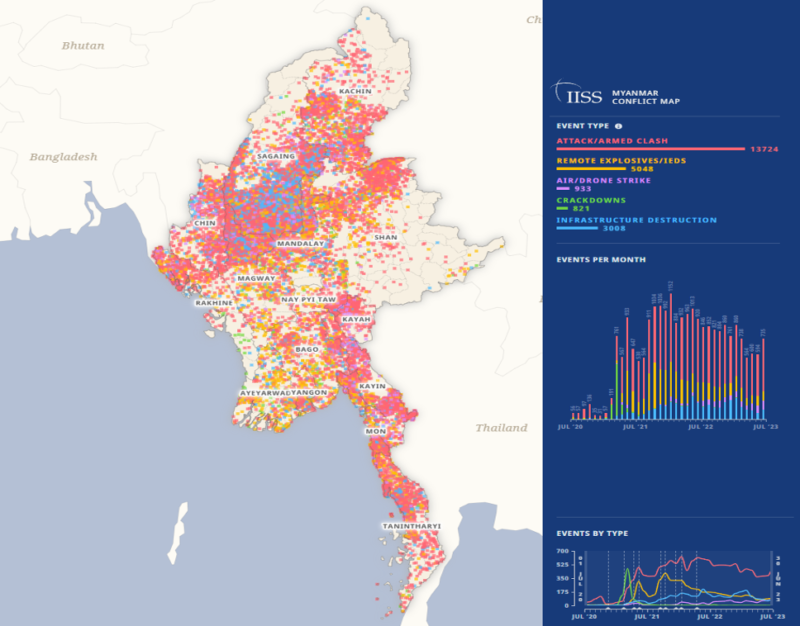
The map published by the International Institute for Strategic Studies lists the number and type of violent events countrywide until July 2023. Since then, there has been a spike in the level of violence. Most prominent has been the coordinated attack on 27 October on Tatmadaw (Myanmar Army) posts in the Northern portion of Myanmar’s Shan state (see map), near the Chinese border by three Ethnic Armed Organisations (EAOs), assisted by other Peoples’ Defence Militias (PDFs). As per Richard Horsey of the International Crisis Group[i], the attacks, dubbed ‘Operation 1027’ (after the date they commenced), involved several thousand experienced, well-armed fighters attacking multiple army posts simultaneously. These troops owed allegiance to three major EAOs – the Myanmar National Democratic Alliance Army (MNDAA), the Ta’ang National Liberation Army (TNLA) and the Arakan Army ( AA), comprising different ethnicities ( Kokang, Ta’ang and Arakanese, respectively). Of the three, the first two are based in Shan state in the East, while the AA, as the name denotes, is based in Rakhine on Myanmar’s West coast, bordering some portion of the Chittagong Division of Bangladesh. Within two weeks, these three armies dubbed the Three Brotherhood Alliance, had seized several towns along the Chinese border, overrun military bases and captured large stocks of munitions. Specifically, to quote the Asia Times…the key border posts of Chin Swe Haw and Mong Ko were seized along with 80 military and police bases. More than 120 military bases have since been overrun, and sizeable amounts of arms and ammunition seized, including reportedly several 14.5 heavy machine guns (HMGs)…‘[ii]. ISP Myanmar, a Myanmarese think tank based in Thailand, notes that resupply columns are being ambushed on the main artery from Mandalay, around the area of Kyaukme, as shown on the map below[iii].

Operation 1027 has created significant disruptions in the Myanmar-China border trade. The current offensive aims to eradicate online gambling and scam call operations from various casinos in the northern portion of Shan and Kayin states bordering China and Thailand, an objective shared by the Myanmar Government, which is under pressure from China on this matter. Nationals from these countries, along with Chinese criminals, have been identified for their involvement in such illegal activity in concert with local pro-government militias. The rebels’ aim could likely be to gain China’s favour and wrest territory from Tatmadaw’s control[i]. To avoid the bloodshed, many Myanmar nationals are attempting to cross into China. China, whose proposed projects under the China-Myanmar Economic Corridor (CMEC) run through these regions in Northern Shan state, has since called for a ceasefire on this border[ii]. Noteworthy for military analysts, however, is the well-coordinated planning and execution displayed in these successful attacks, demonstrating the growing strength and assertiveness of the EAOs and PDFs operating over large swathes of territory.
In concert with Operation 1027, EAOs have been equally active in other parts of Myanmar. The Sagaing region North of Mandalay bordering Manipur and Nagaland is witnessing fresh fighting[iii]. A Myanmar Army spokesman is quoted as having admitted that troops were under “heavy assaults from a significant number of armed rebel soldiers” in Shan state in the North, Kayah state in the East and Rakhine state in the West[iv]. In Rakhine, a year-long ceasefire between the Arakan Army and Tatmadaw collapsed, and fighting recommenced. In Kayah state bordering Thailand, a video clip (verified by Reuters) shows wounded Tatmadaw soldiers surrendering to the rebels who offer medical treatment to them. Fighting rages around the state capital, Loikaw, from which the UN has evacuated its personnel[v]. Heavy fighting has taken place in Chin state. The Junta has declared martial law in certain towns in Shan, Chin and Kayah states and Sagaing region.

India’s Concerns
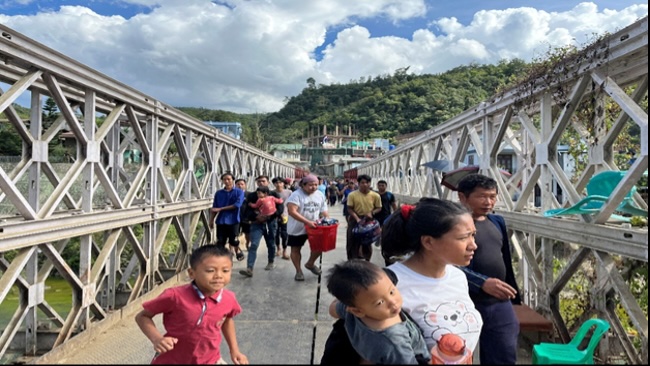
With the Sagaing region bordering Nagaland and Manipur and Chin state bordering Manipur and Mizoram, the upsurge in violence has become a pressing concern for India, which is already grappling with the crisis in Manipur that has a linkage with Myanmar. In the current crisis in mid-November, Chin rebels overran two Tatmadaw posts on the India-Myanmar border in villages close to the Myanmar border township of Rikhawdar. This is adjacent to India’s Land Customs Station (LCS) at Zokhawthar. The Tiau River forms the boundary crossed by a Bailey bridge (picture below).

A fresh flow of refugees (estimates from four to five thousand) has now crossed over to the Indian side to escape the fighting as the Tatmadaw attempts to retake these posts. This influx is in addition to those who crossed over earlier during the coup in February 2021. The capitulation of the Tatmadaw in these bases has also resulted in a unique situation; 74 Myanmar soldiers fled to India with their weapons and surrendered to the Indian authorities, who, at the request of the Myanmar Government, facilitated their return[i].
All the above issues highlight the highly volatile climate in Myanmar, necessitating the Indian government’s advisory. Sufficient reportage exists to show that the rebel forces under the National Unity Government (NUG) are steadily gaining ground; Gen Min Aung Hlaing, Chairman of the State Administrative Council (SAC) and de facto head of state conceded early this year that only 198 of the 330 townships are “100 per cent stable,” while the remainder required “security attention.”[ii] This is close to fifty per cent of the country. Clearly, the civil war is entering a more intense phase.
State of the NUG
The dynamism of the NUG can be gauged by its creative methods to raise revenues to support its war aims. Some of these mechanisms, based essentially on the buyers’ ( including the diaspora’s) good faith, are zero-interest bonds, real estate auctions of land (including government land taken from civilians – a lakeside villa appropriated by Gen Hlaing was auctioned some time ago), proposed condominiums for later construction, auctioning of mining rights and leases, lotteries, donations and tax collection. It provides primary education, health, justice and law and order in areas under its control. It has launched a digital currency that is run through the open-source blockchain Stellar network73, used through its digital wallet app, NUGPay. It uses commercial quadcopter drones for logistics, has commenced weapons production to include 60mm and 90mm mortars, and is experimenting with 3D printing[iii].
The NUG’s success in creating such an infrastructure despite the SAC’s depredations and the victories of its forces on the ground over the last two years is testimony to the support it enjoys among the ordinary people, bolstered by sophisticated information operations. The latter includes a Policy Paper of 2021[iv], which enunciates NUG’s efforts to become more inclusive. A beginning has been made by appointing a Rohingya, Aung Kyaw Moe, to a ministerial post. His appointment as the NUG’s Deputy Human Rights Minister is a signal to others, including the UN whose Special Rapporteur for human rights in Myanmar, Tom Andrews, stated this year that ..’ Min Aung Hlaing, who led the genocidal campaign, is now at the head of an illegal and illegitimate military junta that is attacking civilian populations throughout Myanmar. He must be brought to justice and made to answer his crimes…‘[v]. The NUG Policy Paper promises to bring perpetrators of crimes against Rohingyas to justice and grant citizenship rights to all based on parentage or birth in Myanmar. It also speaks of developing a comprehensive repatriation plan for Rohingyas who have fled Myanmar. Resolving this issue will remove a significant obstacle in ties with Bangladesh, which shelters over one million Rohingyas while looking to curb activities of militant organisations like the Arakan Rohingya Salvation Army (ARSA). The ARSA operates from both sides of the border, using tunnels to move cadres to and fro and has frequently resorted to terrorism.
Crystal Gazing
What, then does the future hold for the SAC? The regime is facing multiple sanctions from the West. Citing ongoing violence, it had earlier announced the postponement of elections planned for August 2023 and continues with the state of emergency. It, however, seeks to exploit its geography as an Indian Ocean littoral and land bridge between South and South East Asia to gain strategic advantage. Trade with Russia has increased, and MOUs on cooperation in various infrastructure projects, including nuclear and natural energy, have been signed. Though the CMEC is now moving at a snail’s pace with many impediments and under constant security threats, none of its projects have been cancelled[vi] as has happened elsewhere. Russia and China are also the leading suppliers of advanced weapon systems to Myanmar. Military cooperation has been extended to naval exercises; this month, Myanmar held a three-day maritime security exercise’ with the Russian Navy from 06 November in the Andaman Sea for the first time. Again, on 28 November, two Chinese warships and a resupply vessel have docked in Yangon on a ‘goodwill visit’ to be followed up with exercises. Despite such signalling, there is no guarantee how much support these two countries would provide in an increasingly uncertain climate.
India’s policy has been one of non-interference in Myanmar’s affairs. It has been feeling its way through the deepening crisis in that country that originated with the coup over two years ago. Government-to-government cooperation continues, with visits by senior Indian dignitaries on essential occasions. Though India does not support the NUG, looking beyond and planning for multiple outcomes is prudent.
India’s priority is to have peace on the border with Myanmar. Instability here has directly impacted the internal security and societal dynamics of at least two border states. For securing the border, an advanced intelligent fencing system of 100 km along the border ‘is in the pipeline’ while a little over 6 Km has been physically fenced around the border township of Moreh in Manipur[vii]. Fencing the entire 1643 km long border is unlikely to find favour for multiple reasons – costs, physical difficulty, and social and political implications, especially when ethnic kin live on both sides with a Free Movement Regime (FMR) in place that permits movement up to 16 Km inside.
The other way of securing the border will be through cooperation between the three affected parties – India, the SAC and insurgent groups operating in the vicinity. It is here that India’s leverages can come into play – the goodwill built up with local communities by sheltering and providing succour to those who have come across, and non-interference with activities of the Tatmadaw, including assisting as in the case of the fleeing soldiers. Considering that peace on the border will benefit all three parties, communication at the local level with the insurgents through intermediaries and parallel government-to-government interaction can ensure that guarantees for the same are obtained. This can be combined with rehabilitation projects for those displaced, with Indian assistance.
Looking beyond the immediate, the difficulty in providing any prognosis for Myanmar should not obscure the fact that it remains among India’s most important neighbours and a vital cog of our Act East policy. With peace prevailing, its role in the development of our North East will only increase, as an overall assessment of the Kaladan Multi-Modal Transit Transport Project’s potential shows. A stable, peaceful and multi-ethnic Myanmar will always remain a priority for India. In the interim, the need is to contemplate multiple outcomes and plan for eventualities, favourable or otherwise.
Notes
[i] ‘29 Myanmarese soldiers repatriated from Mizoram amid border tension’ Statesman News Service Aizawl 20 November 2023.
[ii] ‘Sustaining Funding for Myanmar’s Spring Revolution’ Stimson Policy Paper Zachary Abuza May 17, 2023
[iii] Ibid.
[iv] ‘ Policy Position on the Rohingya in Rakhine State’ Republic of the Union of Myanmar National Unity Government June 03 2021.
[v] ‘UN expert demands accountability for the Rohingya and an end to ‘paralysis of indifference’’ United Nations Human Rights Office of the High Commissioner, press release 24 August 2023.
[vi] ‘The Dwindling Prospects For Russian and Chinese-Backed Infrastructure Projects in Myanmar’ Syah Vaghji
The Diplomat November 09, 2023
[vii] Government of India Ministry of Home Affairs Annual Report 2022-23 Chapter 3 Border Management para 3.21
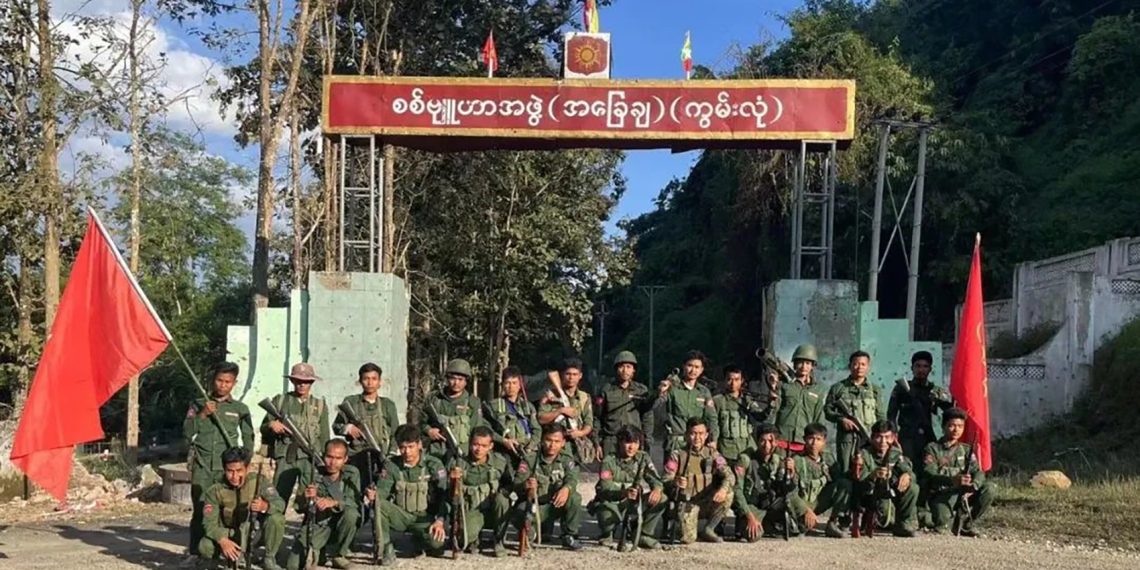
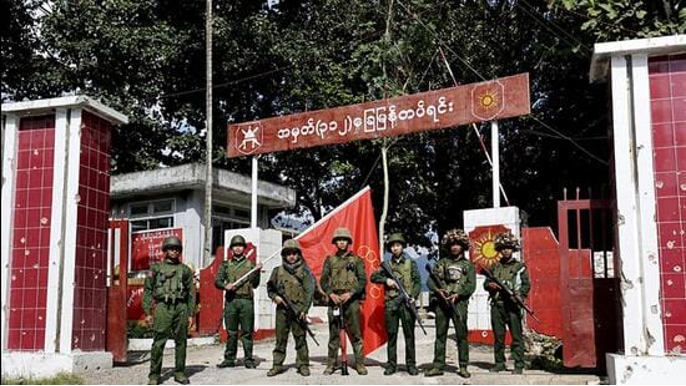
Feature Image: Brotherhood Alliance fighters are seen at the entrance of a regime Army base in Kunlong on Nov 12, 2023/MNDAA – www.irrawaddy.com

[powerkit_button size=”lg” style=”info” block=”true” url=”https://admin.thepeninsula.org.in/wp-content/uploads/2023/05/India-and-Myanmar-Two-years-after-the-Coup-1.pdf” target=”_blank” nofollow=”false”]
Download
[/powerkit_button]
Relegated to the sidelines with the ongoing Ukraine war and other crises like Taiwan, Myanmar has resurfaced in world headlines. In a recent dispatch, Associated Press (AP) reported that on 11 April 2023 ‘a fighter jet dropped bombs directly onto a crowd of people who were gathering at 8 am for the opening of a local office of the country’s opposition movement outside Pazigyi village in Sagaing region’s Kanbalu township….’ 1 . Subsequent information indicates that the number of dead including women and children is over 170. If so, this is the deadliest aerial attack carried out by the Myanmar military on its own people in the bloody aftermath of the military coup two years ago.
With various Ethnic Armed Organisations (EAOs) and Peoples’ Defence Forces (PDFs) battling the Tatmadaw, martial law has been declared in 47 townships in Myanmar, cutting across states and regions. 2 More than 154,000 people have been displaced in the first two months of 2023, with total numbers of Internally Displaced People (IDPs) since the military takeover now at 1.3 million. Heavy fighting rages in Kachin State, the South East and North West of the country, 3 and overall 3000 civilian deaths since February 2021 are estimated 4 . Targeted assassination of military appointed government officials continues, the latest victim being the deputy director-general of the Union Election Commission who was shot dead on 22 April this year 5 . In 2022, up to 30,000 civilian infrastructures, including schools are reported to have been destroyed during military operations 6 . This situation has compelled the Tatmadaw to again postpone elections earlier scheduled for August 2023. The state of emergency has been extended.
Important Developments Post February 2021
The above statistics provide a telling perspective of the current violence in Myanmar. Yet there are other noteworthy developments in the country post the February 2021 coup. First of these is the increasing relevance of the opposition National Unity Government (NUG) around which civilian support appears to have coalesced.
[powerkit_button size=”lg” style=”info” block=”true” url=”https://admin.thepeninsula.org.in/wp-content/uploads/2023/05/India-and-Myanmar-Two-years-after-the-Coup-1.pdf” target=”_blank” nofollow=”false”]
Read More
[/powerkit_button]
Featured Image Credits: CNBC Indonesia


Abstract
Following the Galwan valley clash in 2020, Ladakh has become the most important place of strategic and operational importance since it adjoins two adversarial neighbours who are strategically aligned with each other. China’s belligerence is taking many forms such as information warfare, land transgression, allegations of hacking, etc. The recent claim of unfurling of the Chinese flag supposedly in Galwan, which was later clarified to have been done in another location is a spoke of its information warfare against India. China’s construction activities enabling quick buildup of its troops and armaments are also a major cause of concern for India. While there are some initiatives launched by the Indian army and the Central government to strengthen the infrastructure in the Northern borders, special attention needs to be paid towards the holistic development of human resources and infrastructure in Ladakh.
2022 began with a fresh show of Chinese belligerence in Ladakh, with a well-known Chinese media outlet putting out a tweet saying, “China’s national flag rises over Galwan Valley on the New Year Day of 2022“, following up with a short video of the event. The tweet further claimed that the flag was special, having flown earlier over Tiananmen Square in Beijing[i]. As Indian government sources confirmed that the ceremony did not occur in any disputed area, the Indian Army released photographs of soldiers hoisting the flag in the Galwan Valley on the occasion of the New Year[ii]. In other incidents across the rest of the Line of Actual Control (LAC), China suddenly ‘renamed’ 15 locations in Arunachal Pradesh, continuing efforts to undermine Indian sovereignty in that state. The Chinese embassy in Delhi wrote to counsel Indian MPs who had attended a reception hosted by the Tibetan government in exile in late December 2021[iii]. The frigid relationship between the two nations was underscored once again by the inconclusive outcome of the 14th round of Corps Commander’s talks held on the LAC on 12 Jan 2022[iv]
Chinese activities have not been restricted to the information domain alone. Construction of a bridge across the Pangong Tso, starting 20 km east of Finger 8 to connect its North and South banks, has come to light, providing an additional approach for a quick build-up of troops and logistics. While the above actions by China, both in the realm of information warfare and otherwise, have been effectively countered by the Indian government[v], the overall situation across the entire LAC continues to be of significant concern. This is despite the much-publicized sharing of sweets between Indian and Chinese troops at ten border crossings across the LAC[vi] in January.
Strategic Importance of Ladakh
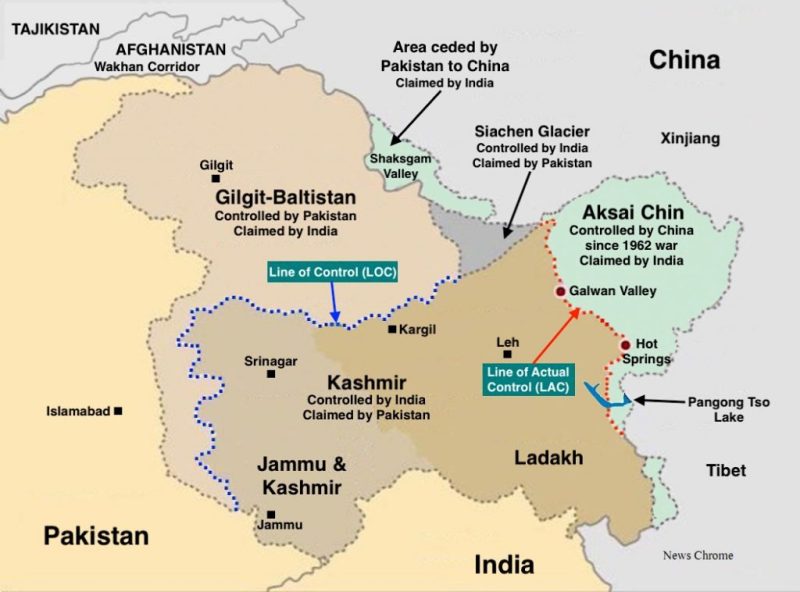
As compared to the rest of the LAC, the situation in Ladakh is serious. The killing of 20 Indian soldiers, including a Commanding Officer, in June 2020 has thrust the region into the nation’s collective consciousness. Galwan, Gogra, Daulet Beg Oldi, Pangong Tso, and Chushul are household names across the country and the public today is better educated about the sheer complexity of the border issue and our history of dealing with China on the matter. The importance of safeguarding national sovereignty has taken centre stage with issues such as the institution of ‘no patrolling zones’ and perceptions about the LAC being subjected to frequent debate in the media and elsewhere.

In the aftermath of the Galwan events, the strategic importance of Ladakh, seen more through the lens of tourism in tranquil times, has acquired renewed relevance. It is the only borderland of India adjoining two hostile states, both of which have gone to war with India at different times for their own reasons. Ladakh abuts Gilgit Baltistan, which is under illegal occupation of Pakistan, and Tibet, which is under China’s forced occupation. As the likelihood of collusive action between these countries increasingly grows, Ladakh will remain primus inter pares amongst all the regions on our Northern borders for strategic and operational reasons. Accordingly, plans to bring about a qualitative change in capacity and capability in all aspects of the region’s development to meet security challenges and human aspirations acquire greater importance vis-a-vis other locations.
The above aspect is well appreciated by the Central Government, which has taken many initiatives towards strengthening infrastructure development along the Northern borders in recent years. With regards to Ladakh, development has accelerated dramatically post creation of the Union Territory (UT) of Ladakh in 2019. A review of the UT Administrations’ activities after two years of its creation by the Lt Governor during a media interaction reveals the scale and scope of its achievements[vii]. Future plans are contained in a comprehensive ‘Vision Document,’ prepared on its behalf by a reputed consultancy, available on the internet[viii]. The Document is a comprehensive data-backed effort, listing the status of various developmental markers today and the desired end state. Achieving the vision would require effort, time, and planning for its translation into practical and prioritized implementables, after further considering risks, costs, benefits, and overall viability while adhering to timelines. Despite the progress made on many fronts and considering the constraints remaining, continued and focused long-term efforts by the administration are required here: equally important, the current and future security perspective has to be a key pillar of such plans.
Development Issues and Imperatives
A key priority that requires greater impetus is to accelerate the movement of locals for populating areas that, for reasons of geography and proven Chinese intent, have acquired strategic or operational significance. Page 9 of the Vision Document[ix] mentions that 65% of the total population is in and around Leh and Kargil cities. Though the paper has recommended setting up other population centres, enhanced hostile activity by China in and around places like Demchok on the LAC warrants that such areas also be included for consideration. In recent years, the Border Roads Organisation (BRO) has dramatically enhanced connectivity. Greater resources and manpower have constructed important roads and opened up East Ladakh and other parts of the UT[x]. The next step is to actualize a long-term plan with short and intermediate goals, which could see the setting up of small townships – after creating suitable infrastructure in housing, health, education, connectivity, and other civic amenities to support small-sized populations. Here the focus has to be on providing livelihood options other than the purely pastoral, with options explored for setting up Small Manufacturing Enterprises (SMEs), which might take time to prove financially viable. In this respect, China has succeeded with the construction of border villages and resettlement of Tibetans in areas opposite the LAC in Arunachal Pradesh and its disputed border with Bhutan[xi]. Though the Indian experiment in that region, which commenced post-1962, has not been as successful, it has to be pushed through in Ladakh. Here, reconciling developmental cum security needs with genuine environmental concerns would be necessary, considering that the Army’s premier firing range in Ladakh in the Tangtse Chushul area was closed some years ago for such reasons.

There is scope too for the military, as an essential stakeholder to assist in development in other spheres, such as preparation of dual-use facilities; helipads and Advanced Landing Grounds wherever feasible, are one example. Another option is to create infrastructure for specialized training in the Ladakh region – archives of the Press Trust of India mention an international training event, ‘Exercise Himalayan Warrior’ held in 2007 where Indian and British troops trained together in mountain warfare techniques in an area North of Leh[xii]. Training facilities of this nature would naturally benefit the local economy, though the fallout of such strategic signalling would have to be carefully weighed.
A fourth option to enhance the military’s participation, albeit indirectly, is to increase local recruitment. While recruit balancing would be carried out at Army Headquarters, there is a need to examine the feasibility of expanding the number of Ladakh Scout battalions (either regular units or on the Territorial Army model), which are eminently suited for fighting in such terrain. Being a permanent measure, this would offset, to an extent, the expense on induction of at least a few units from outside Ladakh. Benefits accruing from deploying local sons of the soil can be easily appreciated.
Harnessing through Civil-Military Engagement
At the turn of the century, it was in Ladakh that the Indian Army launched Operation SADHBHAVNA. Displaying strategic foresight, then GOC 14 Corps, Lt Gen Arjun Ray, set a one-point aim – ‘To Forestall Militancy in Ladakh.’ The program, a runaway success, was adopted subsequently by other field formations of the Indian Army. A process of continued oversight, course correction, innovation, and streamlining at various levels has made it an effective tool for helping assimilate our border populations into the national fold by winning hearts and minds. Here, it must be emphasized that SADBHAVNA has not been conceptualized as a developmental program per se. Neither is such an approach being followed on the ground – the projects being small, community-based, and including aspects of human resource development. It has had very positive spinoffs, with Ladakh being a significant beneficiary. With major development programs like the Ministry of Home Affairs’ flagship Border Areas Development Program (BADP) and others at the state level already in place, it is worth examining if an interaction between the local administration (at the panchayat level, say) and local military garrisons, both working from the ground upwards can help further synergize efforts to achieve optimum results.
Strategic contestation between India and China is a reality. The border issue will continue to influence many aspects of bilateral relations. Continued information warfare, a huge trade deficit, allegations of hacking, and now evidence of massive tax evasion by smartphone companies[xiii] are indicators of the need for a realistic appraisal of that country’s intentions and strengthening own capabilities. The development of Ladakh is an important factor in this regard.
Notes
[i] Free Press Journal, January 03, 2022.
[ii] ‘LAC Standoff: India exposes China’s lies in Ladakh as Indian Army hoists tricolour in Galwan Valley’. Ajeyo Basu, News24, January 04, 2022.
[iii] ‘China protests Indian MPs’ attending Tibetan reception, Tibet govt-in-exile fires back’. Geeta Mohan, India Today, January 01, 2022.
[iv] ‘Joint Press Release of the 14th round of India-China Corps Commander Level Meeting’. Ministry of External Affairs, Government of India, January 13, 2022.
[v] ‘Government breaks silence, hits back at China on letter to MPs, Pangong bridge’. Shubhajit Roy, Indian Express, January 07, 2022.
[vi] ‘New Year: Indian, Chinese troops exchange sweets at Demchok and other border points’. Press Trust of India, January 01, 2022.
[vii] ‘Major transformation in developmental profile of Ladakh UT in nearly 2 years: Lt Governor’. Mohinder Verma, Daily Excelsior, September 18, 2021.
[viii] ‘Vision 2050 for UT of Ladakh’. Government of India.
[ix] ibid
[x] ‘Five Mega Road Infrastructure Projects Launched in Ladakh Amid Border Row With China’. PTI, October 01, 2021.
[xi] ‘More evidence of China building villages in disputed areas along borders with India, Bhutan’. Hindustan Times, November 18, 2021.
[xii] Press Information Bureau, Government of India. Ministry of Defence note, Exercise “Himalayan Warrior”. September 16, 2007.
[xiii] ‘Xiaomi India under lens: DRI says evasion of customs duty of Rs 653 cr by Chinese smartphone maker’. Economic Times, January 05, 2021.
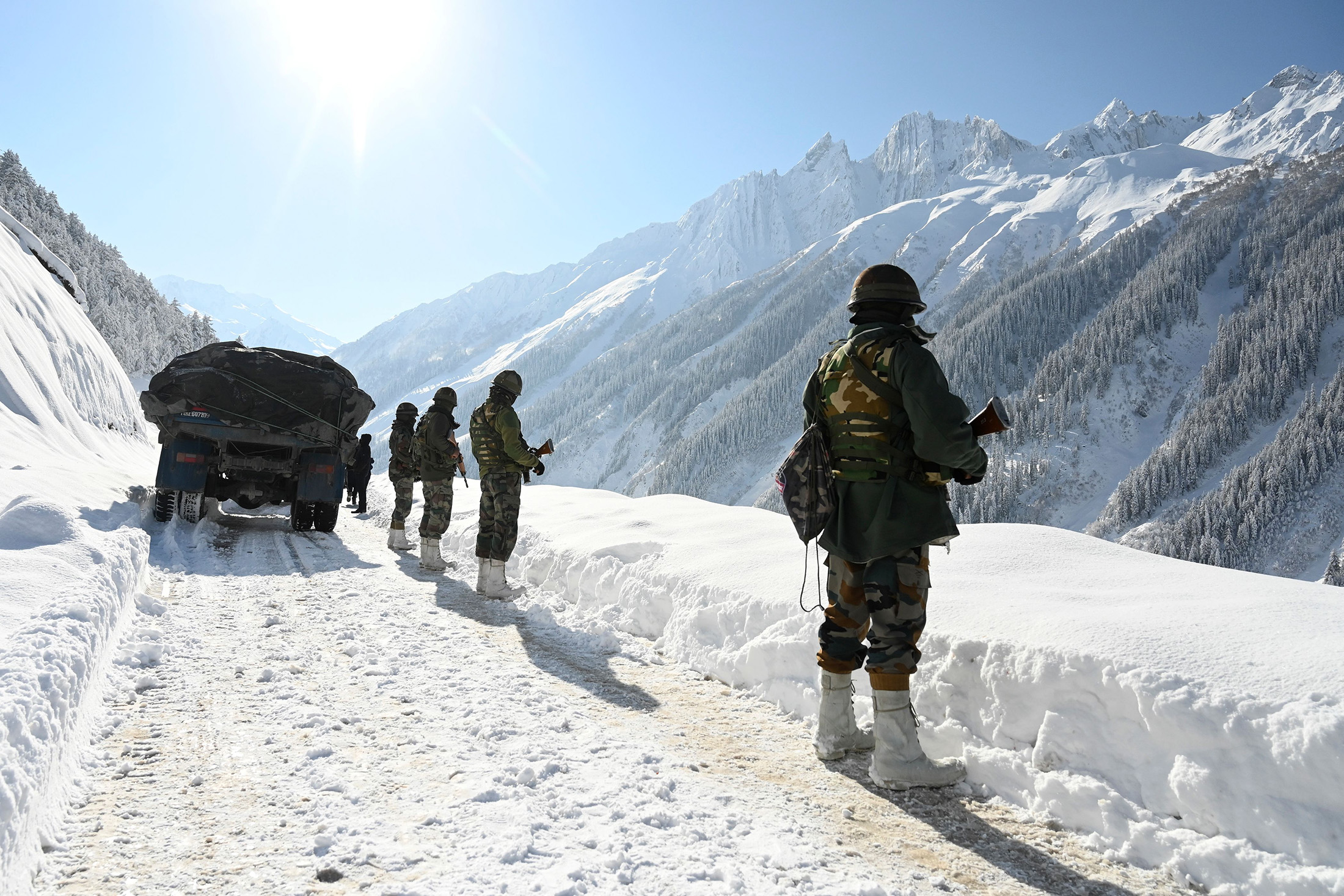
Feature Image Credit: Bloomberquint
Map Credit: Newschrome
Images: www.deccanherald.com and www.business-standard.com

As one writes, a phase of the events in the Galwan valley near the Line of Actual Control (LAC) has come to an end. Inputs from government, media and private commentators, have provided a perspective of the events preceding the incidents of 15/16 June and thereafter till the current day. For the world, the occasion has provided the opportunity yet again to witness the fighting spirit and junior leadership of all ranks of the Indian Army, who despite being outnumbered, were able to inflict far greater casualties on their adversaries, in inhospitable terrain under fading light conditions. The sacrifices of the men of 16 BIHAR, 3 PUNJAB, 3 Medium Regiment, and individual personnel from 81 Field Regiment, Corps of Signals and the Army Medical Corps have added lustre to the reputation of the Indian military. Their deeds shall remain enshrined in the memory of a grateful nation. At this watershed moment, we salute them.
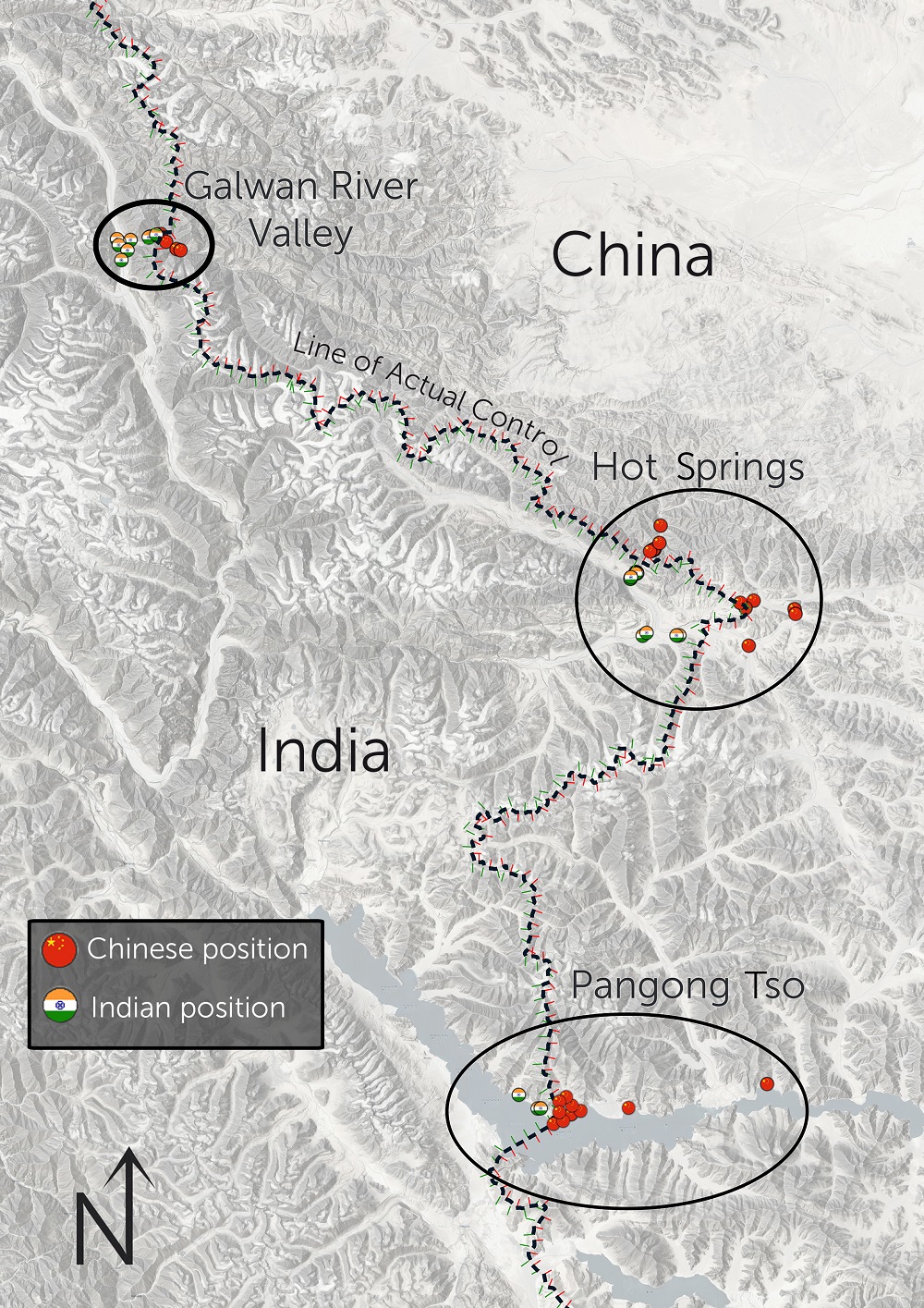
China is contesting control over settled areas (Galwan), exploiting laid down rules and norms of border management by resorting to use of primitive weapons instead of firearms, and pushing the envelope on the ground in attempting to increase areas under control such as at Hot Springs and Pangong Tso – all actions just short of war.
One theory gaining currency in attempting to understand China’s recent behaviour, pertains to its unhappiness over what it perceives as alteration of the status quo on the LAC by designating Ladakh as a Union Territory – resulting in active collusion with Pakistan which shares Beijing’s sentiments on this issue, amongst others. However, there is no doubt that the strategy applied by China in East Ladakh comes straight out of its manual on Grey Zone Warfare. It is contesting control over settled areas (Galwan), exploiting laid down rules and norms of border management by resorting to use of primitive weapons instead of firearms, and pushing the envelope on the ground in attempting to increase areas under control such as at Hot Springs and Pangong Tso – all actions just short of war.

While the situation on the Pangong Tso awaits resolution, what is amply clear is that the era of explaining away patrol clashes on the LAC to the Indian public, in terms of ‘varying perceptions held by both sides’, is past. By its perfidious actions in East Ladakh this year, China has shredded in letter and spirit the border agreements built up over the last three decades. The recent incidents have brought greater clarity to the public mind, with a consensus that China’s salami slicing tactics cannot be tolerated any further. Indian soldiers see the LAC as a line marked on the map. Commanders are clear that the areas up to that line are to be either physically occupied or patrolled at will from bases in the vicinity, supplemented by other forms of surveillance. As per media reports, the Government has over the weekend ‘revised the Rules of Engagement’, giving ‘a free hand to the Army’ to deal with occurrences of this nature. By implication, in future if patrols cannot resolve their face offs peacefully, there will be no resorting to hand to hand scuffles with primitive weapons – unsuccessful efforts at border management will give way to border defence, through resort to tactical military operations.
As per media reports, the Government has over the weekend ‘revised the Rules of Engagement’, giving ‘a free hand to the Army’ to deal with occurrences of this nature. By implication, in future if patrols cannot resolve their face offs peacefully, there will be no resorting to hand to hand scuffles with primitive weapons – unsuccessful efforts at border management will give way to border defence, through resort to tactical military operations.
Response to this new paradigm places another set of challenges before the Indian Army. Prior to May 2020, Galwan was not in the category of disputed areas, as understood in LAC parlance. Neither had any Chinese activity been sensed in the preceding years. While construction of the DSDBO road could be the trigger, the fact that an area where the LAC had lain undisturbed since 1962 could become the scene of such a violent action, warrants scrutiny of PLA intent across the board. Previous assumptions with respect to the PLAs likely areas of interest across the entire Northern border, therefore, certainly warrants a relook. Conclusions drawn would mandate contingency planning and consequent tasking at strategic, operational and tactical levels. Such plans doubtless exist. However, it is obvious that their scope, timelines, and imperatives for successful implementation will need review in conjunction with the other services.
Outcomes of such reviews would inevitably renew the focus on capability building and in the middle term, might even alter priorities for the same. Substantial enhancements in the areas of surveillance, tactical and strategic air mobility and real time communication links continue to retain their importance. Induction of greater varieties of kinetic non-contact weapon systems, complemented by force multipliers such as cyber warriors and special forces too remain on top of the list. Also, the continued ceasefire violations on the Line of Control to the West, and the relentless tempo of counter terrorist operations in the Valley during this period smack of collusion and tell a tale which defence planners must take note of. Developing the desired capability will be predicated on guaranteed funding and fast track procedures. It is heartening to peruse reports in the Economic Times of 22 June that the Government has granted emergency financial powers up to Rs 500 crore per procurement project to each service for buying weapons and ammunition. Even if new projects cannot be initiated immediately because of fund constraints imposed by the Covid-19 pandemic and otherwise, it is time for stalled ones like the Mountain Strike Corps to be quickly completed. The example of the PLA which has almost completed its reorganisation for fighting wars of the future and tested the response of its field force during the Covid-19 pandemic, must be taken note of.
Thanks to the Galwan episode, the vital aspect of border infrastructure has gained nationwide attention. There is perceptive increase in the pace of development over the last few years. The sequence and methodology however are dictated essentially by two factors – availability of resources (funds and specialist equipment) and the need for calibrating messages implicit in such actions to China. Despite Covid-19 constraints, the current crisis mandates that funds currently earmarked for infrastructure development continue to flow so that development progresses, albeit at a slower pace. As regards messaging to China, we have reached a watershed moment. As high level military talks continue and spell out the Indian position on the ground to the Chinese, creating an ‘all of nation approach’ for tackling China becomes necessary.
Galwan incident has ensured that the negative perception of China worldwide is now shared by almost all sections of Indian society. This bitterness is fuelled by the sheer brutality of the Chinese military and duplicity of the Chinese government, bringing back memories of 1962 for many who have only heard of that era. It is driven further by a realisation of the scale of India’s dependence on China, be it in the import of manufactured goods of all hues, or technology, and the consequent harm to Indian interests and livelihoods. Awareness has spread amongst Indians that China’s constant working against India’s interests in world fora, be it in vetoing expansion of the permanent membership of the Security Council for ‘technical reasons’, blocking its membership in the Nuclear Suppliers Group or introducing discussions on Kashmir are all part of its plan to obstruct India’s progress to its rightful place in the comity of nations. In attempting to correct an unequal economic relationship, ensuring that India retains its position in the region and preventing erosion of its influence in South Asia and beyond, all elements of the Indian state have their tasks cut out. It becomes imperative now to prepare a different toolkit with a wider range of options (including those not envisaged earlier) to manage India-China relations. Such options now require to be coordinated at all levels of the government and intimated to stakeholders including industry and other influencers for implementation. This coordination is long overdue. Resetting the economic relationship will not be easy. However, announcement of a practical time bound and holistic road map which has been thought through with all stakeholders would be a beginning.
Galwan incident has ensured that the negative perception of China worldwide is now shared by almost all sections of Indian society.
To supplement the proposed policy outlined above, articulation of a holistic Strategic Narrative vis-a-vis China becomes necessary. Such a narrative would pertain to as many aspects as possible – bilateral issues (including border management), local and regional matters, so that consistent, coherent and long term views are voiced, keeping in mind the national interest. information operations would be a subset of such a narrative, and briefings organised as frequently as possible would be useful force multipliers. It might be necessary for the concerned sections in the newly formed Department of Military Affairs and the Department of Defence to coordinate these aspects. India must also actively consider the possibilities that other forms of conflict, including hybrid warfare, are necessary to exploit and invest in the same. Here too, employment of such methodologies by China is an example. China has been refining its doctrine of ‘Unrestricted Warfare’ since the early 90s. The effects are there to see in South China Sea and elsewhere. It is executing certain aspects of this strategy against India on the Northern borders.
Managing relations with China is destined to remain the major preoccupation for Indian strategic thinkers in coming years. Tensions along the LAC are but one manifestation of this problem. Both nations are hostage to geography. China’s behaviour over the last decade has influenced Indian foreign and military policies like no other, causing India to take decisions that were not in the realms of possibility earlier. Articulating a holistic China strategy through an all of government approach within the overall ambit of a National Security Strategy to ensure that India achieves its rightful place, has never been so important.
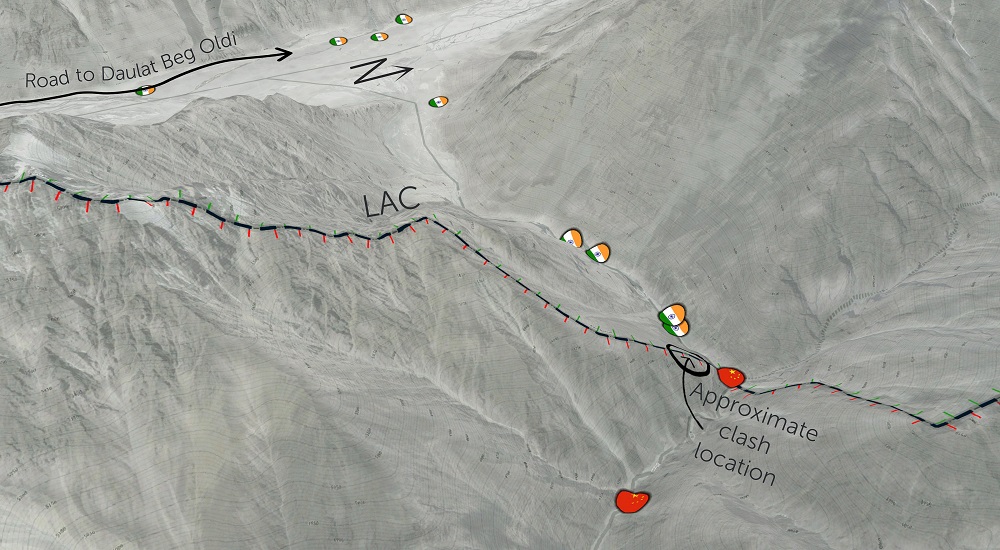
Image Credit: ASPI:The Strategist – Nathan Ruser